
What Those Late-Night Coyote Howls Around Your Massachusetts Home Really Mean
You are settling in for the night when a wild chorus of yips and howls rises from the woods behind your house. It can sound close, loud, and a little spooky.
Coyotes live all around Massachusetts, so many people hear them, yet few know what the sounds really tell us. Here is what a howl can and cannot mean, and what to do around your yard.
A chorus is a poor head count
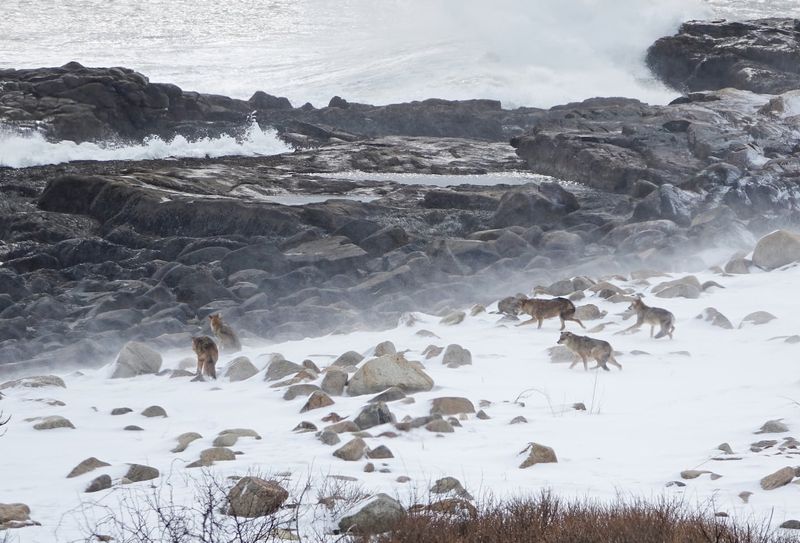
Picture a chorus of yips and howls drifting across the yard at midnight. It is easy to imagine a big pack gathered just past the fence.
Often that picture is wrong, because a few coyotes can sound like many.
MassWildlife says coyotes are hard to count by sound. A 2017 study played recordings of one to four coyotes to 427 people.
On average, listeners guessed nearly twice as many animals as were actually there.
There is a catch. That study used recordings from southern Texas, so it is not a Massachusetts-specific estimate.
What it gives us is a general caution: our ears are not good counters when howls overlap and echo.
Coyotes also have a way of making their voices seem to come from several places at once. Yips, barks, and howls blend together in the dark, and the sound bounces off trees, houses, and hills.
A loud chorus can leave you sure that a crowd is outside, when a small family group may be the more likely source.
So when you hear a racket after dark, try not to treat it as a headcount. In MassWildlife’s coyote FAQ, coyotes in Massachusetts are described as living in territorial family groups, not as roaming mobs.
The next question is what all that noise is for in the first place.
What are coyotes saying?

Howling is how coyotes keep in touch. According to MassWildlife’s FAQ, a howl may help coyotes find family members, or it may signal territory to other coyotes.
Young pups also howl as they practice.
Loud noises can set them off too. Coyotes sometimes howl back at sirens or other sudden sounds, a bit like a dog joining in when an ambulance goes by.
Details like these appear on the state’s Learn about coyotes page.
Notice the word “may” in all of that. These are possible reasons, not a secret code you can read from one call.
A single howl at 11 p.m. does not tell you which job the sound is doing.
It also does not tell you what the coyote has been up to. A howl is not a victory shout after a kill, and it is not proof that coyotes are courting.
Nothing in state guidance says either of those things.
Think of it like hearing a distant voice calling out in a neighborhood. You know someone is communicating, but you cannot say whether they are calling a friend, answering a noise, or just checking in.
Coyotes are in a similar spot: the sound tells you they are out there, and that is about all.
Knowing that can take some of the mystery out of the night noise. The howl is communication among coyotes, and most of the time it is not aimed at you.
November is dispersal season, not mating season
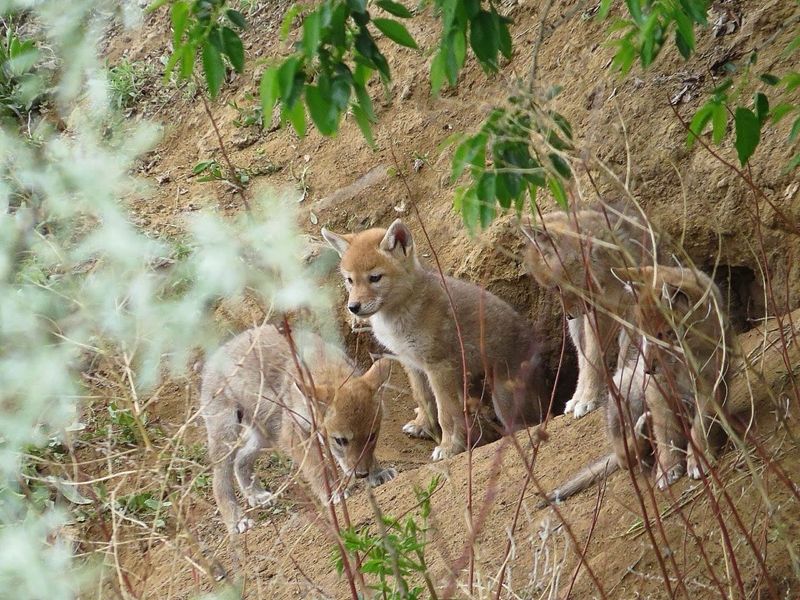
Many people assume that fall howling means mating, but the calendar says otherwise. MassWildlife places Massachusetts coyote mating season in late January through early March.
That is the stretch when activity picks up for breeding, not November.
Fall has its own rhythm. September through November is the pup-dispersal period, when young coyotes leave the area where they were born and look for a place of their own.
The magazine article Annual Coyote Life Events lays out this yearly cycle.
Young coyotes on the move are more likely to be noticed. You may see one crossing a road or trotting through a yard, and neighbors may start posting about it.
More reports can simply mean more movement and more visibility.
That does not prove there are more coyotes than before. As the state’s coyote FAQ explains, a change in sightings does not necessarily mean the population has grown.
Here is the careful part. Knowing that November is dispersal season does not let you say that a particular howl came from dispersing young.
It also does not let you say the howl came from mating coyotes, because sound alone cannot tell you what is going on.
The calendar gives useful background, not a decoder. It explains why coyotes may seem more visible this month, and it keeps us from pinning a late-night chorus on the wrong season.
A howl does not make your yard a danger zone
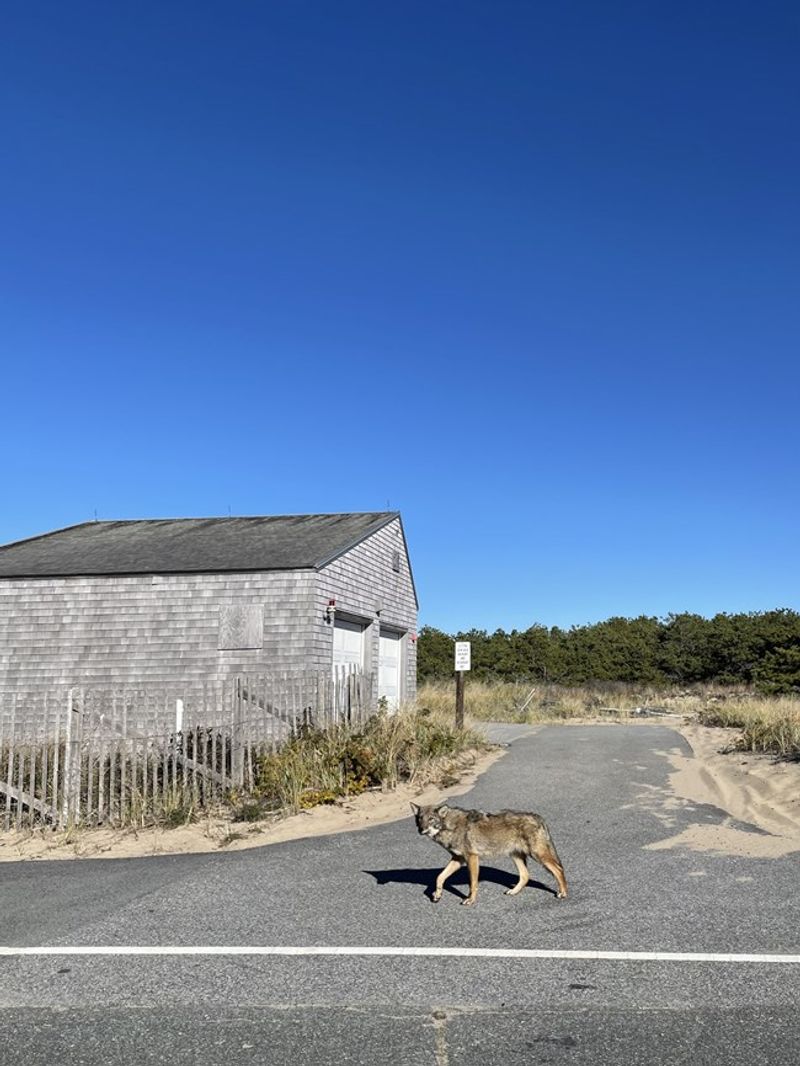
Coyotes live in nearly every Massachusetts city and town, including urban and suburban areas. Hearing one howl nearby is part of living in the state, not a sign that something has gone wrong.
According to MassWildlife’s FAQ, residential use and frequent daytime activity are considered normal for coyotes.
That means a coyote crossing your yard is not automatically dangerous. A coyote seen in daylight is not automatically sick or rabid either.
Coyotes can be active around the clock.
It helps to keep two risks apart. The chance of a coyote attacking a person is described as extremely low.
Low is not the same as zero, so reporting unusually bold behavior still makes sense.
Pets are a separate question. Small pets can be at real risk, and that is why supervision matters for cats and dogs.
Treating the person risk and the pet risk as one big worry leads to either panic or carelessness.
So what should you watch? Behavior, not the sound.
A howl in the distance tells you little about whether anything is wrong, while a coyote that follows people or acts strangely tells you much more.
For most households, hearing coyotes calls for sensible habits, not alarm. The next two sections cover what those habits look like around the house and when it is time to get help.
Food and pets shape the practical risk
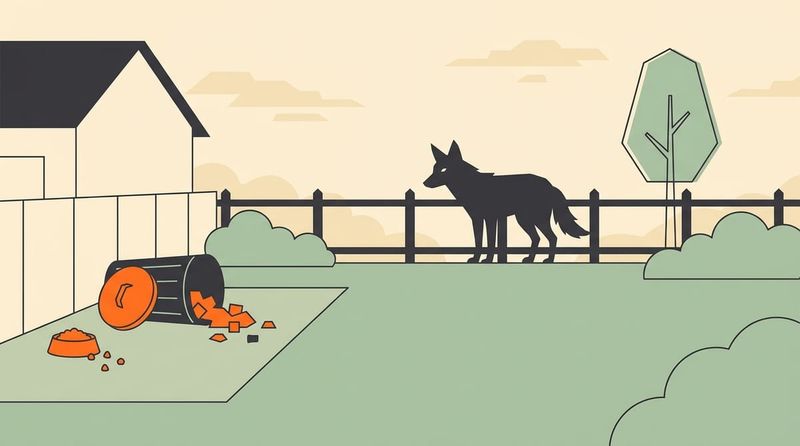
The most useful thing you can do is make your yard less appealing. MassWildlife’s prevention guide recommends securing trash and compost, picking up fallen fruit, and never leaving pet food outside.
Feeding coyotes, on purpose or by accident, is something to avoid.
Rodents are part of the picture too. Birdseed spills and other foods can bring mice and rats, and those can draw wildlife in turn.
Mass Audubon points to this kind of food source as something to manage.
Next, think about your pets. Keep cats indoors, and supervise dogs outside, using a leash when you are not in a fenced and watched space.
A quick trip out at night is a good moment to stay close.
The risk is not the same for every animal. Coyotes may treat small pets as prey.
Medium and large dogs are more likely to be seen as competitors, especially during mating season and near dens, as described in MassWildlife’s life-events article.
A practical example: a small dog let out alone at 10 p.m. is in a very different spot than a larger dog walking on a leash beside you. Matching your caution to the pet makes the plan simple.
None of this requires fear. A short evening routine of checking the bins, bringing in the bowls, and walking out with your dog handles most of the risk.
When should you act?
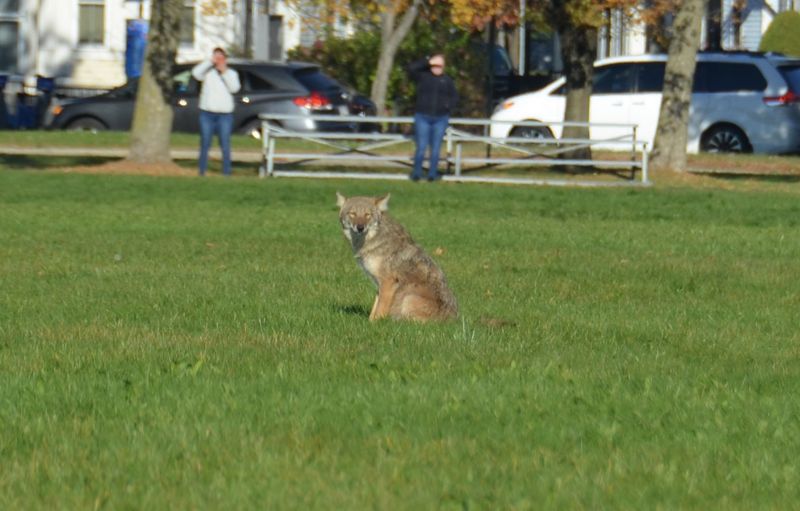
If a coyote seems comfortable lingering in your yard or neighborhood, MassWildlife recommends hazing. From a safe position, make yourself look large, make loud and unusual noises, or spray a hose.
The goal is to scare the animal, not hurt it, as explained in the state hazing guide.
There are clear limits. Do not haze an animal that looks injured or sick.
Do not corner a coyote, and do not drive it toward a road.
Dens call for a different move. If you think a den is nearby, keep your pets leashed and calmly leave the area, as noted in MassWildlife’s life-events article.
Do not walk closer to investigate.
Some behavior goes beyond ordinary presence. MassWildlife classes approaching or closely following people as very bold, and so is a coyote that does not flee after effective hazing.
A physical attack on a person is aggressive behavior.
Illness has its own clues. Stumbling, circling, paralysis, or excessive salivation are signs to take seriously.
Call your local Animal Control or police.
For very bold or aggressive behavior, the MassWildlife FAQ lists local police or the Massachusetts Environmental Police as the contacts.
A coyote seen in daylight, or one that simply trots through, does not meet any of these descriptions on its own. Look for the behavior, and match your response to what you actually see.
The useful signal is what the coyote does next
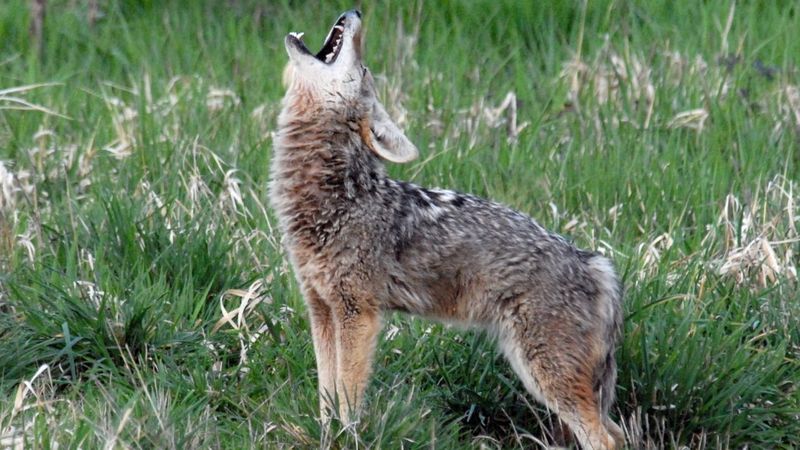
A howl in the dark tells you that coyotes are around, and that is where its message ends. As MassWildlife’s FAQ makes clear, sound alone cannot reveal exact activity or numbers.
And since mating season is late January through early March, a November howl is not evidence of mating.
Ordinary presence calls for ordinary care. Unusually bold, aggressive, or visibly ill behavior calls for a different response.
So next time the chorus starts, you can listen with curiosity. The song is not the story; the behavior is.