
Those Brown Bags Dangling From Your Illinois Arborvitae Have Something Alive Waiting Inside
Spot a few brown, cone-shaped things hanging from your arborvitae and you might shrug them off as pinecones. Some of them could be bagworm cases, and what is inside matters for next summer’s leaves.
A little know-how in the cold months can help you cut down on trouble before it starts. Here is how to sort out what you are seeing and what to do about it.
Those cone-like objects may be bagworm cases
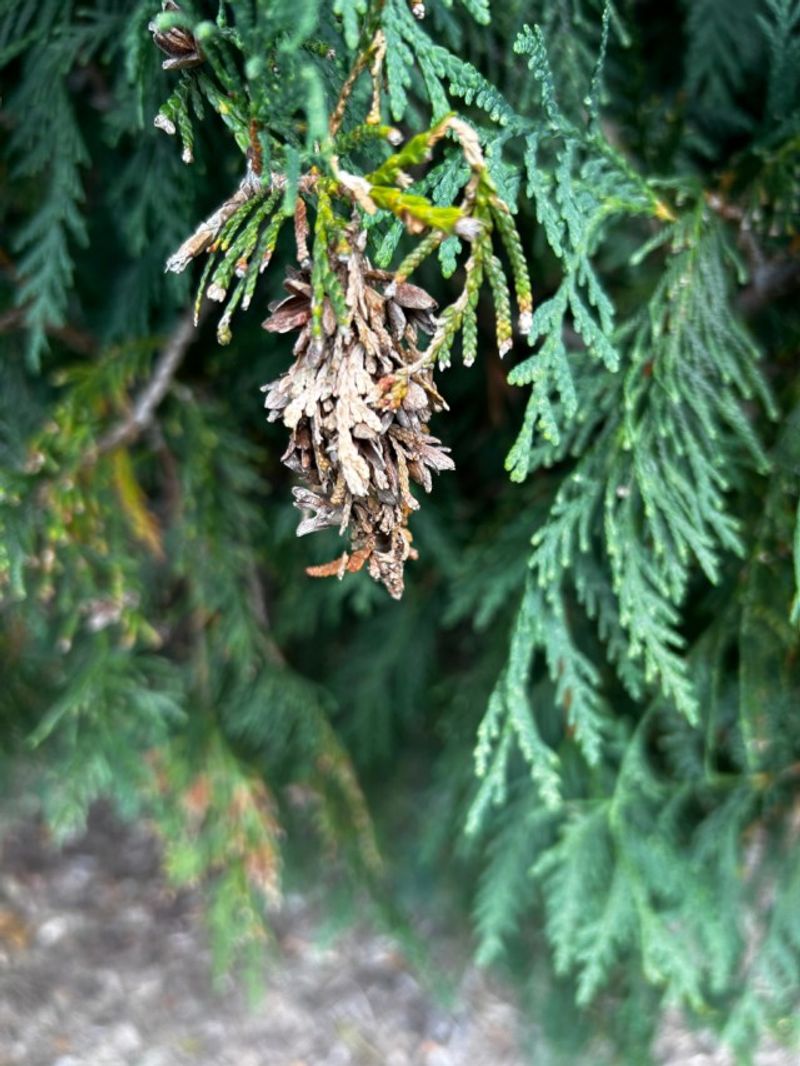
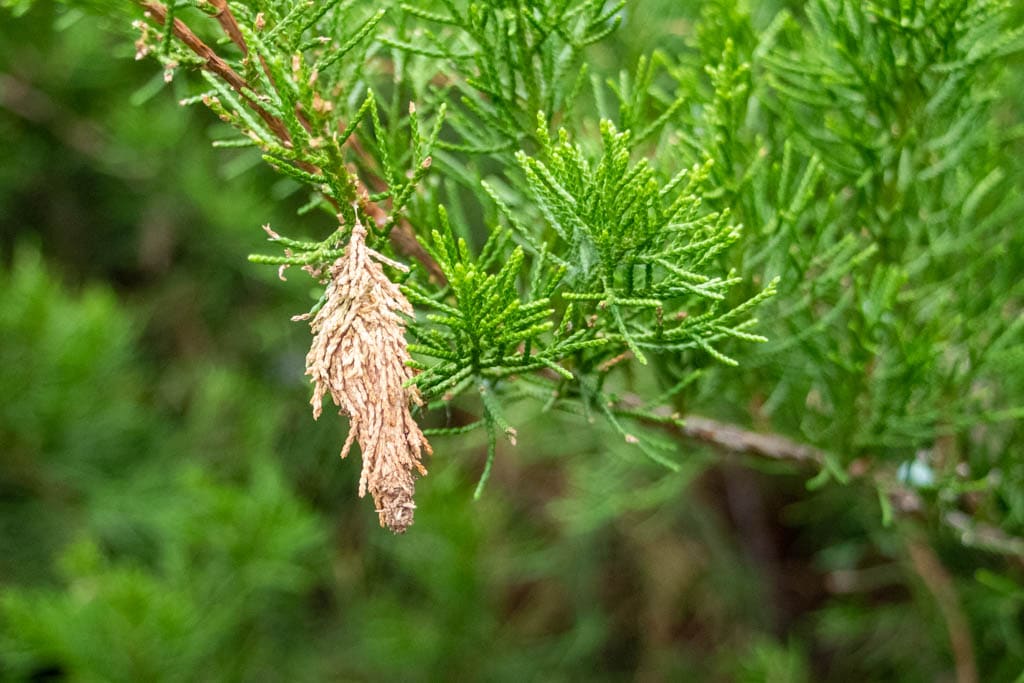
Walk up to an arborvitae in late fall and you may see small brown shapes dangling from the branches. Some are about the size of a thumb and look a lot like tiny pinecones.
A few of them could be bagworm cases.
Bagworms are caterpillars that build a protective bag around themselves. According to Kansas State Extension, the bag is made of silk and bits of the host plant’s foliage, and it can resemble a pinecone or another plant part.
That disguise is exactly why so many people overlook it.
Arborvitae and juniper are common targets. Bagworms also feed on many other trees and shrubs, so a case on a spruce or a maple is possible too.
The Illinois Extension bagworm page is a handy reference if you want to compare what you see.
Looks alone cannot settle the question, though. A real cone, a dead clump of foliage, or another plant structure can sometimes pass for a case at a glance.
Check a few clues before you decide.
A bagworm case hangs from a silk attachment on a twig, and it is covered with bits of the same foliage that surrounds it. A true cone grows from the branch and has hard, woody scales.
Arborvitae cones are small and upright, while the bags tend to droop and are often longer.
Gently pinch one and notice whether it feels like a soft, silky pouch. If you are still unsure, take a clear photo and ask your local Extension office to look at it.
Calling them is free in many counties and beats guessing.
Eggs—not a live caterpillar—may overwinter inside
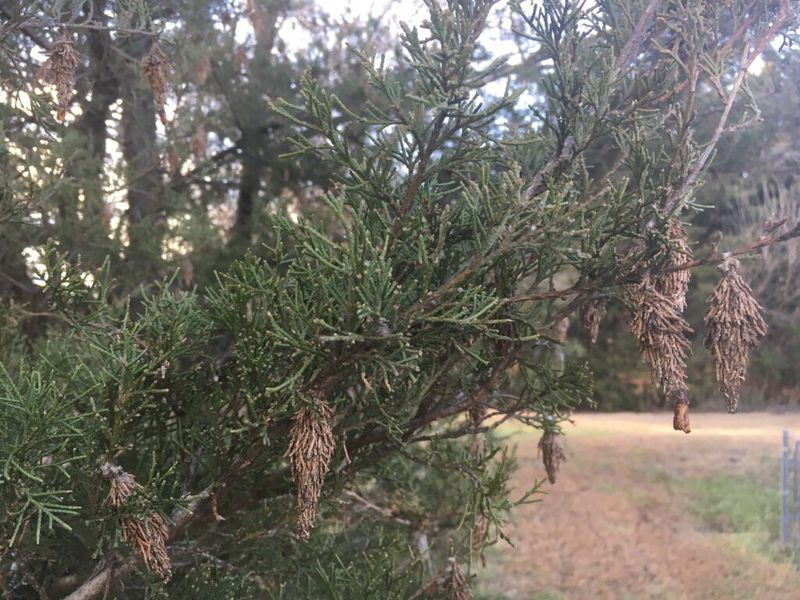
The idea that something alive is waiting inside is a little off. By the time winter arrives, the female bagworm has generally died inside her case after laying her eggs.
What carries on through the cold is the eggs, not a caterpillar.
The University of Georgia Extension describes the life cycle this way, and it matches what Illinois experts report. The eggs sit tucked in the old case until the weather warms in late spring.
Then tiny larvae crawl out and start to feed.
Here is the catch: not every bag will be full of promise for the next generation. Some cases may be empty, and others may not hold viable eggs.
A case hanging on a branch does not prove that it will produce a single larva.
Bagworms are also not all alike in the way people picture them. Male moths leave their cases to find a mate, so those empty bags are common.
A small hole near the bottom can be a clue that something has already left.
The protective bag also matters for treatment, since Illinois Extension notes the eggs are shielded inside it. That is a big reason timing matters, which the next sections cover.
So think of each case as a possible egg holder. You cannot tell without opening it, and you do not need to open every one.
Treat them as a likely risk and plan to remove the ones you can safely reach.
Remove cases before hatch to reduce potential numbers
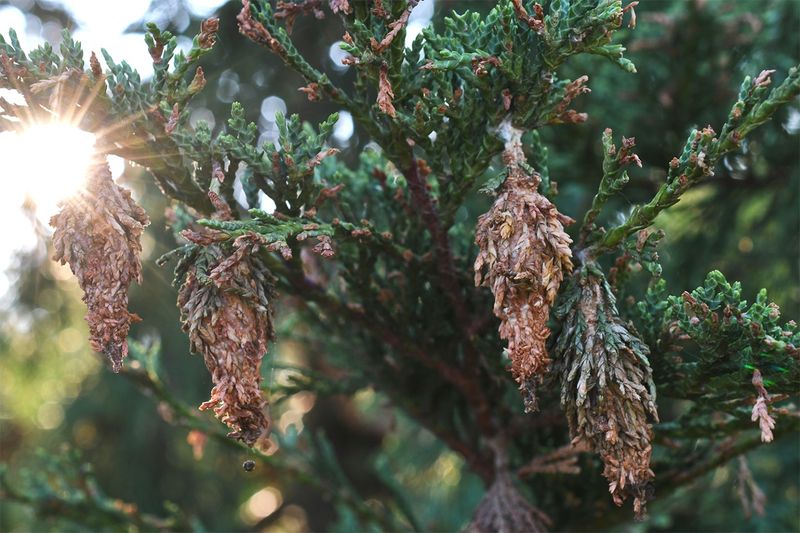
Timing is the whole game here. Once eggs hatch, the tiny larvae start feeding and building their own bags, and you are suddenly in a different situation.
Removing cases beforehand takes away some of the potential hatchlings.
In Illinois, hatch is typically placed from late May to mid-June, according to the Illinois Extension bagworm page. Another Illinois Extension article describes it as mid-to-late June.
Treat these as a rough seasonal guide, since weather and location can shift the date from year to year.
That means fall, winter, and early spring are your window for hand removal. Once the cases are off the shrub, the eggs inside them cannot hatch onto it.
The Clemson Extension guide supports picking bags off before the eggs hatch as a way to lower the next population.
A cold, clear day in February is a fine time to do a walk-around. Bare neighboring trees make the dangling bags easier to spot, and you are not racing a spring deadline.
Keep your expectations realistic, though. Removal reduces the local number of potential hatchlings, and that is a real benefit.
It cannot stop every infestation, because bagworms can arrive from a neighbor’s tree or a nearby shrub. See it as lowering your odds, and keep an eye out in early summer.
If you miss the window, you are not out of options. Later sections cover what to do once larvae are active.
Remove reachable cases and dispose of them securely
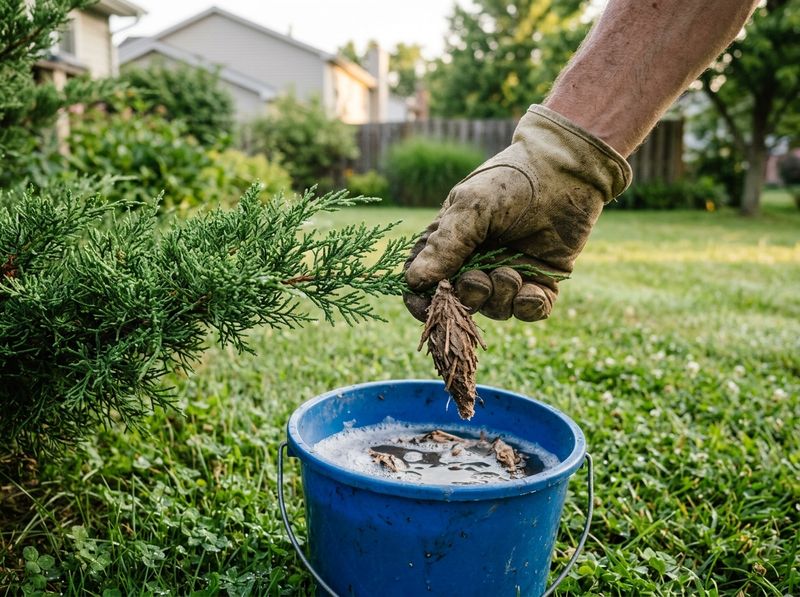
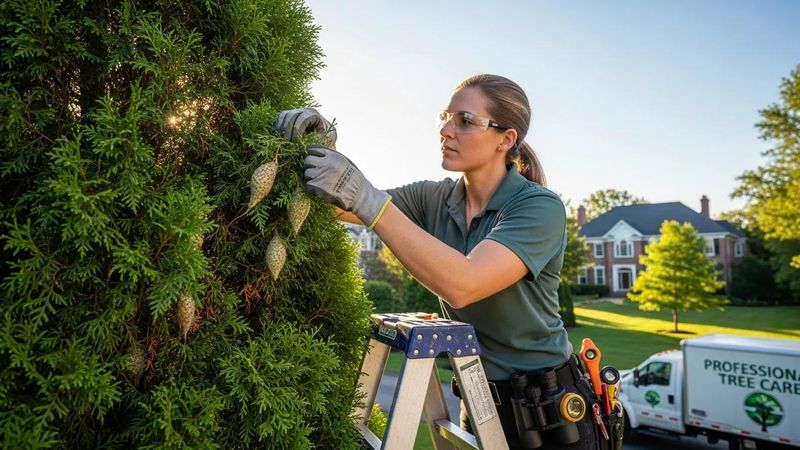
For a small infestation, a pair of gloves and a few minutes can go a long way. Pick off each case you can reach without stretching, or snip it free with hand pruners if the silk is tough.
The Illinois Extension pest guide recommends hand removal for light infestations.
Where the cases go next matters just as much. Drop them into a plastic bag, seal it, and put it in the trash.
You can also destroy them, for instance by soaking them in a bucket of soapy water for a few days.
Do not toss them on the ground beneath the shrub. The Clemson guide and Georgia Extension both warn that eggs in a discarded bag may stay viable.
A pile of cases at the base of your arborvitae simply moves the problem a few feet.
Work slowly and check the inner branches, where cases can hide against the trunk. Cases that blend into the foliage are easy to miss on a quick pass.
A second look a week later often turns up a few more.
Safety comes first. If cases sit high in a tall shrub or a tree, do not climb a ladder to chase them.
A fall is a far bigger problem than a bagworm.
For anything out of safe reach, call a certified arborist or a pest control professional. They have the equipment and training to handle tall plants safely.
Sprays target young larvae, not dormant eggs
It is tempting to grab a sprayer in January and coat every brown bag you see. That would be wasted effort.
Illinois Extension explains that the eggs are protected inside the bag, so control is futile until the young larvae emerge.
Sprays are aimed at the larvae after hatch, while they are small and actively feeding. At that stage they are more exposed, and the bags they build are tiny.
Larger larvae with thick bags are much harder to control.
The Illinois Extension bagworm page lists Bt (Bacillus thuringiensis var. kurstaki) as an option for young larvae. It is a bacterium-based product that works when caterpillars eat treated foliage.
This article will not give you a calendar date, because hatch varies. Instead, watch for tiny bags and fresh feeding on the foliage in early summer.
Then ask your local Extension office what timing fits your area and season.
Always read and follow the product label. It spells out which plants and sites are approved, how much to mix, and how to apply it.
Labels are the law, and they also keep you and your pets safe.
Sprays can help, but they are one tool. Combined with hand removal, they give you better odds than either one alone.
Removal lowers risk but cannot guarantee a healthy shrub
Picking off reachable cases before hatch is a smart move, and it can shrink the number of bagworms that start the season on your shrub. It is not a promise of a pest-free summer.
Young larvae can drift to new plants on silk threads, and a neighbor’s tree can send them your way, as noted by Kansas State Extension.
Infestations can also return, as Georgia Extension points out. Heavy feeding can kill branches or whole plants, and Illinois Extension warns that defoliated conifers may die.
That does not mean every infestation ends badly.
So keep checking your shrub each year and remove what you can reach safely. A bagworm bag is easier to deal with when it is one of a handful than one of hundreds.