
Why Florida Palms Shoot Up Those Giant Flower Stalks and Whether You Should Cut Them Off
Maybe you stepped outside one morning and saw a huge, branching stalk poking out of your palm tree. It looks a little like a pale fountain or a giant antler, and it seems to appear overnight.
Many Florida homeowners wonder if it means the palm is sick, or if they should grab a saw. Here is what that odd stalk really is, and how to decide what to do about it.
That tall structure is usually a palm inflorescence
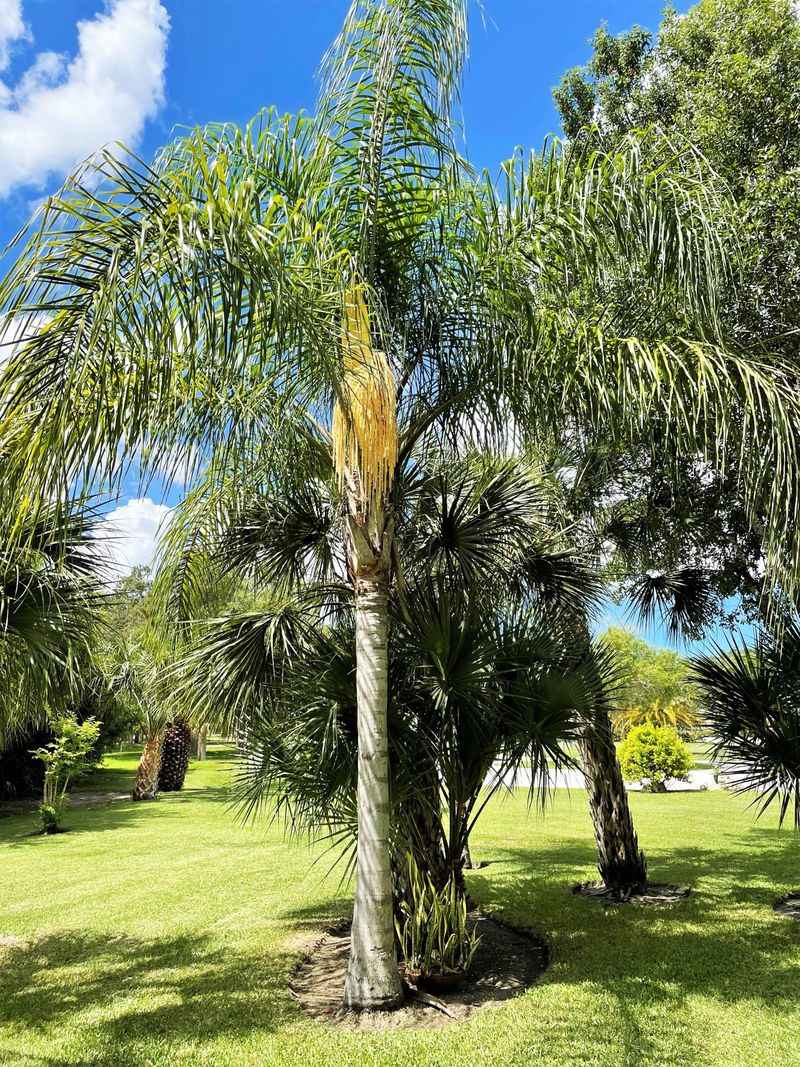
Picture a tall, feathery branch loaded with tiny beads or buds, sticking out from your palm. That is almost always an inflorescence, which is just the palm’s flower-bearing stalk.
It is the palm’s way of making flowers, and it is a normal part of how palms reproduce.
Where it appears depends on how the palm is built. In many palms, the stalk grows from a leaf axil, the spot where a leaf stem meets the trunk.
In palms with a crownshaft, the smooth, tight column of leaf bases at the top of the trunk, the stalk emerges just below that crownshaft. According to UF/IFAS palm morphology and anatomy information, these differences in position are a basic feature of palm structure.
The stalk can look very different from one palm to the next. Some are long and droopy with many thin branches, and others are stout and upright.
Some start out wrapped in a woody, boat-shaped covering that splits open as the stalk grows. Early on, it can look like a strange growth, which is why so many people worry.
Seeing one is not a symptom of trouble by itself. Think of it the way you would think of blooms on an oak or a flowering shrub.
The palm is simply doing what mature plants do. A healthy palm with green, full fronds and a flower stalk is usually just an adult palm at work.
Keep in mind that not every palm produces the same branching shape. What you see on your neighbor’s palm may look quite different from the stalk on yours, and that is perfectly ordinary.
When and where a stalk appears depends on the palm
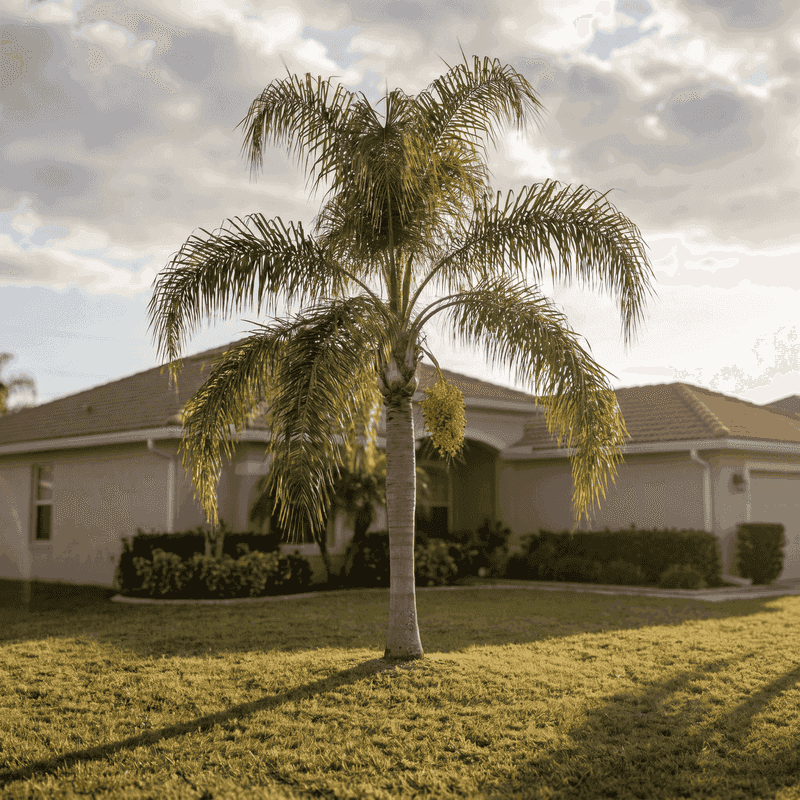
Florida has dozens of palm species in yards, parks, and along streets, and they do not all follow the same schedule. One homeowner might see stalks in May while another sees them in July, and both can be right.
That is why the first step is knowing which palm you have.
Sabal palms, the state tree, make a good example. UF/IFAS Gardening Solutions describes branched flower clusters on sabals in late spring.
Queen palms are a bit different. UF/IFAS information on queen palm lists flowering in spring and summer, so the window is wider.
These two are only examples, not a statewide calendar. Other palms follow their own patterns.
Shape and position vary too. As covered in UF/IFAS palm anatomy notes, palms differ in where stalks emerge, so a stalk may hide among the fronds on one palm and hang below a crownshaft on another.
A simple habit helps. Snap a photo of the whole palm, including the trunk and the base of the fronds, and compare it with a plant guide or ask your county extension office.
Once you know the species, the timing and look of the stalk will make a lot more sense.
A flower stalk alone does not mean the palm is dying
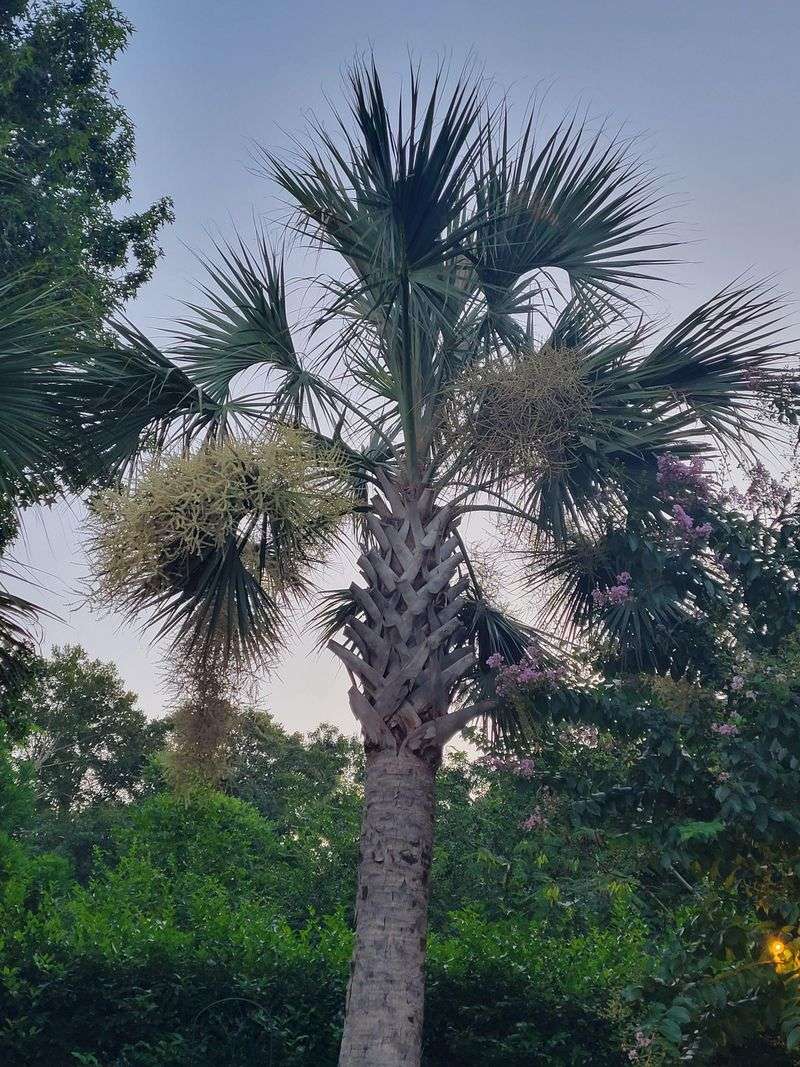
Plenty of people assume a flowering palm is on its last legs. For most landscape palms, that is simply not true.
Flowering is ordinary reproduction, and a stalk by itself tells you very little about the palm’s health.
There is a real exception, though. A few palms flower and fruit only once and then die, a pattern called hapaxanthy.
UF/IFAS lists examples in groups such as Caryota (fishtail palms), Corypha, Arenga, and Metroxylon.
That is a small slice of the palm family, so it should not be applied to palms in general. The idea that all palms die after flowering is false.
Many common palms flower year after year for decades.
So what should you do if you spot a stalk? Start by identifying the species.
If it is a fishtail palm, for instance, flowering may be a sign of its life cycle ending. If it is a sabal or another common palm, it is likely just normal growth.
To judge health, look at the fronds instead. Are the new leaves green and growing?
Is the crown full? As described in UF/IFAS palm anatomy resources, the stalk is simply a flower structure.
Yellowing, spotting, or a bent growing tip are better clues than a stalk.
Flowers may develop into fruit after pollination
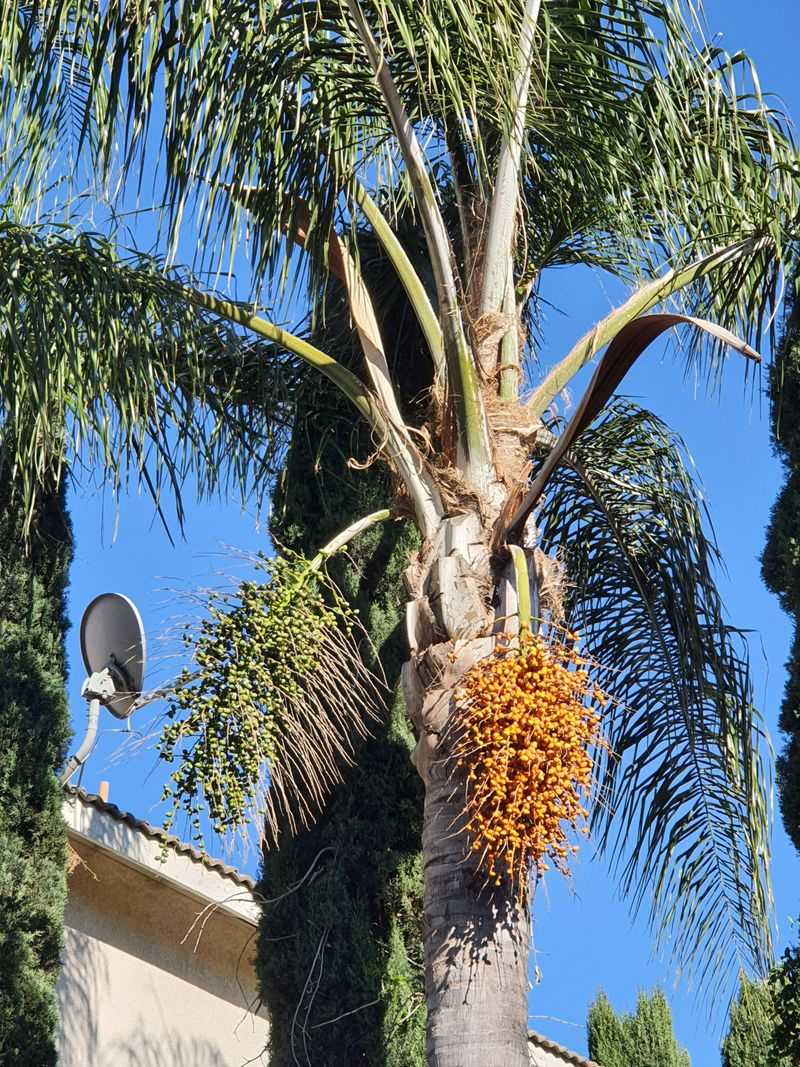
Once the tiny flowers open, insects, wind, or other helpers may carry pollen from one flower to another. If pollination works, some flowers can swell into fruit.
That is why a stalk that looked like a bead-covered branch in spring may be dripping with berries by late summer or fall.
Fruit is a possible outcome, not a promise. Not every stalk ends up with fruit, and the amount varies a lot.
Palm species also differ in how they arrange male and female flowers. As explained in UF/IFAS palm morphology and anatomy information, some palms carry both kinds on the same plant, while others have separate male and female palms.
If your palm is a male of a species with separate sexes, it may never produce fruit at all.
That helps explain the mess some people find under their palms. Fallen fruit can stain pavement, attract insects or critters, and sprout seedlings in nearby beds.
A neighbor’s palm of a different species may drop nothing at all.
A word on handling. Some palm fruits contain calcium oxalate crystals that can irritate exposed skin, but this depends on the species, so not all palm fruit does this.
If you do not know what kind of palm you have, wear gloves when picking up fallen fruit and wash your hands afterward.
Keep the stalk unless it creates a practical problem
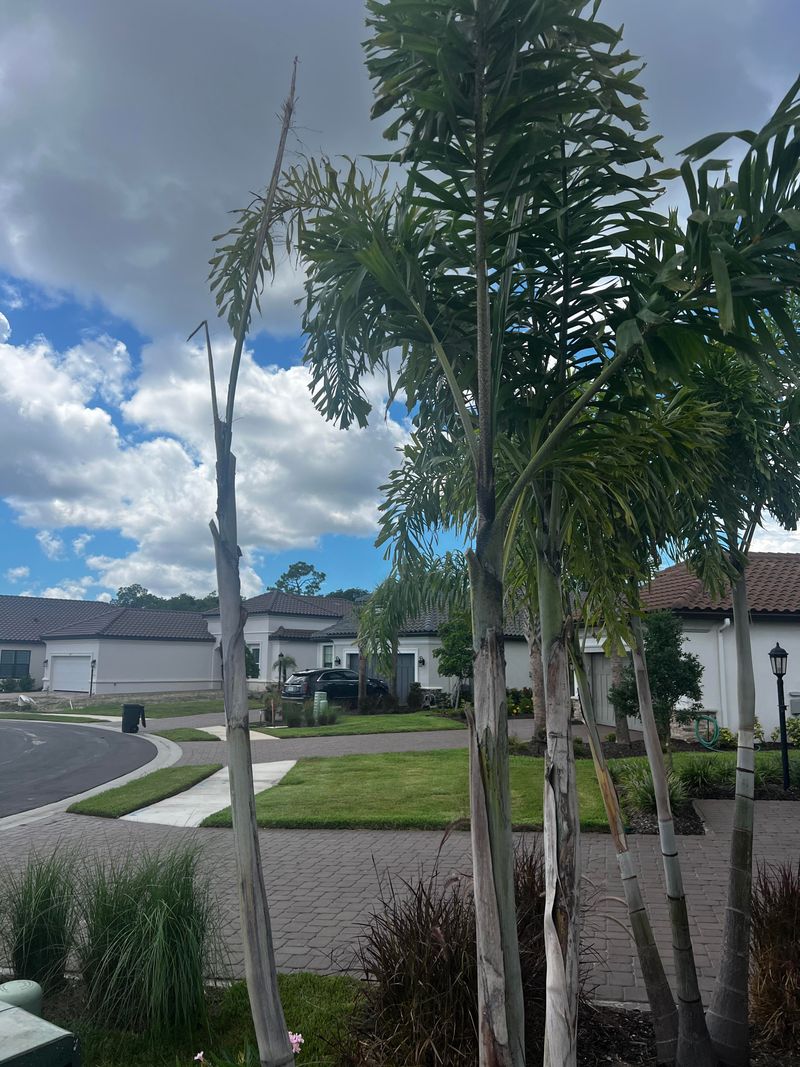
Whether to cut or keep a stalk is a choice, not a rule. The good news is that neither option is wrong, so you can base it on what bothers you.
Removal makes sense in a few situations. Heavy fruit may drop onto a walkway, patio, or parked car.
Fallen fruit may sprout unwanted seedlings in your beds. Or there may be a specific hazard, such as heavy fruit clusters hanging over a place where people gather.
If you do remove stalks, you can do so with a calm mind. UF/IFAS pruning guidance says there is no evidence that removing living flower or fruit stalks harms palms.
That does not mean you must remove them, and it does not make every kind of pruning harmless.
Leaving them alone has benefits too. As UF/IFAS Extension Orange County points out, flowers and fruit can feed pollinators and wildlife.
Bees and other insects visit the blooms, and birds and small animals may eat the fruit later.
A quick test can settle it. Ask yourself whether the stalk is causing a real problem, such as mess, seedlings, or falling fruit.
If the answer is no, you can enjoy the extra wildlife activity. If the answer is yes, a careful cut is a reasonable fix.
Remove accessible stalks carefully and leave healthy fronds alone
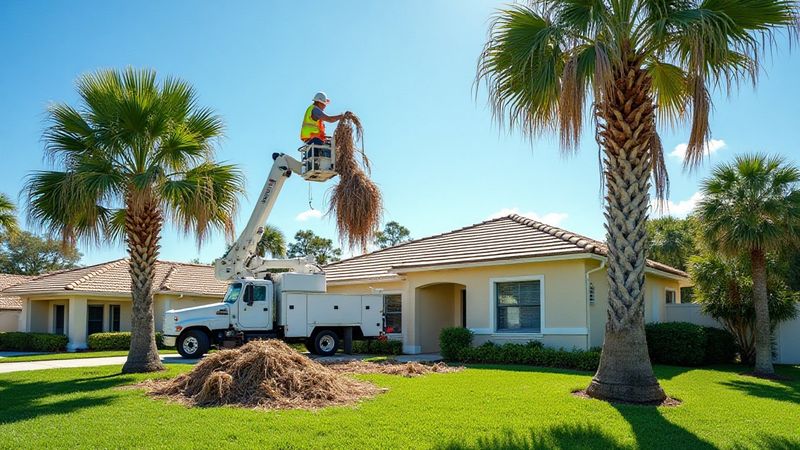
If you decide to remove a stalk, timing helps. UF/IFAS pruning guidance notes that taking it off before the fruit becomes heavy can be easier than handling a mature fruit cluster.
Keep the job to what you can do safely from the ground. Use sharp pruners or a hand saw on a stalk you can reach without stretching.
Wear gloves and eye protection, and cut near the base without slicing into the live trunk or crown tissue.
Some jobs are not for homeowners. Do not climb with spikes, and do not use a chainsaw from a ladder.
Stay away from stalks near power lines. OSHA’s landscaping hazards page lists dangers such as falls, being struck by objects, and electrical contact, and OSHA’s chainsaw safety guide warns against overhead cutting and using a chainsaw from a ladder or tree.
If the stalk is high, tangled in wires, or just out of reach, call a qualified tree-care professional. It is a small cost compared to an injury.
Finally, do not mix up stalks and fronds. A flower or fruit stalk is a different structure from a healthy green leaf.
UF/IFAS Gardening Solutions explains that cutting healthy green fronds can deprive a palm of nutrients and weaken it. Leave the green leaves on, and trim only what is dead, brown, or clearly a stalk.
Choose based on the palm and your yard
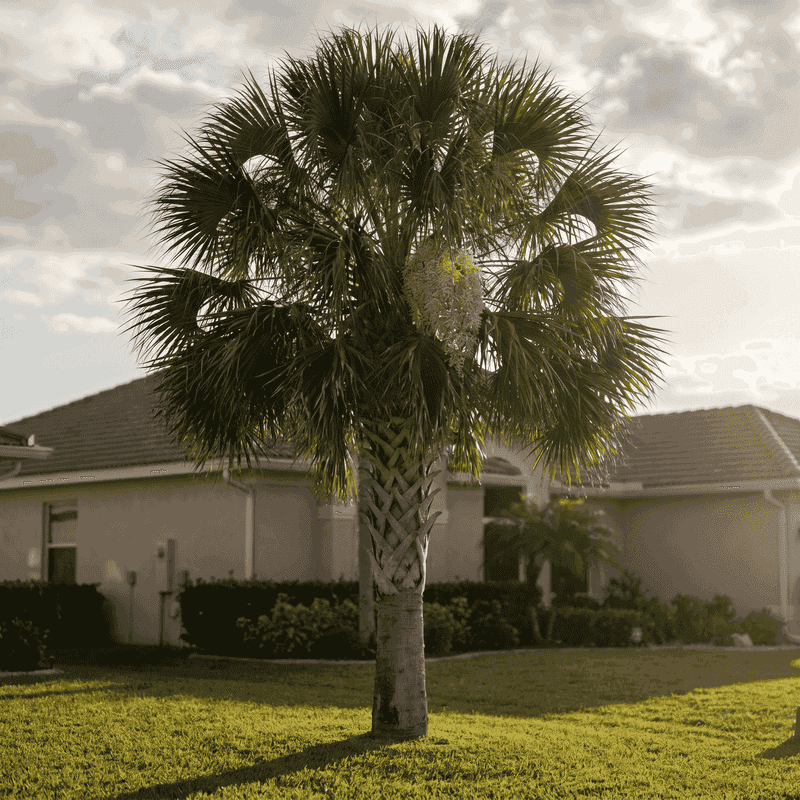
That towering stalk is usually just a flower structure doing its job. Whether it stays or goes comes down to fruit, seedlings, wildlife, and safety in your own yard.
UF/IFAS pruning guidance finds no evidence that removing living stalks harms palms, and UF/IFAS Extension Orange County reminds us that leaving them can help wildlife.
Know your species, and hand any high or hazardous cutting to a professional. A palm that flowers is simply a palm that has grown up.