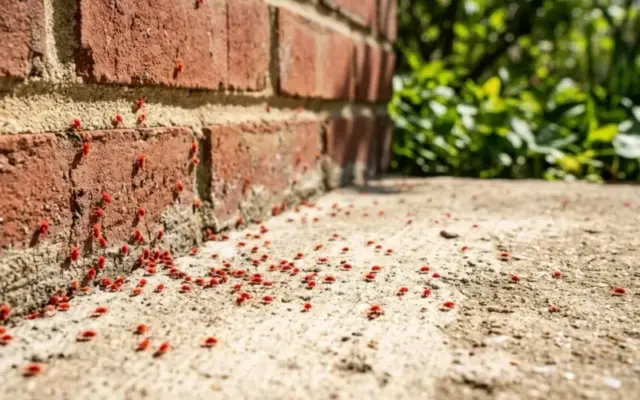
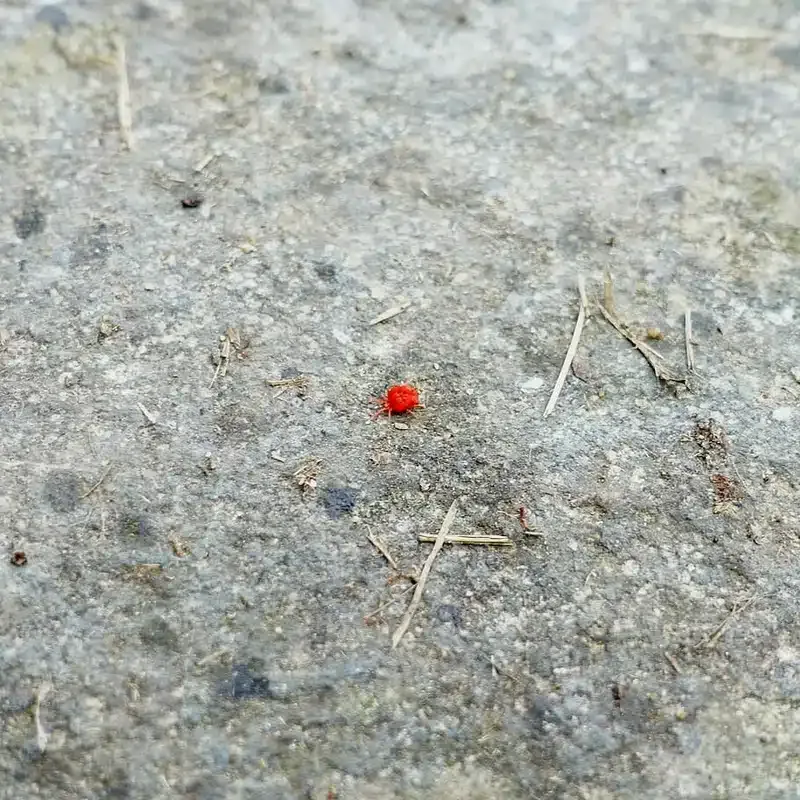
You step onto the patio and spot hundreds of specks, each smaller than a pinhead, moving across the stone. They look like red dust, but dust does not walk.
In Maryland, one common explanation is the clover mite, a tiny creature that can leave a surprising red smear if it gets squashed. Here is how to tell what you may be seeing and what to do about it, without making a mess or reaching for spray.
Clover Mites Are One Likely Explanation

Picture a speck smaller than the period at the end of this sentence, reddish-brown, and moving fast. When a crowd of those shows up near grass or clover, clover mites are a leading possibility.
They are not dust, and they are not insects either. According to University of Maryland Extension, clover mites are arachnids, relatives of spiders and ticks, and they measure less than 1 millimeter long.
The best clue is on the front end. Clover mites have an unusually long front pair of legs that sticks forward and can look like a set of antennae.
If you have a magnifier or a phone camera with a macro mode, look for those stretched-out legs on an adult that is reddish-brown.
Maryland has a track record with these tiny visitors. A 2025 University of Maryland Extension report described red clover mites crawling across sidewalks and the outsides of buildings.
Still, where you found them does not settle the question. A patio sighting alone cannot confirm the species, because other small red mites also turn up on hard surfaces.
Think of clover mites as the front-runner, not the final answer, until you have looked closely at the mites and at what is growing nearby.
Concrete Mites Can Also Run Across Patios
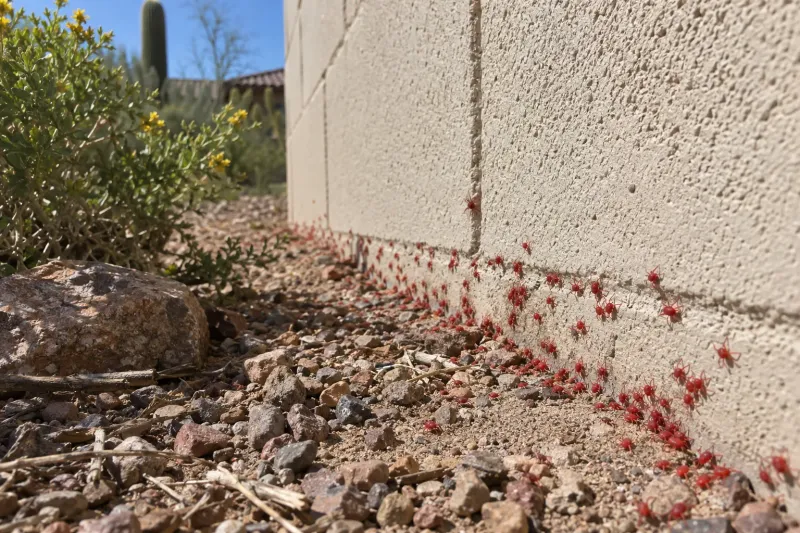
Clover mites are not the only tiny red crawlers that favor a warm patio. Concrete mites, also called sidewalk mites, are often seen running over patios, pavement, and masonry.
That overlap is why a spot on the map cannot name the culprit.
Extension writers at Alabama Cooperative Extension describe concrete mites as more closely tied to hard surfaces. Clover mites, by contrast, are tied to grass and other plants and carry that notably long front pair of legs.
Treat those as helpful hints rather than a foolproof field test.
Ask yourself a few practical questions. Is there thick lawn or clover running right up to the slab or wall?
Do the mites seem to have front legs that stretch well ahead of the body? Or are they racing around on bare stone far from any plants?
If you still cannot tell, take a sharp close-up photo or collect a few mites in a sealed jar or on a piece of clear tape. The Maryland extension report reflects how identification often depends on a good image or specimen, which an expert can check.
Crushing a Clover Mite Can Leave a Red Stain
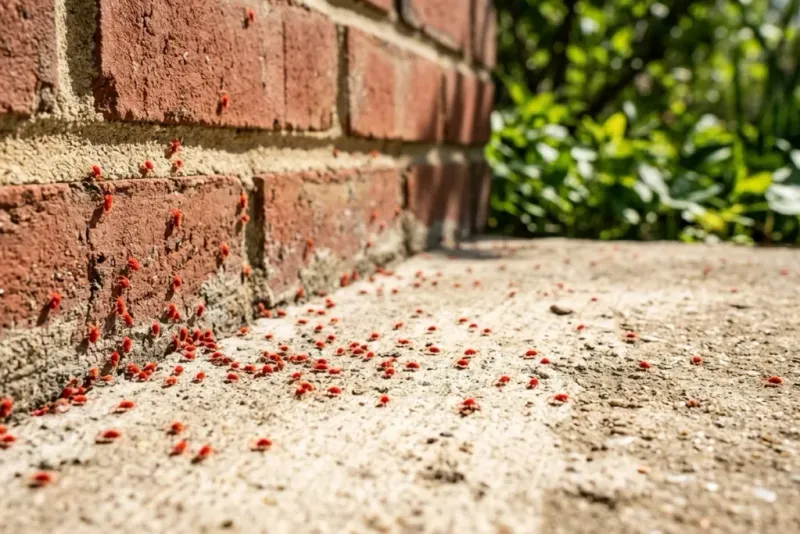
Here is the part that surprises most people. A clover mite that gets squashed can leave a bright red streak behind.
The color comes from red pigment and body fluids released from the crushed mite, as explained by University of Kentucky Extension.
That smear is not blood. Clover mites are plant feeders, so there is no meal of blood to leak out.
The mark is simply their own coloring and fluids.
Light-colored surfaces show it most, including pale concrete, siding, window sills, curtains, and carpet. One or two stray mites will not matter much, but a swarm wiped away by hand or by a damp rag can turn a faint problem into a long red stripe.
The practical advice from University of Maryland Extension is to avoid crushing or smearing them. Resist the urge to swat, scrub, or sweep.
Gentle removal, which comes up again in the indoor advice below, keeps the stain from forming in the first place.
Their Color Does Not Mean They Feed on People
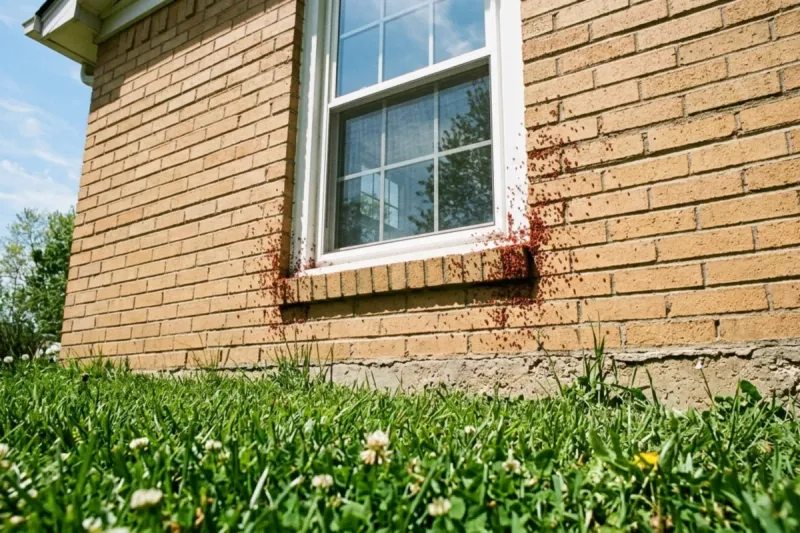
Red can look alarming, and it is easy to assume a red mite wants a bite of you. Clover mites do not.
They feed on grasses, clover, and other plants, not on human or animal blood.
According to University of Maryland Extension, clover mites do not bite and do not carry diseases. For a family with kids and pets playing near the patio, that is reassuring news about this particular mite.
It does not mean every red mite is harmless. Some mites do bother people, and a swarm of lookalikes on the patio does not tell you what caused a skin problem.
If you have an itchy rash, mites seen nearby are not proof of the source, and a health professional is the right person to ask.
For a broader look at which mites actually affect people, NC State Extension offers a helpful overview. Keep the two questions separate: what the mites are, and what is behind any skin irritation.
Plant-Feeding Mites Can Appear on Building Surfaces
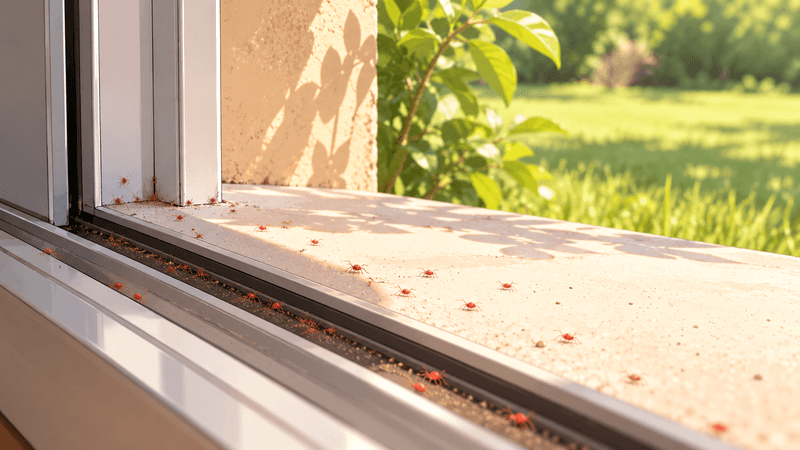
If clover mites live on plants, why are they crawling up your wall? Their home base is the lawn and garden, where they feed on grasses, clover, and other plants.
From there, they can spread onto nearby surfaces and become easy to see.
University of Maryland Extension notes that they can be conspicuous on sunny walls and other surfaces, especially in spring and fall. Those seasons are when many Maryland homeowners first notice them.
The state has seen it firsthand. A May 2025 Extension report described sidewalk activity in Maryland, which fits what many people notice on pavement and building exteriors.
Beyond those details, it is wise not to guess. No single weather trigger explains every swarm, and not every patio crowd has the same cause.
Use the timing, the nearby plants, and a close look at the mites to judge what is going on at your own home.
Vacuum Indoor Strays and Reduce Repeat Entry
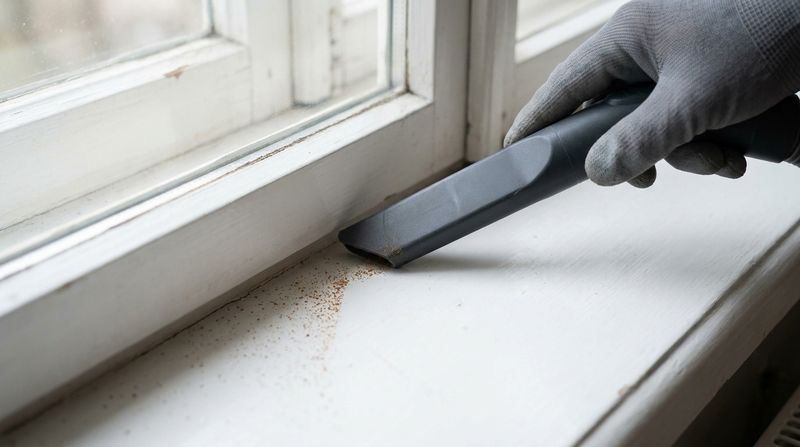
Once a few mites wander indoors, grab the vacuum. University of Maryland Extension advises vacuuming them up rather than wiping or sweeping, since those moves can leave stains.
A hose attachment works well along window sills, door frames, and baseboards.
Empty the vacuum bag or canister outdoors afterward so the mites do not crawl back out. Skip the damp cloth, even if it feels faster.
If mites keep showing up inside, focus on how they get in. They are tiny, so cracks and gaps around windows, doors, and the foundation are easy doorways.
Sealing those exterior gaps and cracks can cut down on repeat visits.
If needed, the same Extension guidance describes a vegetation-free zone next to the foundation, from 6 inches to 2 feet wide. That strip of bare ground or mulch-free gravel keeps grass and plants, and the mites that feed on them, from sitting right against the wall.
Most Sightings Do Not Require Pesticides
A few specks on the patio rarely call for a chemical response. University of Maryland Extension says intervention is usually unnecessary unless lawn damage recurs significantly or mites repeatedly enter a building.
It also says insecticide is not needed for clover mites inside the home.
Clover mites are not entirely without impact. Heavy plant feeding can blemish lawn blades, and stains are a real annoyance.
Still, that is a nuisance to manage, not an emergency.
Go easy on lawn fertilizer too. Extra fertilizer is not a fix, and the Extension advises applying it based on a laboratory soil test.
If you do consider a pesticide because the problem keeps returning, read the product label first. Use only a product approved for the site where you plan to apply it, and confirm the identification before you start.
University of Minnesota Extension offers additional guidance on clover mite control.
Most of the time, patience and a vacuum win the day.
Share this story