Get the latest garden guides in your inbox →
Gardening Latest
  • General Gardening
  • Lawn Care
  • Plant Care
  • Composting
  • Soil Health
  • Backyard
  • Garden Muse Magazine
  • General Gardening
  • Lawn Care
  • Plant Care
  • Composting
  • Soil Health
  • Backyard
  • Garden Muse Magazine
  • News
  • Gardening Calendar
  • Garden Structures
  • Vegetable Garden
  • Vertical Garden
  • Raised Beds
  • Hydroponics
  • General Equipment
  • Community Gardens
Garden Themes
  • Spiritual Garden
  • Hydroseeding
  • Seeding and Laying Sod
  • Artificial Grass
  • Lawn Care Equipment
  • Plants
  • Trees
  • Planting Tools
  • Composting Basics
  • Fertilizer
  • Alternative Growing Mediums
  • Front Yard
  • Backyard Activities
  • Landscaping
Gardening Latest

Explore by state

Which state is your garden in?

Currently viewing New Jersey

All states

Northeast

  • Connecticut —
  • Delaware 26
  • Maine —
  • Maryland 13
  • Massachusetts 29
  • New Hampshire —
  • New Jersey 13
  • New York 22
  • Pennsylvania 22
  • Rhode Island —
  • Vermont —

Southeast

  • Alabama 12
  • Arkansas —
  • Florida 12
  • Georgia 13
  • Kentucky 26
  • Louisiana 11
  • Mississippi —
  • North Carolina 11
  • South Carolina 25
  • Tennessee 9
  • Virginia 12
  • West Virginia —

Midwest

  • Illinois 11
  • Indiana 14
  • Iowa 26
  • Kansas —
  • Michigan 13
  • Minnesota 11
  • Missouri 11
  • Nebraska —
  • North Dakota —
  • Ohio 13
  • South Dakota —
  • Wisconsin 27

Southwest

  • Arizona 12
  • Colorado —
  • Nevada —
  • New Mexico —
  • Oklahoma —
  • Texas 11
  • Utah —

West

  • Alaska —
  • California 12
  • Hawaii —
  • Idaho —
  • Montana —
  • Oregon —
  • Washington —
  • Wyoming —

No state matches that search.

Site menu

Gardening Latest
  • General Gardening
    • News
    • Gardening Calendar
    • Garden Structures
    • Vegetable Garden
    • Vertical Garden
    • Raised Beds
    • Hydroponics
    • General Equipment
    • Community Gardens
    Garden Themes
    • Spiritual Garden
  • Lawn Care
    • Hydroseeding
    • Seeding and Laying Sod
    • Artificial Grass
    • Lawn Care Equipment
  • Plant Care
    • Plants
    • Trees
    • Planting Tools
  • Composting
    • Composting Basics
  • Soil Health
    • Fertilizer
    • Alternative Growing Mediums
  • Backyard
    • Front Yard
    • Backyard Activities
    • Landscaping
  • Garden Muse Magazine

Explore

  • About GardeningLatest.com
  • Contact Us

Get the latest from the garden

New guides on lawn care, plants and backyard projects, sent when they go up.

Subscribe →

Follow

  • Facebook
  • X
  • Pinterest
  • YouTube
New Jersey Gardening

Hearing Coyotes Howl Near Your New Jersey Home at Night? Here’s What They’re Actually Saying

Those howls, yips, and barks drifting through the dark are coyotes talking to each other.

AR

By Angela Russo

November 24, 2026 · 6 min read

Hearing Coyotes Howl Near Your New Jersey Home at Night? Here’s What They’re Actually Saying
Hearing Coyotes Howl Near Your New Jersey Home at Night? Here's What They're Actually Saying

Those howls, yips, and barks drifting through the dark are coyotes talking to each other. They use these calls to stay in touch with family and probably to mark out their territory.

A late-night chorus can sound spooky, but it rarely tells you what the animals are doing or how close they are. Here is what the sounds can and cannot tell you, plus easy steps to keep your yard and pets safe.

At a glance

Where
New Jersey Gardening
Hardiness zone
7 0 to 10°F
Read
6 minutes
Published
November 24, 2026

Coyotes use developed landscapes, too

Coyotes use developed landscapes, too
© The Pulse USA Morristown

Hearing a coyote at night in New Jersey is not strange at all. Rutgers Cooperative Extension notes that coyotes are most active from dusk to dawn, and that they live in developed areas as well as wilder landscapes.

That means the animal behind a howl might be in the Sussex County woods, a creek corridor behind a subdivision, or a patch of brush near a shopping center. Coyotes are adaptable, and they have settled into many kinds of habitat across the state.

Still, a sound at night does not prove the coyote is close. Sound carries oddly in cold, still air, and a call can bounce off buildings and hills.

You cannot reliably judge distance or exact location by ear.

So the first takeaway is simple. A nighttime howl is a plausible sign that coyotes live somewhere in your area, which is common in New Jersey.

What the howl actually communicates is a different question, and the next section tackles it.

Coyotes communicate with a range of calls
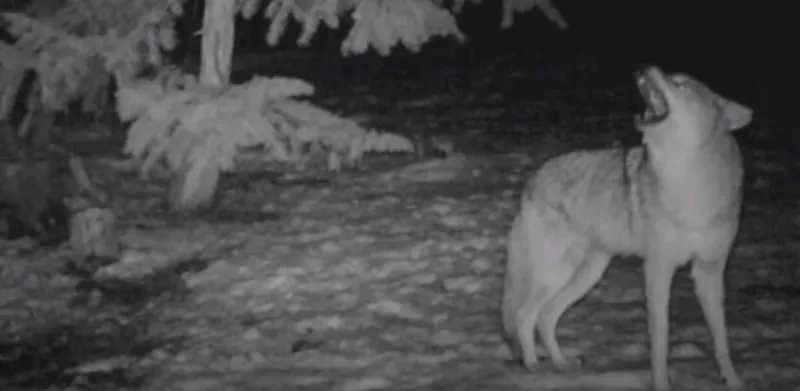
Coyotes communicate with a range of calls
© Lite 96.9 WFPG

Coyotes have a surprisingly large vocabulary. According to Rutgers, they use yips, barks, and howls to communicate, probably helping defend territories and maintain family bonds.

Think of it as a way of saying “we live here” and “where is everyone?” That is a broad, general purpose, not a line-by-line translation of any single call.

Bring pets indoors at night, and do not leave small pets outside unattended, since pets can be vulnerable.

Researchers have looked closely at this. A peer-reviewed study of coyote vocalizations describes a wide range of sounds and many combinations of them.

Because calls can blend together, one howl or one burst of yips is hard to pin down to a single meaning.

That is why popular claims fall apart. A howl does not establish that a hunt or kill is underway.

It does not mean an attack is about to happen, and it does not show that the caller is approaching your house.

Hearing a call is not the same as having an encounter. It is a sign that coyotes are talking, and most of the time the conversation has nothing to do with you.

A chorus does not reveal how many coyotes are there
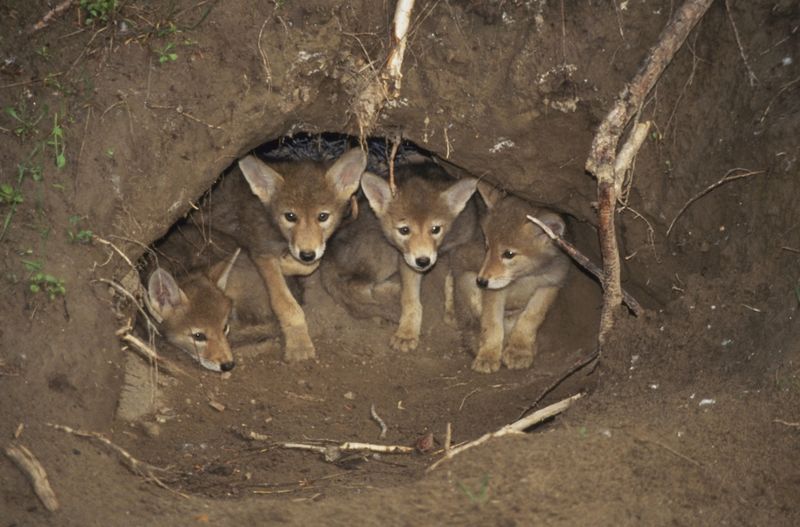
A chorus does not reveal how many coyotes are there
© Outdoors

A burst of overlapping yips can sound like a whole crowd has gathered outside. Your ears may be fooling you, though.

In a listening experiment, 427 participants heard recordings of one to four coyotes. The study found that people overestimated the number by nearly twofold on average.

The experiment took place in southern Texas, so its exact result is not a New Jersey count. Its real value is as a warning: guessing group size by ear is unreliable.

Local coyotes also do not usually form big, wolf-like packs. Rutgers describes the typical New Jersey social unit as a small family, a mated pair and sometimes their young.

So a noisy chorus is more likely to be a few animals than a crowd, though a call alone cannot give you a count. Two or three coyotes can sound like many, especially when yips echo through the trees.

Late autumn provides context, not a howl calendar

Late autumn provides context, not a howl calendar
© A-Z Animals

Fall nights bring crisp air and early darkness, so it is natural to notice sounds more. The coyote calendar offers some seasonal context, though not a simple answer.

Rutgers says young coyotes disperse by early fall, leaving the area where they were born to find their own space. A howl in late autumn could happen amid that movement, but nobody can tell who is calling or why from the sound alone.

It also does not mean coyotes howl more in November. No source reviewed shows a November surge in howling.

Mating is a separate chapter. Rutgers places heightened mate-search activity in January through March and mating in February or March, so a November howl should not be read as a mating call.

Treat the season as background, not a decoder. Late autumn may be part of the story, but one call still cannot reveal the reason behind it.

Everyday steps can reduce conflict
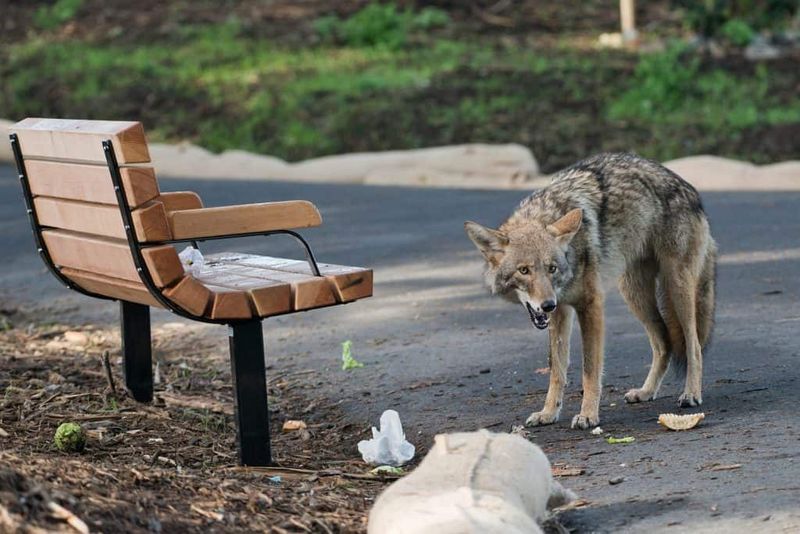
Everyday steps can reduce conflict

The best way to avoid trouble is to make your yard boring to wildlife. Never feed coyotes, on purpose or by accident.

Per Rutgers guidance, secure garbage, compost, and pet food. Bring pets indoors at night, and do not leave small pets outside unattended, since pets can be vulnerable.

Coyotes are naturally wary, and direct encounters with people are uncommon. Even so, a few simple habits lower the odds of a problem.

If a coyote approaches you, stay in a safe position and stay calm. Make yourself look large and use a loud voice.

If it does not retreat, non-injurious hazing, such as spraying it with a hose, is a possible next step. Never approach, corner, handle, or try to hurt a coyote.

Hearing a howl alone is not a reason to haze anything. Save those steps for an animal that is actually coming toward you.

When a coyote sighting warrants a call
When a coyote sighting warrants a call
© letgirlscouts

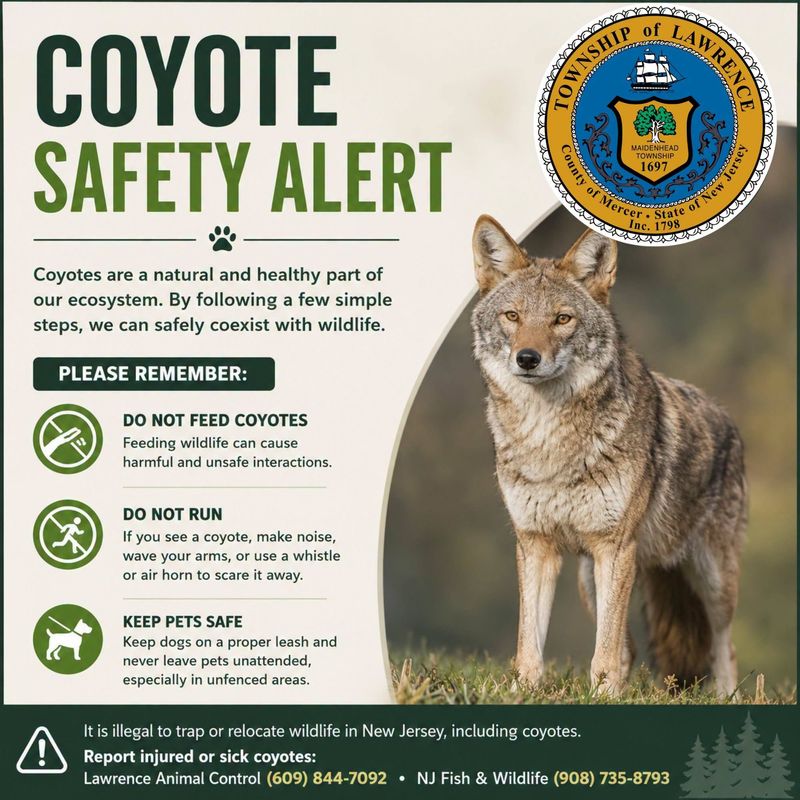
Seeing a coyote in daylight can be startling, yet Rutgers says a daytime sighting alone does not mean the animal is sick or abnormal. Coyotes simply move around at different hours.

The more useful clue is behavior. NJ Fish and Wildlife advises contacting local police and the agency if a coyote attacks a person, or if one is seen in daytime and shows no fear of people.

A fearless coyote might not run when it notices you, or it may keep coming closer. That is different from one that trots off and disappears.

The agency lists 908-735-8793. Outside normal business hours, call the DEP Hotline at 877-WARN-DEP.

Keep this separate from a howl in the night. Ordinary nighttime calls do not call for a report, while attacks on people, though rare, have happened and deserve a quick response.

A howl is not a dependable warning

A howl is not a dependable warning
© WildlifeHelp.org

Coyote calls are conversation, not a warning bell. They cannot reliably tell you whether a coyote is near, whether one is about to approach, or how many animals are out there.

What you can control is your yard. As Rutgers advises, lock down garbage and pet food and bring pets inside at night.

The next howl you hear is most likely coyotes keeping in touch with each other. Let it be a little wild music, with the pets already safely inside.

Share this story

AR

Written by

Angela Russo

More from Angela Russo →

About Gardening Latest

Gardening Latest provides in-depth guides to maintaining and enhancing your garden and backyard. Learn how to make the most of the space you have and create a beautiful garden.

More about us →

Latest stories

  • Maryland GardeningWhy Coyotes Sound So Close to Your Maryland Home at Night Right Now, and What the Howling Means

    Why Coyotes Sound So Close to Your Maryland Home at Night Right Now, and What the Howling Means

    Just now
  • Iowa GardeningIowa Gardeners Keep Brushing Against Io Moth Caterpillars, and Here’s How to Calm That Sting Quickly

    Iowa Gardeners Keep Brushing Against Io Moth Caterpillars, and Here’s How to Calm That Sting Quickly

    6 min ago
  • Virginia Gardening9 Protected Animals Virginia Homeowners Aren’t Allowed To Remove On Their Own

    9 Protected Animals Virginia Homeowners Aren’t Allowed To Remove On Their Own

    12 min ago
  • North Carolina GardeningYour Dog Just Ran Through a Fire Ant Mound in North Carolina, and Here’s What to Do First

    Your Dog Just Ran Through a Fire Ant Mound in North Carolina, and Here’s What to Do First

    25 min ago
  • Michigan GardeningMichigan’s Only Venomous Snake Has Company: a Thumb-Sized Shrew Living in Your Yard

    Michigan’s Only Venomous Snake Has Company: a Thumb-Sized Shrew Living in Your Yard

    30 min ago

Gardening by state

Stories for your state, and the hardiness zone most of it gardens in.

Keep exploring

Read next

All New Jersey Gardening →
New Jersey GardeningNew Jersey Folks Eating Celery Every Day Are Learning What It Really Does To Their Bodies
New Jersey Gardening

New Jersey Folks Eating Celery Every Day Are Learning What It Really Does To Their Bodies

3 hr ago
New Jersey GardeningThese 8 Scary-Looking New Jersey Neighbors Seem Dangerous But Are Actually Totally Harmless
New Jersey Gardening

These 8 Scary-Looking New Jersey Neighbors Seem Dangerous But Are Actually Totally Harmless

18 hr ago
New Jersey GardeningThe Silvery Wiggling Bug Darting Across Your New Jersey Bathtub At Night Is Totally Harmless
New Jersey Gardening

The Silvery Wiggling Bug Darting Across Your New Jersey Bathtub At Night Is Totally Harmless

20 hr ago

More from New Jersey Gardening

  • These Venomous Critters Are Hiding Closer To Your New Jersey Porch Than You Think

    Nov 22
  • Is That Red Vine on Your New Jersey Tree Virginia Creeper or Poison Ivy?

    Nov 22
Back to top

Leave a response Cancel

Your email address stays private. Required fields are marked with an asterisk.

Gardening Latest

In-depth guides to maintaining and enhancing your garden and backyard: how to make the most of the space you have, and how to make it beautiful.

  • Facebook
  • X
  • Pinterest
  • YouTube

We may earn a portion of sales from products or services that are purchased through our site as part of our affiliate partnerships with retailers.

Explore

  • About GardeningLatest.com
  • Contact Us
  • Terms and Conditions
  • Privacy
  • Editorial Note:
  • FTC Disclosure

Newsletter

New garden guides and seasonal tips, straight to your inbox.

We’ll email you a link to confirm. Unsubscribe any time.

Almost there! Check your inbox and tap the link to confirm.

© 2026 Gardening Latest. All rights reserved.

Back to top