
That bright orange critter crawling across a damp New York trail really does carry a deadly toxin. The red eft, a young eastern newt, can contain tetrodotoxin, a poison that can be life-threatening or fatal if swallowed.
Seeing one is perfectly safe, though, and a few simple habits keep it that way. Here is what hikers should know about this tiny, glowing wanderer.
Meet New York’s red eft
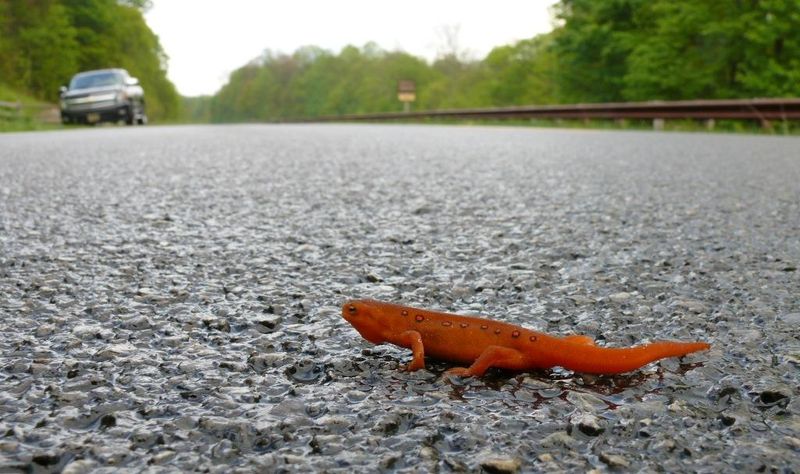
Picture a small, glowing orange creature moving slowly over wet leaves after a summer rain. That is the red eft, the land-dwelling juvenile stage of the eastern newt, a species found in New York.
Spotting one is easy once you know the clues. New York DEC’s amphibian identification guide describes the eft as reddish-orange, with two rows of dark-bordered spots running along its back.
Its skin looks rough rather than slimy, and its tail is rounded.
The adult looks quite different. Grown eastern newts live in ponds and slow water, and they are more olive or brown with a flattened tail built for swimming.
So if you see an orange newt on a forest path, far from any pond, you are almost certainly looking at an eft.
Efts can wander in the open during damp weather, which is why hikers meet them so often. Their bold color is a warning sign to predators, and it is a big reason these animals stand out so clearly against the brown forest floor.
What the toxin can do
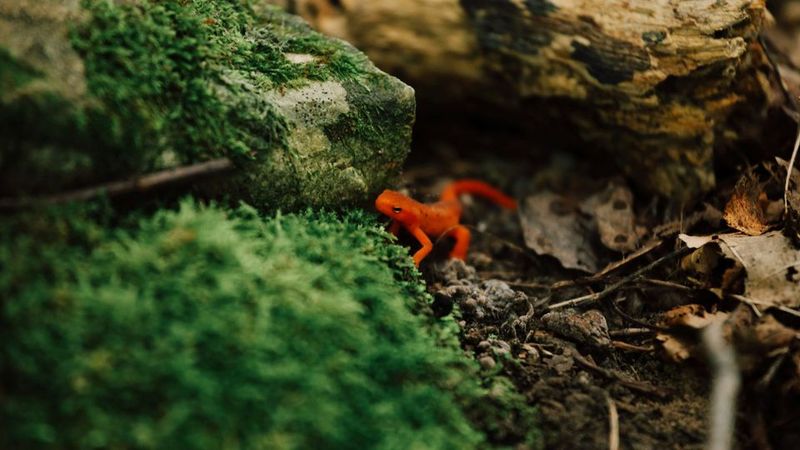
Eastern newts can contain tetrodotoxin, often shortened to TTX. The animal uses it as a defense against predators.
In people, the toxin interferes with the signals that travel from nerves to muscles.
Poisoning from swallowing it can start with numb lips and tongue, then move on to weakness and paralysis, including the muscles used for breathing. Poison Control describes this progression, and tetrodotoxin poisoning can be life-threatening or fatal.
The research on efts adds some detail. In a 2018 study of 15 efts and seven adults from Virginia, the tested efts contained more toxin than the tested adults.
The same study found no higher concentration in the red spots than in nearby unspotted skin, so the spots are not toxin hotspots.
Toxin levels also vary. A study of 142 red-spotted newts found big differences among animals and populations, including New York samples that ranged from undetectable to measurable.
Looks alone cannot tell you how much toxin one eft holds.
The famous fatal case is often misunderstood. That JAMA report involved a man who swallowed an Oregon rough-skinned newt, a different species.
It does not establish a lethal dose or a comparable risk from an ordinary red-eft encounter.
Does touching one put you in danger?
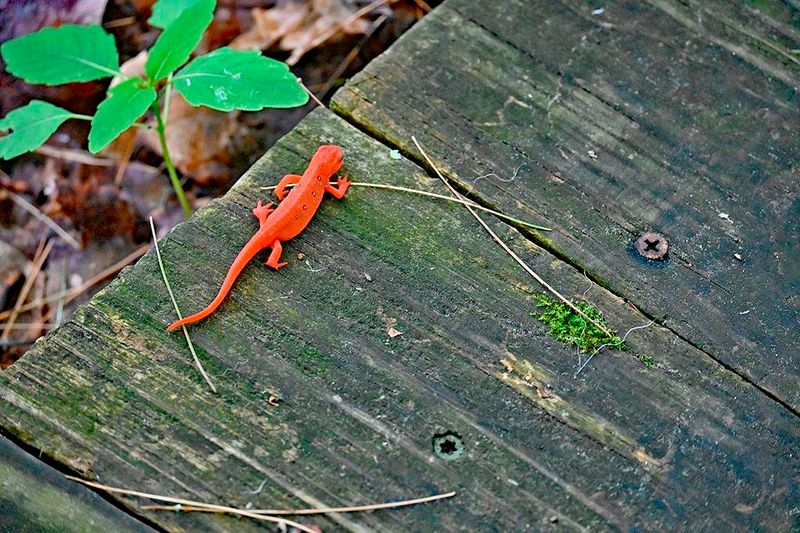
Start with the good news: looking at an eft exposes you to nothing. The toxin stays in the animal unless something goes into a mouth.
Putting an eft in your mouth, or moving skin material from your fingers to your lips, is the avoidable risk.
Touch is a murkier question. The CDC’s NIOSH emergency response card says the significance of tetrodotoxin exposure through skin is not established.
In plain terms, nobody has pinned down what skin contact means for people.
That gap cuts both ways. You cannot honestly say a brush with an eft is deadly, and you cannot say handling one is definitely harmless.
Both claims go further than the facts.
So the sensible approach is simple and calm. Enjoy the view, keep your hands to yourself, and let the eft go about its day.
If a curious child scoops one up, there is no need for panic, just a good handwashing afterward and a reminder to keep fingers away from faces.
Why the best encounter is hands-off

A good trail rule fits in one line: watch, photograph, walk on. Do not pick up, lick, or eat an eft, and never test its toxicity by trying any of those things.
If you do end up handling one by accident, keep your hands away from your mouth and eyes.
Toxin is not the only reason to keep your distance. CDC guidance notes that amphibians can carry Salmonella even when they look perfectly healthy.
A clean-looking eft can still leave germs on your fingers.
Efts are also delicate. New York DEC’s volunteer handbook explains that amphibians readily absorb chemicals through their skin.
Insect repellent, lotion, or hand sanitizer on your palms can harm them, which is why handlers are told to handle them as little as possible.
After any accidental handling, wash with soap and running water. Brief contact is not cause for alarm, just a good reason to scrub up before you eat your trail snacks.
What to do after contact or suspected ingestion
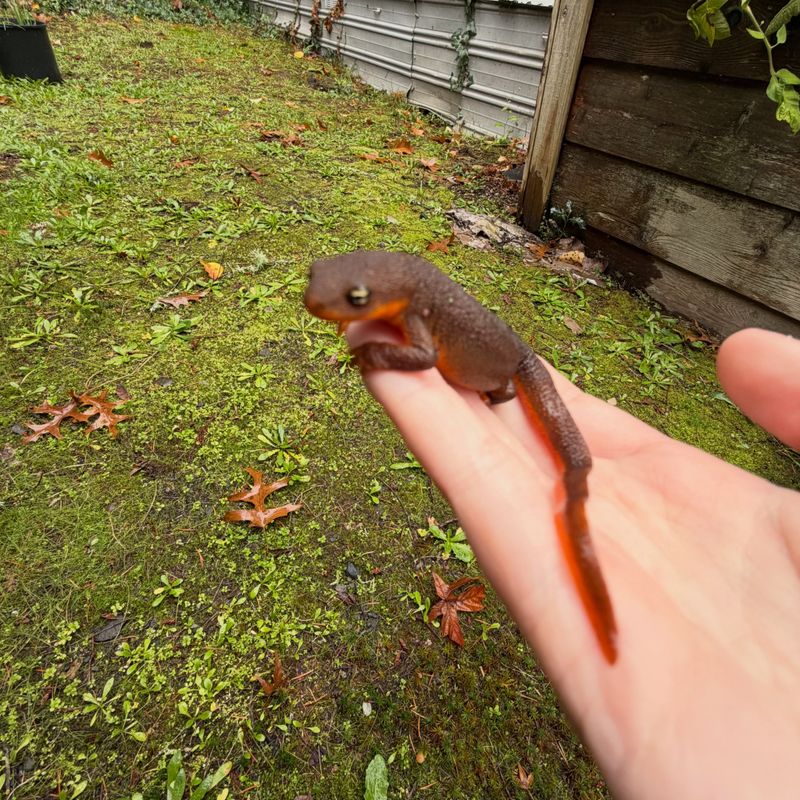
Most meetings with an eft end with nothing more than a story. If you picked one up by accident, set it down gently where you found it and wash your hands with soap and running water.
That covers routine contact.
A suspected exposure is a different situation. Poison Control recommends washing, rinsing, or flushing the exposed area with water, then getting expert advice rather than managing a significant exposure at home.
In the United States, call Poison Control at 1-800-222-1222. The line is free and staffed by specialists who can tell you what to do next.
If someone may have swallowed an eft, or if symptoms appear such as numbness around the mouth, weakness, or trouble breathing, seek urgent medical guidance right away. Do not wait to see whether things improve.
Not every touch needs emergency care, but a possible swallowing deserves a quick, expert answer.
Let the eft stay wild

Admire the eft, keep it out of your mouth, and leave it right where you found it. That approach protects you, and it protects an animal whose skin soaks up whatever lands on it, as DEC’s handbook explains.
Simply seeing one is never the danger. The best souvenir of a red eft is a photo and a good story.
Share this story