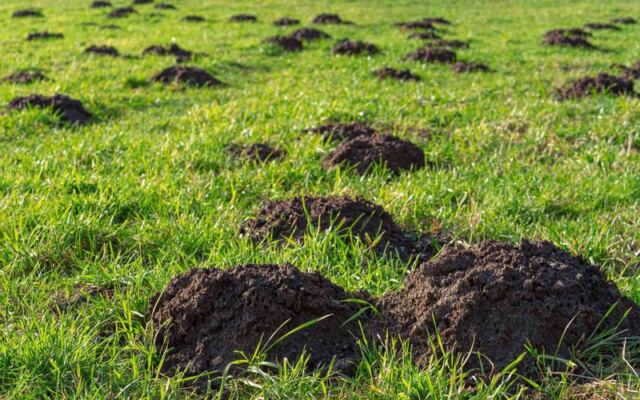
Those little piles of loose soil in your lawn are most often ants digging out an underground nest. The dirt they push up has to go somewhere, so it builds into a small mound.
Seeing one after a storm is common, but the rain did not necessarily cause it. Here is how to tell what you are looking at and when it is worth doing anything about it.
What a soil mound can tell you
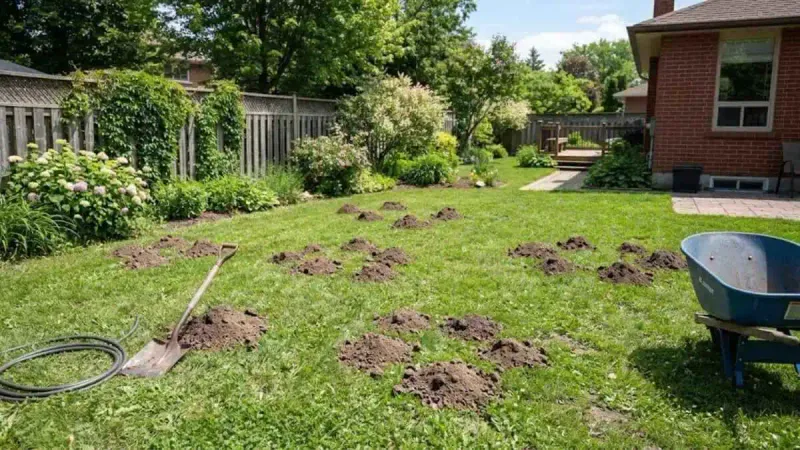
Ants that nest in the ground have to move soil to make room for tunnels and chambers. The dirt they carry out gets dropped at the entrance, and over time it stacks up into a visible pile.
That is the simple story behind most of the little mounds that pop up across a yard. MU Extension describes ant soil nests as excavations that produce these mounds.
Not every mound looks alike, because ant species differ in where they nest and how obvious their work is. Some leave a scattering of tiny crumbs around a hole.
Others build larger domes. MU Extension notes that Missouri field ant mounds can reach about a foot across, and the Allegheny mound ant can build much larger structures.
Size alone will not tell you which ant made the pile. A small mound might belong to a young colony, or to a species that simply keeps a low profile.
A big one might be several years old, or it might be a different kind of ant altogether.
Size also says nothing about when the mound appeared or why. A pile you notice on Tuesday morning may have been building for days, and you just spotted it once the grass looked different or the ground was wet.
Treat the mound as a clue that something is living below, and not as a full answer.
What the timing after a storm does—and does not—show
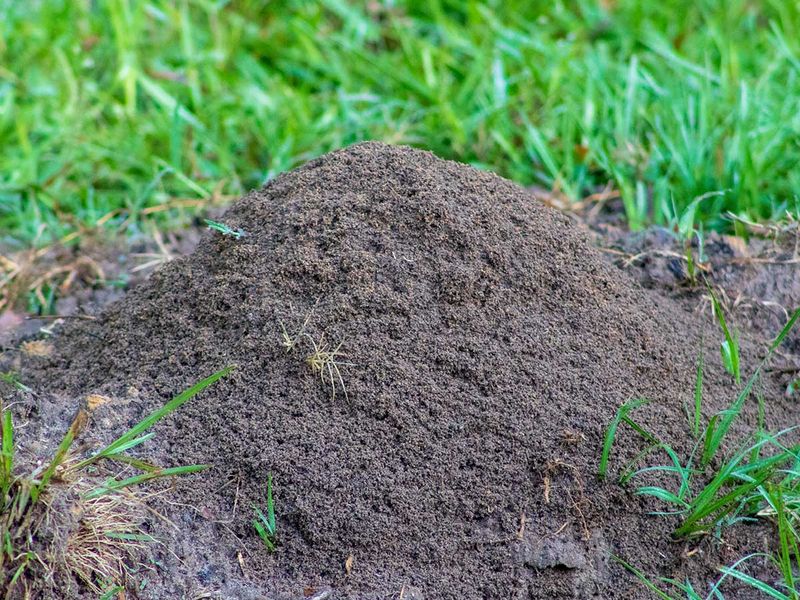
Noticing a mound after a storm is an observation. It is not proof that the rain caused it, pushed a colony into your yard, or that the ants somehow saw the weather coming.
The sources reviewed do not establish a general rule that Missouri lawn ants build visible mounds because rain is coming or has just fallen.
There are plain reasons you might notice mounds then. Wet soil is soft and easy to see, and a freshly washed lawn makes loose dirt stand out.
You may also just be spending more time looking at the yard once the storm passes. MU Extension’s ant guide describes the mounds as excavated soil, without tying them to weather.
Some research does look at mounds and rain, but in a very different place. A study of the tropical ant Diacamma indicum found that its nest mound reduced water entering the nest.
That finding belongs to that species and its study setting, and it cannot be assumed for the unidentified ants in your lawn.
As for ants predicting rain, Charles Sturt University looked at the idea and found no solid basis for treating a small mound as a storm forecast. Some ants do respond to season or conditions in certain settings.
That is a long way from a lawn mound telling you about tomorrow.
Check for ants before identifying a lawn bump

Before you decide what made a bump, look for ants. Watch the spot for a minute or two from a comfortable distance, and see whether ants are coming and going through a small hole.
Ants and an entrance hole point to a nest, while a bump with neither deserves a second look.
Appearance gives only rough clues. University of Minnesota Extension notes that cornfield ants can make small cone-shaped piles in thin or bare turf, while field ants can make larger mounds, even in healthy lawn.
Those patterns are handy hints, and they do not guarantee a species.
Other animals make lawn bumps too. A University of Minnesota lawn diagnostic page lists moles, earthworms and voles among the possible causes.
Mole activity tends to show up as raised ridges or heaps of soil, and earthworms leave small castings, so a bump without ants may have a different story.
If you want to be sure, keep your distance. MU Extension points out that some Missouri ants sting, so do not poke or handle an unfamiliar active mound.
Take a clear photo, note where it sits, and use that to ask for local identification if you need it.
A few mounds do not automatically threaten the lawn
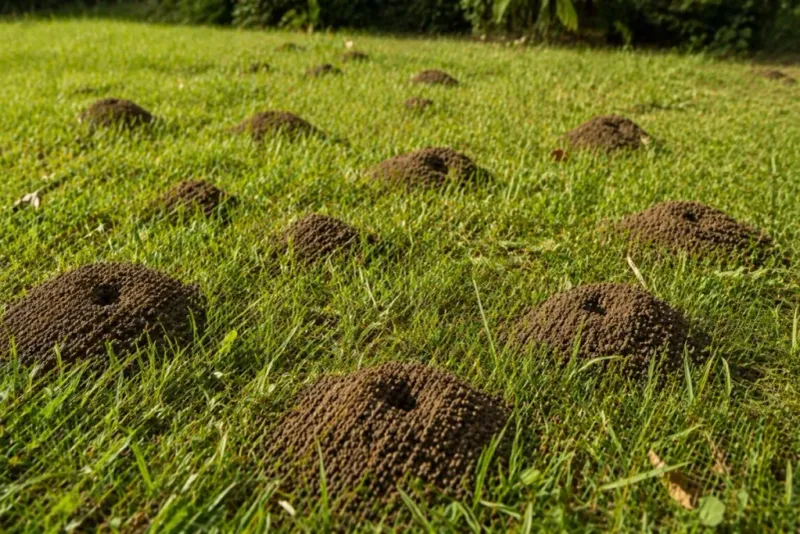
A handful of small mounds is usually a nuisance, not a lawn emergency. Ants generally do not feed on grass, so they are not munching your turf the way some insects do.
Effects vary by species and by lawn, and nobody can say all mounds are harmless or all of them are trouble.
Where problems do show up, they tend to be physical. University of Minnesota Extension notes that excavation and larger mounds can disturb turf.
Soil piled on top of grass can smother small patches, and a lumpy surface can make mowing awkward.
Turf pest guidance points the same way. MU Extension’s turfgrass insects publication covers ants among lawn insects, and Penn State Extension describes their lawn effects as often minor, though particular situations can be troublesome.
A practical test is to walk the lawn with your mower in mind. If the blades skim past the mounds without scalping them, and the grass around them looks fine, you probably have a cosmetic issue.
Thin or stressed turf around a big mound is a better reason to look closer.
Decide whether the mound is worth managing
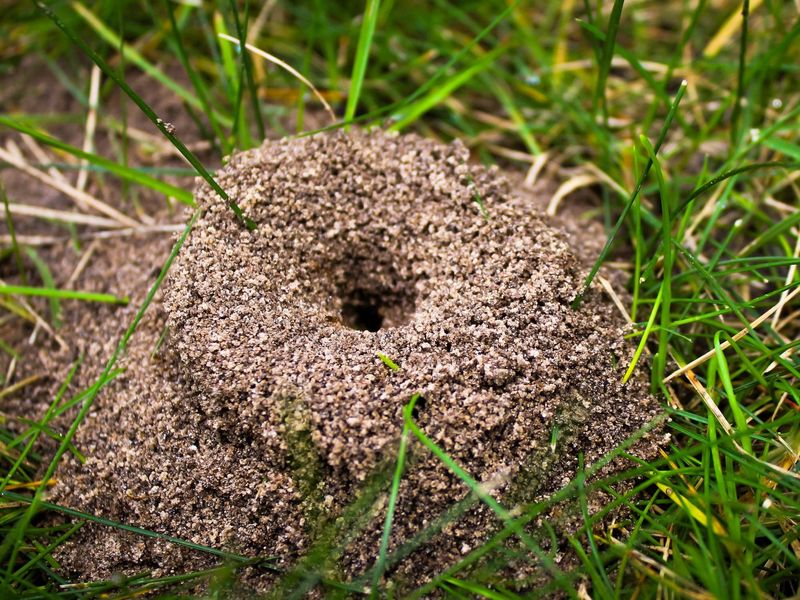
Think of it as a trade: how much do the mounds bother you versus how much effort the fix takes. If they do not interfere with mowing or how you use the yard, the simplest plan is to leave them alone.
University of Minnesota Extension supports tolerating mounds that cause no practical problem.
Some situations tip the balance. Mounds that snag the mower, sit on a play area, or crop up in a freshly laid sod job are fair reasons to act.
A new lawn is still rooting in, so soil piles and tunneling can matter more there than in an established yard.
Know the limits before you start. University of Illinois Extension cautions that repeated treatment of small lawn mounds gives only short-lived relief, because ants can recolonize treated areas.
Chasing every little pile can turn into a weekly chore with little to show for it.
A lighter touch often works. You can brush or rake a small pile flat once you have confirmed no stinging ants are present, and see whether it comes back.
If new piles keep appearing in the same spot, that tells you the nest is still active, and you can decide whether that spot truly needs attention.
Choose a safe response if you decide to act

If you decide to act, start with identification and safety. Do not handle or disturb an unfamiliar active mound.
MU Extension notes that some Missouri ants sting, so if you see aggressive or stinging ants, get local identification before you do anything else.
Imported fire ants deserve careful wording. MU Extension says red imported fire ants are not currently established in Missouri.
USDA APHIS lists the pest’s range, and its Missouri pest page shows the state as one to watch. That does not make an encounter impossible, so a painful sting from an unknown ant is worth reporting.
No single fix suits every mound. Boiling water can injure you and kill nearby plants, and Texas A&M’s fire ant FAQ is a reminder that home remedies and fire-ant products are not universal answers.
Blanket pesticide applications across the whole lawn are not a fair match for a few small mounds either.
If you choose a pesticide, use only a product labeled for the pest and site. The EPA’s label guidance says to read and follow directions, including precautions for children, pets, water and treated areas.
A mound is often just a doorway, and the real decision is whether anyone needs to use that doorway’s yard differently.
Share this story