Once your agave’s flower stalk has shot up, cutting it is not a dependable way to keep that flowering plant alive. Cutting can still make sense for cleanup or a specific problem in your yard, but it does not undo the flowering.
Leaving the stalk alone gives it time to make flowers, and sometimes seeds or tiny baby plants called bulbils. Here is how to tell which choice fits your garden.
The giant stalk follows years of growth

Years of quiet growth come before that dramatic spike. The agave stores energy in its thick leaves, and when the plant is ready, it sends up a tall stalk topped with flowers.
How long that takes is not fixed. A peer-reviewed review of the agave family reports a broad range of maturation times, from about 7 years to more than 40, depending on the species.
Climate, water, and soil play a role too.
That is why the nickname “century plant” can mislead you. Few agaves wait anything close to 100 years, and no one can give you an exact date for your plant.
Research on agaves in Arizona landscapes also points to how much timing varies by species and conditions.
Most agaves are monocarpic, which means each rosette flowers one time. After that big effort, the flowering rosette usually declines.
A few agaves are exceptions and can flower more than once, so the habits of your own species matter.
If your stalk just appeared, you are seeing the result of many seasons of building up. The plant is not sick.
It is doing what its life plan calls for.
The flowering rosette is not the whole clump
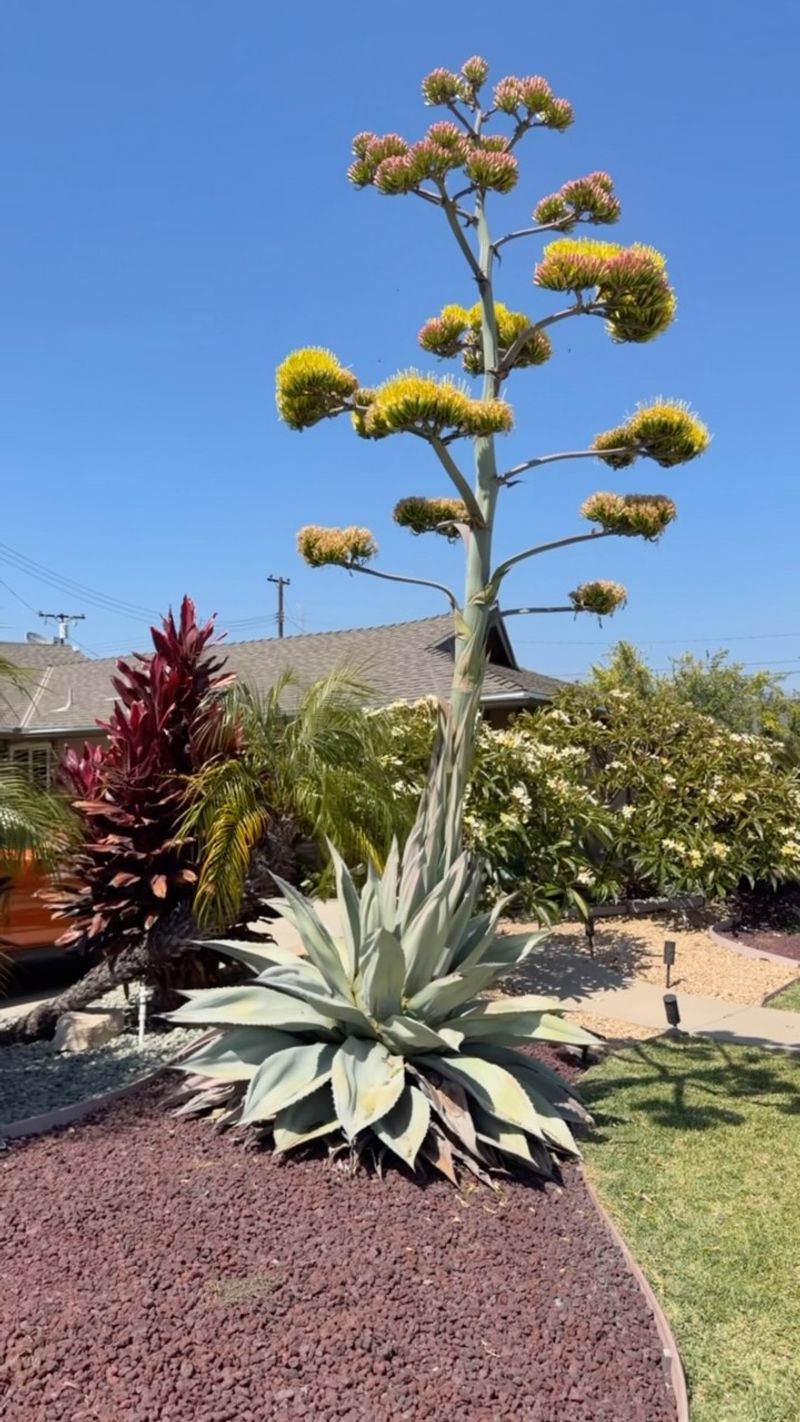
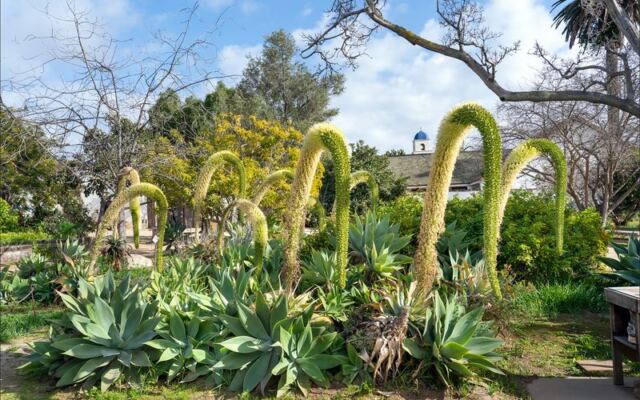
The stalk is the plant’s inflorescence, which is the part that holds the flowers. It grows from the center of a single rosette, the circle of thick leaves most people picture when they think of an agave.
When gardeners say an agave “dies,” they usually mean that one flowering rosette. UC Master Gardeners of Sonoma County describe how the mother rosette may decline while pups at the base or plantlets on the stalk carry on as new plants.
Pups are small offsets that sprout near the base. Some agaves also grow bulbils, tiny plantlets that form on the stalk itself.
Not every species does both, and some do neither.
So a clump can stay in your garden for years even as its original rosette fades. Look around the base of your plant for small rosettes.
If you see them, the clump may continue.
Knowing this takes some of the sting out of watching the big plant change. The show is the end of one rosette, not always the end of the planting.
What cutting the stalk can—and cannot—do
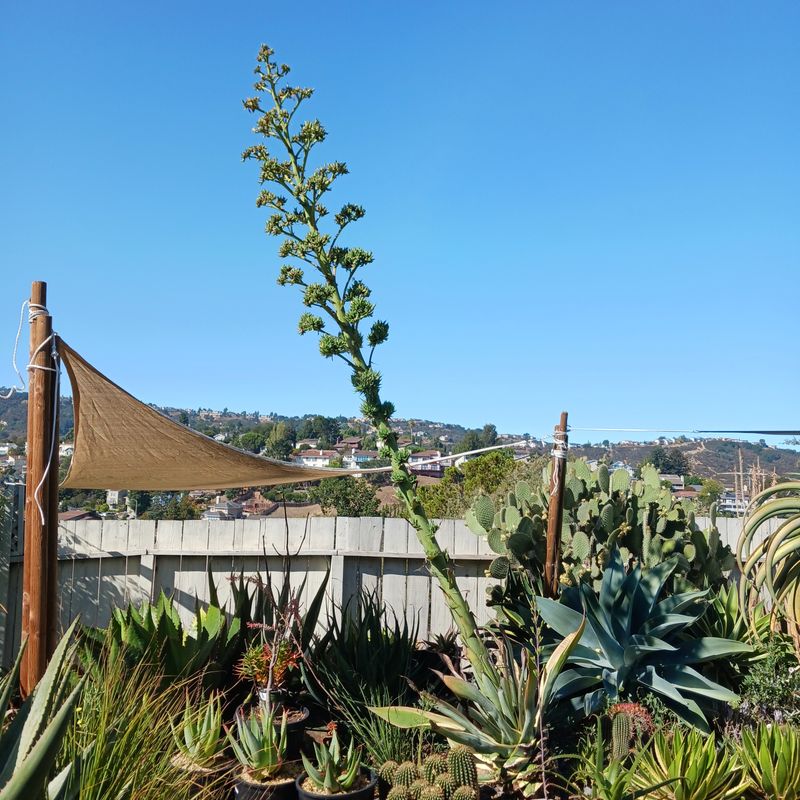
Cutting an emerged stalk is not a dependable way to save the flowering rosette. That is the plain answer, and it can save you some effort.
The best evidence comes from a field study of Agave macroacantha. The researchers concluded that the rosette’s death process was irreversible once stalk production began.
Some plants with cut stalks still made bulbils, while others made no propagules at all.
That study looked at one species. It does not prove that every ornamental agave behaves the same way, so treat it as a strong clue rather than a rule for all of them.
Available evidence also does not show that cutting reliably prolongs the rosette’s life. There is no proven number of extra months or years, so be wary of anyone who promises one.
Cutting does change one thing for sure: it removes the flowers and any seeds or bulbils that would have formed. If you want those, cutting works against you.
Wait if you want seeds or bulbils
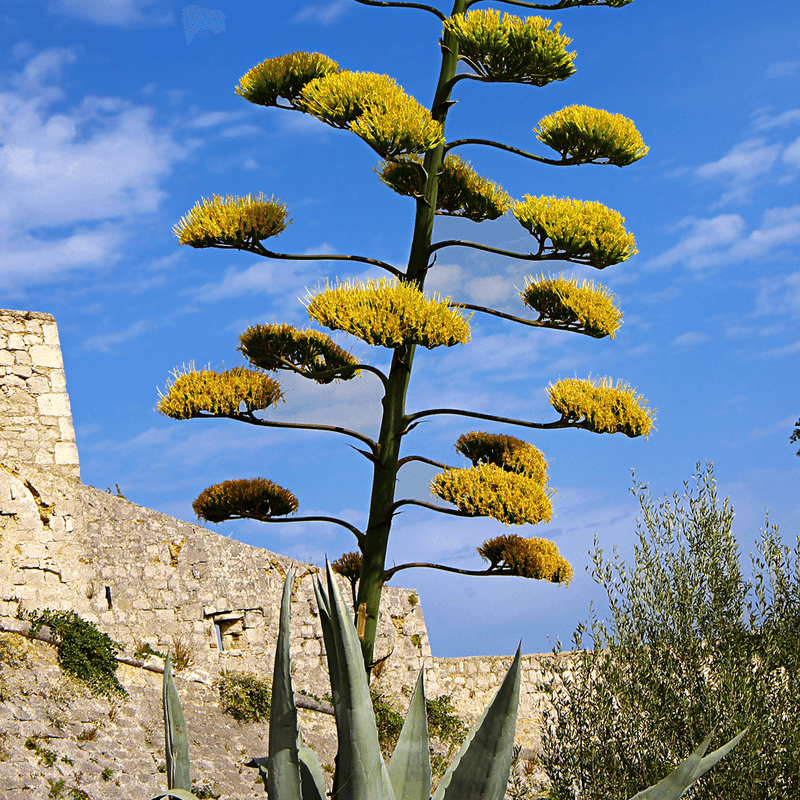
Seeds and baby plants need time, and the stalk is where they develop. If you hope to collect either one, leave the stalk in place.
For seed, University of Nevada, Reno Extension advises waiting until seeds are mature or have dispersed before cutting. Pulling the stalk early could throw away the whole crop.
Some agaves also form bulbils on the stalk. University of Arizona Cooperative Extension describes removing these little plantlets and potting them up so they can grow roots.
Here is the catch. Not every plant makes seed or bulbils, and it depends on the species and sometimes on pollination.
If your stalk shows only flowers that drop away, there may be nothing to collect.
Do not cut early hoping to protect the rosette. Cutting is not a proven way to keep it alive, and it can remove the very material you wanted.
A good habit is to check the stalk every few weeks. Watch for dry seed pods or small plantlets, and decide once you can see what actually formed.
A spent stalk can be removed for cleanup
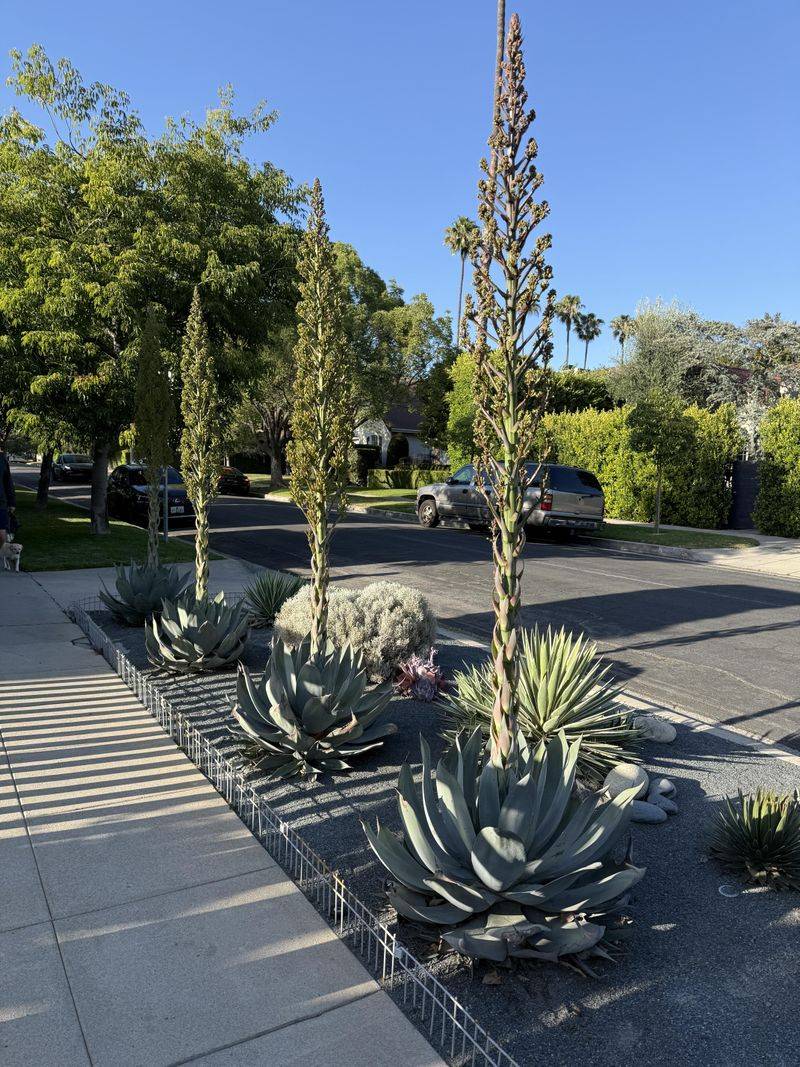
After the flowers fade and the stalk turns brown and dry, it is fair to call it finished. At that point, taking it down is a matter of tidiness.
Extension guidance, such as the pruning advice from University of Nevada, Reno, supports removing faded agave bloom spikes. Think of it as cleanup, not medicine for the plant.
Sometimes a stalk causes a specific problem. It might lean over a walkway, block a view, or sit where a falling stalk could hit something.
Removing it for reasons like these is a practical choice.
Compare that with leaving it up. A standing stalk can keep making flowers, seeds, or bulbils if your species produces them, and birds and pollinators may visit.
Many gardeners enjoy that part of the show.
There is no universal date or cutting height to follow. Let the condition of the stalk and the needs of your yard guide you, and remember that taking it down will not bring the rosette back.
A towering stalk calls for a safety-first decision
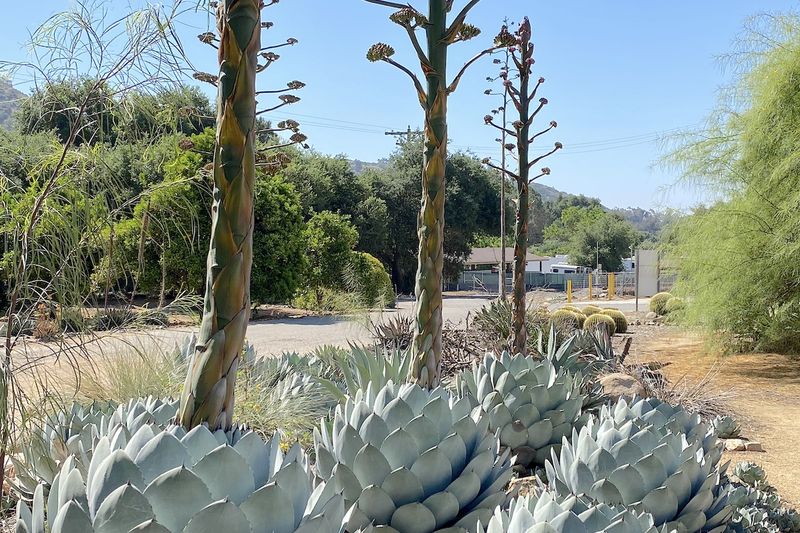
Agaves look calm, but they can hurt you. Many have sharp spines on the leaf tips and edges, and the sap can irritate skin.
Eyes are especially at risk. UC Agriculture and Natural Resources advises protective clothing, gloves, sturdy shoes, and eye protection when handling agave.
A flowering stalk adds more trouble. It can be very tall and heavy, and it may be hard to control as it comes down.
A stalk that moves the wrong way can swing into you or the leaves around it.
If the stalk is large, unstable, or hard to reach, ask a professional to assess it. A tree service or an experienced landscaper can judge the risk and decide how to take it down.
This is a precaution, not a how-to. There is no single safe method or height that fits every plant, so skip the shortcuts.
Choose what you want to preserve
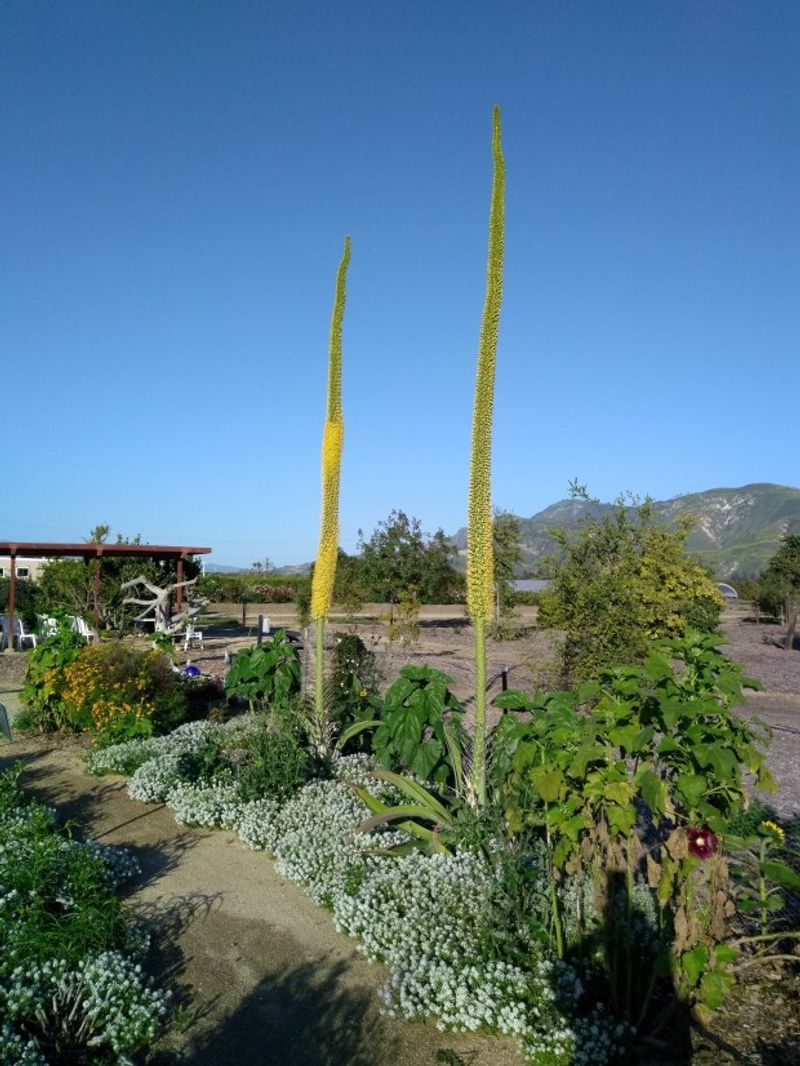
Start with your goal. Do not cut an emerged stalk expecting to save its rosette, since the Agave macroacantha study found that decline was irreversible once the stalk began.
Leave the stalk if you want flowers or possible seeds and bulbils. Consider removal for cleanup or a site concern, using the Extension pruning guidance as a guide.
Species differ, and pups may carry the clump on.
The big rosette gives its all to one tall flag, and the next generation often grows at its feet.
Share this story