Clusters of new tree-of-heaven shoots can appear in California yards and vacant lots, and they often trace back to the roots of an older tree nearby. Cutting or disturbing that tree can send up even more shoots, which is why it can feel like pulling one seedling makes more pop up.
A lone seedling on its own is a different story, but the two can look alike. Knowing which one you have makes a big difference before you grab a shovel.
New shoots can share an established tree’s roots
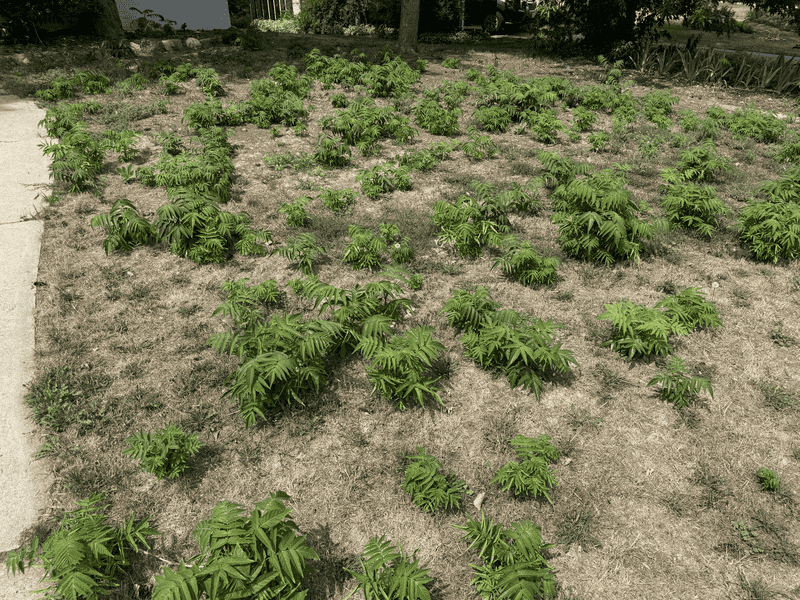
Here is the key idea: a seedling grows from a seed, while a sucker pops up from the roots of an established tree. A sucker can stay connected to its parent far beyond the shoot you can see.
From above ground, the two can look almost the same.
In California, the roots are usually the bigger story. UC Cooperative Extension writing for California says most new shoots are root sprouts.
The California Department of Food and Agriculture describes seed reproduction here as rare. So a tight cluster or a row of shoots near an older tree often points to roots.
Disturbance matters too. Cutting the parent tree, or damaging its roots, can trigger vigorous sprouting, a pattern also described in UConn Extension’s factsheet.
That is likely what people notice when more shoots appear after a removal attempt.
Not every new shoot is a sucker, though. A single, isolated plant with no mature tree nearby may well be a true seedling.
Pulling an independent seedling does not by itself cause new trees to appear, so the first job is figuring out what you are looking at.
Tree-of-heaven is established across parts of California
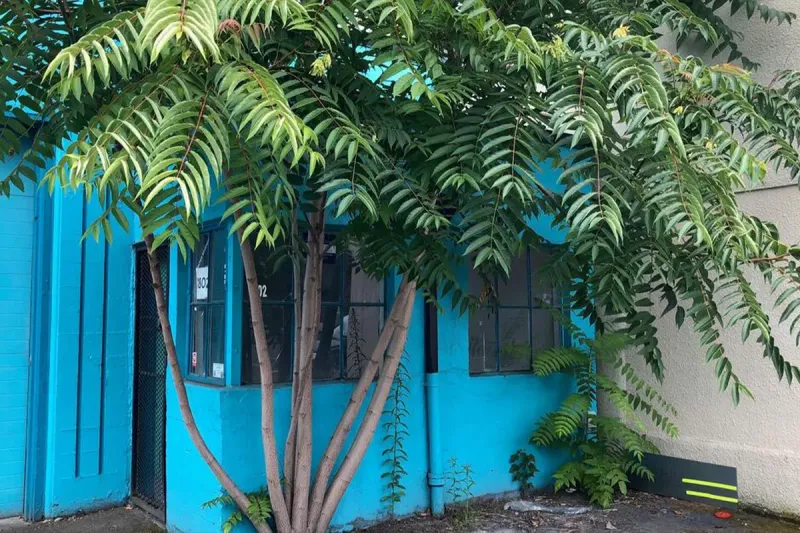
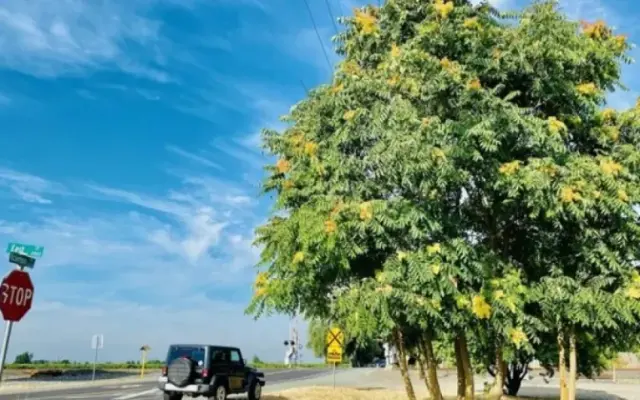
Tree-of-heaven is a long-standing resident of California, not a brand-new arrival. It turns up in cities and suburbs, along roadsides and on vacant or disturbed ground, and in streamside areas.
Where it grows, it often takes hold in places that people have already cleared, graded, or left untended.
The scale is easy to exaggerate. The California Invasive Plant Council describes its distribution as broad but discontinuous.
That means it is found in many regions, with gaps between them, rather than blanketing the state evenly.
You may also see the figure of 39 counties. That comes from a 2018 California Department of Food and Agriculture assessment, so it is a snapshot from several years ago, not a current statewide survey.
What does that mean for your street? Some neighborhoods have plenty of trees and some have none.
Finding one on your block is worth a closer look, but it is not proof that your whole area is being overrun.
Its effects vary with the site
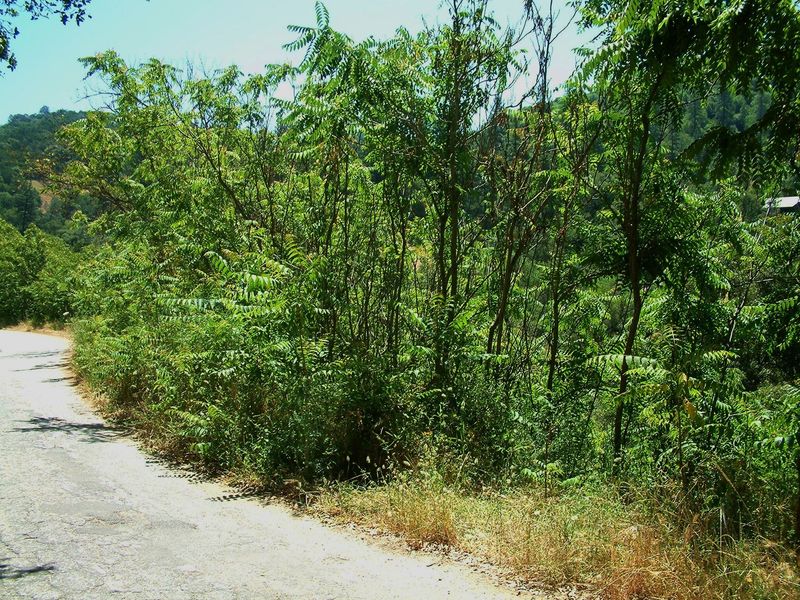
Where a tree-of-heaven lands changes how much it matters. In disturbed lots and streamside areas, it can form dense stands that crowd out other plants.
A single tree in a tidy yard is a smaller concern than a thicket along a creek.
Part of its edge may be chemical. The U.S.
Forest Service’s Fire Effects Information System notes that extracts from the tree can inhibit other plants in lab tests. That effect is documented, but it is only one piece of the puzzle.
Field results are more mixed. A 2008 Journal of Ecology study found that the tree’s chemicals affected the growth of some tree seedlings, but how much depended on the species and on the surrounding plant community.
So the tree does not poison everything around it, and chemistry alone does not explain its success. Fast growth, root sprouting, and open, disturbed ground all help it spread.
Check the leaves before you remove a tree
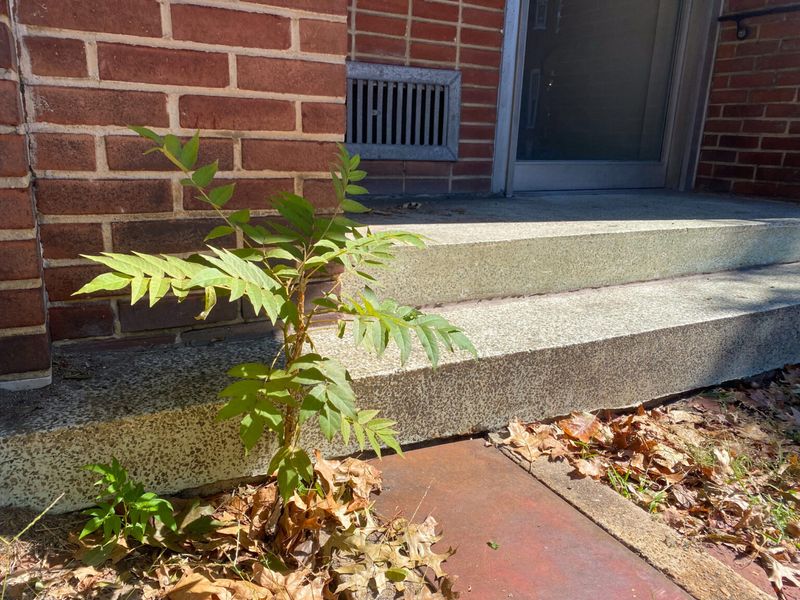
Leaves are your best first clue. Tree-of-heaven has long compound leaves, with many leaflets lined up along a central stalk.
Most leaflet edges are smooth, with one or two distinctive teeth near the base.
Crush a leaf and sniff. UC Cooperative Extension notes the unpleasant odor that crushed leaves can give off.
Treat that smell as one more hint, not a final answer.
Lookalikes are common. Sumac, walnut, and other trees with compound leaves can fool a quick glance, and the California Invasive Plant Council’s profile is a good place to compare details.
Take photos of the leaves, stem, and any seeds or bark. If you are still unsure, bring them to a local Extension office, Master Gardener help line, or certified arborist.
Confirming the plant comes before any removal.
A small seedling differs from a root sucker
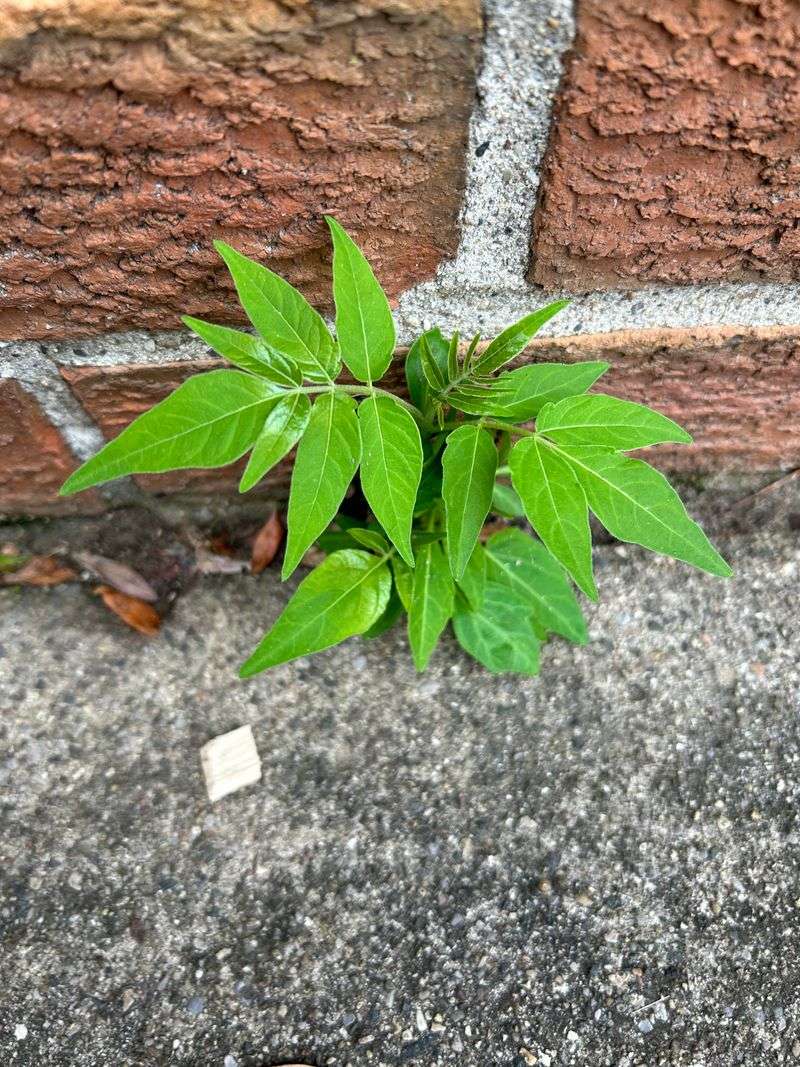
Size and setting give hints, but they rarely settle the question. A true small seedling is the easiest case.
According to UC Master Gardeners of Contra Costa County, hand-pulling works best when the soil is moist, and you should remove as much of the root as you can.
A sucker is a different matter. It is attached to an established tree’s root system, so the visible shoot is only a small part of the plant.
Pulling it may snap the connection and leave the source untouched.
Looking at the shoot alone, you may not be able to tell which one you have. UConn Extension points out that the two can be confused.
One practical check: gently loosen the soil and follow the root. If it runs sideways toward a larger tree, you likely have a sucker.
If it ends cleanly in a small taproot with no mature tree nearby, a seedling is more likely.
Cutting alone can lead to more sprouting
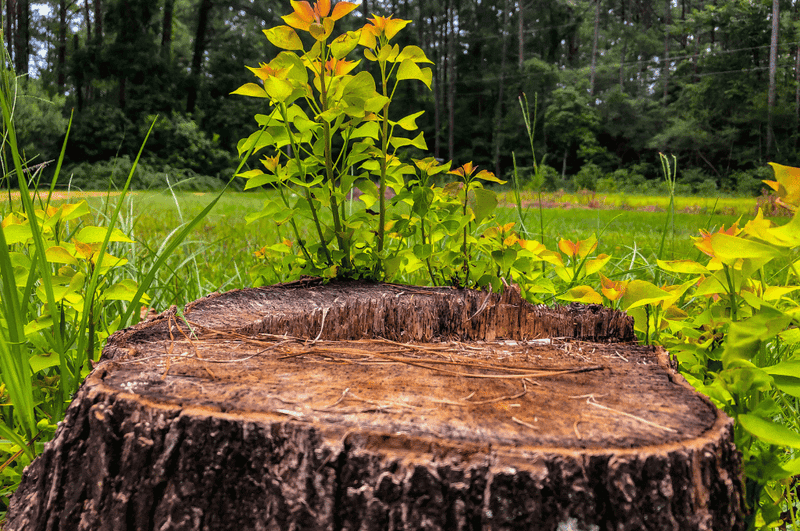
A saw or mower feels like a decisive answer, yet it often backfires. Tree-of-heaven can resprout from stumps and from roots, so a cut tree may return as a crowd of shoots.
The Cal-IPC and UC weed control handbook describes this resprouting habit, and it notes that it is not a formal recommendation.
Roots add to the problem. Digging or pulling that breaks roots can leave fragments in the soil that are able to sprout.
Disturbing the ground near a mature tree can also trigger new growth, as UC Master Gardeners of Contra Costa County explain.
Set your expectations accordingly. Control usually takes follow-up, and monitoring for several years is common.
New sprouts that appear after a cut are a sign the roots are still alive, not a sign you did something wrong.
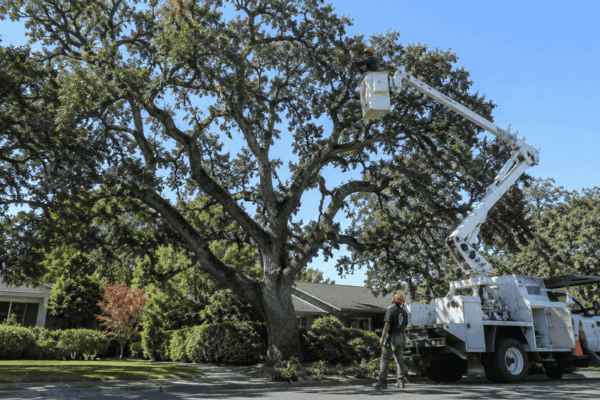
That is why this article does not offer a felling or root-digging recipe. A big tree near buildings, power lines, or neighbors calls for a plan made for that site.
Get site-specific advice for an established tree
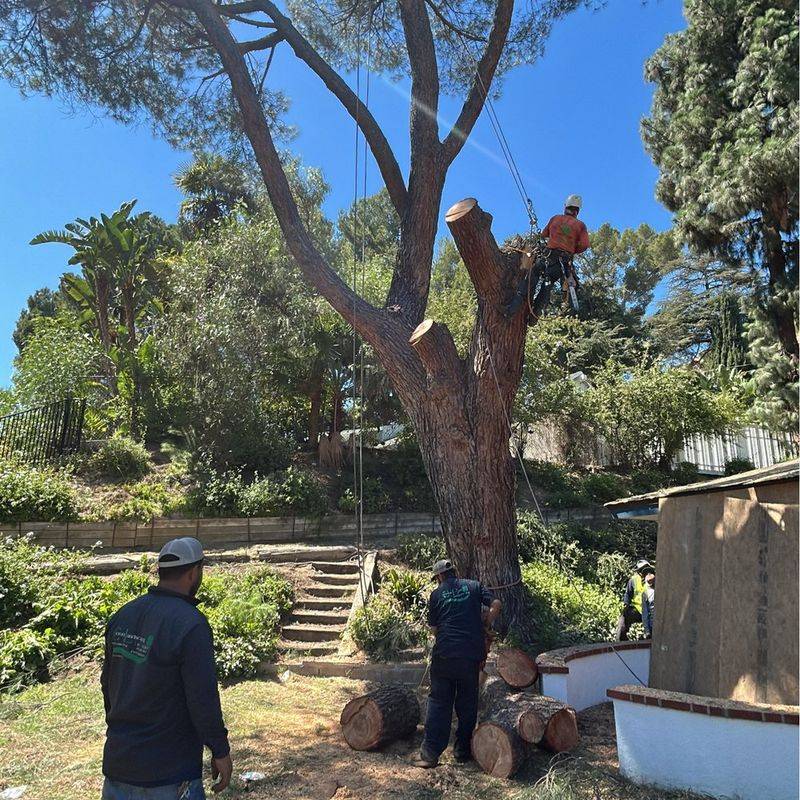
If the tree is large or well established, bring in someone who knows it. A qualified tree-care or vegetation-management professional can confirm the species, trace root connections, and judge what is growing nearby.
The right choice depends on the site, the method, and the product.
Timing varies as well. UC Master Gardeners note that herbicide approaches differ, so no single recipe fits every yard.
If a product is used, California rules require following its label and safety directions, as outlined in the Department of Pesticide Regulation’s guide.
Protect yourself while you work near the plant. Penn State Extension reports that contact can irritate the skin of some people, so wear gloves, long sleeves, and long pants.
Most people will not have a problem, but it costs little to be careful.
Until you have a plan, avoid cutting the tree or digging around its roots. A confirmed ID and a site-specific plan are worth the wait.
A tree that took years to settle in rarely leaves quickly, so patience beats a hasty swing of the axe.
Share this story