
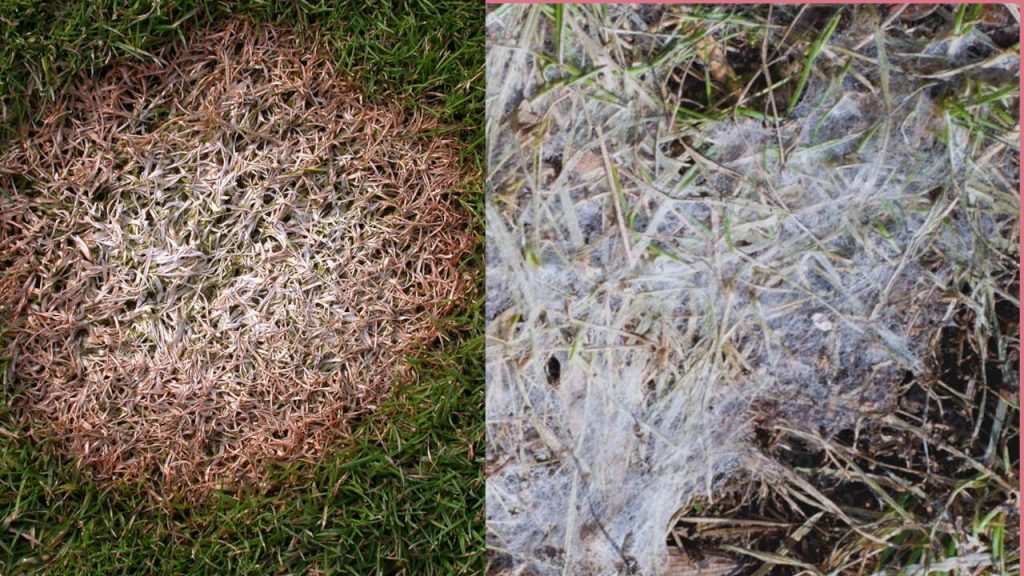
Snow mold is an invasive lawn fungus that can have a devastating impact on your lawn. There are two varieties and differences between gray and pink snow mold are important to know as they can affect the way in which you deal with the lawn infection.
Gray snow mold and pink snow mold are actually two different fungal lawn diseases caused by completely separate two pathogens. Although often classed together because they usually appear after snow covering they are in fact separate lawn diseases that affect the grass in different ways and require separate treatments to cure.
| Gray Snow Mold | Pink Snow Mold | |
|---|---|---|
| Pathogen | Typhula incarnata | Microdochium nivale |
| Typhula ishikariensis | ||
| Disease Characteristics | ||
| – Visual | Small to broad patches grayish in color | Circular-shaped bleached patches six inches wide with a reddish border |
| -Environmental | Active in temperatures between 32F and 40F | Active in temperatures between 32F and 60F |
| Can remain dormant during the summer months | ||
| -Conditions | Snow cover required | Snow cover is not required |
| Damage | Attacks the grass blades | Attacks grass blades and roots and can kill the grass |
| Disease Control Options | ||
| -Cultural Control | Treatment is not always necessary | Will need fungicide treatment |
| -Fungicides | Contact fungicides | Penetravive fungicides |
| Prevention | Mowing grass to around 5-6 cm | Mowing grass to around 5-6 cm |
| Aerating and scarifying in Spring | Aerating and scarifying in Spring | |
| Antifungal protection prior to first snowfall. | Antifungal protection prior to first snow fall. |
Snow Mold Pathogens
Gray and pink snow mold are very different infections, Although they share some similarities in conditions required to thrive, they are caused by different, unrelated pathogens.
Gray snow mold is caused by the Typhula genus pathogen which has two distinct varieties that cause gray snow mold, the Typhula incarnata or Typhula ishikariensis. Typhula incarnata infections tend to be less severe
Pink snow mold on the other hand is caused by Microdochium nivale pathogen. This is a more invasive infection and can severely damage and even kill the grass.
Different Disease Characteristics
Both gray and pink snow molds display different characteristics both visual and environmental.
Visual Characteristics of Pink and Gray Snow Mold

Gray snow mold lawn damage appears in patches of differing sizes, which may overlap. The fungus spreads by the enlarging of mycelium and if left untreated can cover large areas of a lawn. Fungi build sclerotia (yellowish fibers) that become black when completely grown. It is easy to see these fibers and they can last, The fungus begins infecting grass blades approximately four to six weeks after the snow cover has disappeared.

Pink snow mold produces bleached spots that are generally round in form and range in size from one to six inches in diameter. The area will seem crimson and water-soaked at first, but it will ultimately become pinkish-white with a reddish border.
Environmental Conditions Required for Gray and Pink Snow Mold
Both varieties of snow mold tend to appear after a snow covering. However, they become active and survive under slightly different environmental conditions.
Gray snow mold environmental conditions
Gray snow mold thrives under a narrower temperature band. For it to become active it needs the temperature needs to be between 32o F and 40o F. The pathogen can survive during the summer months as sclerotia (Fruiting structures start to form on leaf blades) in grass clippings and in the soil[1].
Pink snow mold environmental conditions
Pink snow mold operates in a wider temperature band than gray snow mold, 32o F to 60o F. In addition the fungus lies dormant in summer as mycelium or spores the latter of which are invisible over the warmer months.[2]
Types of Damage Caused
Both gray and pink snow mold cause unsightly patches on your lawn. The fungi however work in different ways with pink snow mold generally being the most destructive.
Damage that can be caused by gray snow mold
Unless there is a prolonged period of snow on the ground gray snow mold attacks tend not to be too severe. However, when the grass is tall and matted and the temperature falls within the gray snow mold active temperature range gray snow mold can attack. If left the purplish-black patches that appear can spread over large areas. The damage itself, caused by gray snow mold is to the grass blade.
Damage that can be caused by pink snow mold
Pink snow mold attacks both the grass blade and the root and if left untreated can kill the grass.
Disease Control Options
Because of the different types of damage that is caused and disease cycles, there may be some differences in the approach you use to eradicate snow mold on your lawn. However, in terms of long-term prevention, the steps you need to take are the same.
Gray snow mold disease control
Unless it is a very severe attack cultural control options are usually adequate. Removal of the patches and mowing the grass to be around 5 to 6cm in length. It is important to thoroughly clean your equipment after mowing and raking infested regions before using the equipment on the rest of your lawn or other grass areas.
If the attack is on the severe side then you might have to use a fungicide solution. Generally, a contact fungicide will be adequate to get rid of the infection
Grass regions damaged and thinned by grey snow mold should be restored as quickly as possible in the spring by raking and reseeding.
Pink snow mold disease control
Being more invasive pink snow mold can be more difficult to deal with. If you have an infection cultural control methods are unlikely to be good enough to eradicate the infection particularly as it can lie dormant unseen during the summer months.
Once the grass starts to grow again at the start of spring, penetrative fungicides are usually successful in eliminating and preventing further damage caused by the pinkish patch phase of the disease. Fungicides with iprodione as the active ingredient are particularly effective.
Gray and Pink Snow Mold Disease Prevention
This is an area where preventative actions taken are largely the same. The obvious step is to keep snow lying on the grass for as short a time as possible. Secondly, it is important to maintain the grass at around 5-6cm in length to prevent matting.

In addition, treating your lawn or grass areas with a contact fungicide like PCBN prior to the first snowfall is good because its agents remain active over a prolonged period and can help keep both gray and pink snow mold away.
Summary: Differences Between Gray and Pink Snow Mold
We have listed and discussed the distinctions and similarities between gray and pink snow mold, two prevalent fungal lawn diseases. We have also provided a thorough examination of the pathogens, disease characteristics, damage, and control options for both types of snow mold.
The information underscores that while both molds may appear post-snowfall, they are instigated by different pathogens and exhibit varied characteristics and damage patterns. Gray snow mold, caused by the Typhula genus pathogen, generally inflicts less severe damage to the grass blades and thrives between 32°F and 40°F. Conversely, pink snow mold, attributed to the Microdochium nivale pathogen, can be notably destructive, impacting both grass blades and roots, and operates effectively between 32°F and 60°F.
In addition, we have also considered specific disease control and prevention strategies, emphasizing the importance of pre-winter lawn care and strategic fungicide application. You should be able to the comparative table at the top of the article to diagnose potential issues. It offers a succinct overview of the two molds’ aspects, thereby serving as a valuable resource for you if grappling with these lawn fungi.
References
Share this story


