If a neighbor’s branches hang over your yard, Tennessee law lets you cut them back, as long as you stop at the property line. The Tennessee Supreme Court recognized this right in a case called Lane v.
Curry & Sons. You pay for the work yourself, and you do not have to prove the branches are causing harm.
A few details about ownership, safety, and local rules can still change what you should do before the saw comes out.
What Tennessee’s cut-back rule allows
Tennessee’s rule comes from a court decision, not from a statute. In Lane v.
Curry & Sons, decided by the Tennessee Supreme Court in December 2002, the justices reaffirmed a common-law rule. An adjoining owner may cut encroaching branches or roots back to the property line, at that owner’s own expense, whether or not the growth causes harm.
That wording matters, so it helps to read it closely. The rule covers growth that crosses into your space.
You do not need to show that the limbs are damaging your roof or killing your lawn, and you do not need to ask the tree’s owner to fix the problem first.
The rule is also narrow. It does not let you step onto the neighbor’s land to reach a branch or a root.
It does not let you take down the tree. It lets you remove the part that has crossed over to your side, and that is where the right ends.
Think of it as limited self-help. You may trim, but the cost and the labor are yours.
Nothing in the decision means the neighbor owes you for the work.
Several other questions can change the picture, and the sections below take them one at a time. Where exactly is the line?
Does the trunk stand on it? Is there real damage or danger?
Are power lines involved? Does your city or county have its own tree rules?
Legal permission to cut is only the starting point.
Confirm the boundary before you cut
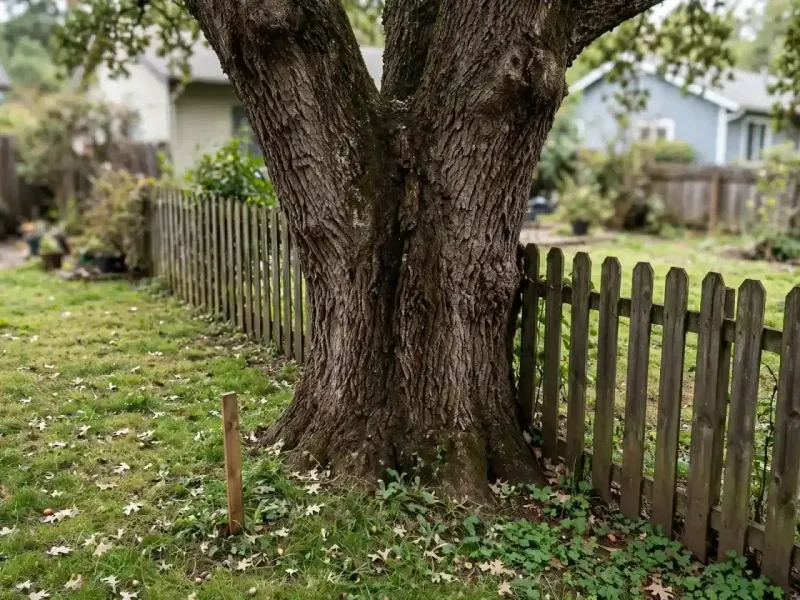
Few yards follow the legal property line neatly. Fences get built a little off.
Landscaping beds drift. A line of shrubs can feel like a border when it is not one.
If you guess wrong, you may cut on land that is not yours or take more than the rule allows.
The right described in Lane ends at the property line. It lets you cut growth back to that line, and it does not give you permission to cross it.
So the whole rule depends on knowing where the line actually sits.
Start with your deed and any plat or survey you received when you bought the home. Look for corner markers, often metal pins, and see whether they match what you assumed.
Photos with measurements can help you document where the branches cross.
If the line is unclear or your neighbor disagrees about it, slow down. A licensed surveyor can mark it, and a real estate attorney can explain what to do about a dispute.
These are sensible precautions, not steps the decision itself requires.
A conversation with the neighbor beforehand can also save trouble, even though the law does not demand one. Showing them the branches and the line often settles things before a disagreement starts.
A tree on the boundary has shared ownership
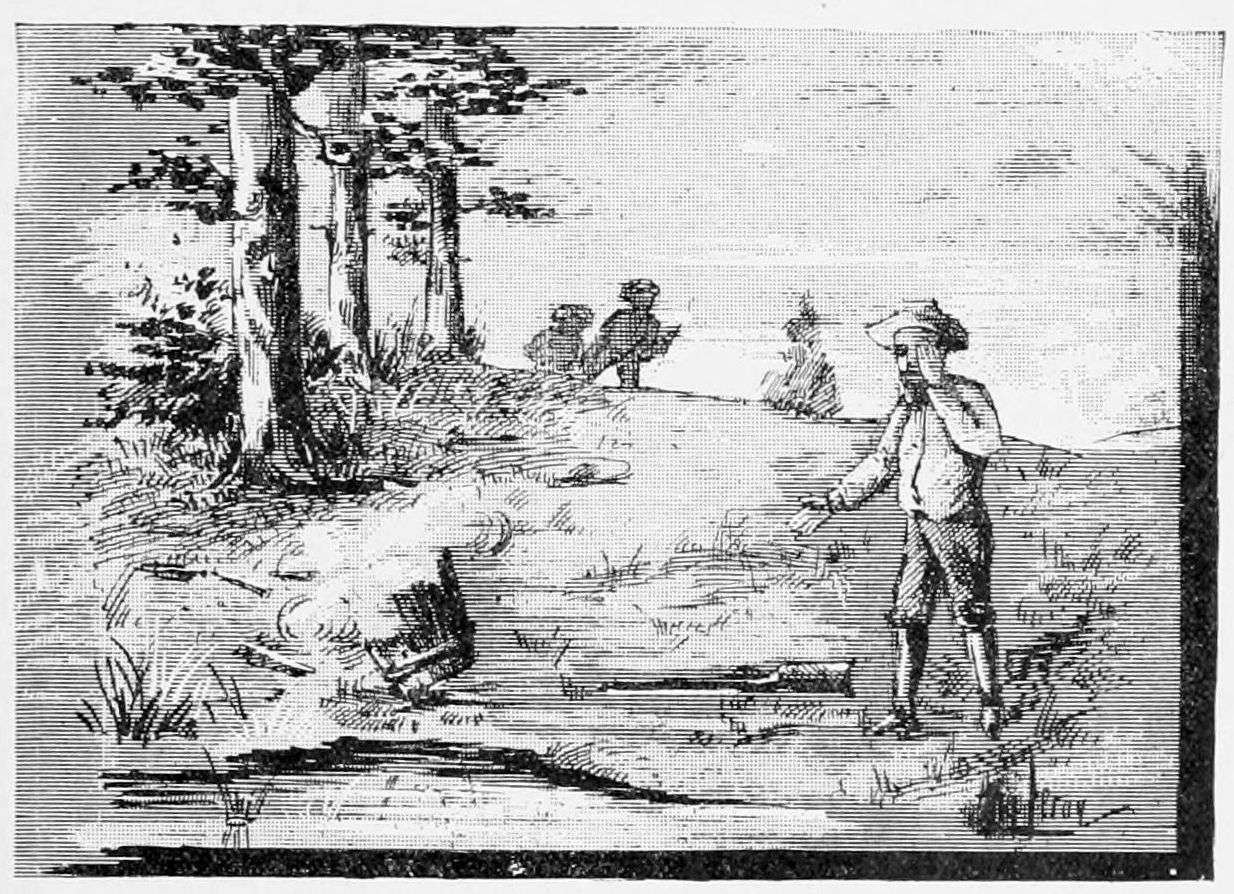
Branches crossing a line are one thing. A trunk standing on the line is another.
When a tree grows right on the boundary, it is not simply your neighbor’s tree with some limbs in your yard.
In Cathcart v. Malone, the Tennessee Court of Appeals treated a tree straddling the line as the common property of the adjoining owners.
It held that one owner could not destroy the tree without the other’s consent.
That has a practical consequence. The cut-back rule from Lane deals with growth that crosses over.
It does not turn a shared tree into one you can remove because it bothers you. Treating a boundary tree as an ordinary neighbor-owned tree is a mistake.
A clue that you may have this situation is a trunk that looks centered on the fence or very close to a boundary marker. Because trunks are wide and lines are narrow, only a survey can answer it reliably.
If the survey shows the trunk sits on the line, plan on talking with your neighbor.
Get agreement before anyone trims heavily, removes, or poisons the tree. If you cannot agree, an attorney can explain your options.
Acting alone on a shared tree is where a small yard problem can become a lawsuit.
Ordinary encroachment does not by itself establish nuisance
Two different ideas often get mixed up here. One is the right to cut back what crosses your line.
The other is a nuisance claim, which asks a court to deal with a tree that is a real problem. They work differently.
Under Lane, you do not have to prove nuisance to use the cut-back remedy. You may trim encroaching growth to the line whether or not it hurts anything.
A nuisance claim needs more. The tree has to be causing actual harm or presenting imminent danger.
A limb leaning over a house after storm damage, or roots lifting a foundation, are the kinds of facts that could support one.
Everyday annoyances do not count by themselves. Shade, fallen leaves, flowers, fruit, and mere encroachment alone do not establish a nuisance under Lane.
So you cannot assume your neighbor must remove a tree because it drops messes in your yard.
The reverse is true as well. A neighbor who owns a leafy tree is not obligated to cut back every troublesome branch.
Your own remedy is usually to trim to the line yourself.
If you think a tree is actually damaging your property or may fall, document it with photos and repair estimates, and talk with an attorney about the next step.
Call a professional for hazardous or consequential cuts
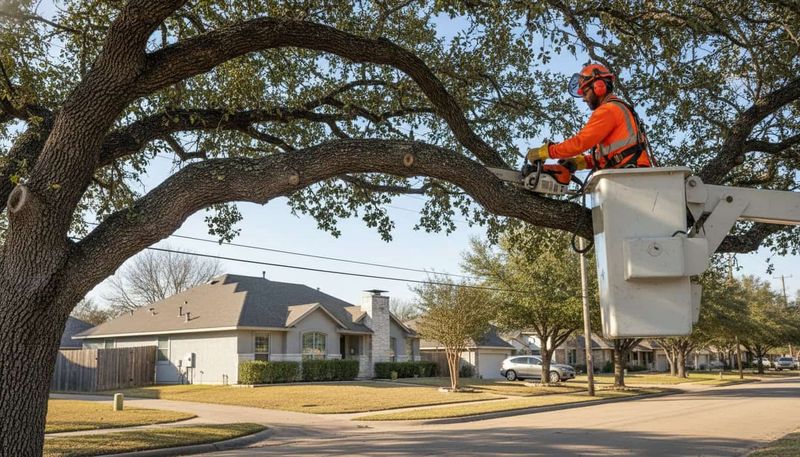
Being allowed to cut does not make a cut safe. Power lines are the clearest example.
OSHA guidance says tree work within 10 feet of an energized power line must be done by trained, experienced line-clearance tree trimmers.
Standing on your own side of the fence does not change that. If a branch is near a line, stop and call the utility company instead of trying the work yourself.
High or heavy limbs deserve the same caution. Falling branches can injure people and damage property, and ladders and chainsaws are a risky mix.
Guidance from the International Society of Arboriculture warns that inappropriate pruning can weaken a tree and recommends hiring a qualified arborist.
An arborist can tell you which cuts a tree will tolerate and how a large cut might affect its structure. That matters for you, too, since a badly cut tree may decline or become hazardous.
Lane gives you the right to cut growth back to the line. It does not say every pruning method is safe, and it does not settle every question about damage to the tree.
For a large or consequential cut, an arborist and, if needed, legal advice are wise additions.
Check local rules before significant work
State court decisions are not the only rules that can apply. Cities and counties sometimes regulate trees, especially those on public property, protected trees, or trees in certain zones.
Knoxville offers one example. Its Urban Forestry page describes a city tree ordinance and a permit process for trees on public property.
That is a local example only, and it does not show a single statewide permit rule.
You may also hear that Tennessee requires 48 hours’ notice before anyone trims a tree over 36 feet. That is not a current statewide rule.
A 2022 proposal along those lines did not become law, according to the state’s bill record for SB 2312.
So before significant work, check your own city or county. Call the planning office, public works, or urban forestry department and ask whether any ordinance, permit, or neighborhood covenant applies to the tree or the work you have in mind.
If a tree sits near a street or sidewalk, or you suspect it belongs to the city, ask first. A short phone call costs far less than a fine or a dispute.
Know when to pause and get help
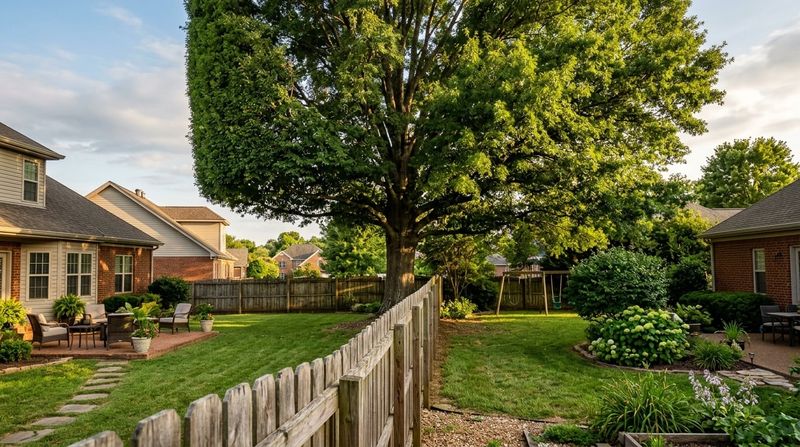
Before you cut, run through a short list. Confirm where the actual boundary is.
Decide whether you have overhanging branches or a trunk that stands on the line, which Cathcart treats as shared. Stop if the work would cross the line, come near a power line, or risk serious damage.
Tennessee recognizes limited self-help under Lane, not blanket permission for any pruning conduct. When the facts are unclear, bring in a surveyor, arborist, or attorney.
A property line tells you where your saw must stop, not whether the cut is wise.
Share this story