Get the latest garden guides in your inbox →
Gardening Latest
  • General Gardening
  • Lawn Care
  • Plant Care
  • Composting
  • Soil Health
  • Backyard
  • Garden Muse Magazine
  • General Gardening
  • Lawn Care
  • Plant Care
  • Composting
  • Soil Health
  • Backyard
  • Garden Muse Magazine
  • News
  • Gardening Calendar
  • Garden Structures
  • Vegetable Garden
  • Vertical Garden
  • Raised Beds
  • Hydroponics
  • General Equipment
  • Community Gardens
Garden Themes
  • Spiritual Garden
  • Hydroseeding
  • Seeding and Laying Sod
  • Artificial Grass
  • Lawn Care Equipment
  • Plants
  • Trees
  • Planting Tools
  • Composting Basics
  • Fertilizer
  • Alternative Growing Mediums
  • Front Yard
  • Backyard Activities
  • Landscaping
Gardening Latest

Explore by state

Which state is your garden in?

Currently viewing Wisconsin

All states

Northeast

  • Connecticut —
  • Delaware 40
  • Maine —
  • Maryland 26
  • Massachusetts 42
  • New Hampshire —
  • New Jersey 26
  • New York 35
  • Pennsylvania 35
  • Rhode Island —
  • Vermont —

Southeast

  • Alabama 26
  • Arkansas —
  • Florida 26
  • Georgia 27
  • Kentucky 40
  • Louisiana 25
  • Mississippi —
  • North Carolina 24
  • South Carolina 39
  • Tennessee 23
  • Virginia 25
  • West Virginia —

Midwest

  • Illinois 25
  • Indiana 27
  • Iowa 39
  • Kansas —
  • Michigan 26
  • Minnesota 25
  • Missouri 25
  • Nebraska —
  • North Dakota —
  • Ohio 26
  • South Dakota —
  • Wisconsin 41

Southwest

  • Arizona 26
  • Colorado —
  • Nevada —
  • New Mexico —
  • Oklahoma —
  • Texas 25
  • Utah —

West

  • Alaska —
  • California 25
  • Hawaii —
  • Idaho —
  • Montana —
  • Oregon —
  • Washington —
  • Wyoming —

No state matches that search.

Site menu

Gardening Latest
  • General Gardening
    • News
    • Gardening Calendar
    • Garden Structures
    • Vegetable Garden
    • Vertical Garden
    • Raised Beds
    • Hydroponics
    • General Equipment
    • Community Gardens
    Garden Themes
    • Spiritual Garden
  • Lawn Care
    • Hydroseeding
    • Seeding and Laying Sod
    • Artificial Grass
    • Lawn Care Equipment
  • Plant Care
    • Plants
    • Trees
    • Planting Tools
  • Composting
    • Composting Basics
  • Soil Health
    • Fertilizer
    • Alternative Growing Mediums
  • Backyard
    • Front Yard
    • Backyard Activities
    • Landscaping
  • Garden Muse Magazine

Explore

  • About GardeningLatest.com
  • Contact Us

Get the latest from the garden

New guides on lawn care, plants and backyard projects, sent when they go up.

Subscribe →

Follow

  • Facebook
  • X
  • Pinterest
  • YouTube
Wisconsin Gardening

Those Fluffy Black-and-Rust Caterpillars Crossing Wisconsin Driveways Freeze Solid All Winter and Wake Up Fine

A fuzzy black-and-rust caterpillar humping across your driveway in autumn looks tiny and fragile.

HB

By Heidi Brandt

November 27, 2026 · 5 min read

Those Fluffy Black-and-Rust Caterpillars Crossing Wisconsin Driveways Freeze Solid All Winter and Wake Up Fine

A fuzzy black-and-rust caterpillar humping across your driveway in autumn looks tiny and fragile. Yet this animal can live through some freezing that would kill most insects.

The real story is more interesting, and more complicated, than the popular claim that it freezes solid and wakes up fine. Here is what scientists have measured, and what the winter-forecast folklore gets wrong.

At a glance

Where
Wisconsin Gardening
Hardiness zone
5 −20 to −10°F
Read
5 minutes
Published
November 27, 2026

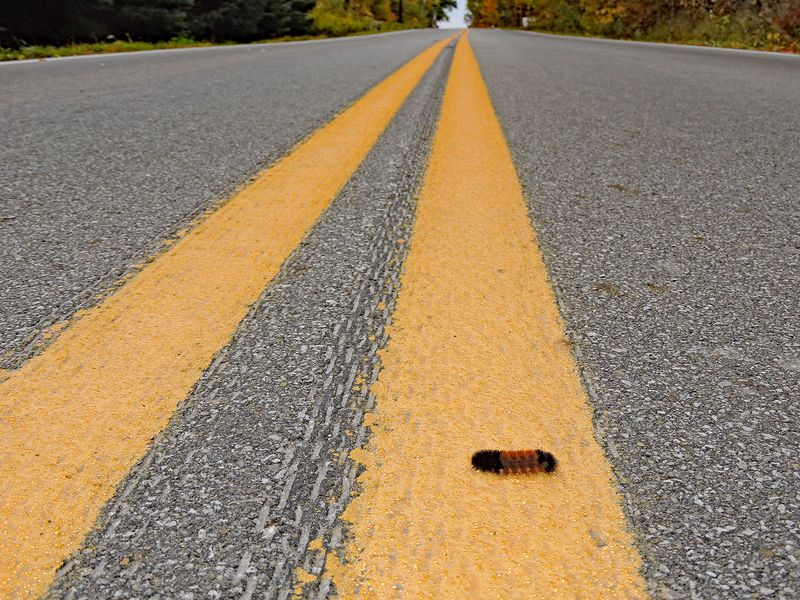
Why are woolly bears crossing driveways now?
Why are woolly bears crossing driveways now?
© Farm and Dairy

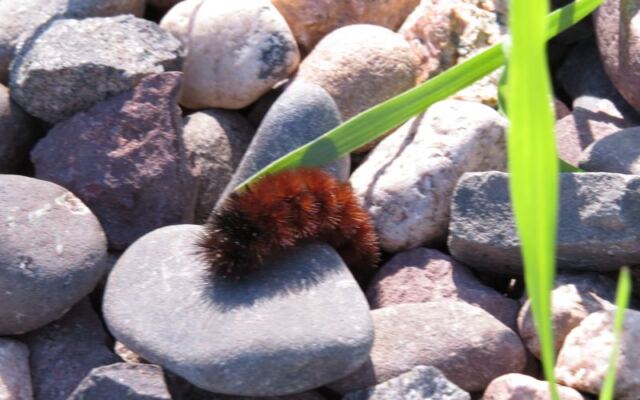
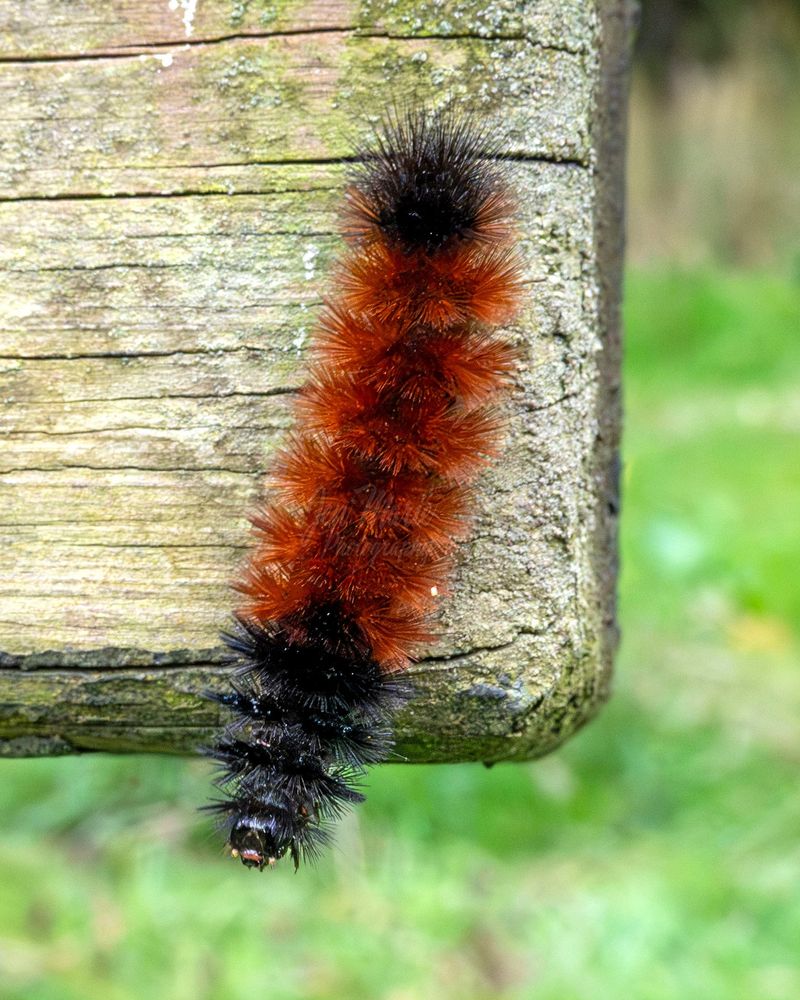
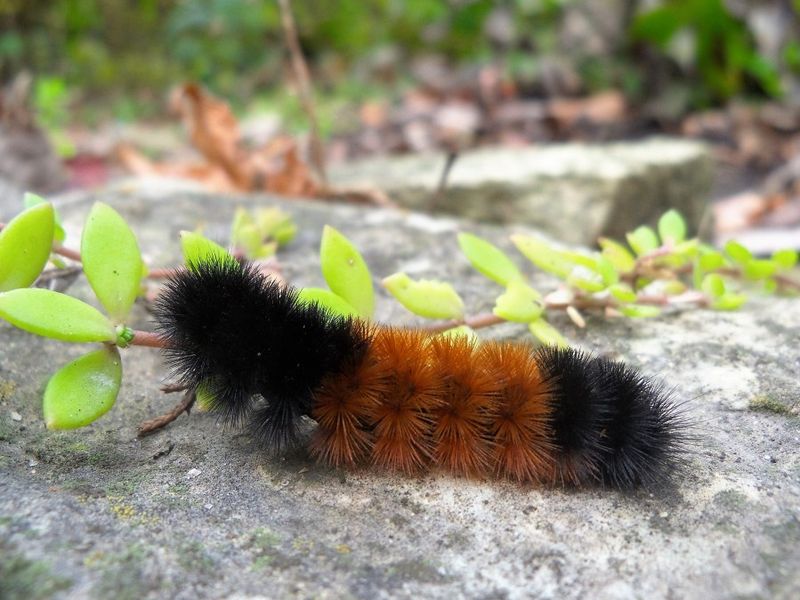
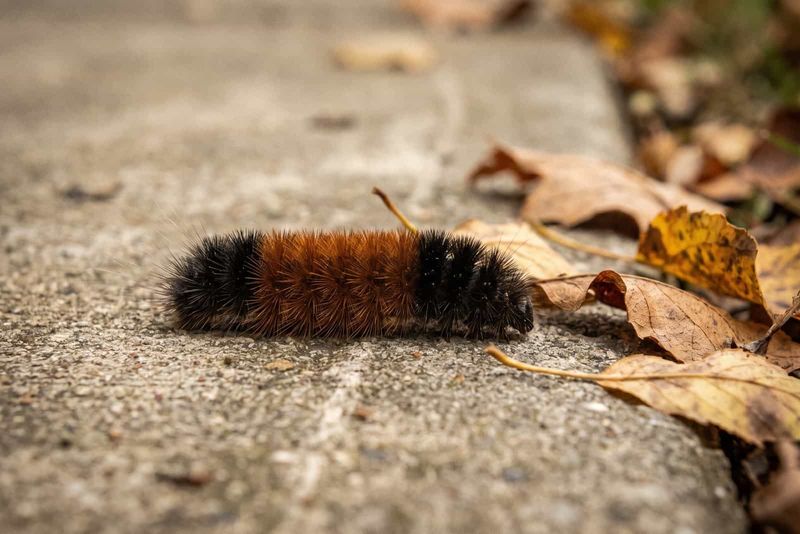
The familiar black-and-rust caterpillar is the larva of the Isabella tiger moth, Pyrrharctia isabella. Not every fuzzy caterpillar is a woolly bear, so a quick look at the pattern matters.

The classic one has a rusty middle band with black at both ends.

According to the USA National Phenology Network, nearly mature caterpillars commonly wander in autumn before they settle into shelter. They overwinter in places such as leaf litter or under boards and rocks.

Once the weather turns cold, they become inactive.

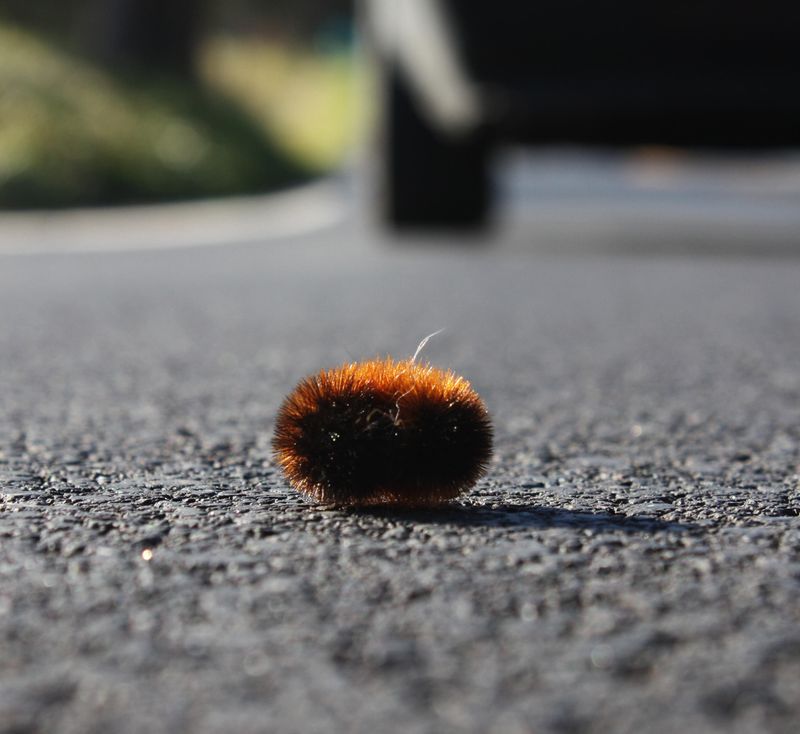
That wandering explains many driveway sightings. A caterpillar on pavement is most likely on the move, searching for a spot to tuck in, not aiming for your driveway on purpose.

Open pavement just happens to be hard to avoid when you are a small animal crossing a yard.

Timing varies from place to place and from year to year. The network describes this behavior across much of the species’ range, so nobody can promise a fixed Wisconsin calendar date.

If you spot one on a mild October afternoon or a chilly November morning, either is consistent with this seasonal search for shelter.

Cold acclimation changes the caterpillar’s chemistry
Cold acclimation changes the caterpillar’s chemistry
© jen.marie.photography44124

A caterpillar that has been through gradual cooling is not the same animal that crawled around in summer. Cold acclimation changes its body fluids.

One key change is a buildup of glycerol, a compound that helps limit damage when freezing happens.

Folklore says a wide rusty band means a mild winter, and a lot of black means a harsh one.

Researchers call glycerol and similar compounds cryoprotectants. A study of freeze temperature and survival found glycerol in the caterpillars’ body fluid.

Another paper on triggering cryoprotectant synthesis reported that cold acclimation and dehydration can prompt the caterpillar to make these protective compounds.

You will often hear this called antifreeze. That is a loose comparison, and it can mislead.

Glycerol and related chemicals help cells cope with freezing, but the research does not show that the caterpillar produces antifreeze proteins or that it stays liquid in the cold.

Think of it as a shield, not a force field. The chemistry lowers the odds of injury when ice forms in parts of the body.

It does not make the animal immune to winter.

How much freezing can they survive?
How much freezing can they survive?
© Business Insider

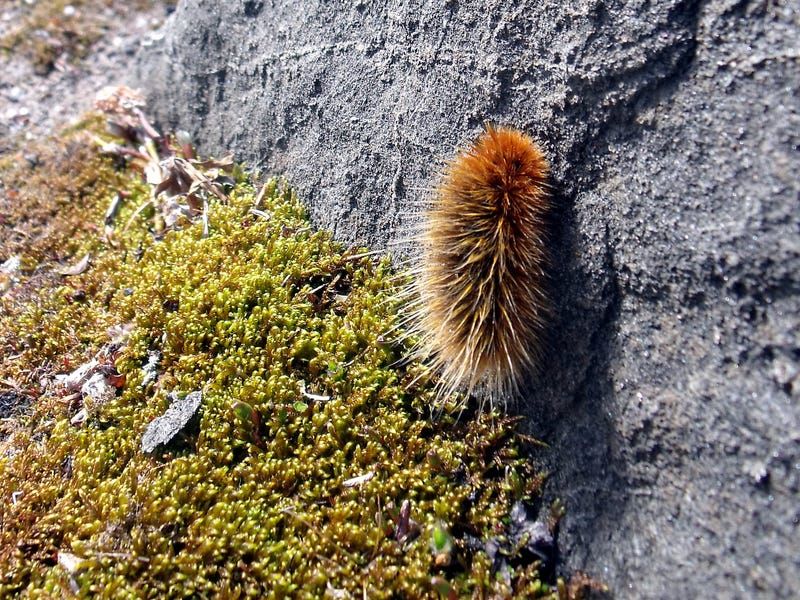
Lab results are impressive, but they come with fine print. In a Journal of Experimental Biology study, caterpillars were acclimated at 5°C for 18 weeks.

All of them survived a week frozen at -20°C, and all survived seven freeze-thaw cycles at that temperature. None survived freezing at -80°C.

Freezing here does not mean the whole caterpillar turns to ice. Earlier research on ice formation measured partial ice formation, so some body water stays unfrozen.

A separate team got a different picture. In a repeated-freezing experiment, five freeze-thaw cycles raised mortality to almost 30 percent and caused tissue damage.

The two studies used different protocols, so neither result can be stretched to cover all repeated freezing.

Neither one gives a universal outdoor limit either. Your backyard has wind, snow cover, moisture, and temperature swings that no lab copies exactly.

Movement after thawing is not proof of recovery. Some caterpillars moved soon after thawing and still died in the following weeks.

Surviving the freeze is only part of the story.

The color bands are not a winter forecast
The color bands are not a winter forecast
© NEWS10 ABC

Folklore says a wide rusty band means a mild winter, and a lot of black means a harsh one. It is a fun tradition, and many towns celebrate it with woolly bear festivals.

As a forecast, though, it does not hold up.

The National Weather Service in La Crosse explains that color reflects factors such as age, feeding, and species, not the severity of the coming winter. Band width, hairiness, and even the direction a caterpillar crawls are not reliable clues about snow or cold.

Development matters a lot. The USA National Phenology Network notes that the rusty center band widens with molts.

So an older caterpillar can look different from a younger one on the very same lawn.

Here is a quick test for yourself. Collect a handful of caterpillars from one yard and compare them.

You will probably find several different patterns, all from the same weather.

Enjoy the tradition as a seasonal ritual. Just check an actual forecast before you plan your snow tires.

A nearby shelter is a cautious option for one on pavement
A nearby shelter is a cautious option for one on pavement
© Emmitsburg.net

Most woolly bears crossing a driveway will do fine on their own. If one is in immediate danger, say on a spot where cars are pulling in, you may choose to move it a short distance.

A nearby pile of leaf litter or another sheltered spot fits what the USA National Phenology Network describes as overwintering habitat.

That is a reasonable idea, not a proven rescue method. No source gives a special handling procedure, and moving a caterpillar cannot promise it will survive.

Only do it if you are confident about what you are looking at.

Identification matters, because not every fuzzy caterpillar is a woolly bear. UMass Extension says woolly bear hairs are not stinging hairs, but sensitive people may still get skin irritation.

Other caterpillars can cause stronger reactions. The National Capital Poison Center offers general guidance on caterpillar stings.

If you are unsure of the species or have sensitive skin, skip bare hands and use a leaf or a stiff piece of paper to nudge it along.

The real winter story
The real winter story
© Farmers’ Almanac

Woolly bears have a remarkable but conditional cold tolerance. As laboratory work shows, some survive freezing under set conditions, yet freezing can still injure or kill them.

Their bands, according to the National Weather Service, tell us nothing about the winter ahead.

The caterpillar is not a prophet. It is a small survivor with good chemistry and a bit of luck.

Share this story
HB

Written by

Heidi Brandt

More from Heidi Brandt →

About Gardening Latest

Gardening Latest provides in-depth guides to maintaining and enhancing your garden and backyard. Learn how to make the most of the space you have and create a beautiful garden.

More about us →

Latest stories

  • Arizona GardeningThis Invasive Tree Keeps Outrunning the Arizona Homeowners Trying to Pull It

    This Invasive Tree Keeps Outrunning the Arizona Homeowners Trying to Pull It

    3 min ago
  • Texas GardeningA Texas Storm Just Put Your Neighbor’s Tree in Your Yard, and Here’s Who Really Pays

    A Texas Storm Just Put Your Neighbor’s Tree in Your Yard, and Here’s Who Really Pays

    8 min ago
  • Georgia GardeningDon’t Panic Over That Giant Flower Stalk on Your Georgia Sweet Onions. Here’s What It Means and Whether to Cut It

    Don’t Panic Over That Giant Flower Stalk on Your Georgia Sweet Onions. Here’s What It Means and Whether to Cut It

    13 min ago
  • Wisconsin GardeningWisconsin Winters Don’t Kill Your Brown Recluse Worries, Because Hobo and Yellow Sac Spiders Move Indoors Now

    Wisconsin Winters Don’t Kill Your Brown Recluse Worries, Because Hobo and Yellow Sac Spiders Move Indoors Now

    19 min ago
  • Missouri GardeningYour Frozen Missouri Lawn Isn’t Empty: A Tiny Mammal With a Venomous Bite Hunts Below All Winter

    Your Frozen Missouri Lawn Isn’t Empty: A Tiny Mammal With a Venomous Bite Hunts Below All Winter

    25 min ago

Gardening by state

Stories for your state, and the hardiness zone most of it gardens in.

Keep exploring

Read next

All Wisconsin Gardening →
Wisconsin GardeningWisconsin Winters Don’t Kill Your Brown Recluse Worries, Because Hobo and Yellow Sac Spiders Move Indoors Now
Wisconsin Gardening

Wisconsin Winters Don’t Kill Your Brown Recluse Worries, Because Hobo and Yellow Sac Spiders Move Indoors Now

19 min ago
Wisconsin GardeningWhile Your Wisconsin Lawn Sleeps Under Snow, a Tiny Mammal With a Venomous Bite Hunts Below
Wisconsin Gardening

While Your Wisconsin Lawn Sleeps Under Snow, a Tiny Mammal With a Venomous Bite Hunts Below

6 hr ago
Wisconsin GardeningWisconsin Porcupines Chew the Bark Off Backyard Trees All Winter, and Here’s How to Stop the Damage
Wisconsin Gardening

Wisconsin Porcupines Chew the Bark Off Backyard Trees All Winter, and Here’s How to Stop the Damage

21 hr ago

More from Wisconsin Gardening

  • Your Wisconsin Christmas Tree Brings Thousands of Hidden Bugs Inside, and Here’s What Actually Hatches

    Nov 26
  • Wisconsin Winters Bring Big White Tracks Into Your Yard, and Here’s Which Animal Left Each One

    Nov 25
Back to top

Leave a response Cancel

Your email address stays private. Required fields are marked with an asterisk.

Gardening Latest

In-depth guides to maintaining and enhancing your garden and backyard: how to make the most of the space you have, and how to make it beautiful.

  • Facebook
  • X
  • Pinterest
  • YouTube

We may earn a portion of sales from products or services that are purchased through our site as part of our affiliate partnerships with retailers.

Explore

  • About GardeningLatest.com
  • Contact Us
  • Terms and Conditions
  • Privacy
  • Editorial Note:
  • FTC Disclosure

Newsletter

New garden guides and seasonal tips, straight to your inbox.

We’ll email you a link to confirm. Unsubscribe any time.

Almost there! Check your inbox and tap the link to confirm.

© 2026 Gardening Latest. All rights reserved.

Back to top