Get the latest garden guides in your inbox →
Gardening Latest
  • General Gardening
  • Lawn Care
  • Plant Care
  • Composting
  • Soil Health
  • Backyard
  • Garden Muse Magazine
  • General Gardening
  • Lawn Care
  • Plant Care
  • Composting
  • Soil Health
  • Backyard
  • Garden Muse Magazine
  • News
  • Gardening Calendar
  • Garden Structures
  • Vegetable Garden
  • Vertical Garden
  • Raised Beds
  • Hydroponics
  • General Equipment
  • Community Gardens
Garden Themes
  • Spiritual Garden
  • Hydroseeding
  • Seeding and Laying Sod
  • Artificial Grass
  • Lawn Care Equipment
  • Plants
  • Trees
  • Planting Tools
  • Composting Basics
  • Fertilizer
  • Alternative Growing Mediums
  • Front Yard
  • Backyard Activities
  • Landscaping
Gardening Latest

Explore by state

Which state is your garden in?

Currently viewing Iowa

All states

Northeast

  • Connecticut —
  • Delaware 45
  • Maine —
  • Maryland 31
  • Massachusetts 47
  • New Hampshire —
  • New Jersey 31
  • New York 40
  • Pennsylvania 40
  • Rhode Island —
  • Vermont —

Southeast

  • Alabama 31
  • Arkansas —
  • Florida 31
  • Georgia 31
  • Kentucky 45
  • Louisiana 30
  • Mississippi —
  • North Carolina 29
  • South Carolina 44
  • Tennessee 28
  • Virginia 30
  • West Virginia —

Midwest

  • Illinois 30
  • Indiana 32
  • Iowa 44
  • Kansas —
  • Michigan 31
  • Minnesota 30
  • Missouri 30
  • Nebraska —
  • North Dakota —
  • Ohio 31
  • South Dakota —
  • Wisconsin 45

Southwest

  • Arizona 30
  • Colorado —
  • Nevada —
  • New Mexico —
  • Oklahoma —
  • Texas 29
  • Utah —

West

  • Alaska —
  • California 30
  • Hawaii —
  • Idaho —
  • Montana —
  • Oregon —
  • Washington —
  • Wyoming —

No state matches that search.

Site menu

Gardening Latest
  • General Gardening
    • News
    • Gardening Calendar
    • Garden Structures
    • Vegetable Garden
    • Vertical Garden
    • Raised Beds
    • Hydroponics
    • General Equipment
    • Community Gardens
    Garden Themes
    • Spiritual Garden
  • Lawn Care
    • Hydroseeding
    • Seeding and Laying Sod
    • Artificial Grass
    • Lawn Care Equipment
  • Plant Care
    • Plants
    • Trees
    • Planting Tools
  • Composting
    • Composting Basics
  • Soil Health
    • Fertilizer
    • Alternative Growing Mediums
  • Backyard
    • Front Yard
    • Backyard Activities
    • Landscaping
  • Garden Muse Magazine

Explore

  • About GardeningLatest.com
  • Contact Us

Get the latest from the garden

New guides on lawn care, plants and backyard projects, sent when they go up.

Subscribe →

Follow

  • Facebook
  • X
  • Pinterest
  • YouTube
Iowa Gardening

That Woodpecker Drumming on Your Iowa Siding in Winter Is Hunting Bugs Hiding Inside the Wall

A woodpecker hammering on your Iowa house in winter may well be hunting for insects in the siding or trim.

LP

By Lyle Petersen

November 28, 2026 · 6 min read

That Woodpecker Drumming on Your Iowa Siding in Winter Is Hunting Bugs Hiding Inside the Wall

A woodpecker hammering on your Iowa house in winter may well be hunting for insects in the siding or trim. It could also be sending a message or carving out a place to sleep, so the noise alone does not tell the whole story.

Knowing which one you are dealing with helps you fix the right problem and keep the bird safe. A short walk around your house can tell you a lot.

At a glance

Where
Iowa Gardening
Hardiness zone
5 −20 to −10°F
Read
6 minutes
Published
November 28, 2026

Winter pecking can have more than one cause
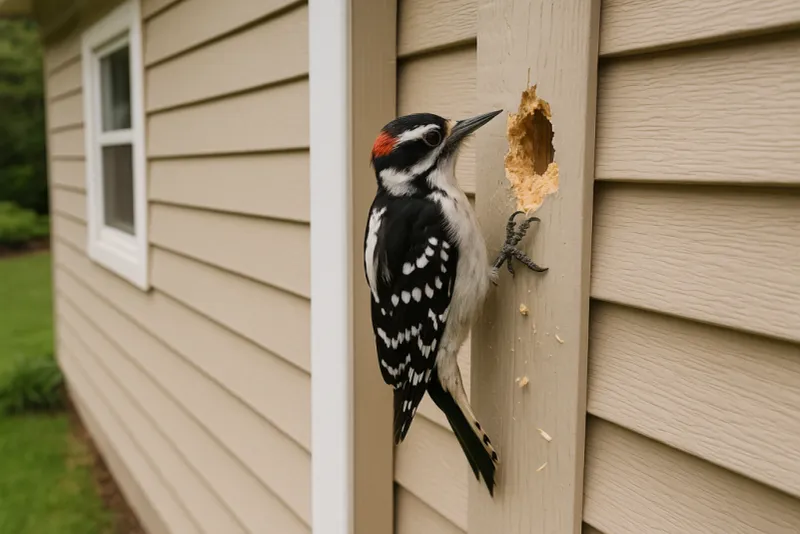
Winter pecking can have more than one cause
© Huntsman Wildlife Cincinnati

Downy and hairy woodpeckers stay in Iowa all year, so seeing one on your house in January is normal. According to Iowa State Extension, woodpeckers may search siding for grubs, beetles, and other insects.

That is one real possibility, and it is the reason many people blame bugs first.

It is not the only one. Woodpeckers also drum, which means they rap on a resonant surface such as a gutter, vent, or hollow siding to make a loud sound that communicates with other birds.

Drumming is different from feeding, which tends to leave small holes or furrows, and different from cavity work, where a bird digs a deeper hole for nesting or sleeping.

Timing gives a hint, but not an answer. Iowa State says drumming is most frequent in spring and summer.

Wildlife guidance from Connecticut DEEP notes that some house drilling increases in fall, and those holes may become winter roosts.

So winter activity alone cannot tell you what the bird is doing. It also cannot prove that insects are living inside your wall.

A bird searching siding does not by itself mean you have an infestation. Treat the pecking as a reason to look closer, not as a diagnosis.

Sound and damage patterns offer clues
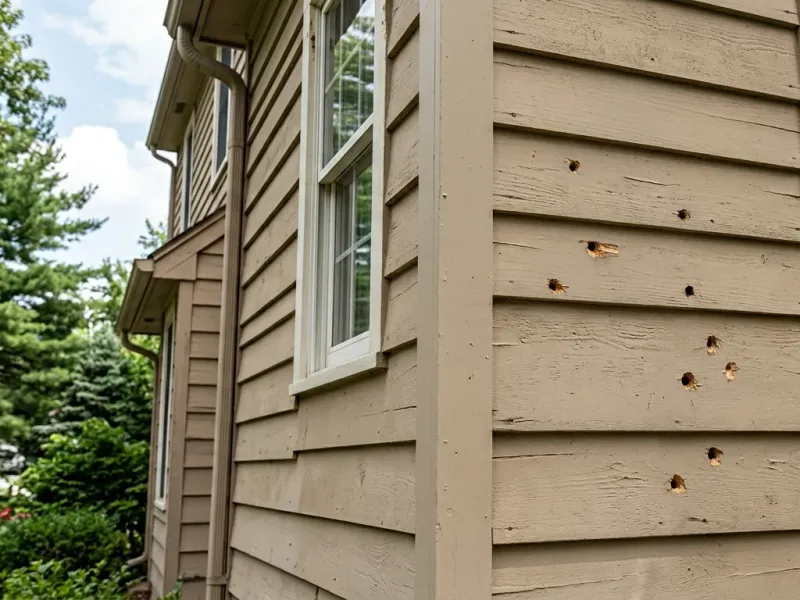
Sound and damage patterns offer clues
© AB Edward

Listen first. A fast, steady rattle that rings out from a gutter, metal vent, or hollow-sounding panel fits drumming.

The bird is making noise, not necessarily digging for food, and drumming usually causes little structural damage.

If the same spot keeps getting hit after repairs, blocking access is the more dependable move.

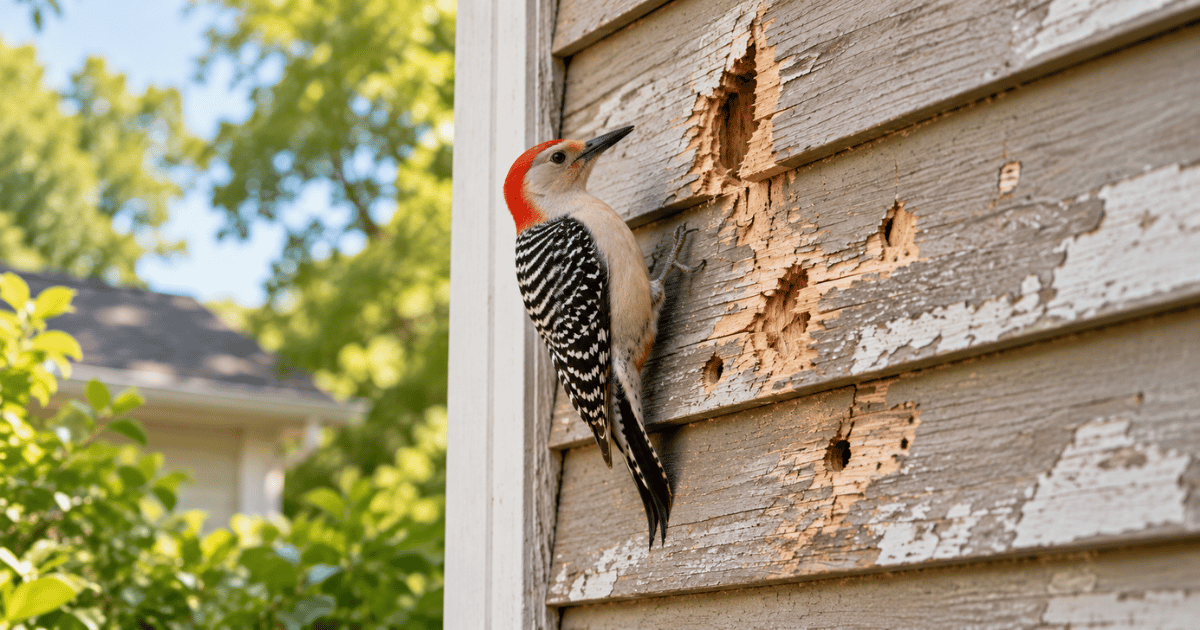
Now look at what is left behind. Small, scattered holes or furrows along seams, trim boards, and window frames can fit insect searching.

Larger, deeper, round holes that keep getting wider may point to cavity excavation, where a bird is making a roost or nest space.

Connecticut DEEP cautions that a bird searching for insects may or may not mean pests are actually present. A pattern of holes is a clue, not proof of an infestation or of the bird’s purpose.

Keep notes that help you later. Write down where the pecking happens, what time of day, and whether the sound is rhythmic tapping or slow, deliberate chipping.

A quick photo of the holes with a ruler beside them can help you or a pest or siding professional compare what you see. Use the word drumming only for the sound-making, and treat feeding and cavity work as separate things.

Inspect the siding before treating for insects
Inspect the siding before treating for insects
© Red Stick Construction

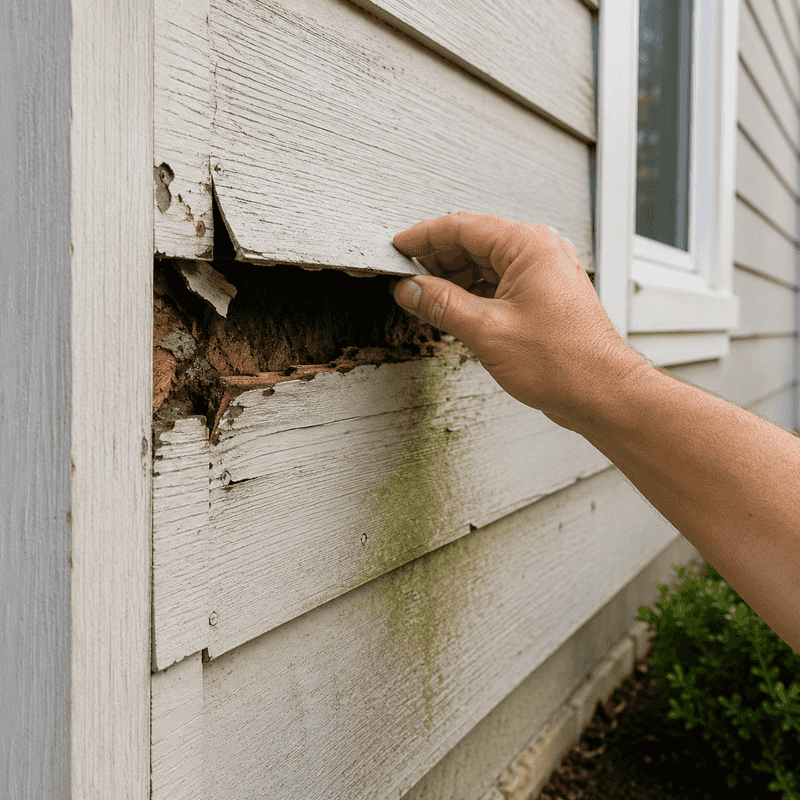
A slow walk around the house with a flashlight is the best first step. Check the siding and trim for soft or rotting wood, loose boards, gaps at seams, and any holes that already exist.

Pay extra attention around window frames, corners, and the eaves, where birds often work.

Press gently on suspect wood with a screwdriver. Wood that crumbles, sawdust-like frass, tunnels, or small exit holes can point to insects such as carpenter bees or ants.

If you find them, they deserve attention whether or not they caused the pecking.

The U.S. Fish and Wildlife Service suggests checking for insect problems and fixing the real issue.

The Michigan DNR offers similar advice about repairing damaged wood.

If inspection turns up a confirmed problem, deal with that problem directly. That might mean replacing rotted boards, sealing gaps, or calling a pest professional.

A woodpecker’s presence is not a reason to spray pesticide. If the wood is sound and no insects show up, treatment will not help, and the bird may simply be checking the siding.

Physical barriers can protect repeatedly targeted siding
Physical barriers can protect repeatedly targeted siding
© Bird Barrier

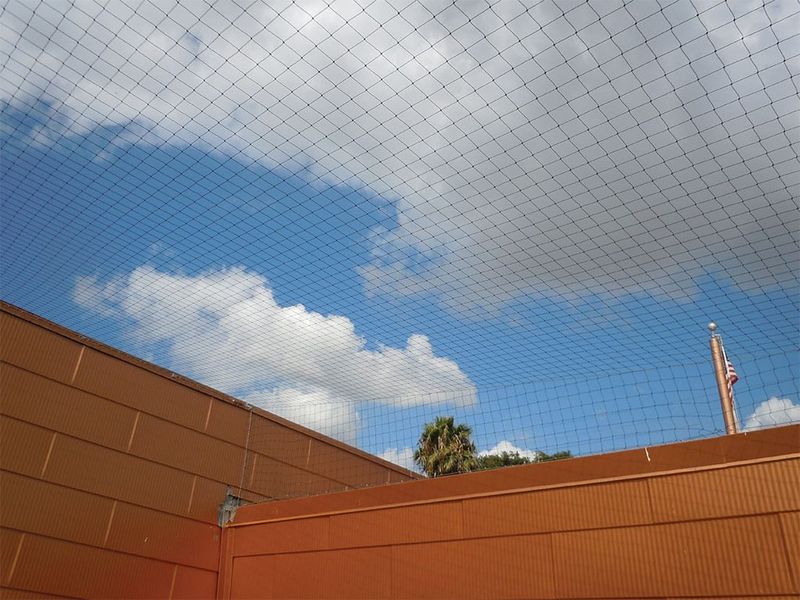
If the same spot keeps getting hit after repairs, blocking access is the more dependable move. Iowa State Extension lists metal hardware cloth or sheeting, and plastic netting placed 2 to 3 inches out from the siding, among the more effective options.

The gap matters. A bird that cannot reach the wall or cling to it has little to peck.

Mount the netting on a simple frame or standoff so it does not sag against the surface.

The U.S. Fish and Wildlife Service also recommends bird netting, with one condition: keep it taut and maintained.

Loose or torn netting can tangle birds, so check it often.

Visual deterrents such as shiny tape, hanging pie tins, or plastic owls are cheaper and easier. They work inconsistently, and birds often get used to them.

Treat them as something to try, not a guarantee.

No single measure stops every bird. Cover the most damaged areas first, and watch whether the activity moves to another part of the house.

Check cavities before sealing holes
Check cavities before sealing holes
© Viking Product Supply

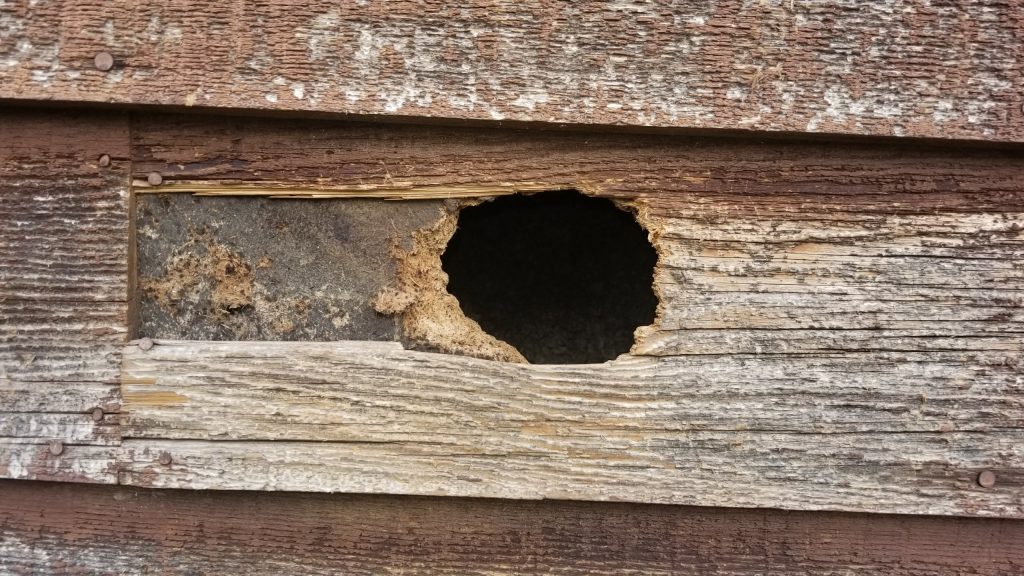
Before you fill a hole, make sure nobody is using it. A woodpecker may sleep in a cavity on cold nights, and in spring a pair may nest there.

Watch the hole at dawn and dusk from a distance for a few days to see if a bird goes in or out.

The U.S. Fish and Wildlife Service says control measures at an active nest should wait until the young have left permanently, and timing varies.

Sealing too early could trap a bird or its young.

Woodpeckers are protected under the Migratory Bird Treaty Act, and taking protected birds requires authorization. The Service also explains in its bird nest guidance that destroying a nest with eggs or chicks is illegal without authorization.

An empty, inactive hole is not the same as an active nest, but confirm which one you have first.

Skip sticky gels and tactile repellents. They can damage feathers, impair a bird’s flight, and keep it from staying warm in cold weather.

Lethal control is not a routine do-it-yourself option. If you are unsure, contact your state wildlife agency.

Match the fix to what you find
Match the fix to what you find
© Allrite Home & Remodeling

Start by treating the pecking as a clue. Inspect the siding, and fix any confirmed insect or wood damage.

If the problem returns, add physical barriers and keep to the federal guidance on nests and repellents.

A sound house and a safe bird can go together. The bird is usually just looking for food, a signal post, or a warm place to sleep.

Share this story
LP

Written by

Lyle Petersen

More from Lyle Petersen →

About Gardening Latest

Gardening Latest provides in-depth guides to maintaining and enhancing your garden and backyard. Learn how to make the most of the space you have and create a beautiful garden.

More about us →

Latest stories

  • Missouri GardeningIf Your Missouri Woodpile Sits Against the House, You’re Inviting Brown Recluses Indoors This Winter

    If Your Missouri Woodpile Sits Against the House, You’re Inviting Brown Recluses Indoors This Winter

    4 min ago
  • Tennessee GardeningBefore You Dig In, Here’s How To Recognize Every Venomous Creature Sharing Your Tennessee Yard

    Before You Dig In, Here’s How To Recognize Every Venomous Creature Sharing Your Tennessee Yard

    10 min ago
  • Alabama GardeningThat Burning Saddleback Caterpillar Sting in Your Alabama Garden Calls for These Steps Right Away

    That Burning Saddleback Caterpillar Sting in Your Alabama Garden Calls for These Steps Right Away

    16 min ago
  • Minnesota GardeningBefore You Pick Up That Big Black Caterpillar With White Spots In Minnesota, Read This

    Before You Pick Up That Big Black Caterpillar With White Spots In Minnesota, Read This

    22 min ago
  • Illinois GardeningDeer Are Rubbing Their Antlers on Your Illinois Saplings Right Now, and Here’s How to Save Them

    Deer Are Rubbing Their Antlers on Your Illinois Saplings Right Now, and Here’s How to Save Them

    28 min ago

Gardening by state

Stories for your state, and the hardiness zone most of it gardens in.

Keep exploring

Read next

All Iowa Gardening →
Iowa GardeningFound Bright Orange Jelly Blobs on Your Iowa Cedar Tree? Here’s What’s Growing There
Iowa Gardening

Found Bright Orange Jelly Blobs on Your Iowa Cedar Tree? Here’s What’s Growing There

1 hr ago
Iowa GardeningIowa Deer Are Rubbing Your Young Trees Raw Right Now, and a Simple Wrap Stops It
Iowa Gardening

Iowa Deer Are Rubbing Your Young Trees Raw Right Now, and a Simple Wrap Stops It

7 hr ago
Iowa GardeningLate at Night, the Coyotes Howling Near Your Iowa Home Are Actually Having a Conversation
Iowa Gardening

Late at Night, the Coyotes Howling Near Your Iowa Home Are Actually Having a Conversation

10 hr ago

More from Iowa Gardening

  • Snow Piled Against Your Iowa Shrubs Is Hiding Rabbit Damage You’ll See in Spring

    Nov 27
  • That Little Brown Mouse in Your Iowa Garage Is a Deer Mouse, and Here’s Why It Matters

    Nov 26
Back to top

Leave a response Cancel

Your email address stays private. Required fields are marked with an asterisk.

Gardening Latest

In-depth guides to maintaining and enhancing your garden and backyard: how to make the most of the space you have, and how to make it beautiful.

  • Facebook
  • X
  • Pinterest
  • YouTube

We may earn a portion of sales from products or services that are purchased through our site as part of our affiliate partnerships with retailers.

Explore

  • About GardeningLatest.com
  • Contact Us
  • Terms and Conditions
  • Privacy
  • Editorial Note:
  • FTC Disclosure

Newsletter

New garden guides and seasonal tips, straight to your inbox.

We’ll email you a link to confirm. Unsubscribe any time.

Almost there! Check your inbox and tap the link to confirm.

© 2026 Gardening Latest. All rights reserved.

Back to top