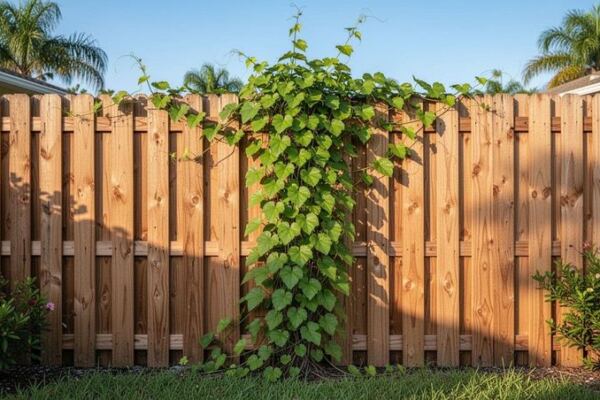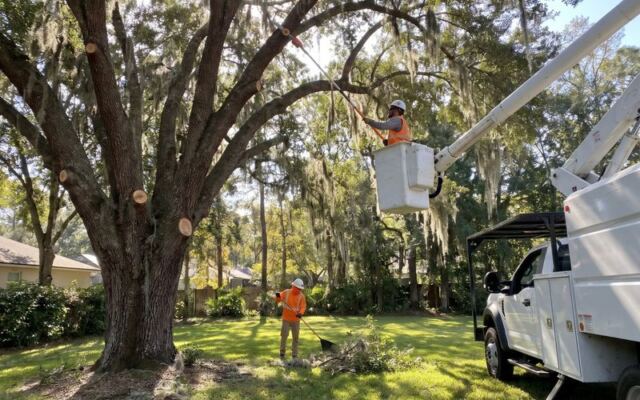
In Florida, you generally have a legal right to trim the part of a neighbor’s oak limb that hangs over your yard, as long as you stop at the property line and pay for the work yourself. That right is narrower than it sounds, because it does not make the limb yours or let you hurt the tree.
Where the line sits, how big the limb is, and what your city or county requires can all change what you should do next. Here is how to handle an overhanging oak without starting a fight or getting hurt.
Florida law generally lets you trim only the growth over your land
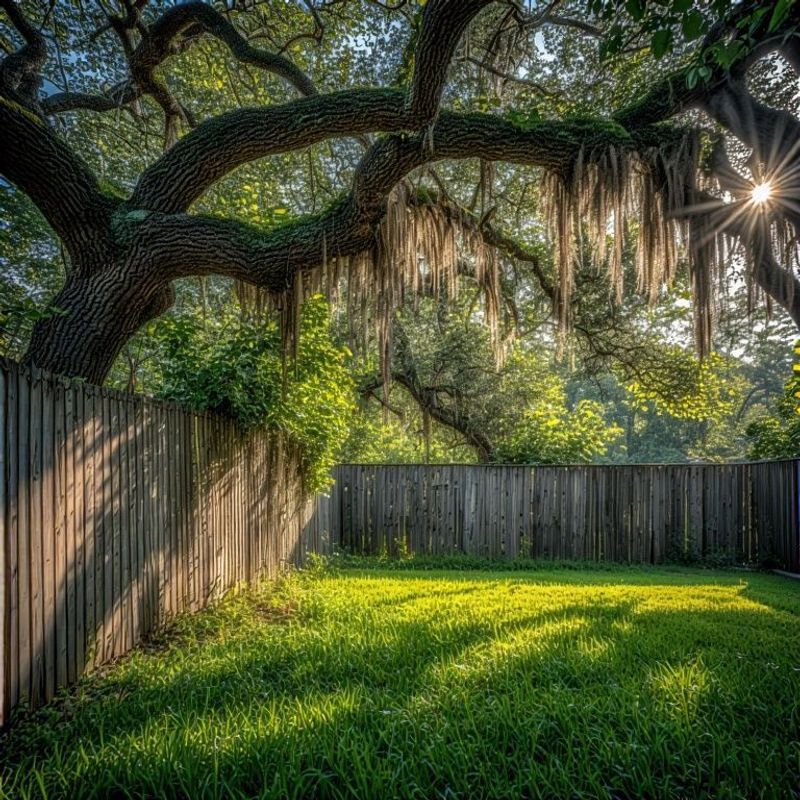
Florida appellate courts have recognized a limited right for an adjoining owner to trim branches that have grown onto their property. You do it at your own expense, and you may go only as far as the property line.
Think of it as a way to deal with encroachment, not a claim on the tree.
The Fourth District applied that rule in Scott v. McCarty, which is the main support for the principle.
A later Sixth District opinion, Vaughan v. USMI Properties Five, LLC, discusses the same self-help idea while deciding a different question about a known rotten tree.
It does not widen the rule.
Here is what the right does not mean. The limb does not become legally yours just because it crosses the line.
You also cannot cut past the boundary, strip the tree, or damage it in ways that reach beyond the overhanging portion.
So the safe way to read the rule is simple. You may remove the encroaching growth on your side, at your cost, and nothing more.
Anything beyond that, such as removing the tree or cutting limbs that stay on the neighbor’s side, is outside what these cases support.
Local rules, the tree’s location, and safety can also shape how you carry this out, which the next sections cover.
Find the actual property line before you cut
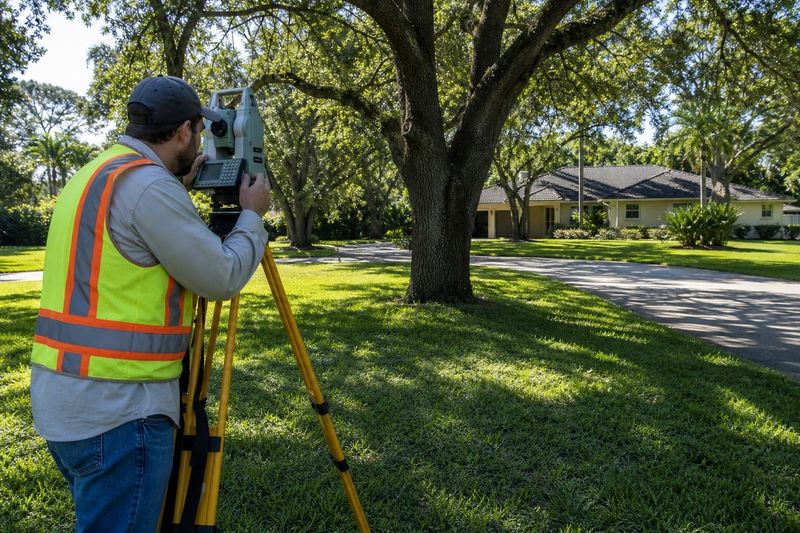
A fence or an assumed yard line may not mark the legal boundary. Fences get built a few feet off the line, and neighbors often mow to a habit rather than a measurement.
If you cut to the wrong spot, you could trim wood that sits on the neighbor’s land.
Check your deed, your plat, or a recent survey, and consider hiring a licensed surveyor if the line is unclear. Do this before anyone picks up a saw.
Next, look at the trunk. If a branch crosses over from a tree rooted entirely on your neighbor’s side, that is an overhanging limb.
If the trunk straddles the boundary, you have a boundary tree. UF/IFAS Extension guidance describes such a tree as jointly owned and says neither neighbor should remove it without the other’s consent.
The UF/IFAS fence and property law handbook covers tree responsibility in more detail.
One more caution. The cases discussed in this article do not decide whether you may step onto a neighbor’s land to do the trimming.
Do not assume the trimming rule gives you that permission. Get the neighbor’s consent before entering, ideally in writing or a text message.
Leave large oak limbs to qualified professionals
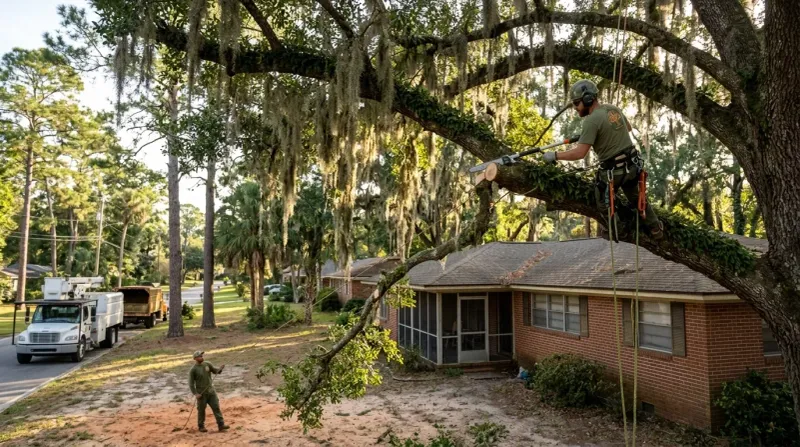
Once you know a limb crosses the line, the next question is who should cut it. A mature oak limb can weigh hundreds of pounds, and it can swing or split in ways that are hard to predict.
Ladders and chainsaws are a bad mix.
According to UF/IFAS pruning guidance, do-it-yourself work should stay limited to minor pruning. For trees taller than about 15 feet, it recommends hiring an ISA-certified arborist.
It also says to avoid companies that top trees, since topping leaves large wounds and weak regrowth.
Tell the arborist exactly where the boundary is and that the job covers only the overhanging portion. A good professional can make proper cuts that keep the tree healthy while staying on your side of the line.
Power lines call for a separate warning. FPL says only specially trained line-clearing professionals should work around overhead lines.
If a limb is touching or near a line, do not trim it yourself and do not hire a general crew to try. Contact the utility instead.
Check local tree rules before arranging the work
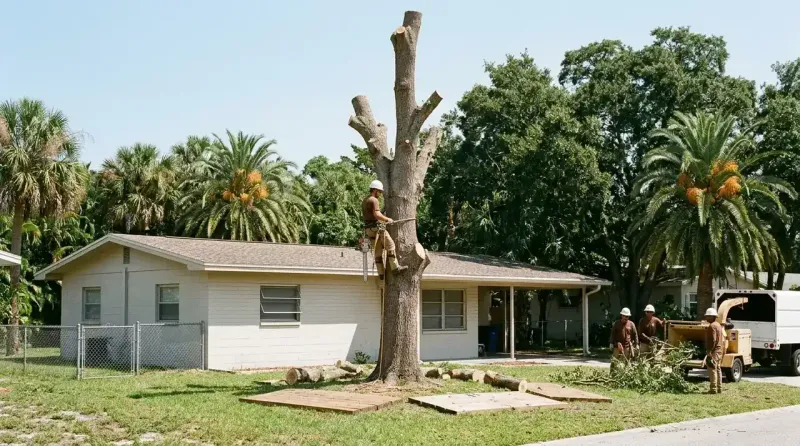
The general trimming principle does not settle every permit question. Cities and counties across Florida write their own tree rules, so look up yours before scheduling the work.
A call to the local planning or environmental office often answers it quickly.
Pinellas County is a useful local example, not a statewide rule. Its habitat permit and compliance page says routine pruning does not require a permit there.
It also warns that excessive pruning can raise compliance issues involving protected trees, and it points out that mangroves fall under separate rules.
You may also hear about Florida Statute 163.045. It is a conditional limit on local permit requirements.
It applies to qualifying single-family residential property when the owner has specified onsite risk-assessment documentation of an unacceptable risk. It is not a blanket exemption for trimming a neighbor’s tree, and it does not cover delegated mangrove protection.
If your oak might be protected, or your lot is in an unusual zone, get the answer in writing from the local office before any cutting starts.
A rotten or dangerous tree raises a separate liability question
Trimming a healthy tree’s encroaching branches is one thing. A tree that is dead, decayed, or dangerous is a different kind of problem, and it raises questions about responsibility rather than just about cutting rights.
The Sixth District’s decision in Vaughan v. USMI Properties Five, LLC shows why.
The plaintiff alleged that the owner knew a rotten oak was dangerous and failed to act. The court held those allegations were enough for a negligence claim to go forward, so it reversed a judgment on the pleadings and sent the case back.
Read that result narrowly. The court did not decide that the owner was ultimately liable.
It also expressly left open whether Florida recognizes the healthy-tree rule as a general exception to ordinary negligence duties.
For readers, the practical lesson is about notice and condition. Avoid sweeping claims such as that a neighbor is always responsible, or never responsible, when a limb falls.
The answer depends on facts like what the owner knew and how the tree looked.
If you see signs of decay, such as fungus, hollow areas, or dead limbs, document them with dated photos. Share your concern with the neighbor in writing, and talk with a Florida attorney or an arborist about next steps instead of treating it as a routine trim.
Keep the trimming narrow and the work safe
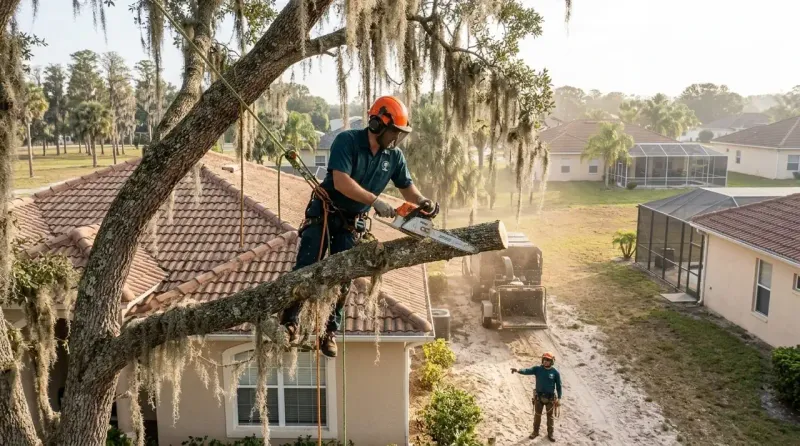
Use this short checklist before anything gets cut. First, confirm the actual boundary, and treat a trunk on the line as a shared boundary tree.
Second, limit trimming to the overhanging part, as in Scott v. McCarty.
Third, get the neighbor’s consent before entering their land. Fourth, check city or county requirements.
Fifth, leave big limbs to a certified arborist, and call the utility about anything near power lines.
If the real worry is a rotten tree, treat it as a separate matter like the one in Vaughan. A good fence rule is just a good neighbor rule: cut only what crosses, and ask first.
Share this story