Get the latest garden guides in your inbox →
Gardening Latest
  • General Gardening
  • Lawn Care
  • Plant Care
  • Composting
  • Soil Health
  • Backyard
  • Garden Muse Magazine
  • General Gardening
  • Lawn Care
  • Plant Care
  • Composting
  • Soil Health
  • Backyard
  • Garden Muse Magazine
  • News
  • Gardening Calendar
  • Garden Structures
  • Vegetable Garden
  • Vertical Garden
  • Raised Beds
  • Hydroponics
  • General Equipment
  • Community Gardens
Garden Themes
  • Spiritual Garden
  • Hydroseeding
  • Seeding and Laying Sod
  • Artificial Grass
  • Lawn Care Equipment
  • Plants
  • Trees
  • Planting Tools
  • Composting Basics
  • Fertilizer
  • Alternative Growing Mediums
  • Front Yard
  • Backyard Activities
  • Landscaping
Gardening Latest

Explore by state

Which state is your garden in?

Currently viewing Alabama

All states

Northeast

  • Connecticut —
  • Delaware 41
  • Maine —
  • Maryland 27
  • Massachusetts 43
  • New Hampshire —
  • New Jersey 27
  • New York 36
  • Pennsylvania 36
  • Rhode Island —
  • Vermont —

Southeast

  • Alabama 27
  • Arkansas —
  • Florida 27
  • Georgia 27
  • Kentucky 41
  • Louisiana 26
  • Mississippi —
  • North Carolina 25
  • South Carolina 40
  • Tennessee 23
  • Virginia 26
  • West Virginia —

Midwest

  • Illinois 26
  • Indiana 28
  • Iowa 40
  • Kansas —
  • Michigan 27
  • Minnesota 26
  • Missouri 25
  • Nebraska —
  • North Dakota —
  • Ohio 27
  • South Dakota —
  • Wisconsin 41

Southwest

  • Arizona 26
  • Colorado —
  • Nevada —
  • New Mexico —
  • Oklahoma —
  • Texas 25
  • Utah —

West

  • Alaska —
  • California 26
  • Hawaii —
  • Idaho —
  • Montana —
  • Oregon —
  • Washington —
  • Wyoming —

No state matches that search.

Site menu

Gardening Latest
  • General Gardening
    • News
    • Gardening Calendar
    • Garden Structures
    • Vegetable Garden
    • Vertical Garden
    • Raised Beds
    • Hydroponics
    • General Equipment
    • Community Gardens
    Garden Themes
    • Spiritual Garden
  • Lawn Care
    • Hydroseeding
    • Seeding and Laying Sod
    • Artificial Grass
    • Lawn Care Equipment
  • Plant Care
    • Plants
    • Trees
    • Planting Tools
  • Composting
    • Composting Basics
  • Soil Health
    • Fertilizer
    • Alternative Growing Mediums
  • Backyard
    • Front Yard
    • Backyard Activities
    • Landscaping
  • Garden Muse Magazine

Explore

  • About GardeningLatest.com
  • Contact Us

Get the latest from the garden

New guides on lawn care, plants and backyard projects, sent when they go up.

Subscribe →

Follow

  • Facebook
  • X
  • Pinterest
  • YouTube
Alabama Gardening

Yellow Jackets Nesting In The Ground Near Your Alabama Home? Here’s How To Handle Them

A steady stream of wasps going in and out of a hole in your yard can point to a social-wasp nest…

LT

By Loretta Tate

November 28, 2026 · 6 min read

Yellow Jackets Nesting In The Ground Near Your Alabama Home? Here’s How To Handle Them
Yellow Jackets Nesting In The Ground Near Your Alabama Home? Here's How To Handle Them

A steady stream of wasps going in and out of a hole in your yard can point to a social-wasp nest, and the best way to handle it is to stay back and make a plan. Yellow jackets are one wasp that nests this way, though a hole alone cannot tell you who lives inside.

Where the nest sits and who lives nearby matter more than any quick fix. Here is how to size up the situation safely and decide what to do next.

At a glance

Where
Alabama Gardening
Hardiness zone
8 10 to 20°F
Read
6 minutes
Published
November 28, 2026

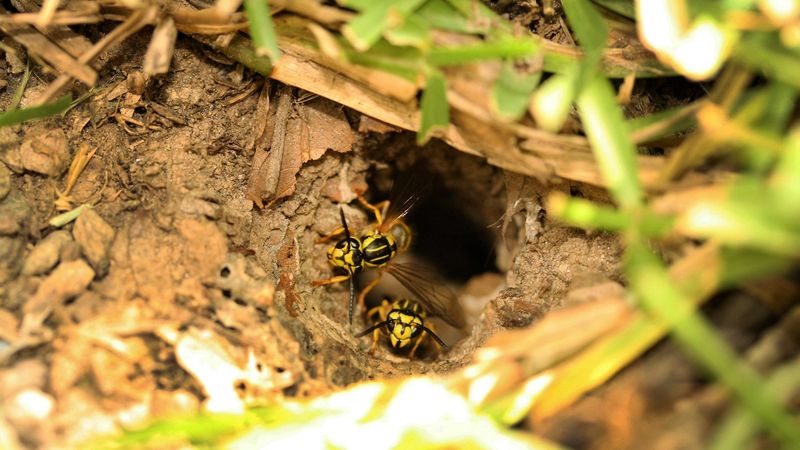
A ground hole does not identify the wasp
A ground hole does not identify the wasp
© Cool Green Science – The Nature Conservancy

Seeing wasps zip in and out of one hole in the ground is a useful clue. A steady stream of traffic can suggest a social-wasp nest, and those wasps may defend it.

But the hole by itself does not prove that yellowjackets live there.

Plenty of wasps dig in soil. Solitary wasps nest in the ground too, so a busy entrance is a hint, not a final answer.

Guessing wrong can lead to the wrong response, which is why identification should come before any treatment.

Cicada killers are a common lookalike. According to University of Maryland Extension, these predatory wasps are much larger than yellowjackets and generally docile.

They leave distinctive soil mounds and tunnel openings, and Virginia Tech Extension describes the same pattern in turf.

If you cannot tell what you are seeing, watch from a distance. Notice the size of the wasps, whether there is a pile of loose soil, and how many fly in and out.

Photos taken from far away, or help from an expert, can settle the question without anyone getting close to the opening.

Why late summer can raise the stakes
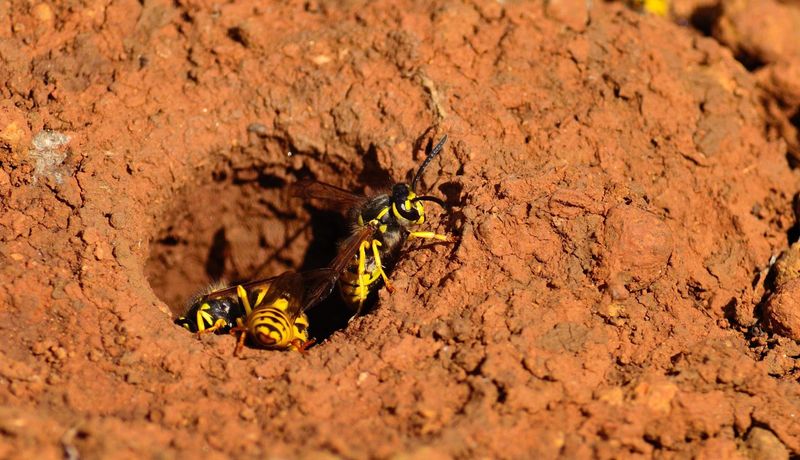
Why late summer can raise the stakes
© The Old Farmer’s Almanac

Yellowjacket colonies start small and grow as summer goes on. Alabama Extension identifies late summer and fall as the peak season, when nests can hold many more wasps than they did in spring.

Timing still varies from nest to nest, so no calendar date applies to every yard.

For a nest near people, a large or hard-to-reach nest, uncertain identification, or someone at higher sting risk, a pest-management professional is the safer default.

Size matters because yellowjackets can sting repeatedly. A nest that was easy to ignore in June may be more active by September.

That does not mean every encounter ends in serious trouble, but a larger colony has more wasps ready to respond.

Vibration is another trigger. Alabama Extension notes that mowing or other ground vibration can provoke a nest, and UGA Extension also points out the risks of disturbing a nest.

Think of a nest beside a mowing route, a swing set, or a back step. Those spots put people in the path of a defensive colony.

Location, more than the calendar alone, tells you how much concern the nest deserves.

Keep people and pets away first
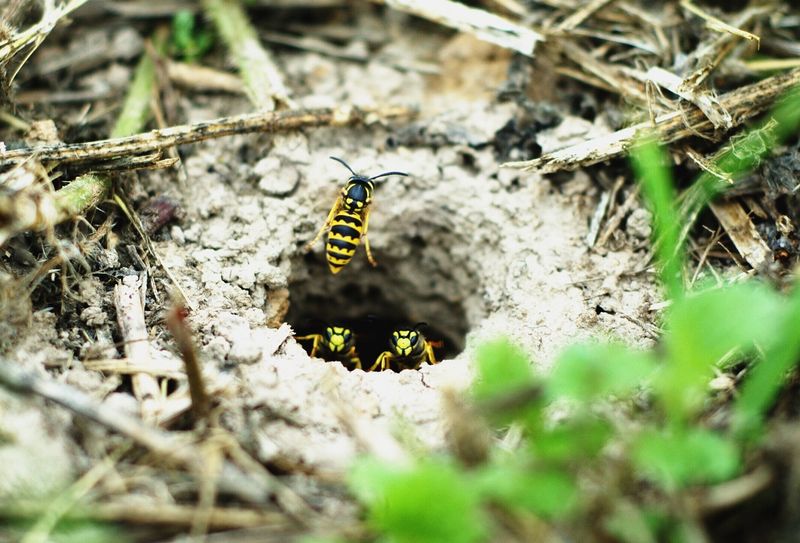
Keep people and pets away first
© BugSpray.com

Your first move is simple: keep everyone clear. Walk kids and pets away from the area and steer them to another part of the yard.

A temporary marker placed from a distance can help others remember where to avoid.

Do not mow over the spot, dig it up, or pour liquids into it. Do not plug the opening either.

Disturbance can set off defensive wasps, and Alabama Extension warns that mistakes with a nest can be dangerous, as does UGA Extension.

Resist walking up for a closer look. A quick fix is tempting, but getting close is how most stings happen.

Not every nest is in the ground. If wasps are coming and going from a wall or other part of a building, leave that opening alone.

Virginia Tech Extension warns that workers may chew a new opening through to the interior if the entrance is plugged.

When leaving the nest alone makes sense
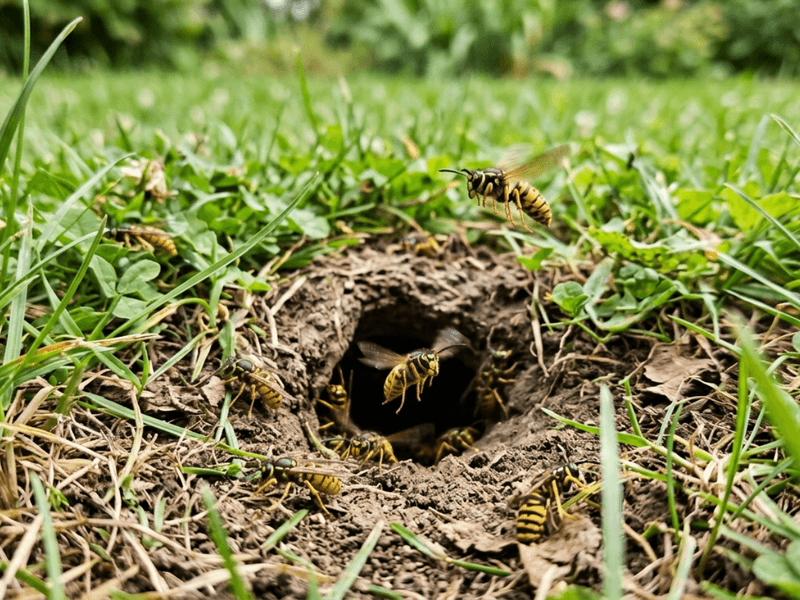
When leaving the nest alone makes sense
© The Economic Times

Some nests are simply not in anyone’s way. If the opening is far from doorways, paths, play areas, and mowing routes, leaving it undisturbed is a reasonable choice.

In that case it does not pose a practical risk, and not every nest needs to be eradicated.

Walk through your daily routine and picture where people and pets go. Check the garden gate, the route to the mailbox, the spot where the dog likes to dig, and the line the mower follows.

If none of those pass near the nest, the exposure is low.

Things change when the nest is close to regular activity. Proximity to people or pets raises the stakes, and so does a household member with a known sting allergy.

In those cases, intervention matters more, as UGA Extension guidance on neighborhood stinging insects suggests.

Keep in mind that yellowjackets may also nest above ground or inside structures, as Alabama Extension notes. Check eaves, sheds, and wall gaps from a distance too, since a hidden nest near a door can matter just as much.

Match treatment to the nest and the label
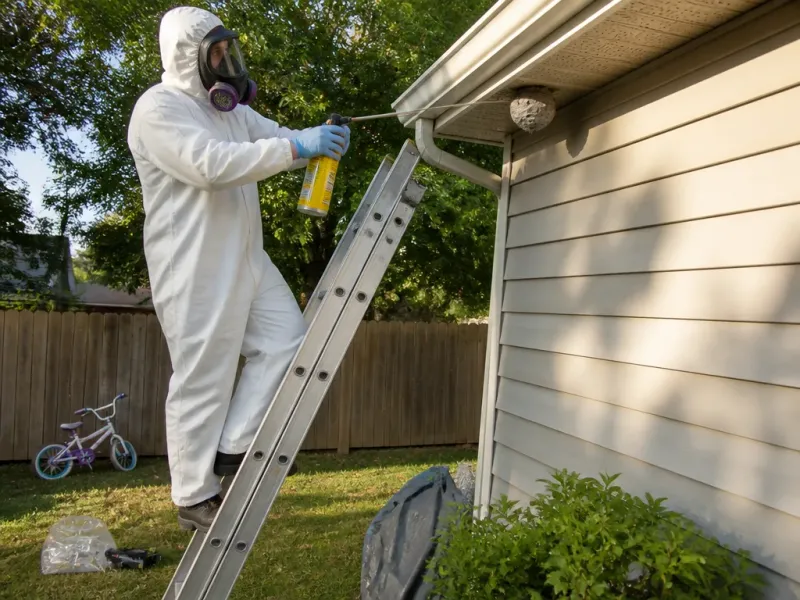
Match treatment to the nest and the label
© Pest Control Experts

For a nest near people, a large or hard-to-reach nest, uncertain identification, or someone at higher sting risk, a pest-management professional is the safer default. UGA Extension cautions that treating a nest wrongly can be dangerous.

Alabama Agriculture and Industries licenses businesses that provide structural pest control services. Ask whether the provider holds the relevant Alabama license for the service being performed.

If you consider treating it yourself, the product label comes first. The product must be EPA-registered, and its label must explicitly permit the intended outdoor yellowjacket or ground-nest use.

EPA says using a pesticide in a way that conflicts with its label violates federal law.

Follow your product’s directions, not another’s. One example label has its own timing and steps, and those apply only to that product.

Skip homemade mixes. Soapy solutions or covering an entrance with a pan are uncorroborated suggestions, not proven methods.

Wall or building nests call for extra care. Never plug the opening, because Virginia Tech Extension warns workers may chew another way into the interior.

Know when a sting is an emergency
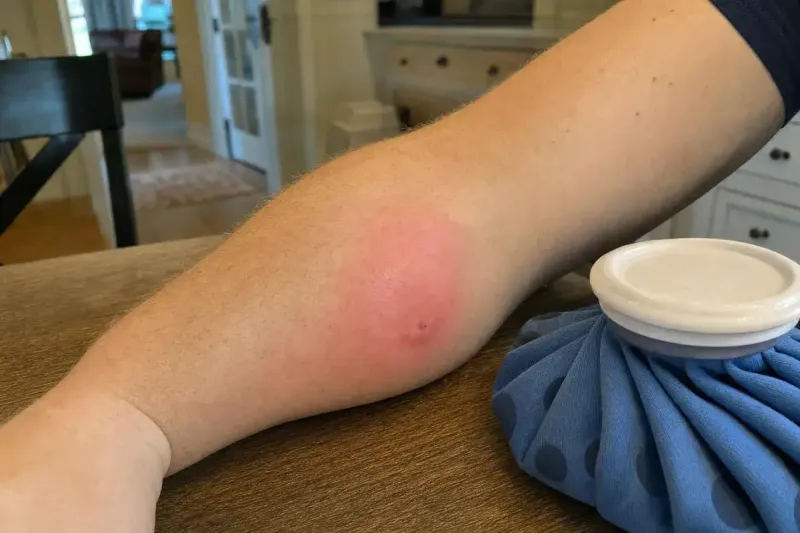
Know when a sting is an emergency
© Better Termite

Most stings cause local pain, redness, and swelling around the spot. That is uncomfortable, and it is the usual pattern, not a sign of a medical emergency.

The American College of Allergy, Asthma and Immunology separates these ordinary reactions from anaphylaxis, which is less common but can be life-threatening.

Get emergency help for trouble breathing, swelling of the throat or face, or difficulty swallowing. Other severe symptoms count too, such as dizziness or widespread hives.

For anaphylaxis, ACAAI advises immediate epinephrine and medical attention.

MedlinePlus advises calling 911 for severe symptoms. Do not wait to see if they pass.

If someone in your home has had a serious reaction before, talk with a doctor ahead of time about a plan. Knowing the warning signs beforehand makes it easier to act quickly.

Choose the response that keeps distance
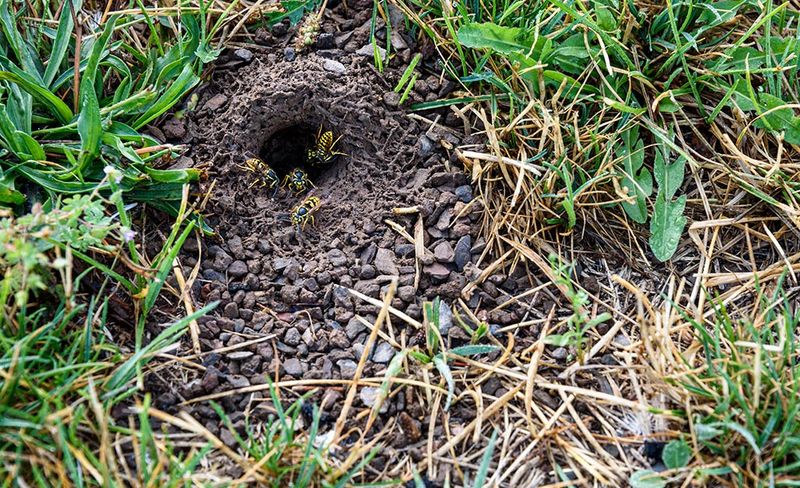
Choose the response that keeps distance
© The Home Depot

Watch from far away, stay clear of any suspected nest, and let a low-exposure nest be. When location, identification, or allergy risk makes it a concern, call a professional.

Alabama Extension backs a cautious approach.

A wasp hole is one more thing in the yard to respect, and distance is the one tool that always works.

Share this story
LT

Written by

Loretta Tate

More from Loretta Tate →

About Gardening Latest

Gardening Latest provides in-depth guides to maintaining and enhancing your garden and backyard. Learn how to make the most of the space you have and create a beautiful garden.

More about us →

Latest stories

  • Minnesota GardeningFresh Ant Hills After a Minnesota Summer Rain Point to What’s Going On Under Your Lawn

    Fresh Ant Hills After a Minnesota Summer Rain Point to What’s Going On Under Your Lawn

    8 min ago
  • Illinois GardeningSpotted a Huge Black Moth Clinging to Your Illinois Porch Light? Here’s What It Is

    Spotted a Huge Black Moth Clinging to Your Illinois Porch Light? Here’s What It Is

    14 min ago
  • Louisiana GardeningWhy Great Horned Owls Won’t Stop Hooting Outside Your Louisiana Home After Dark

    Why Great Horned Owls Won’t Stop Hooting Outside Your Louisiana Home After Dark

    20 min ago
  • Delaware GardeningThose Orange Mushrooms Popping Up in Your Delaware Mulch After Rain Are Toxic to Dogs

    Those Orange Mushrooms Popping Up in Your Delaware Mulch After Rain Are Toxic to Dogs

    26 min ago
  • South Carolina GardeningFound a Huge Black-and-Yellow Spider Hiding in Your South Carolina Woodpile? Here’s Whether It Bites

    Found a Huge Black-and-Yellow Spider Hiding in Your South Carolina Woodpile? Here’s Whether It Bites

    34 min ago

Gardening by state

Stories for your state, and the hardiness zone most of it gardens in.

Keep exploring

Read next

All Alabama Gardening →
Alabama GardeningHearing Great Horned Owls Hoot Outside Your Alabama Home at Night? Here’s What It Means
Alabama Gardening

Hearing Great Horned Owls Hoot Outside Your Alabama Home at Night? Here’s What It Means

2 hr ago
Alabama GardeningCoyotes Howling Outside Your Alabama Home Late at Night Are Actually Checking In With Their Family
Alabama Gardening

Coyotes Howling Outside Your Alabama Home Late at Night Are Actually Checking In With Their Family

6 hr ago
Alabama GardeningSouthern Short-Tailed Shrews in Alabama: What We Know About Their Size, Habitat, and Possible Venom
Alabama Gardening

Southern Short-Tailed Shrews in Alabama: What We Know About Their Size, Habitat, and Possible Venom

9 hr ago

More from Alabama Gardening

  • Alabama Gardeners Pull Its Seedlings by the Handful, but This Invasive Tree Keeps Spreading

    Nov 26
  • In Alabama, the Property Line Marks Exactly How Far You Get to Trim a Neighbor’s Overhanging Branches

    Nov 25
Back to top

Leave a response Cancel

Your email address stays private. Required fields are marked with an asterisk.

Gardening Latest

In-depth guides to maintaining and enhancing your garden and backyard: how to make the most of the space you have, and how to make it beautiful.

  • Facebook
  • X
  • Pinterest
  • YouTube

We may earn a portion of sales from products or services that are purchased through our site as part of our affiliate partnerships with retailers.

Explore

  • About GardeningLatest.com
  • Contact Us
  • Terms and Conditions
  • Privacy
  • Editorial Note:
  • FTC Disclosure

Newsletter

New garden guides and seasonal tips, straight to your inbox.

We’ll email you a link to confirm. Unsubscribe any time.

Almost there! Check your inbox and tap the link to confirm.

© 2026 Gardening Latest. All rights reserved.

Back to top