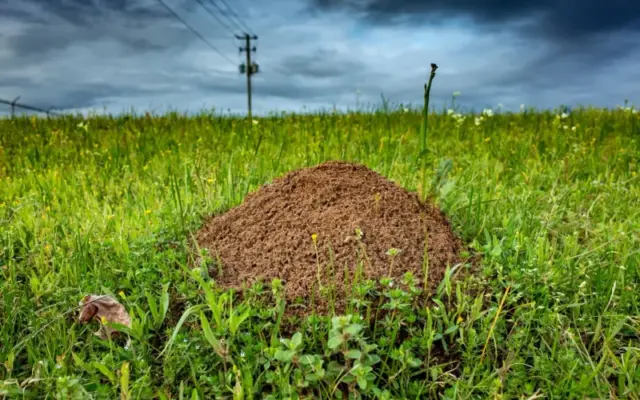
A fresh-looking ant mound after a summer rain usually points to a nest that is already living under your lawn. Minnesota lawn ants dig out soil to build their homes, and a good soaking can make that work easy to spot.
The mound itself, the openings, and the grass around it can give you useful clues. Knowing what you are looking at helps you decide whether to do anything at all.
A mound noticed after rain may have been there already
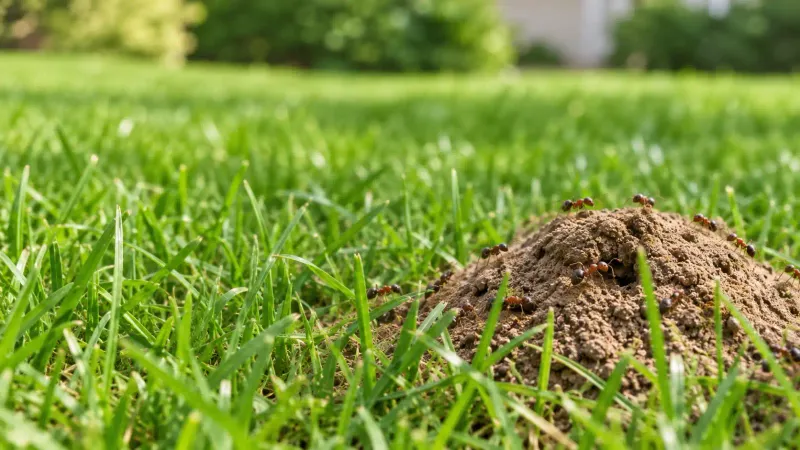
Walk out after a summer shower and a neat pile of loose soil seems to have appeared overnight. Minnesota lawn ants excavate their nests, pushing soil up to the surface as they dig.
A mound you just noticed is newly noticed, but that does not tell you when the nest began or what made the soil show up that day.
The University of Minnesota gives its guidance on common lawn ants and describes how they nest in turf, but it does not name rain as the cause of fresh-looking mounds from these species. So the timing alone is a weak clue.
Wet soil is easier to see, easier to notice from a window, and easier to mistake for something brand new.
Rain can matter for some ants. A peer-reviewed study of an ant in India found that colonies changed their nest entrances and deposited soil after monsoon rainfall.
That is a different species in a very different climate, so it shows that rain can trigger nest changes in some ants. It cannot tell you why a particular mound in your Minnesota yard looks the way it does.
You may also hear that ants build taller hills to predict a storm. Nothing in the research I reviewed supports that idea, so it is best treated as weather folklore.
A better approach is to treat the mound as a clue to what is going on underground and look closer at its shape and the grass around it.
What the mound and grass can tell you
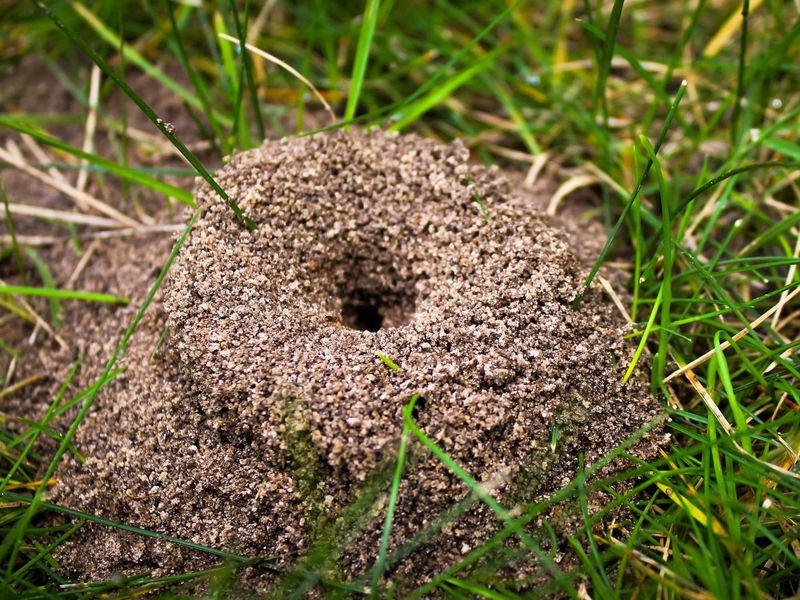
Shape, openings, and turf condition can help you narrow down which ants might be at work. According to the University of Minnesota lawn bump guide, mounds in turf can come from several sources, and ants are only one of them.
Looking closely before you decide anything is time well spent.
A small cone of soil with a single opening, sitting in thin or bare grass, is consistent with cornfield ants. These ants are associated with weak turf, so the thin patch around the mound is part of the picture.
Check whether the grass was already struggling before the mound showed up.
A larger mound with more than one opening points in a different direction. UMN Extension notes that field ants can build bigger mounds, even in healthy grass or in lawns that are starting to thin.
A thick, green lawn with a tall mound is therefore not proof that something else is going on.
Treat all of these as clues, not a final answer. Two different ant species can leave similar mounds, and the same species can look different from one lawn to the next.
Take a photo, note the size and number of openings, and look at the grass within a foot or two. Those notes will help whether you tolerate the nest, ask an expert, or consider a response later.
Not every lawn bump is an anthill
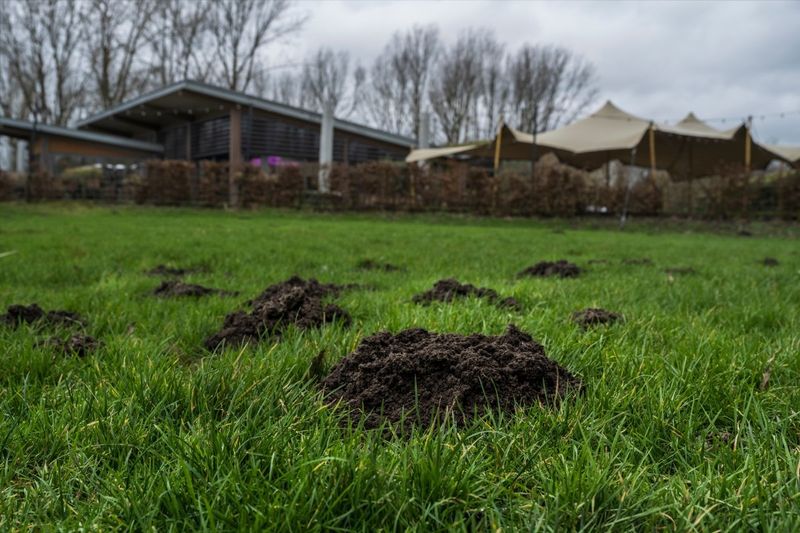
Before you blame ants, consider what else pushes soil up through turf. UMN lists nightcrawler castings and mole activity among the other causes of uneven lawn surfaces.
Each leaves its own signs and tends to show up at different times of year.
Nightcrawler castings are small bits of soil that the worms leave around their burrow openings. Moist conditions often make these easier to see, so a damp stretch of weather can make them seem to appear all at once.
Moles work differently, creating raised tunnels or ridges and larger mounds as they dig below the surface.
The details in UMN’s lawn bump diagnosis page can help you compare what you see against each possibility. Kneel down and look closely at the material itself.
Ask whether it is a single cone, a scatter of small pellets, or a long raised line running through the grass.
Comparing first keeps you from treating the wrong problem. A product aimed at ants will do nothing for worm castings, and it will not solve a mole issue either.
A mound after rain may belong to ants, but it may not, so let the evidence in front of you decide.
Ants rarely eat grass, but large mounds can cause trouble
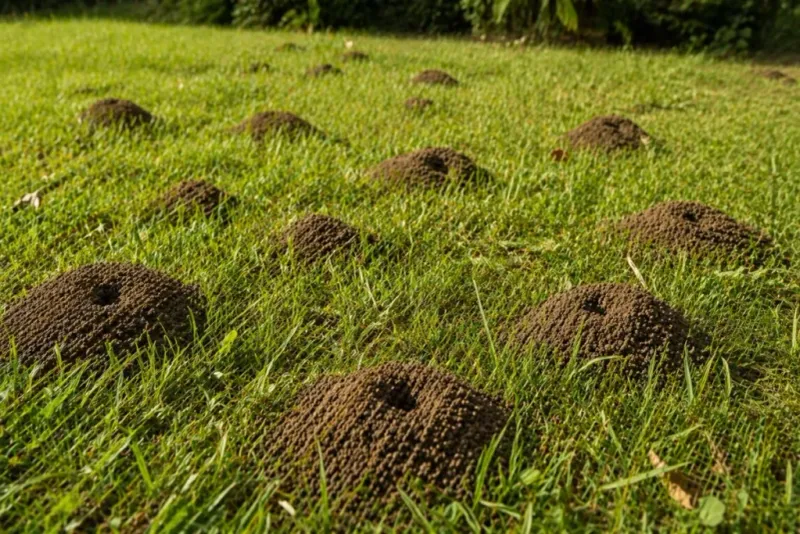
Ants and grass have a more complicated relationship than most people expect. UMN Extension says lawn ants generally do not feed on grass, so they are not chewing your lawn the way grubs or other turf pests might.
The trouble comes from the soil they move rather than from any meal they take.
Large, tall field-ant mounds can get in the way of mowing. A mower can scalp the top of a mound, dull its blade on soil, or throw dirt across the lawn.
In its guide to managing turf insects, the university also notes that mounds large enough can harm the grass beneath and around them.
Size is the key detail. A small cone is unlikely to bother anything, while a big mound can bury grass or leave a bare patch.
Other experts add a reminder that results vary. Cornell’s lawn pest guidance describes ants as helpful in some lawns, while noting that some can bury grass or tend aphids that feed on roots.
In other words, you cannot assume every mound helps your soil or hurts your turf. Look at your own lawn and judge by what is happening there.
Decide whether the nest is causing a real problem
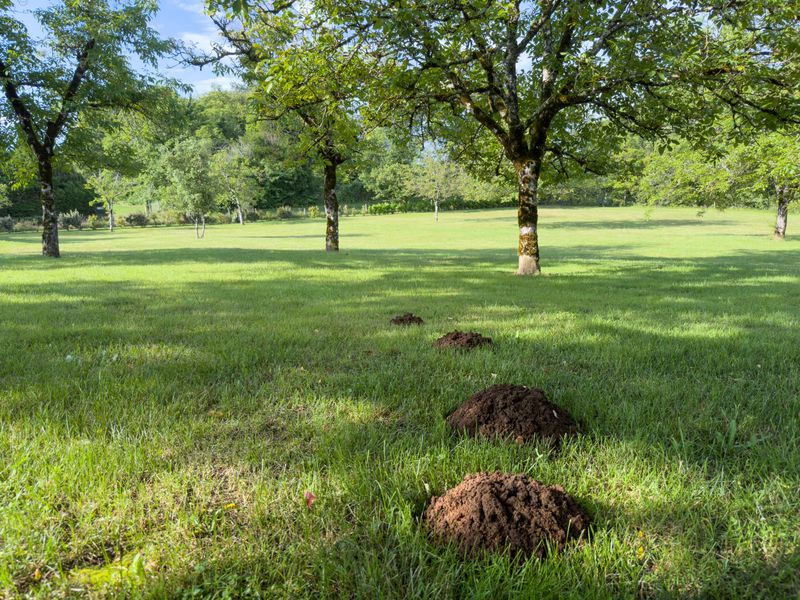
Seeing ants is not the same as having a problem. UMN Extension advises tolerating lawn nests when possible.
That makes a good starting point, because most nests cause little harm and the grass often carries on fine around them.
Instead of asking whether ants are present, ask what the nest is actually doing. Is the mound tall enough that the mower catches it every week?
Is the grass around it dying back or getting buried in soil? Those are concrete problems, and they are better reasons to think about acting than the look of a mound alone.
The university’s turf insect guide backs this up by noting that mounds large enough can harm grass. None of the sources I reviewed set a number, such as a certain count of mounds per yard, that triggers treatment, so a simple rule of thumb works better.
If the nest interferes with a task or damages turf, consider a response. If it just sits there, you can leave it be.
Keep notes for a couple of weeks. Photos taken from the same spot will show whether the mound grows, whether the grass thins, and whether the problem is real or just startling.
Choose a safe response if you decide to act
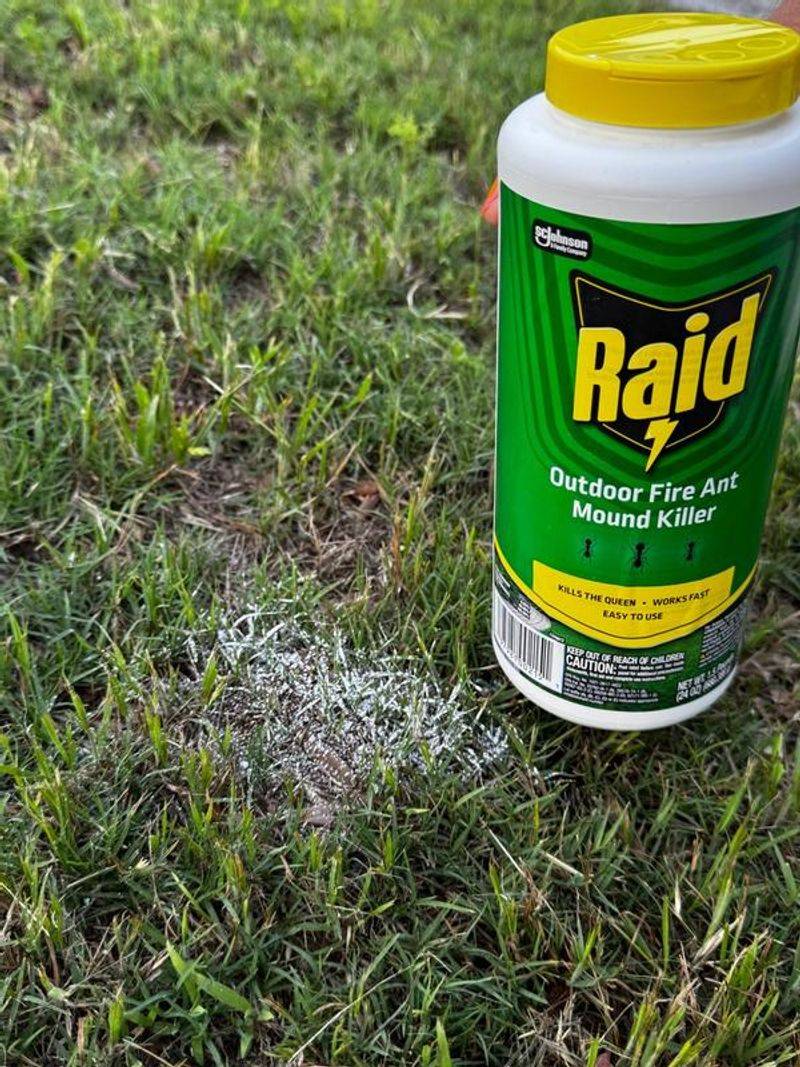
If a nest is truly causing trouble, start by confirming what made the bump. A mound that turns out to be worm castings or mole work needs a different plan than an ant nest.
Identification comes before any product or tool.
Skip the old home remedies. UMN Extension says flooding a nest is ineffective, and it calls pouring gasoline dangerous and polluting to the environment.
Neither belongs in a yard where kids, pets, and groundwater matter.
If you consider a pesticide such as an ant bait, directions depend on the specific product and the site where you use it. Read the label and follow it exactly.
One example is an EPA-registered ant bait label, which says to keep people and pets out during application, avoid applying if rain is likely within 24 hours, and not disturb the mounds. Those directions apply to that product only, and another product may say something quite different.
The sequence is simple: inspect the bump, judge the nuisance, and act only if there is a real reason. A mound that shows up after a rain is a prompt to look, not an order to treat.
Share this story