
What is cold composting?
Cold composting is the easiest and most straightforward method of composting and the materials you need are likely to be plentiful and easy to hand. Most home trash, on average, is about a third of food scraps and yard waste, the majority of which may be composted.
There are of course side benefits to composting. The use of composting reduces the amount of space taken up by waste in landfills and the amount of greenhouse gases such as methane released when this material decomposes anaerobically (without oxygen aiding the process). In addition, composting really provides you with something valuable in the form of a rich substance that can be used to nourish your garden beds and plant containers.
Download FREE Composing Guide
This FREE 29-page guide helps you turn kitchen scraps and garden waste into valuable compost. The comprehensive guide explains hot, cold and worm composting, as well as looks at no-turn (passive) composting methords with clear technical diagrams, detailed instructions and practical solutions for common composting problems.
What Materials Can Be Cold Composted?

A plentiful supply of organic matter may be found in every garden and neighbourhood, including fallen autumnal trees’ leaves and pieces of bark, as well as pruned trees and collected grass clippings.
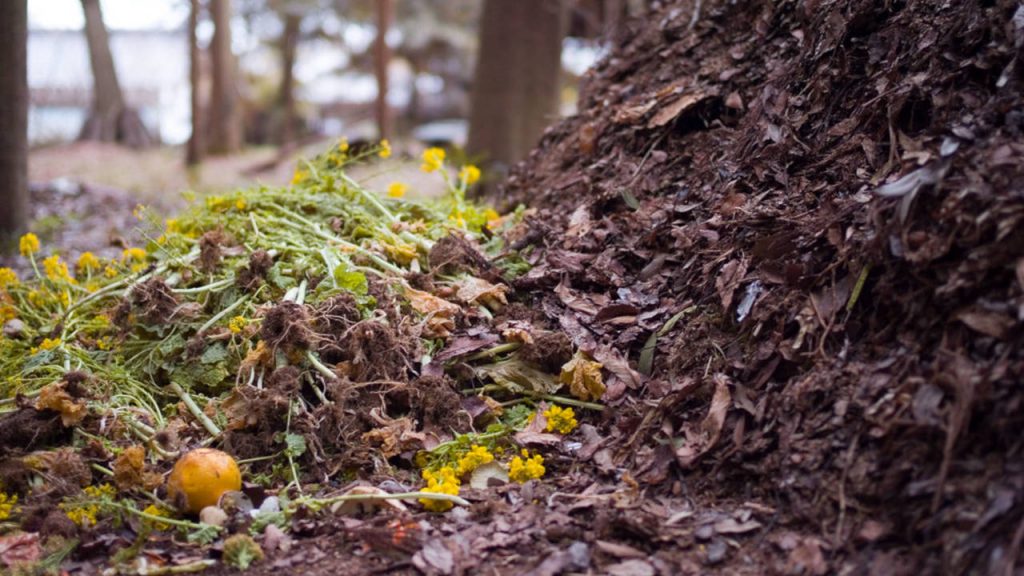
Cold Composting means you pile these organic materials on the ground or in a container and leave it for up to a year. A comprehensive list of what can and cant be composted can be found here.
What Materials Can’t be Cold Composted?
With cold composting, especially when the cold compost pile is in the open, it is best practice to avoid composting meats, fats and other animal byproducts when composing your compost pile. The problem with animal products is that pests will likely be drawn to your cold compost pile as a result of the odor given off. If you have a sealed compost box or instead, using the hot composting method, then you can probably include these.
Other items to avoid composting include: oils, pet waste, charcoal, animal bones, ashes, fungal infected plants or clippings, and clippings or plants that have been treated with pesticides or fungicides.
Cold Composting Ratios
On the whole, ratios are not as crucial for cold composting as they are with hot composting. However, having the right mix of ingredients makes cold composting work better.
A good mix should be about 30% dry materials (such as leaves, twigs, straw) and 70% wet materials (such as chopped up green leaves and grass clippings).
Water is the critical ingredient and makes the difference between success and failure. As the materials are mixed, water is added. The compost pile should be watered regularly. If the pile is low on water after 3 or 4 days, then it should be watered.
Composting works through a chemical reaction between the different types of material. The more heat generated the quicker the material breaks down. Heat is created from the carbon and nitrogen elements in the composting material reacting.
The more nitrogen in the ratio the more heat is created. When cold composting these ratios are not crucial as but it is suggested that the ideal ratio for cold composting is around 30:1 carbon to nitrogen. If there is less nitrogen the process will take longer. If you need your finished compost in four months time then you might spend more time adjusting the ratios of the compost composition.
Cold Composting is most successful when it’s left to the natural process of decomposition. That is why it is often referred to as ‘Cold Composting’.
The decomposition process will break down and mix the organic materials, and the end result will be a rich, dark brown, sweet-smelling compost.
Composting Materials Carbon to Nitrogen Ratios
| Materials High in Carbon | Carbon:Nitrogen Ratio |
|---|---|
| leaves | 30-70:1 |
| straw and hay | 50-100:1 |
| wood shavings or sawdust | 100-300:1 |
| tree bark | 120:1 |
| general paper | 100-200:1 |
| corrugated cardboard | 500:1 |
| Materials High in Nitrogen | Carbon:Nitrogen Ratio |
|---|---|
| vegetable peelings and scraps | 20:1 |
| coffee grounds | 20:1 |
| grass cuttings | 15-30:1 |
| animal manure | 5-30:1 |
Constructing a Cold Compost Pile
Although available space might be a limiting factor decide where you want your compost pile to be located. Generally, you would want your compost pile to be four feet square and as high again.
Once you’ve decided on a spot, create a six-inch-deep layer of brown material by starting with bare ground and layering it with tiny branches, dried grass cuttings, pieces of cardboard or newspapers until the ground is covered.

On top of this begin assembling your pile, first by layering green materials (kitchen scraps) and then brown materials in alternate layers, making sure that the green layers are deeper than the brown ones.
As soon as you’ve finished constructing your pile, water it with a watering can or garden hose to add moisture to the compost pile and kickstart the breakdown process.
Do You Need to Turn Cold Compost?
You do not have to turn your cold compost pile as the decomposition process will eventually take care of itself, however this will extend considerably the time it tales to get finished compost. If you want to have finished compost readily available in three to six month then you will need to turn your compost, probably once every couple of weeks, and this will move along the decomposition process.
Why does turning your compost pile speed up the process?
When you turn your compost pile you are effectively aerating it. This process adds oxygen into the pile which acts as an accelerant to the microbial. The microbial thrives on oxygen, helping break down the composting material faster.
Can you Cold Compost in Winter?
You can use the cold composting process to compost in cold weather as well as during the warmer months as the decomposition method isn’t affected when the temperature drops. However, you should cover your compost pile during this period to avoid the compost pile freezing.
Cold Composting Tips
Make sure the pile is moist. If it’s too dry, add some water.
It is far more efficient to chop up the elements in compost, thus shredding woody materials and breaking up cardboard will accelerate the decomposition process since more of the exterior of the composting materials will be exposed to the bacteria that break down the organic waste.
Turn the pile every 4 to 6 weeks. Turning the pile mixes the materials and helps the decomposition process.
If the pile smells bad, or attracts flies, make it smaller, add more water and leave it for a shorter time. If you need to use the compost right away, you can place the pile in a bin, place a lid on it and turn the pile every 2 weeks. The pile will be ready in 3 to 4 months.
Once the compost is cured, you can use it as a mulch, as a soil conditioner, as a potting mix, or as a soil additive.
How Long does Cold Composting Take?

Cold Composting takes longer than hot composting. It can take one year or more or as little as four months, depending on the condition of the ingredients, carbon to nitrogen ratio, how often the pile is turned, and finally how moist it is.
The composting process can be accelerated by chopping up the materials. Chopping up the materials exposes more surface area for the bacteria to work on.
The bacteria that perform decomposition are aerobic bacteria. They are most active when the air is circulating through the pile. That’s why turning and watering are important. The more air, the quicker the decomposition.
What are the Advantages of Cold Composting?
One of the major advantages of cold composting is its simplicity. The process doesn’t need you to produce heat for the decomposition to take place.
Another significant benefit of cold composting is that it is flexible. It may be constructed to meet your specific requirements. Even if you don’t have a lot of waste you can add what you have and build it up.
A third benefit is that it can almost be “set and forget”. If you have limited time to look after and turn the compost pile it is not important. There is no schedule that needs to be followed.
If you are ready to speed up the process you can, by turning it more often. You can also stat using the compost from the pile that is already finished. Dig up the completed compost that has accumulated under the surface and use it used right away.
Finally, a cold compost pile can work all year round, even in the colder months of the year. Just make sure you cover it so it doesn’t freeze, although this would only pause the process.
Share this story