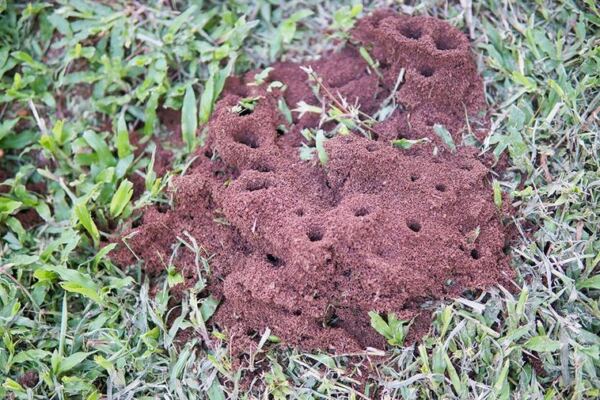
Look for a raised mound of loose soil with no obvious hole in the center, especially in a sunny lawn or beside a sidewalk, and treat it as a possible fire ant nest. That simple clue can save you from a burning, painful surprise.
It is not a perfect test, so a few other signs help you decide how much space to give. Here is what to watch for before your next mowing day or backyard game.
Start with a raised patch of loose soil

Walking across a lawn, your eyes usually catch movement or color. With fire ants, the first clue is often just a raised patch of loose, crumbly soil sitting on top of the grass.
The soil looks freshly dug, because the ants carry it up from underground tunnels as they build.
According to NC State Extension, fire ant mounds can be rounded or more irregular, depending partly on the soil. So do not expect one tidy shape.
A lumpy heap and a neat dome can both be worth a second look.
Where the mound sits adds context. Fire ants often settle in open, sunny spots, and NC State turf guidance notes they also show up near sidewalks and around landscaping or structures.
Think of the edge of a driveway, a flower bed border, a patch of open lawn, or the base of a deck.
None of this proves the ants are fire ants. Other ants in North Carolina also build mounds, and a sunny location is only a reason to be careful, not a test.
What the clues do give you is a sensible rule: if you see raised, loose soil in a spot like this, pause before your next step.
Stay a few feet back and look at the whole area. Scan the grass ahead of you, since mounds often come in groups.
A quick look from a distance costs nothing, and it keeps your shoes, ankles, and weekend plans out of trouble.
A missing center opening is a useful clue
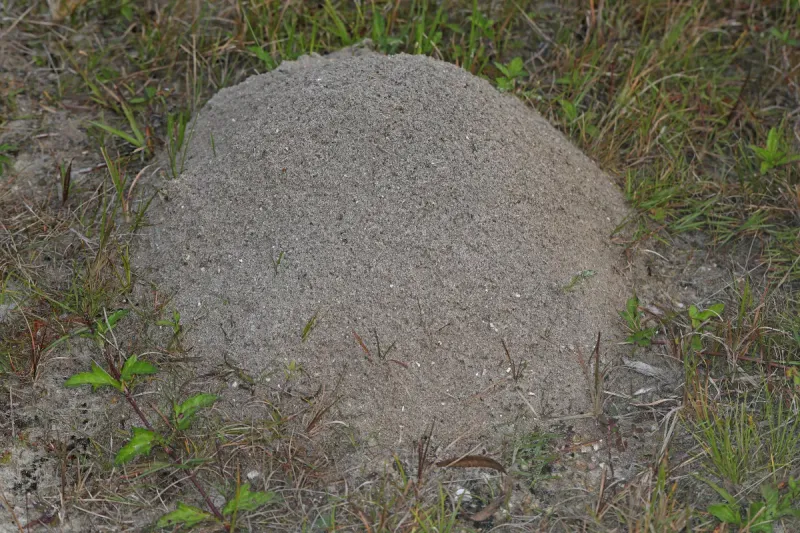
Most people picture an ant hill with a hole right at the top, like a tiny volcano. Fire ant mounds usually do not look like that.
The ants travel through underground tunnels, so you often will not see an obvious entrance in the middle.
As NC State Extension explains, the entrances sit around the outside edges of the mound rather than on top. That is why a smooth, closed-looking dome can still be busy inside.
This makes a missing center opening a handy warning sign. If you spot a raised mound with a solid-looking top, it makes sense to give it room and walk around.
You are using the clue to decide how careful to be, not to name the ant.
Keep the limits in mind. A missing opening raises suspicion but does not prove a fire ant nest, and some mounds may look different once weather or mowing has changed them.
NC State’s turf publication is a good place to read more about how these nests behave.
A practical habit helps here. When you see a closed dome, look for ant traffic only from a distance, and never lean over it for a closer peek.
Treat the blank top as a cue to step wide and keep moving.
Soil and lawn conditions change a mound’s appearance
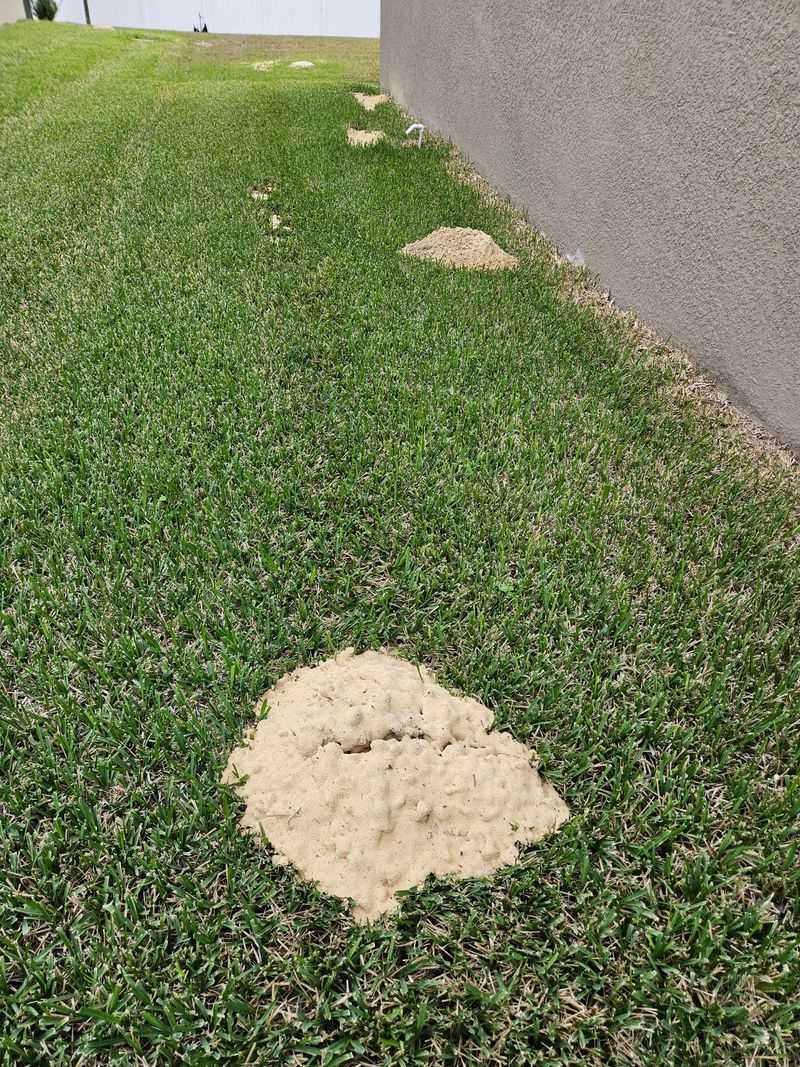
Some people expect a fire ant mound to be big, bright red, and perfectly round. Real yards are messier than that.
Soil type, moisture, colony age, and mowing all change how a mound looks.
NC State Extension notes that mounds in clay soil may be rounded and redder, while those in sandy soil may be irregular and beige. Color and symmetry, then, tell you more about the dirt than about the ants.
Size is just as unreliable. A young colony may have a small mound or none at all, while an older one can grow taller.
Utah State University Extension points out that mound dimensions vary with factors such as age, soil, and moisture, and regular mowing can keep a mound short and easy to miss.
Weather plays a part too. After heavy rain, a colony that was barely noticeable can suddenly show a fresh heap of soil.
If a bump appears overnight after a storm, treat it with the same caution as any other suspicious mound.
The takeaway is simple. Do not wait for a mound to be large, red, or symmetrical before you give it space.
A small, lumpy, tan mound in a mowed lawn can deserve just as much respect as a textbook dome.
Visible ants add clues—but never test the mound

Sometimes ants are easy to see without going anywhere near the mound. If so, a few traits can add to your suspicion.
Remember that they are clues, not proof.
According to NC State Extension, red imported fire ant workers are reddish-brown with darker abdomens, and they come in a range of sizes. They also have two small nodes, or bumps, at the narrow waist.
You will rarely see that waist detail without a close look, so do not lean in to check.
Behavior can be a clue as well. Texas A&M’s fire ant project describes aggressive swarming and ants climbing vertical surfaces as warning signs.
These only count if you happen to notice them from a safe distance, such as ants running up a nearby post or stake.
Never step on, poke, or dig into a mound to see whether the ants rush out. That is unsafe, and CDC guidance says not to disturb or stand on or near ant mounds.
If you cannot tell what you are seeing, the answer is still the same. Back away, mark the spot in your mind, and keep children and pets clear until you know more.
Not every ant hill tells the same story

Calling every other ant hill harmless is too simple. North Carolina has mound-building ants that are not fire ants, and a mound alone cannot guarantee which kind you have.
One example is the Formica group. NC State Extension explains that these nuisance ants can build mounds in turf, sometimes large ones.
They do not pose the same health hazard to people as fire ants, but their mounds can still be a headache for a lawn.
That is why mound features work best as clues. A raised dome with no center hole can fit more than one ant, and it is smart to avoid it anyway rather than guess.
You do not need a perfect identification to decide to walk around.
The opposite mistake matters too. A lawn with no visible mound is not automatically free of fire ants.
As NC State’s biology publication notes, young colonies may not have built a visible mound yet.
So an empty-looking patch of grass can still hold surprises. Ants can also turn up away from any mound.
Keep your eyes open even where the ground looks smooth and clean.
Give suspected nests space before yard work or play

Before you mow, rake, or let kids run across the grass, take a minute to walk the area and look at the ground. Route around any raised mound you spot, leaving generous space on every side.
Mark it with your eyes, or tell others in the household where it is.
A visible mound may not show the whole picture. CDC guidance notes that fire ants can also be encountered away from a mound, including on trees or in water.
Stepping clear of one mound does not mean the surrounding area is ant-free.
Fire ants are also known for how they defend a nest. NC State Extension describes aggressive defense when a mound is disturbed, which is why a quick scan before work or play is worth the effort.
The same CDC page says fire ant stings can burn, and red bumps may turn into white, fluid-filled pustules within a day or two. Seek urgent medical care for symptoms such as loss of breath or serious swelling.
Good habits make the difference: look first, keep a wide berth, and wear closed shoes for yard chores. A mound you notice early is one you never have to feel.
Share this story