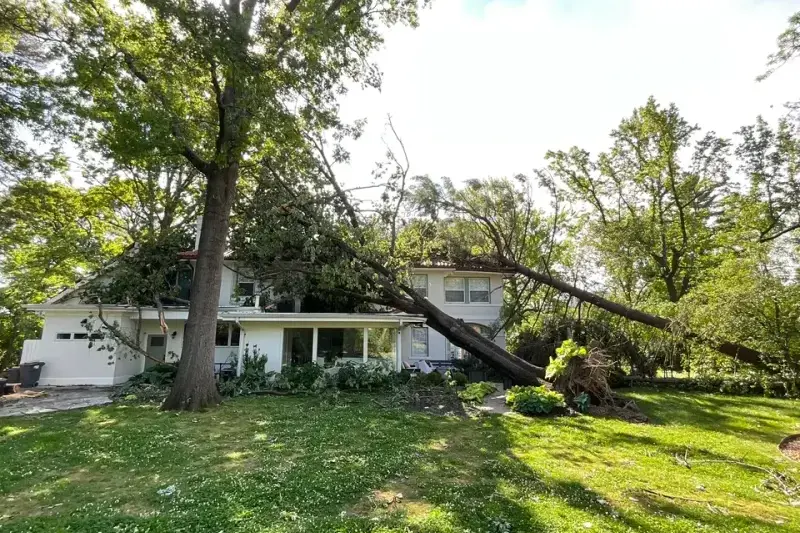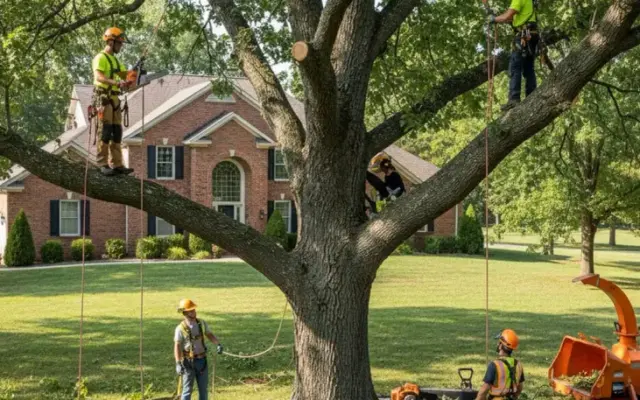
If your neighbor’s branches reach over your fence and into your yard, Missouri courts have said you can trim them back to the property line. That is where your right stops, though.
Knowing exactly where the line sits, what kind of tree you are dealing with, and what could go wrong can save you from a costly mistake with a saw.
Missouri recognizes a limited right to trim overhanging branches

Here is the rule in plain words. Missouri appellate decisions recognize that a landowner may trim a neighbor’s branches back to the property line when those branches reach over onto the landowner’s ground.
Courts describe this as a self-help remedy, meaning you handle the problem yourself instead of suing first.
The older case, Tanner v. Wallbrunn from 1898, said a neighbor could clip overhanging branches only to the extent they overhang his land.
The court also refused an order that would have destroyed the tree. The limit is built into the rule from the start.
A later decision, Hasapopoulos v. Murphy from 1985, relied on Tanner and described cutting offending branches at the property line as the neighbor’s remedy.
It did not treat that remedy as a license to do whatever you like to the tree.
So think of this as a narrow permission, not an unrestricted right. It does not let you cut past the boundary, step onto the neighbor’s land to prune, or remove the tree itself.
It is also not a promise that the work is safe or that every tree is a simple case.
Before you pick up a saw, several checks matter. You need to confirm where the boundary actually runs and see whether the trunk sits on it.
You also need to think about power lines, proper pruning cuts, and any local rules. The sections below take those one at a time.
Find the actual property line before you cut
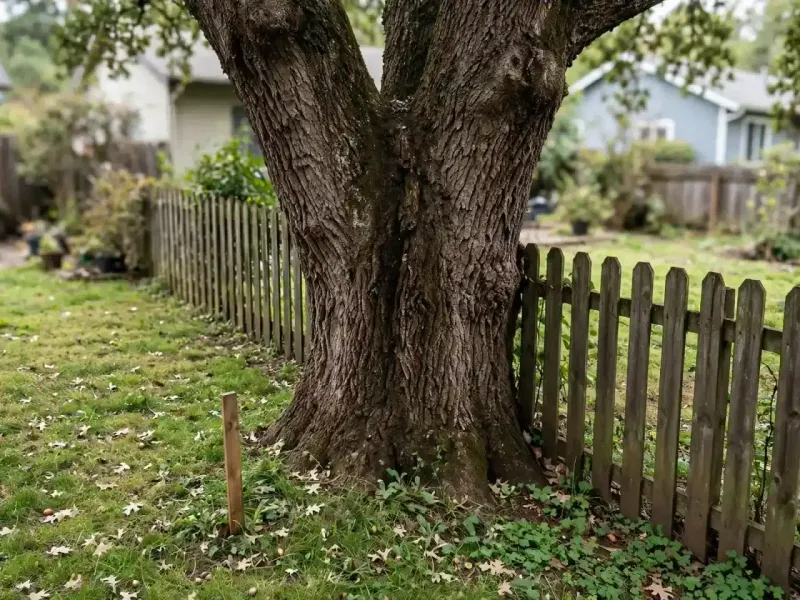
A fence feels like a boundary, but it may not be one. Fences get built a few feet inside or outside the true line, sometimes by earlier owners who guessed.
If you cut back to the fence and the real line sits on the other side, you have cut the neighbor’s tree beyond your rights.
The Missouri Fence and Boundary Law Reference Guide from MU Extension makes the point that boundary disputes can end up needing a court to resolve them. That is a good reason to settle the line first, not after the branches are on the ground.
Your deed, a recorded plat, and survey markers are better starting points than a fence. A licensed land surveyor can establish the line when the paperwork is unclear.
If you cannot establish the boundary, or if you and your neighbor disagree about it, pause. Waiting costs you a little time.
Guessing wrong can cost you a dispute.
You may have heard that Missouri allows entry onto a neighbor’s land for fences. MU Extension guidance on storm-damaged fences says fence law may allow entry to repair a qualifying boundary fence and remove something obstructing it.
That is a narrow fence-related situation. It is not a general right to walk onto the neighbor’s property to prune a tree.
Check whether the trunk stands on the boundary
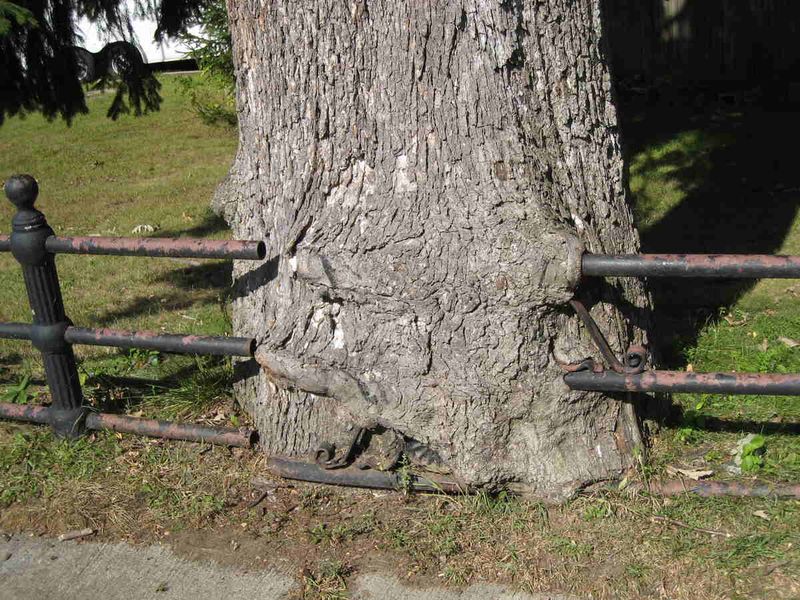
Overhanging branches and a trunk on the line are two different problems. With an overhang, the tree stands on your neighbor’s land and only its limbs cross over.
With a boundary tree, the trunk itself straddles the dividing line.
For the second situation, Yoakum v. Davis, a 1912 Missouri appellate decision, describes adjoining owners as owners in common of a tree whose trunk stands on the line.
In plain terms, the tree belongs to both of you, not just to one.
That changes what you can do. The branch-trimming rule is about limbs that cross over.
It does not tell you that you may cut down a tree you share with someone else.
A quick way to check is to look at the base of the trunk. If the survey line seems to pass through the wood, or the flare of the roots sits on both sides, treat it as a shared-ownership question.
Do not remove or heavily cut the tree on your own.
Talk with your neighbor first and settle ownership before any serious work. If you cannot agree, a conversation with a Missouri real estate attorney is a sensible next step.
Trimming does not mean destroying the tree
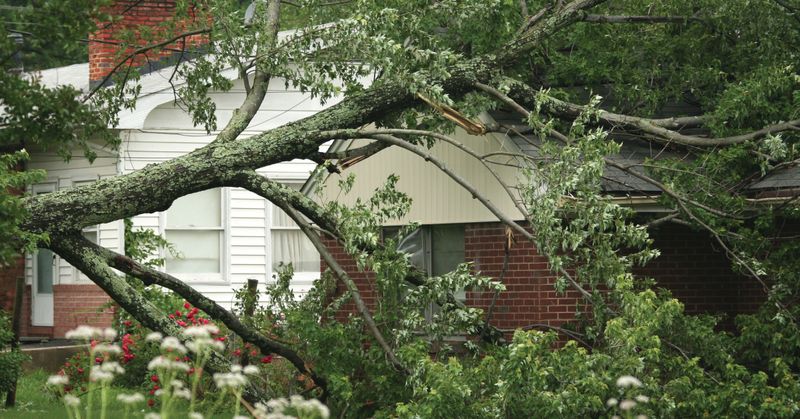
Cutting to the line is a limit, and it works in both directions. You may not go past the boundary, and you may not use pruning as a back door to kill or remove a tree that is not yours.
Tanner rejected an order that would have destroyed the tree, and the later cases treat trimming as a way to deal with encroaching branches, nothing more.
In practice, that means being careful about how much you take. Stripping a tree so heavily that it declines or dies could turn a lawful trim into a claim against you.
If a trim would badly harm the tree, a professional’s opinion is worth getting first.
Many homeowners also ask whether the neighbor must pay for damage from branches or roots. In Hasapopoulos, the court rejected damages on the facts of that case, where healthy trees’ roots and branches had encroached.
It pointed to self-help as the remedy. That does not mean tree owners are never liable, and it does not mean a court will order a healthy tree trimmed.
The opinion separately discusses possible liability when a tree is damaged, diseased, decayed, or otherwise defective. The key facts are that the tree is hazardous and that the problem could be discovered and addressed with reasonable care.
Whether liability follows depends on the facts, and no particular outcome is promised.
If a neighbor’s tree looks dead, split, leaning, or rotten, write down what you see and take dated photos. Share your concern with the neighbor in writing, and consider asking an arborist to assess it.
Leave work near power lines to the utility
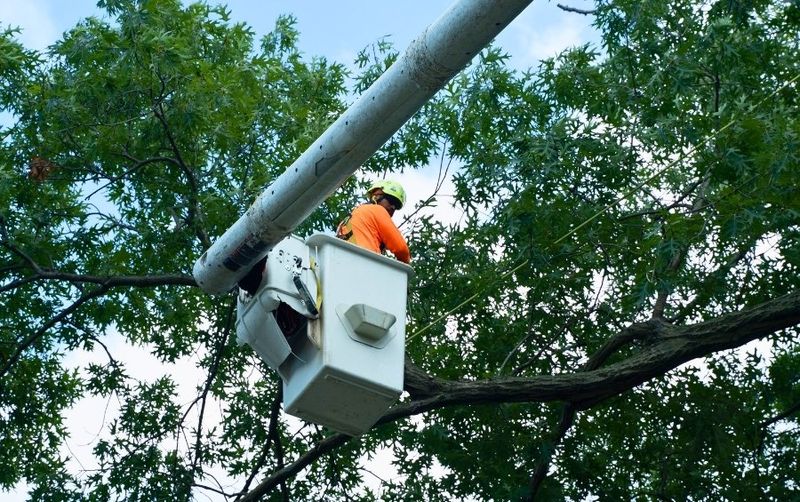
Some jobs are not about the law at all. They are about staying alive.
The Missouri Public Service Commission, in its Trees and Power Lines guidance, warns that a tree touching a line can become energized, and it tells residents not to prune near high-voltage lines.
A branch being on your side of the property line does not make cutting it safe. A limb that looks harmless can carry current, and a falling branch can pull a line down with it.
If branches are close to wires, call the electric utility. Let the utility decide how the work gets done and who does it.
Not sure what kind of wire you are looking at? Call the utility anyway.
The PSC distinguishes the service-drop wire that runs from the pole to a customer’s building, and it advises contacting the utility to identify wires and arrange safe work. Guessing is not worth the risk.
That also means no ladders, pole saws, or long-handled tools anywhere near the lines, even for a small limb.
Prune carefully or hire an arborist
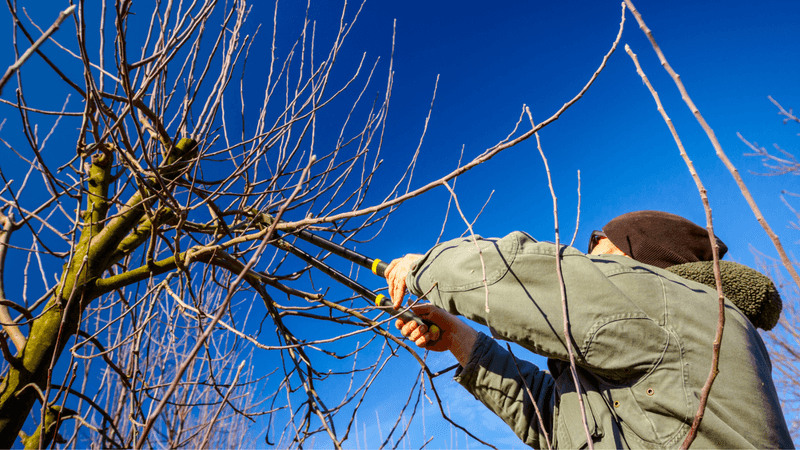
Say the boundary is confirmed, the trunk is clearly on the neighbor’s side, and no wires are nearby. You can still do real damage with a bad cut.
The way you prune affects how well the tree heals, and a sloppy job can leave an open wound.
MU Extension’s guide to pruning and care of shade trees advises avoiding bark tears and making a proper cut at the branch collar, the slightly swollen ring where the branch meets the trunk. Do not cut flush with the trunk, and do not leave a long stub.
For larger branches, the guide describes a three-cut method. Make a first cut on the underside a bit out from the collar.
Make a second cut from the top, farther out, to drop the limb. Then make the final cut just outside the collar to remove the stub.
This approach keeps the weight of the limb from ripping bark down the trunk as it falls. It is a good reason to take your time rather than hacking at a branch from one side.
Hire help when the limb is large, high, over a roof, or hard to control. The Missouri Department of Conservation recommends hiring a qualified arborist for tree-care work.
Certification is a useful credential, but it is not a guarantee, so ask for proof of insurance and references too.
Tell the arborist where the property line is, and that the work must stop there.
Check local rules, especially for public trees

State court decisions are only part of the picture. Cities and counties often have their own tree rules, and they can affect what you are allowed to do, particularly when a tree is on public land or along a street.
Start by finding out who owns the tree. A street tree or a tree in a public right-of-way may belong to the city, and that can change everything about who may prune it.
St. Louis offers a useful local example. The city requires a permit to maintain a City Tree, as explained on its page about the tree permit to maintain.
That is a St. Louis rule. It is not a statewide permit requirement, and you should not assume the same process applies in your town.
Where you live, call city hall, the public works or forestry department, or check your municipal code. Ask whether the tree is public, whether any permit or approval applies, and whether there are rules for trees on private property.
If you rent or belong to a homeowners association, check your lease or covenants as well. A few minutes on the phone beats a fine or a dispute.
The legal right to trim is small, and the checks around it are what keep it useful.
Share this story