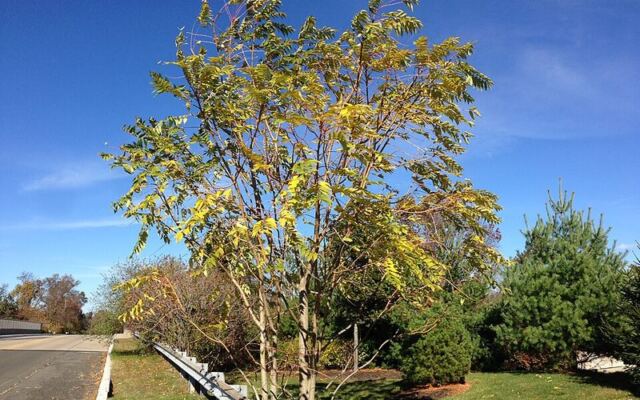
Along sunny fence lines in New Jersey, a fast-growing invasive tree called tree-of-heaven can pop up and quickly become a headache. Once it is established, it is hard to pull out fast enough to keep up, because its roots keep sending up new shoots.
Young seedlings are a different story, and knowing which kind of shoot you have changes everything. Here is how to spot the tree and what to do next.
Tree-of-heaven grows in fence-row habitat
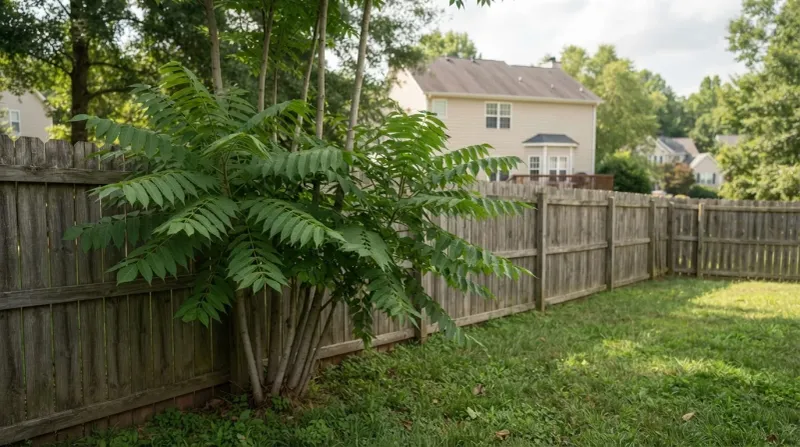
The tree behind the headline is tree-of-heaven, known to scientists as Ailanthus altissima. It is a fast-growing invasive tree that is documented in New Jersey.
Rutgers guidance says it often forms clusters along sunny borders, and it notes that root suckers can come up far from the parent tree.
Fence rows fit that description well. Penn State Extension lists fence rows among the typical places where the tree grows.
Birds and mowers rarely disturb the strip beside a fence, and sun reaches it, so young trees can settle in unnoticed.
It helps to be clear about what those sources show. They document fence rows and sunny borders as habitat for this tree.
They do not measure a recent statewide jump in fence-line infestations, so there is no need to assume your neighborhood is in the middle of a surge.
What matters for you is the next step. Before you pull, cut, or spray anything, confirm that the plant really is tree-of-heaven.
Then work out what kind of shoot you have, because the right control choice depends on both answers.
Check the leaves and other identifying clues
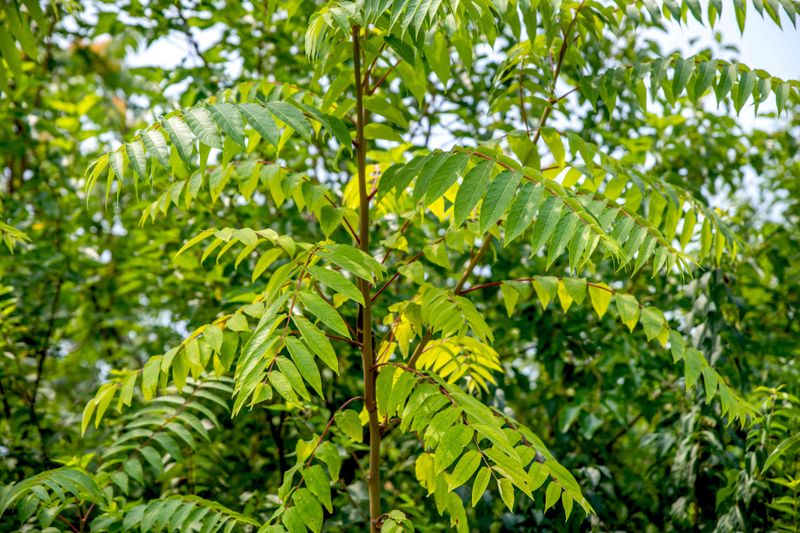
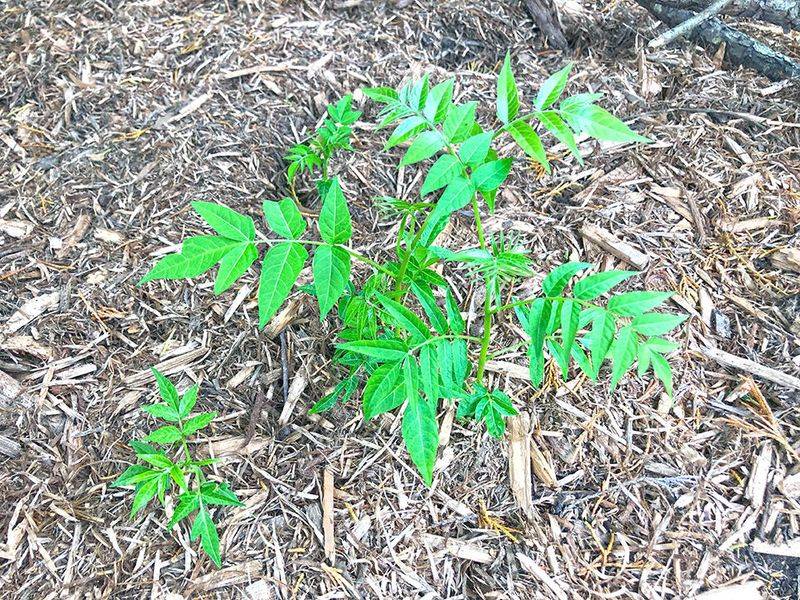
Start with the leaves. Tree-of-heaven has large, pinnately compound leaves, meaning many leaflets are lined up along one central stalk.
Each leaflet has smooth edges, with a few small gland-like notches near its base, as described in Penn State’s identification guide.
Smell can be another clue. Crushed leaves or broken twigs can give off a strong, unpleasant odor.
If you test this, do it on a single leaf and wash your hands afterward.
Be careful, because other plants look alike. Penn State also covers native look-alikes, including black walnut and staghorn sumac.
Both have compound leaves, and both are common in the region.
That is why one clue is not enough. Check the leaflet edges, the notches, the odor, the twigs, and the overall shape of the plant.
A quick glance is risky, and so is trusting a plant identification app on its own.
If you are still unsure, take clear photos of the leaves and stems and ask your county Rutgers Cooperative Extension office. A wrong guess could mean removing a native tree you wanted to keep.
Find out whether a shoot is a seedling or a sucker
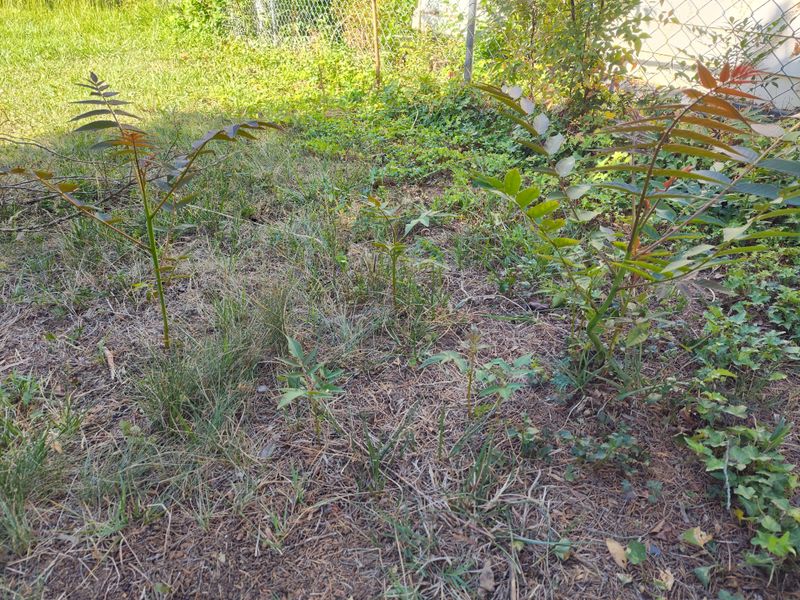
Two shoots can look identical above ground and be completely different below it. A seedling starts from a seed and has its own small root system.
A root sucker grows from the roots of an established tree, and it can emerge some distance from that tree.
This is why a cluster of shoots deserves a second look. Rutgers notes that root suckers may appear far from the parent, so a row of stems along your fence may be linked to one larger tree, perhaps on the other side or down the line.
Rutgers’ advisory explains how this affects control.
A practical test is to look at the base of one shoot. If it ends in its own small root and comes up easily, it is probably a seedling.
If you find a thicker root running sideways toward other shoots or toward a bigger tree, it is likely a sucker.
According to Penn State Extension, hand-pulling young seedlings can work when the soil is moist and the entire root comes out. Root suckers are much harder, and small root fragments left in the ground can regrow.
So pull seedlings after a rain, loosen the soil first, and check the root. If you only snap the stem off, you have not solved anything.
Cutting alone can lead to more growth
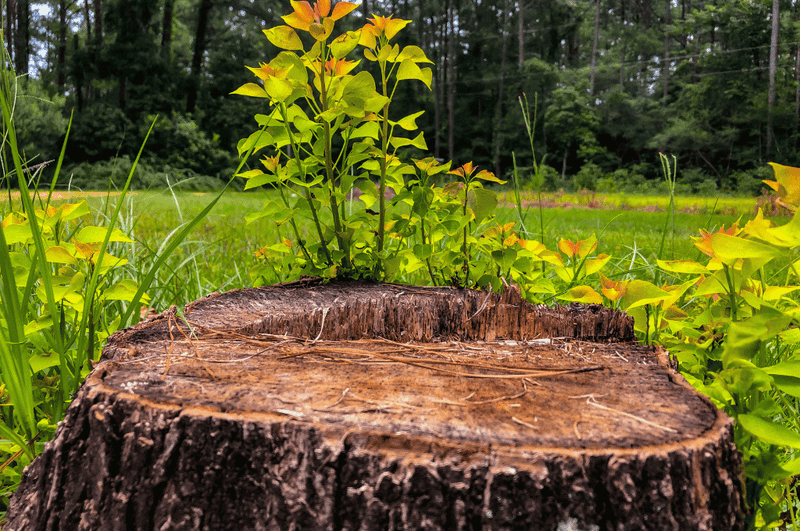
Grabbing a saw feels like the obvious fix, but established tree-of-heaven often answers by growing back. After cutting, it can send up stump sprouts and also root suckers.
Penn State describes this regrowth in its tree-of-heaven profile.
Mowing works the same way. Cutting or mowing established plants is not a stand-alone control plan, because the roots are still alive and the plant tends to spend stored energy on new shoots.
Rutgers adds a few points. Its guidance says cutting before treatment can prompt new growth, and that a cut-stump treatment will not control distant root suckers.
Think about what that means beside a fence. The stump you can see is only part of the plant.
Suckers may be coming up several feet away, under the fence, or in a neighbor’s yard.
If you cut a tree and new shoots appear in a ring around it or across the lawn, that is the root system responding. Treat those shoots as a sign that the plan needs to address the roots, not just the stem.
Established trees need timed treatment and follow-up
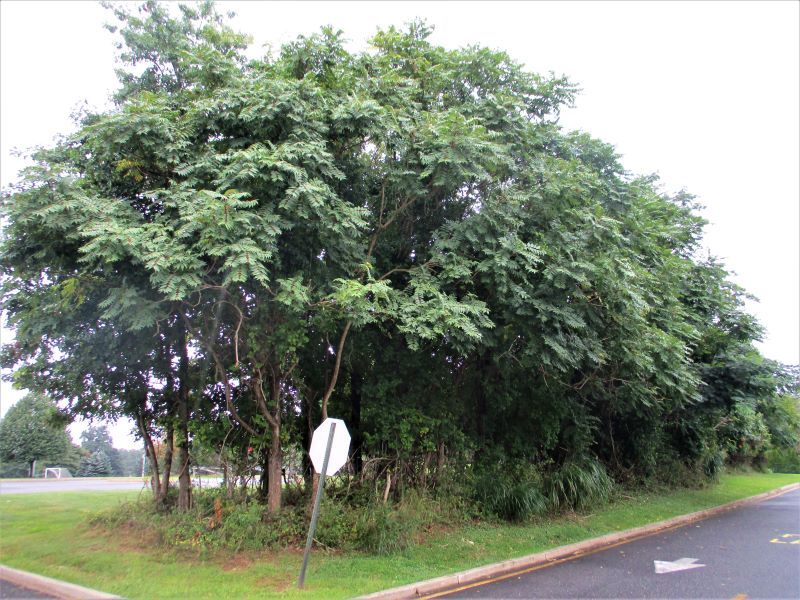
For larger, established trees, timing is a big part of the plan. Rutgers’ New Jersey recommendation is to use systemic herbicide treatments from mid-July to mid-October.
A systemic product moves through the plant instead of only burning the leaves it touches.
After treating, Rutgers recommends waiting at least 30 days before cutting the tree. That gives the treatment time to move down toward the roots.
Cutting too soon can undercut the whole effort, as Rutgers explains.
Rutgers describes several methods, including foliar sprays, basal-bark applications, and hack-and-squirt. Which one suits you depends on tree size and on what grows nearby.
A spray that works on a small shrub-sized tree may harm desirable plants around a fence line.
Plan for more than one year. Rutgers says follow-up treatment may be needed in later years, and Penn State also stresses late-season treatment and monitoring for regrowth.
A simple habit helps: walk the fence each summer and note any new shoots. Catching them small keeps a hard job from growing larger.
Follow product labels and take sensible contact precautions

Herbicide labels are legal documents, and they differ from product to product. Read the label for the product you are considering, and follow it for the site, the plant, and the method.
This article does not give mixing rates or a universal application routine, because those depend on the label and your situation.
Licensing is one example. Rutgers notes that the specific triclopyr ester product it discusses is restricted-use and requires a pesticide license in New Jersey.
That statement applies to that product, not to every triclopyr product on the shelf.
If a label or a product is beyond what you can use legally, ask for qualified local guidance. Your county Rutgers Cooperative Extension office or a licensed applicator can help match a method to your fence line.
Skin contact deserves some care too. Ask Extension reports that skin irritation or dermatitis has occurred in some people.
That does not mean ordinary contact is dangerous for everyone.
When you expect extensive contact, such as clearing a thick patch, wear long sleeves, long pants, and gloves. Wash up afterward.
Tree-of-heaven is not the only spotted lanternfly host
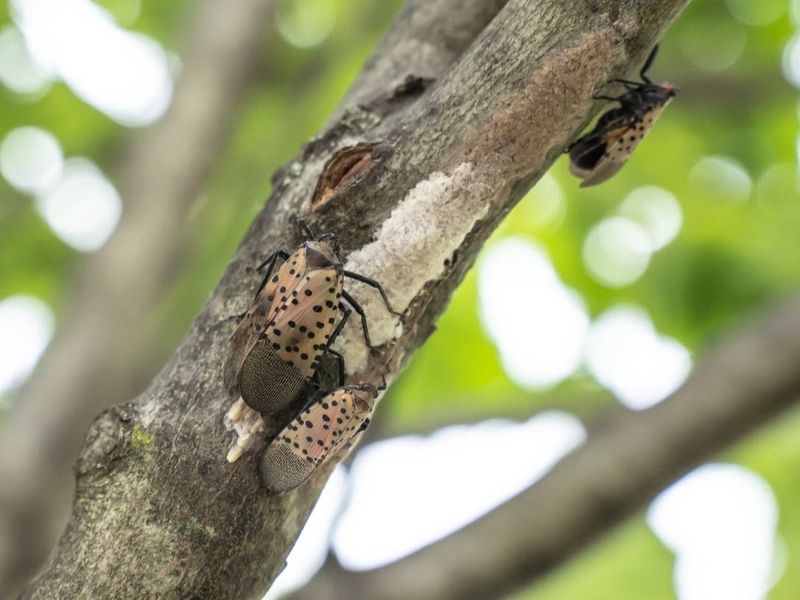
Many people connect this tree with spotted lanternfly, and the link is real. Tree-of-heaven is a preferred host for the insect.
Preferred, though, does not mean required.
The U.S. Forest Service reports that spotted lanternfly has a broad host range and can complete its life cycle without tree-of-heaven.
The insect can feed and develop on other plants.
That means pulling every tree-of-heaven on your property will not wipe out spotted lanternfly. You may still see the insect on other trees, vines, or plants nearby.
Keep the two jobs separate. Dealing with tree-of-heaven is about stopping an invasive tree from spreading along your fence.
Dealing with spotted lanternfly is its own task, with its own guidance from state agencies.
New Jersey’s restrictions take effect in stages
New Jersey’s Department of Agriculture lists tree-of-heaven among the prohibited invasive plants under the Invasive Species Management Act. The rules arrive in stages, and the dates matter.
The department’s invasive species page lays them out.
Propagation restrictions begin January 1, 2027. Sale, distribution, and export restrictions begin January 1, 2030, absent a permit.
Those rules are aimed at growing, selling, and moving the plant. They are not a requirement that homeowners remove trees already on their land.
A tree-of-heaven that is already growing by your fence is not covered by a state removal order based on these dates.
Still, the listing signals how the state views the plant. If you manage a property, it is wise to check the department page for updates and to avoid planting, sharing, or moving it.
Start with the shoot and plan for the roots
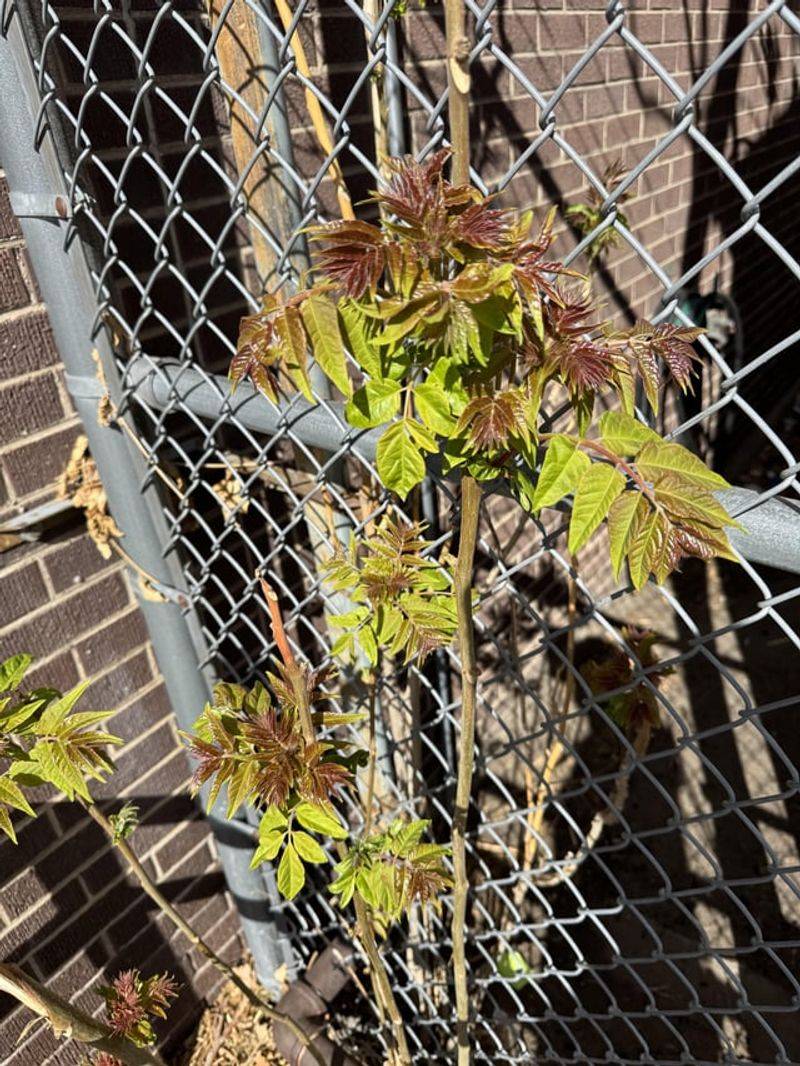
Begin with three checks. Confirm the plant is tree-of-heaven using several features, work out whether the shoot is a seedling or a root sucker, and do not count on cutting alone for established growth.
Penn State supports pulling small seedlings in moist soil with the whole root.
Bigger plants may call for timed, site-appropriate control and repeat visits, as Rutgers describes. No single answer fits every property, and removing the tree will not end spotted lanternfly.
A fence line rewards patience, and the roots decide the outcome.
Share this story