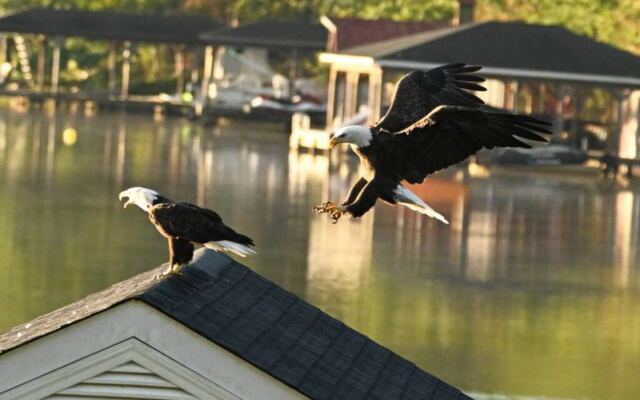
A bald eagle gliding over your Virginia yard is a clue about the land around you. It hints that food, perches, or usable habitat exist somewhere in the surrounding landscape.
That clue is useful, but it has limits, and knowing them helps you read the sky more wisely. Here is what the sighting can tell you, what it cannot, and what to do if eagles matter to your plans.
What a flyover can tell you
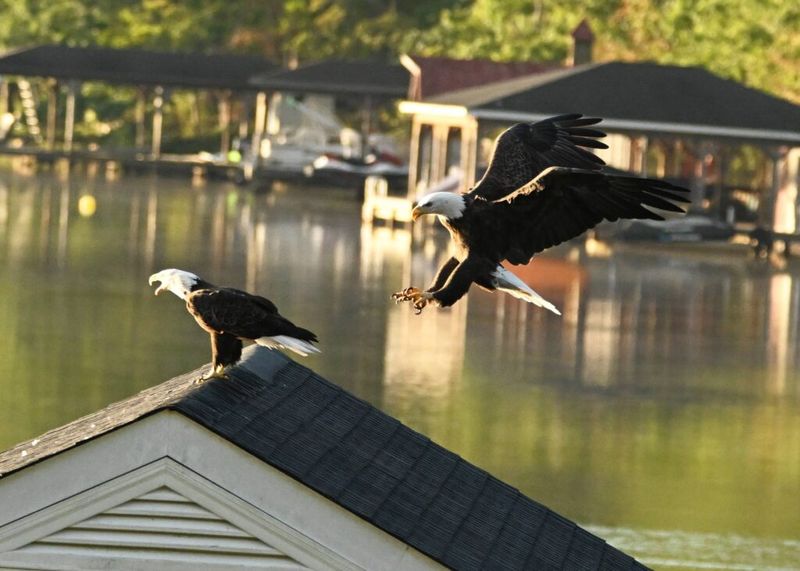
A bald eagle overhead is consistent with food, perches, or usable habitat somewhere in the surrounding landscape. Think of it as a hint about the neighborhood, the watershed, and the wider countryside rather than a report card for your yard.
Eagles need three basic things: food, places to perch, and places to nest. According to the U.S.
Fish and Wildlife Service species page, bald eagles can also travel great distances. A bird crossing your lot may have started its trip miles away and may be headed miles beyond.
That is why a single sighting works best as a landscape clue. Somewhere in the area, the bird may find prey, a sturdy tree to rest in, or open space to hunt.
Your yard might be a small piece of that puzzle, or it might just be along the flight path.
Virginia’s landowner guidance from the Department of Wildlife Resources describes nesting and foraging habitat as a combination of features spread across a landscape. Eagles use the whole mix, not one backyard.
So enjoy the moment, jot down the date and time, and note what the bird did. Those details become more helpful if you see the eagle again.
A single glimpse, though, does not say your property is pristine, unusually healthy, or ready for nesting. It says the bird found something workable in the broader area.
Water matters, but it need not border your property
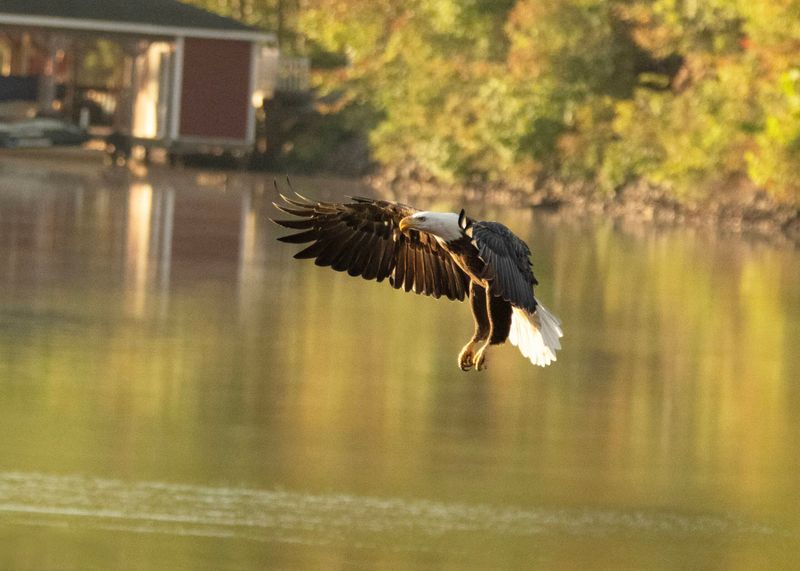
Rivers, lakes, marshes, and streams have long been tied to bald eagles because those waters are where the birds find much of their food. Virginia’s eagle guidelines for landowners say nests generally occur near coastlines, rivers, large lakes, or streams that have enough food.
Water is a strong theme in eagle habitat, but that does not mean a river must run past your fence. Eagles fly well, and a bird seen over your roof may be commuting between a reservoir and a distant roost.
The U.S. Fish and Wildlife Service notes that bald eagles are increasingly found in drier, urban, and suburban areas.
Some of these birds still live within reach of water, but the sighting alone cannot show how far or in which direction it lies.
If you live well away from a large waterway, you can still see eagles. Open fields, highways, landfills, and farmland all offer chances to hunt or scavenge, as the next section explains.
A practical way to use this clue is to look at a map of your area. Check for creeks, ponds, reservoirs, and rivers within several miles.
That gives you a sense of what the bird might be using, without claiming that any one body of water brought it to your yard.
Fish are not the only possible food
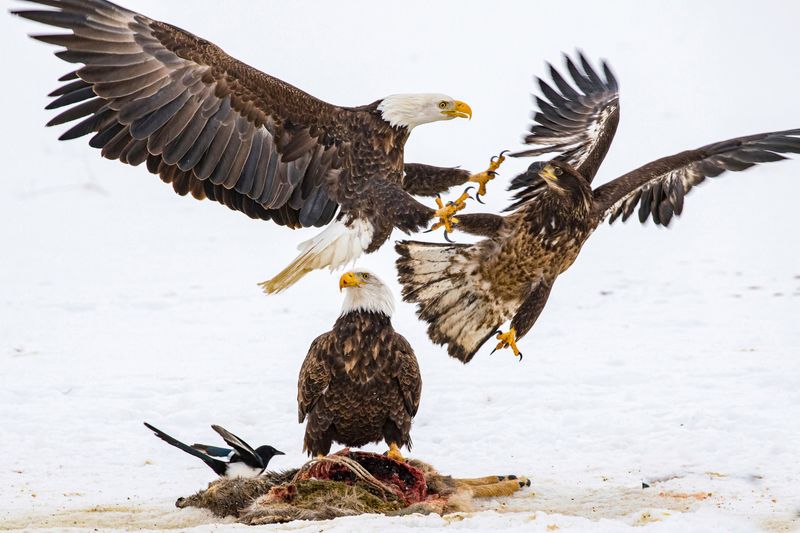
Fish are a staple of the bald eagle diet, which is why the birds are so often pictured with a catch in their talons. Yet the U.S.
Fish and Wildlife Service describes them as opportunistic feeders. Their menu also includes waterfowl, shorebirds, turtles, small animals, and carrion.
Carrion means animals that are already dead, such as roadkill or a deer carcass in a field. An eagle that drops down near a farm or roadside may be checking for exactly that kind of meal.
This variety is one reason you cannot guess what drew a bird to your area. A glide over your yard does not reveal whether the eagle was hunting, scavenging, or just traveling.
It also does not tell you where the bird found its last meal.
Instead of guessing, watch behavior. Does the bird circle low over open ground, follow a crow flock, or head steadily in one direction?
Those observations may be interesting, but they are still only snapshots of one moment.
The takeaway is simple. Treat the sighting as a sign that the wider landscape offers some kind of food.
Do not assume your pond holds fish, or that your yard is the dining spot.
Nesting habitat involves more than a large tree
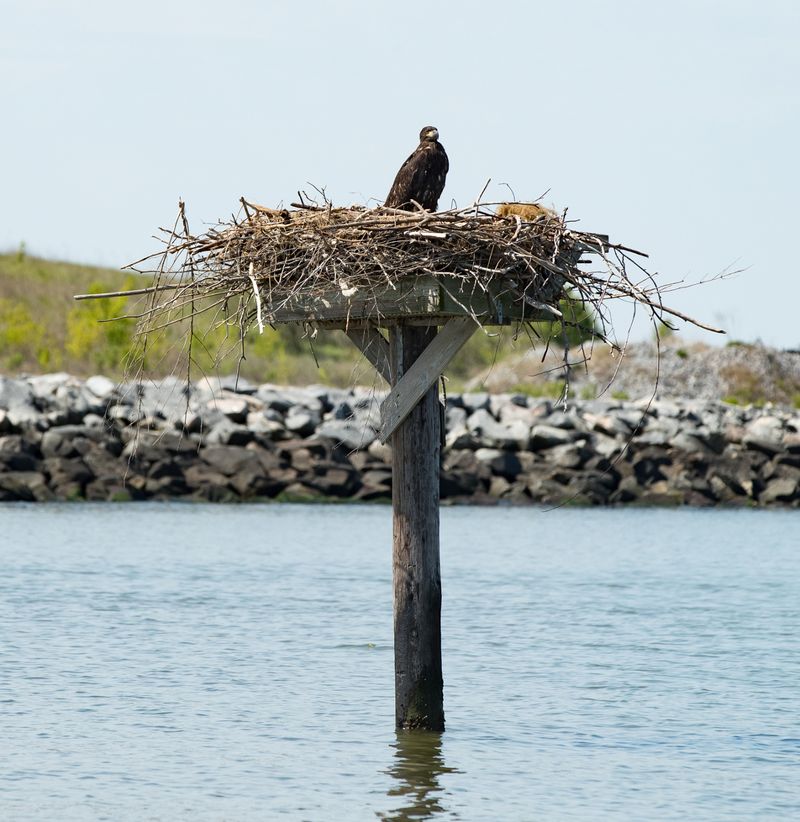
Picture eagle nesting habitat and a giant tree usually comes to mind. That is a big part of it, but good nesting areas also need perches with views over places to find food.
Virginia’s landowner guidelines describe nests as generally near coastlines, rivers, large lakes, or streams with adequate food.
The same guidance also notes that nests occur on cliffs and on human-made structures. So the nest site itself is not always a tall pine or sycamore, and a tall tree does not guarantee a nest.
Habitat features and actual nests are two separate things. Your property might have mature trees and an open view, but that only means it has some traits eagles use.
It does not mean a pair has built there, or that the spot would suit them.
Likewise, a lack of big trees does not prove that no nest exists nearby. Eagles may use sites on neighboring land or structures that you cannot easily see.
If you are curious, learn the habitat pieces and look at your surroundings as a whole. Treat any tree, tower, or ledge as a possible clue only.
Real evidence of a nest comes from separate observation, which the next section covers.
A sighting is not the same as a nest
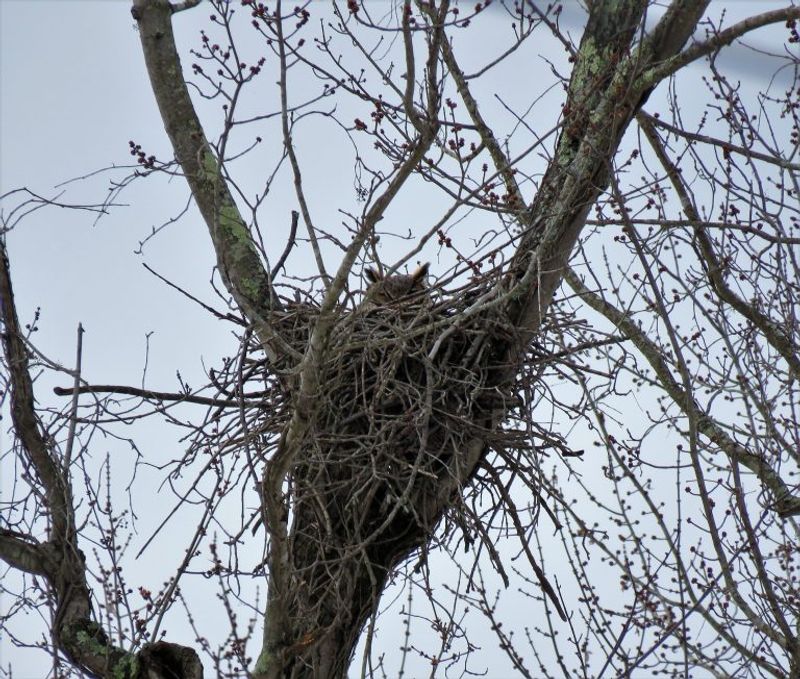
Not all eagle sightings mean the same thing. A flyover is a bird passing through.
A brief perch means the bird stopped, perhaps to rest or look around. Repeated visits suggest your area is part of a route or feeding range.
An occupied nest is something else entirely.
Even repeated appearances do not confirm a nest by themselves. The species may range widely, as the U.S.
Fish and Wildlife Service notes, so a bird that shows up weekly could be living a mile or more away.
To check for known nests, try the Center for Conservation Biology’s Virginia eagle nest locator. Treat it as a starting point.
Its page says some nests go unrecorded and parts of Virginia are not covered by the survey.
That means a clear map does not prove your area is nest-free, and a marked nest does not describe every detail. If you suspect a nest, watch from a distance for signs such as a large stick structure with adults coming and going.
Keep your viewing quiet and far enough away that the birds behave normally. Their calm behavior is a good sign that you are not bothering them.
Check before work that could affect eagles
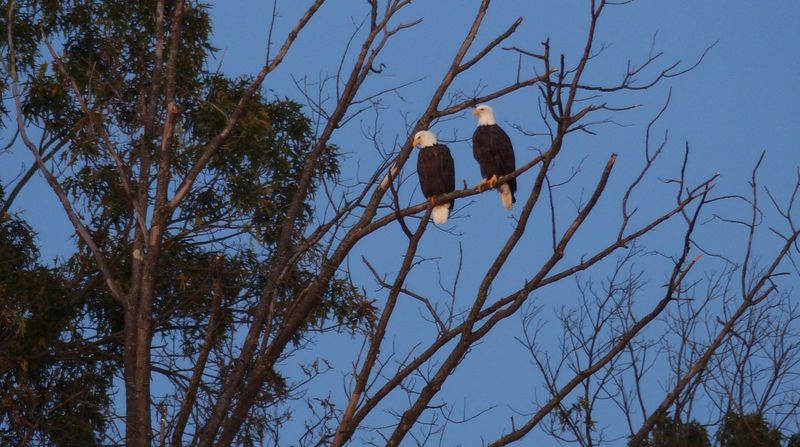
Planning to build, clear trees, or work along a shoreline? Eagles in the area are a reason to pause and gather information first.
Begin by confirming whether a nest is known nearby, using the Virginia nest locator as a first step, remembering that it is not complete.
Next, read current guidance from the U.S. Fish and Wildlife Service.
Its eagle disturbance permits and guidance discuss different distances for different activities, and note that established routine activity may be tolerated at some sites.
Because of that, no single number works as a safe buffer for everyone. A sighting does not give you clearance to proceed, and a distance you heard from a neighbor may not fit your project.
Contact the relevant federal and state wildlife authorities and describe your plans.
Do this before the work starts, since changes are easier on paper than after equipment arrives. Keep notes on what you saw and when, since they can help wildlife staff understand the situation.
In the meantime, watch any nest only from a distance and never approach it. Skip drones near nests, and do not try to flush a bird for a better look.
Calm, distant viewing keeps the birds safe and keeps you on the right side of the rules.
If you find an injured eagle
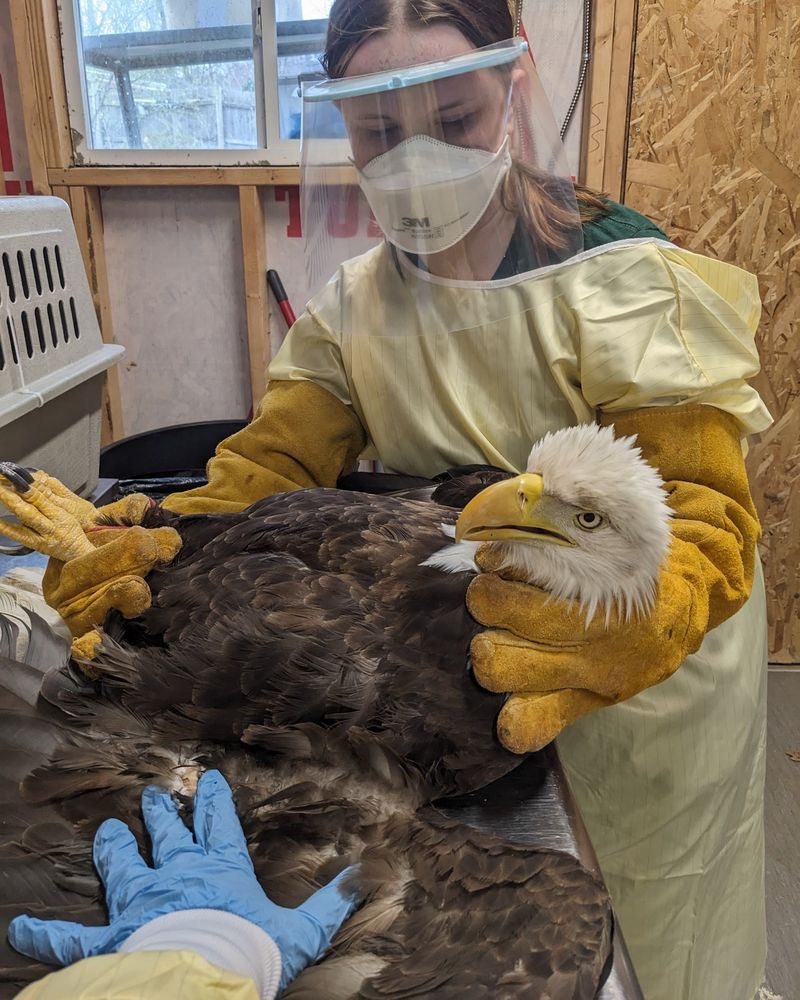
An eagle on the ground that cannot fly is a hard sight, but do not try to pick it up. Large birds have powerful talons and beaks, and handling can hurt both you and the bird.
Keep people and pets back and let the animal stay quiet.
Instead, call for professional help. The Virginia Department of Wildlife Resources advises leaving large injured birds to wildlife professionals.
Its wildlife-conflict helpline, 1-855-571-9003, can help you locate a permitted rehabilitator.
When you call, share the location, what you see, and how the bird is behaving. Stay nearby only if it is safe and the bird is not further stressed.
The same careful thinking applies to every eagle encounter. A sighting can point to resources somewhere in the broader area, but it cannot name the exact food source or prove that your property holds a nest.
The sky tells you a story, though never the whole one.
Share this story