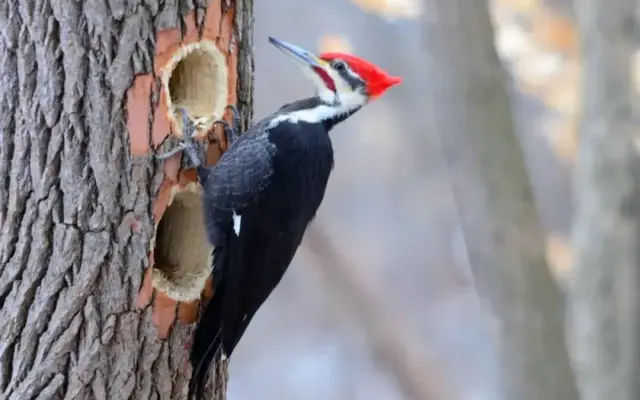
A crow-sized bird with a flaming red crest is pounding on a tree in your yard, and it is a Pileated Woodpecker that is very likely after carpenter ants. The holes it leaves can be big enough to fit your hand, which makes many people wonder if the tree is in trouble.
The answer depends on more than the hole. Here is how to read the clues without panic.
Look for the bird’s red crest and white stripes
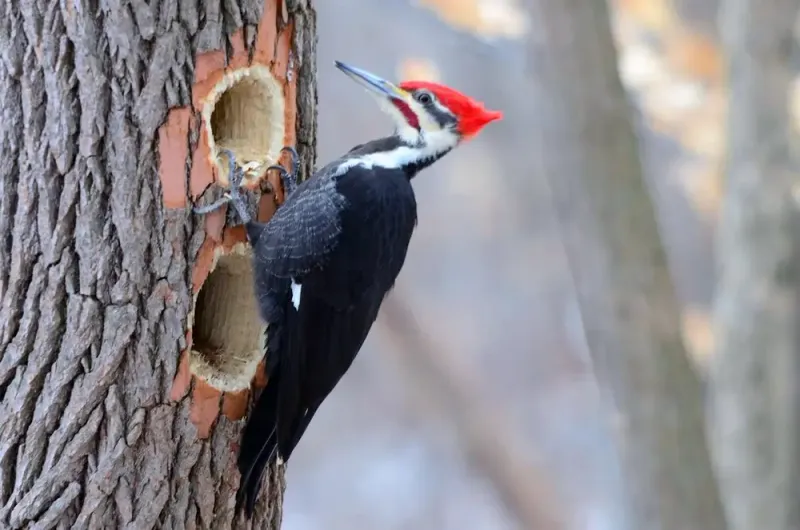
Picture a bird nearly as big as a crow, mostly black, with a pointed red crest that looks like a tiny flame. That is the look of a Pileated Woodpecker, and you can often spot it from across the yard.
Check the face and neck next. Cornell’s identification guide describes bold white stripes running along the face and down the neck.
Males also wear a red stripe on the cheek, while females do not, so a bird with a red crest but no cheek stripe is likely a female.
In flight, look for flashes of white under the wings against a dark body. The bird moves with deep, flapping wingbeats and often lands low on a trunk, bracing itself with its stiff tail.
Those visible markings are a far better way to name the bird than the hole it leaves behind. A big opening in a trunk could have other explanations, so if you have not actually seen the crest and stripes, treat the identification as likely rather than certain.
Once you have a good look at the bird, the next question is what it is doing at your tree. Watching its behavior for a few minutes can tell you a lot, and the holes it leaves tell a story that is more complicated than it first appears.
A large hole can have more than one purpose
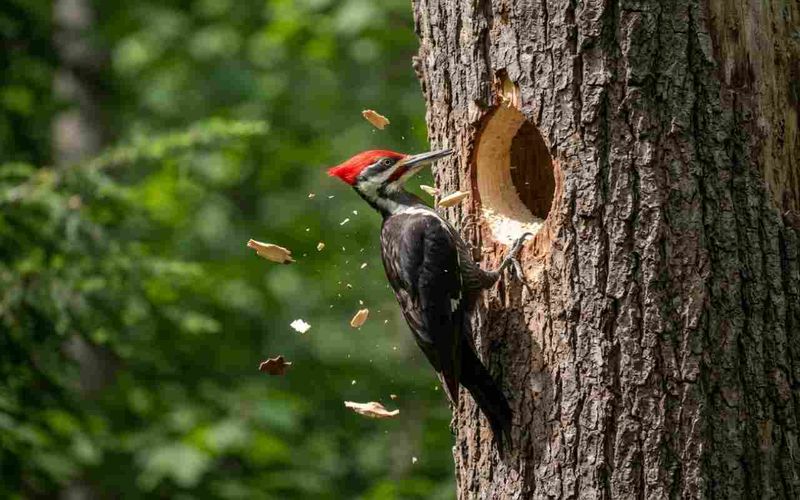
Pileated Woodpeckers are famous for chiseling large, deep, rectangular holes. Cornell’s life history page describes these feeding excavations, which the bird makes while searching for carpenter ants hidden inside wood.
Ants are not the only target, though. The birds also eat wood-boring beetle larvae and other insects, and the National Park Service notes they forage in dead, decaying, or insect-bearing wood.
One study gives a sense of how important ants can be. Research in the coastal forests of Washington found carpenter ants made up 54 percent of the birds’ diet there.
That number belongs to that place and that study, not to every woodpecker everywhere.
There is another wrinkle. These woodpeckers also carve large cavities for nesting, so a big opening might be a nursery or a bedroom rather than a dining room.
That means the shape of a hole, a pile of fresh chips, or even the bird’s presence cannot prove what it was after. Without watching the bird work, or finding other clues, treat the purpose as an open question.
Carpenter ants use softened wood; they do not eat it
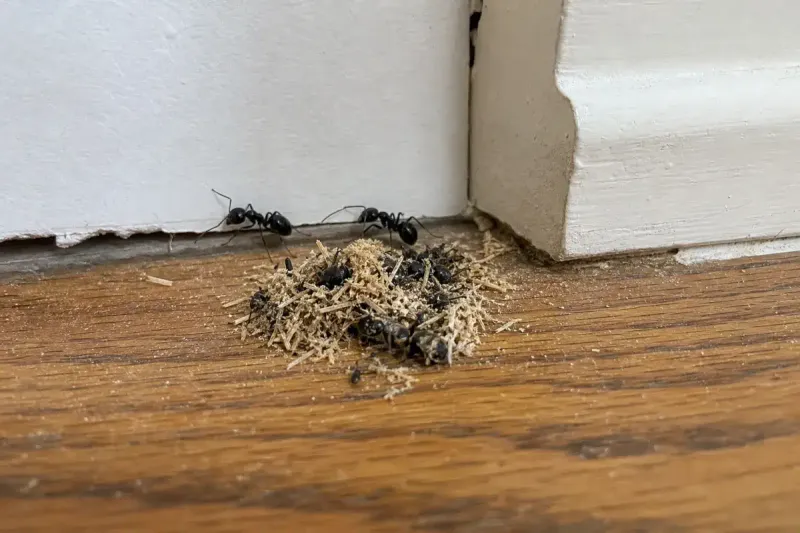
Carpenter ants get blamed for eating wood, but they do not. University of Kentucky entomologists explain that the ants excavate galleries to make nests, then push the shavings out of the openings.
They commonly pick wood that is already soft, moist, or decaying. That is why a colony can show up in a stump, a hollow limb, or a damaged section of a trunk.
Here is where the woodpecker comes in. A bird hunting ants will go after the parts of a tree where those galleries exist, and those parts tend to be weakened.
The hole may be a search through a pocket of softer wood.
Ants can point to decay that is already there. They do not tell you what caused it, whether from an old wound, a broken branch, or water getting in, and they do not necessarily cause it themselves.
They also do not reveal the tree’s overall condition. As Penn State Extension points out, carpenter ants are not generally considered a forest pest.
A colony in one decayed spot is a clue about that spot, not a verdict on the whole tree.
A hole is a reason to inspect, not a tree-risk verdict
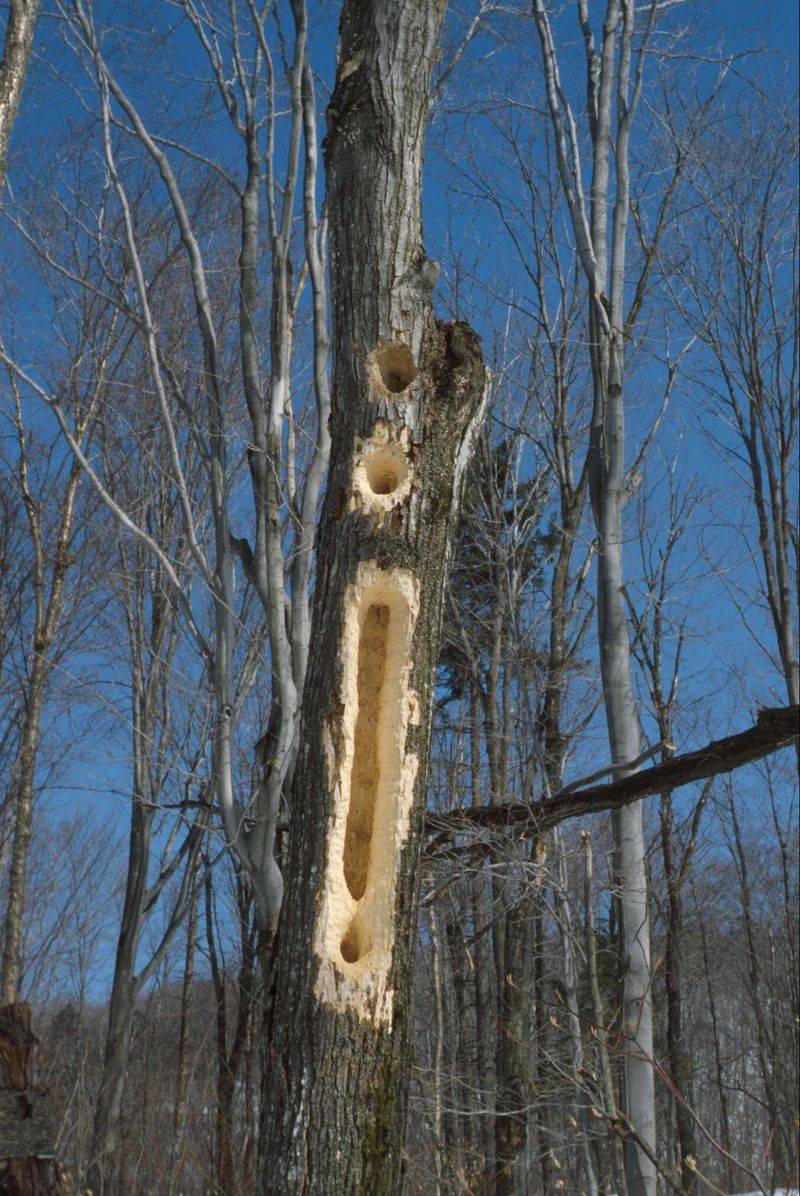
So is your tree doomed? Not necessarily.
A woodpecker excavation can signal insects or weakened wood, but it does not prove the tree is dangerous or must come down.
A tree can be alive and leafy while parts of its wood are compromised. The National Park Service notes that these birds can forage on weakened living trees as well as dead ones, so green leaves alone do not settle the question.
The reverse is true too. Decay does not automatically make a tree hazardous.
University of Kentucky Forestry Extension explains that a small amount of decay does not by itself make a tree hazardous, while large amounts of decay and major cracks deserve attention.
What matters is how much sound wood remains, where the weak area sits, and the tree’s overall condition. A hole high in a limb is a different story from a wide cavity near the base of a leaning trunk.
Think of the hole as a visible clue, not a diagnosis. It tells you to look closer, and the next step is learning what to look for.
Check the tree and what it could hit
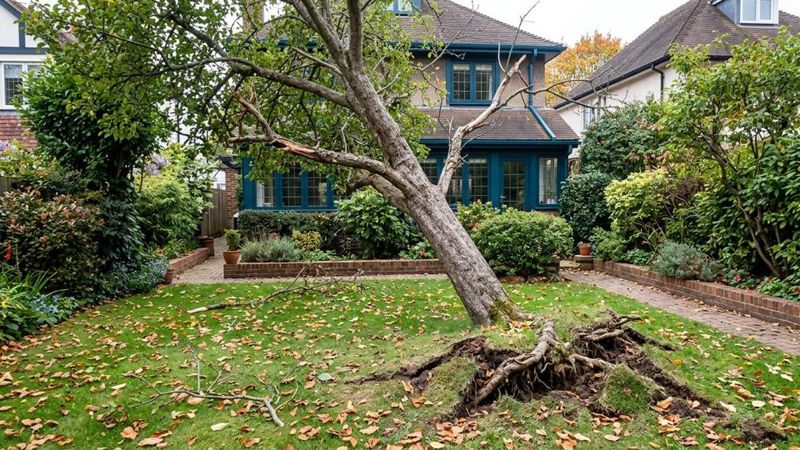
Walk around the tree and look at the whole thing, not just the hole. Kentucky Extension guidance points to broader warning signs, including substantial rotten or crumbling wood, cavities, loose bark, large cracks, dead branches, and a significant lean.
No single sign settles the matter. A few dead twigs are normal, while several signs together deserve a closer look.
Next, think about targets. Ask what would be hit if a trunk or large limb came down: a house, a driveway, a walkway, a play area, a picnic spot, or a parked car.
Urgency rises when something valuable or occupied sits in the fall zone. A damaged tree at the back of an empty field is a lower priority than one leaning over a patio.
If you see substantial defects, or the tree could strike a place where people spend time, arrange an on-site assessment by a qualified arborist or professional forester. They can look at the roots, trunk, and crown up close and give specific recommendations that no photo or checklist can match.
Ants in a tree do not automatically need treatment
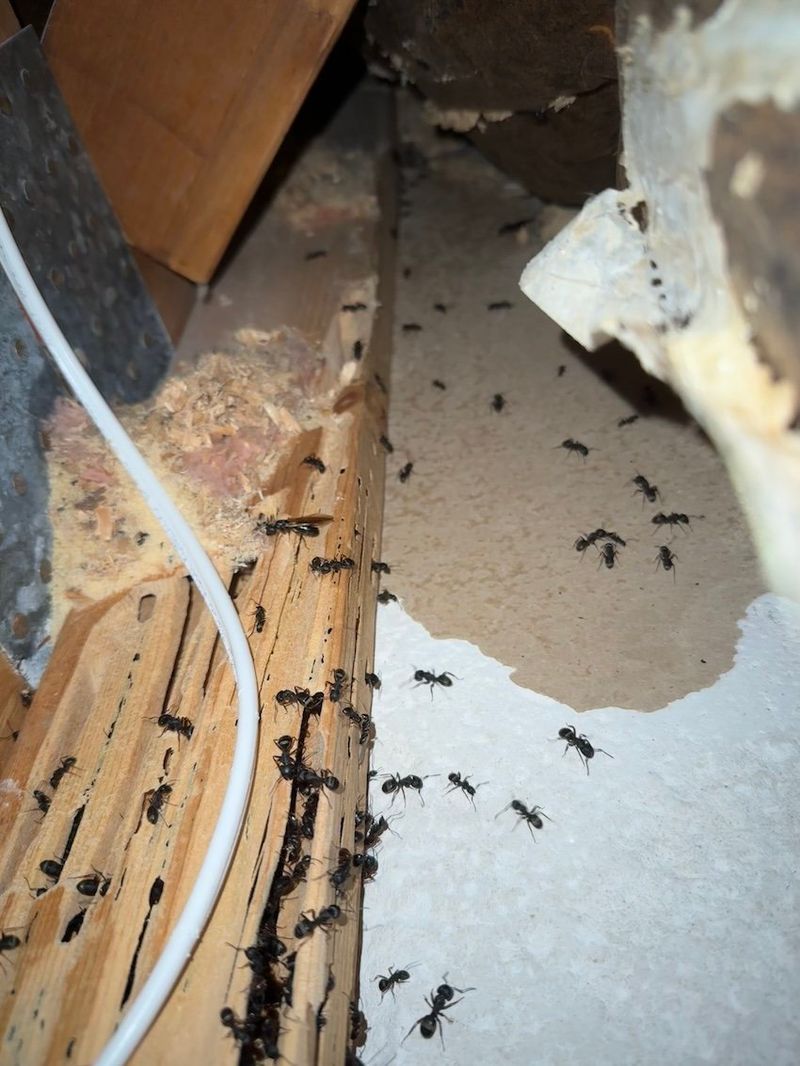
Seeing carpenter ants on a tree can feel like a call for spray, but it usually is not. Penn State Extension says these ants are not generally considered a forest pest, so a colony in a tree does not automatically mean the tree needs pesticide.
An outdoor colony in a decayed limb or stump is part of how a yard works. It may even be a meal source for the woodpecker you enjoy watching.
The situation changes if ants start showing up inside your house. A nest near a building can raise concern about ants moving into walls or other structures.
If that worries you, talk with a reliable pest professional who can inspect the home and the setting. That is better than assuming the tree is the problem and treating it on a hunch.
Leave a suspected active cavity undisturbed
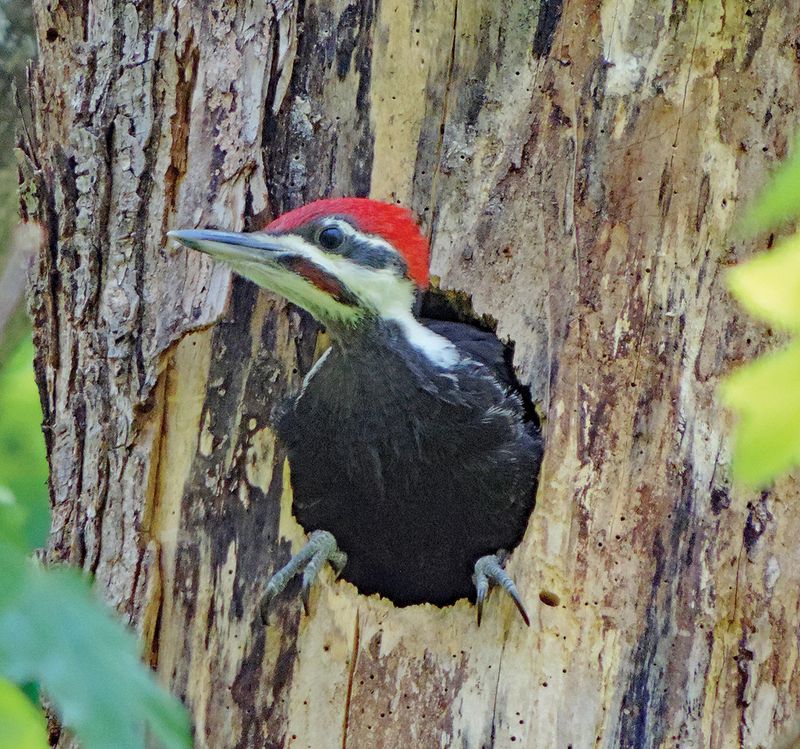
Tree care and wildlife rules can overlap. The Pileated Woodpecker is on the federal list of protected migratory birds under the Migratory Bird Treaty Act.
Federal guidance, including a 2025 Fish and Wildlife Service memo on nests, says destroying an in-use nest requires authorization.
That does not mean every hole is occupied. Many old cavities sit empty.
But if you see birds coming and going from an opening, or hear begging calls from inside, treat it as possibly active.
In that case, do not cut into the cavity or remove the tree section holding it until you have checked the applicable rules and gotten appropriate advice. Your state wildlife agency or the Fish and Wildlife Service can point you in the right direction.
If the tree also worries you, an arborist can help you plan the work around the birds rather than against them.
Use the excavation as a clue
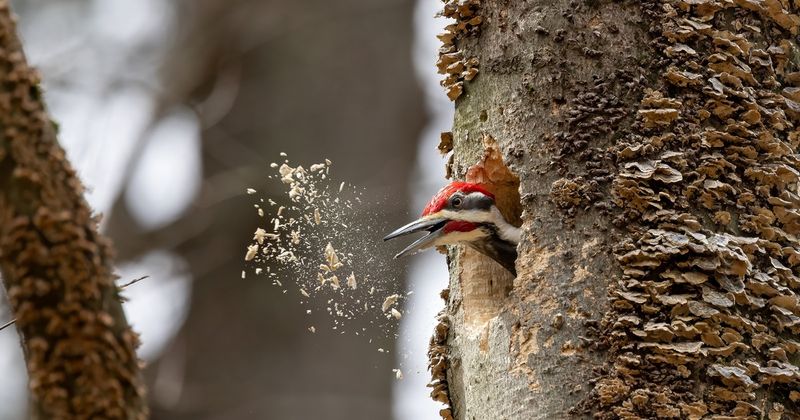
Start with the bird. The red crest and white stripes identify it, and the hole can mean feeding or nesting.
Neither the hole nor the ants diagnose a dangerous tree. Step back, study the whole trunk, and note what stands beneath it, then call a qualified arborist if serious defects and a real target are both present.
Meanwhile, enjoy the show. A woodpecker that big is a reward of a yard with old wood in it.
Share this story