
If a neighbor’s vine has crossed your fence, the general answer in Ohio is simple: you can trim it back to the property line, but not past it. That line is the usual limit described by Ohio appellate courts, though it is not a written rule made just for vines.
Where you stand, what you cut, and how you cut it can all change your legal risk. Here is how to handle the vine without starting a bigger problem.
The usual limit is the property line

Ohio courts describe the general limit for trimming a neighbor’s overgrowth as the property boundary. In Rababy v.
Metter, the Eighth District Court of Appeals adopted what is known as the Massachusetts Rule. Under that approach, a landowner whose neighbor’s ordinary vegetation grows across the line can use self-help, which means cutting the growth back to the boundary.
So the short version for a vine is this: the part that has crossed onto your land is the part you can generally trim. The line itself is the stopping point.
Cutting beyond it is where trouble can start.
Keep the source of this rule in mind. It comes from common law, which is law built from court decisions, and not from a statute that spells out how to cut vines.
No Ohio vine-specific law gives exact instructions for tools, timing, or technique. The opinion mentions branches, leaves, vines, and shrubs in general terms, but the facts in front of the court involved trees.
That makes the property line a solid starting point and not a full set of directions. Think of it as the outer edge of what you can safely do.
Everything else, such as how you cut and what the cutting does to the plant, still needs care, and the next sections cover those details.
The clearest cases concern trees and branches
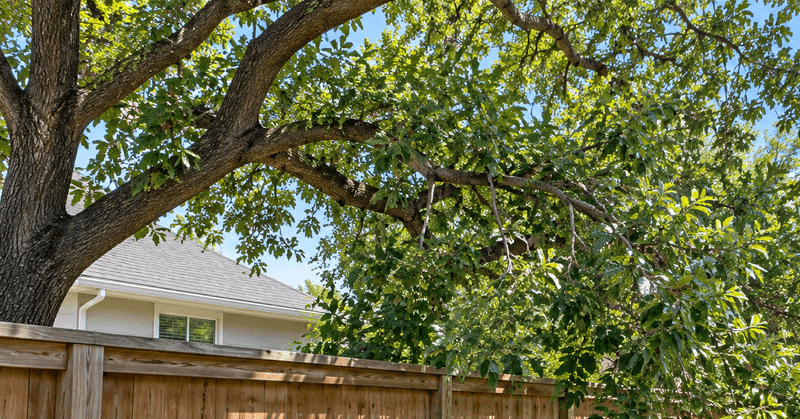
Court decisions on this topic lean heavily on trees. Rababy talks about vegetation broadly, yet the dispute before the Eighth District involved trees.
It is an appellate decision from one Ohio district, so it is strong guidance but not a universal manual for every plant.
A second case adds a warning. In Brewer v.
Dick Lavy Farms, the Second District recognized a common-law privilege to remove encroaching tree branches. The court also held that the privilege is not absolute.
It is limited by the need to avoid injuring the neighbor’s property, and liability was upheld after extensive tree damage during fence-row clearing.
Put the two cases side by side and a careful principle appears. You may deal with growth that crosses onto your land, but you must not harm what belongs to your neighbor while doing it.
What the cases do not give you is a detailed statewide procedure for trimming every kind of vine. A morning glory, a trumpet vine, and a thick woody wisteria can behave very differently, and no Ohio appellate decision sorts them out.
Treat the tree cases as a sensible guide by comparison, not as a promise that every vine and every cutting method is covered.
A fence does not establish the property line

Many people assume the fence is the boundary. Often it is not.
Fences get built a little inside a lot line, a little outside it, or replaced years later in a slightly different spot.
That matters because the property line is the limit in the court decisions. If you trim to the fence and the real line sits on the other side of it, you could be cutting plant growth that is still on your neighbor’s land.
Ohio Farm Bureau’s landowner toolkit gives similar boundary cautions for people dealing with trees and property rights.
Start with what you already have. Look at your deed, your closing paperwork, and any survey from when you bought the house.
Survey pins or markers at the corners can also give clues, and a licensed surveyor can mark the line if the answer still is not clear.
If the location is uncertain, pause before cutting. Waiting a week costs little compared with a dispute over a plant you may have had no right to touch.
Ohio law does not require you to give notice before ordinary trimming. Still, a friendly conversation about where the line runs can head off hard feelings.
Trim on your side without damaging the rooted plant

Picture a vine rooted in your neighbor’s flower bed and reaching across the fence into your yard. The part hanging over your side is the growth you can generally cut back to the boundary.
The roots, the main stem, and the rest of the plant on their side are a different matter.
Staying on your side of the line is the first habit to build. Do not step onto the neighbor’s land to reach a better angle, and do not let clippings fall into their yard.
Ohio Farm Bureau’s landowner toolkit offers similar cautions about boundaries and debris.
The second habit is to avoid work likely to kill or seriously harm the plant. Cutting a vine off at its roots, pulling it out, or heavily stripping it can move from trimming into damaging someone else’s property.
In Brewer, the Second District upheld liability tied to extensive tree damage, and that shows the privilege to trim has limits.
A few practical choices help. Use clean hand pruners, cut only what has crossed, gather the clippings on your side, and take photos before and after.
If a cut would leave the plant badly hurt, stop and rethink.
Reckless injury can create a separate legal risk
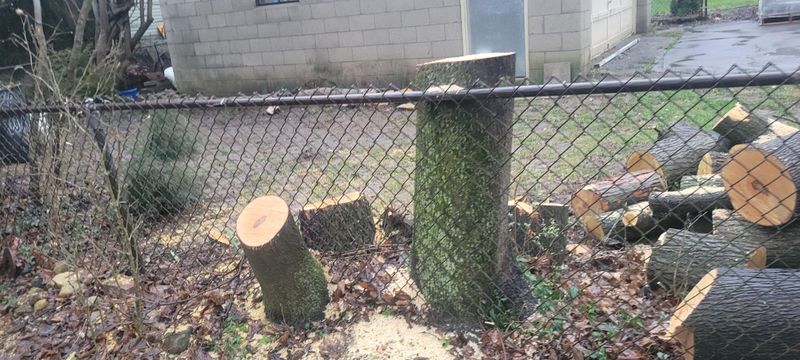
Besides the court-made rules, Ohio has a statute that protects plants. R.C. 901.51 says that, without privilege, a person may not recklessly cut down, destroy, or otherwise injure a vine or other listed vegetation growing on someone else’s land or on public land.
A violation can bring treble damages, meaning three times the injury caused.
Two words in that rule carry weight: recklessly and privilege. Not every bit of damage leads to liability, and treble damages do not follow automatically.
The statute also does not give a detailed cut-here rule for overhanging vines.
Chemicals show how fact-specific these disputes can be. In Hayes v.
Carrigan, a First District case, neighbors fought over bamboo and chemical treatment. The court did not decide that bamboo was covered by the statute, and it found the evidence of recklessness insufficient.
That outcome rested on its own facts. It is not approval of herbicide use, and it does not mean spraying from your own side is safe.
Chemical drift or runoff that harms plants on another’s land can lead to a real dispute, so skip the sprays near a neighbor’s plants.
The four-foot weed rule is not permission to cut vines
Some Ohioans hear about a four-foot rule and assume it allows them to clear whatever grows near a shared fence. It does not.
That rule comes from a different set of laws with a narrow purpose.
R.C. 971.33 deals with partition fences. It requires an owner to keep specified brush, briers, thistles, and other noxious weeds cut in fence corners and in a four-foot strip on that owner’s own side.
The section also says it does not affect planting vines or trees for use.
So the statute puts a duty on each owner to manage certain weeds on their own side. It does not hand you a right to remove a neighbor’s vines, and it does not replace the common-law boundary rule for growth that crosses the line.
If a neighbor does not keep up with those weeds, R.C. 971.34 sets out a separate path. An adjoining owner can give at least 10 days’ notice and then notify the township trustees.
If the trustees find just cause, they may arrange for the cutting.
That process is for specified weeds and brush beside a statutory partition fence. A decorative vine on a backyard fence generally falls outside it.
Pause if the line or likely damage is uncertain
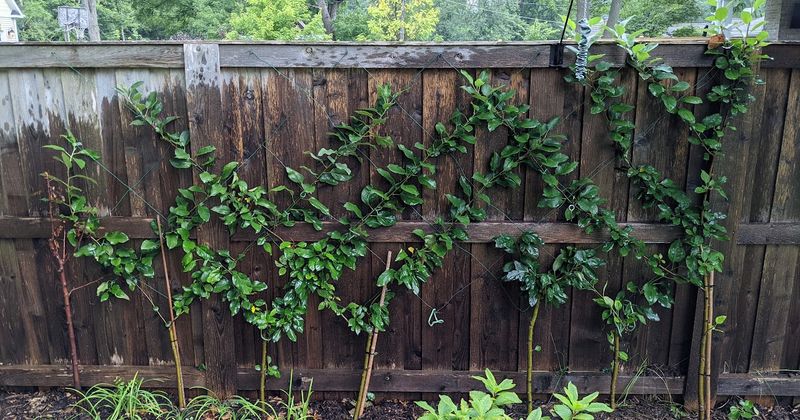
When doubt shows up, slow down. Confirm where the boundary really sits, and keep any trimming to growth on your side of it.
These are prudent choices, not legal requirements for ordinary trimming.
If the line is disputed, or if the work could badly hurt a large plant or a shared structure, ask your neighbor for agreement first or talk with a qualified advisor, such as a surveyor or an Ohio attorney. Ohio Farm Bureau’s landowner toolkit is a useful starting point, and the Brewer decision shows how costly careless cutting can become.
A vine can grow back in a season, but a strained relationship with the people next door often lasts much longer.
Share this story