Get the latest garden guides in your inbox →
Gardening Latest
  • General Gardening
  • Lawn Care
  • Plant Care
  • Composting
  • Soil Health
  • Backyard
  • Garden Muse Magazine
  • General Gardening
  • Lawn Care
  • Plant Care
  • Composting
  • Soil Health
  • Backyard
  • Garden Muse Magazine
  • News
  • Gardening Calendar
  • Garden Structures
  • Vegetable Garden
  • Vertical Garden
  • Raised Beds
  • Hydroponics
  • General Equipment
  • Community Gardens
Garden Themes
  • Spiritual Garden
  • Hydroseeding
  • Seeding and Laying Sod
  • Artificial Grass
  • Lawn Care Equipment
  • Plants
  • Trees
  • Planting Tools
  • Composting Basics
  • Fertilizer
  • Alternative Growing Mediums
  • Front Yard
  • Backyard Activities
  • Landscaping
Gardening Latest

Explore by state

Which state is your garden in?

Currently viewing Iowa

All states

Northeast

  • Connecticut —
  • Delaware 10
  • Maine —
  • Maryland 3
  • Massachusetts 12
  • New Hampshire —
  • New Jersey 3
  • New York 6
  • Pennsylvania 6
  • Rhode Island —
  • Vermont —

Southeast

  • Alabama 3
  • Arkansas —
  • Florida 3
  • Georgia 3
  • Kentucky 11
  • Louisiana 2
  • Mississippi —
  • North Carolina 1
  • South Carolina 10
  • Tennessee —
  • Virginia 2
  • West Virginia —

Midwest

  • Illinois 2
  • Indiana 4
  • Iowa 10
  • Kansas —
  • Michigan 3
  • Minnesota 2
  • Missouri 2
  • Nebraska —
  • North Dakota —
  • Ohio 3
  • South Dakota —
  • Wisconsin 11

Southwest

  • Arizona 3
  • Colorado —
  • Nevada —
  • New Mexico —
  • Oklahoma —
  • Texas 2
  • Utah —

West

  • Alaska —
  • California 3
  • Hawaii —
  • Idaho —
  • Montana —
  • Oregon —
  • Washington —
  • Wyoming —

No state matches that search.

Site menu

Gardening Latest
  • General Gardening
    • News
    • Gardening Calendar
    • Garden Structures
    • Vegetable Garden
    • Vertical Garden
    • Raised Beds
    • Hydroponics
    • General Equipment
    • Community Gardens
    Garden Themes
    • Spiritual Garden
  • Lawn Care
    • Hydroseeding
    • Seeding and Laying Sod
    • Artificial Grass
    • Lawn Care Equipment
  • Plant Care
    • Plants
    • Trees
    • Planting Tools
  • Composting
    • Composting Basics
  • Soil Health
    • Fertilizer
    • Alternative Growing Mediums
  • Backyard
    • Front Yard
    • Backyard Activities
    • Landscaping
  • Garden Muse Magazine

Explore

  • About GardeningLatest.com
  • Contact Us

Get the latest from the garden

New guides on lawn care, plants and backyard projects, sent when they go up.

Subscribe →

Follow

  • Facebook
  • X
  • Pinterest
  • YouTube
Iowa Gardening

Here’s What It Means When Iowa Rhubarb Shoots Up a Giant Flower Stalk, and Whether to Cut It Off

One morning your rhubarb patch looks normal, and a few days later a thick, tall stalk is towering over the leaves…

LP

By Lyle Petersen

November 19, 2026 · 6 min read

Here’s What It Means When Iowa Rhubarb Shoots Up a Giant Flower Stalk, and Whether to Cut It Off
Here's What It Means When Iowa Rhubarb Shoots Up a Giant Flower Stalk, and Whether to Cut It Off

One morning your rhubarb patch looks normal, and a few days later a thick, tall stalk is towering over the leaves. It can look strange, and many gardeners worry something has gone wrong.

The good news is that this is a normal part of the plant’s life. Here is what the stalk means and what to do about it if you grow rhubarb to eat.

At a glance

Where
Iowa Gardening
Hardiness zone
5 −20 to −10°F
Read
6 minutes
Published
November 19, 2026

What does a giant flower stalk mean?

What does a giant flower stalk mean?
© Gardening Know How

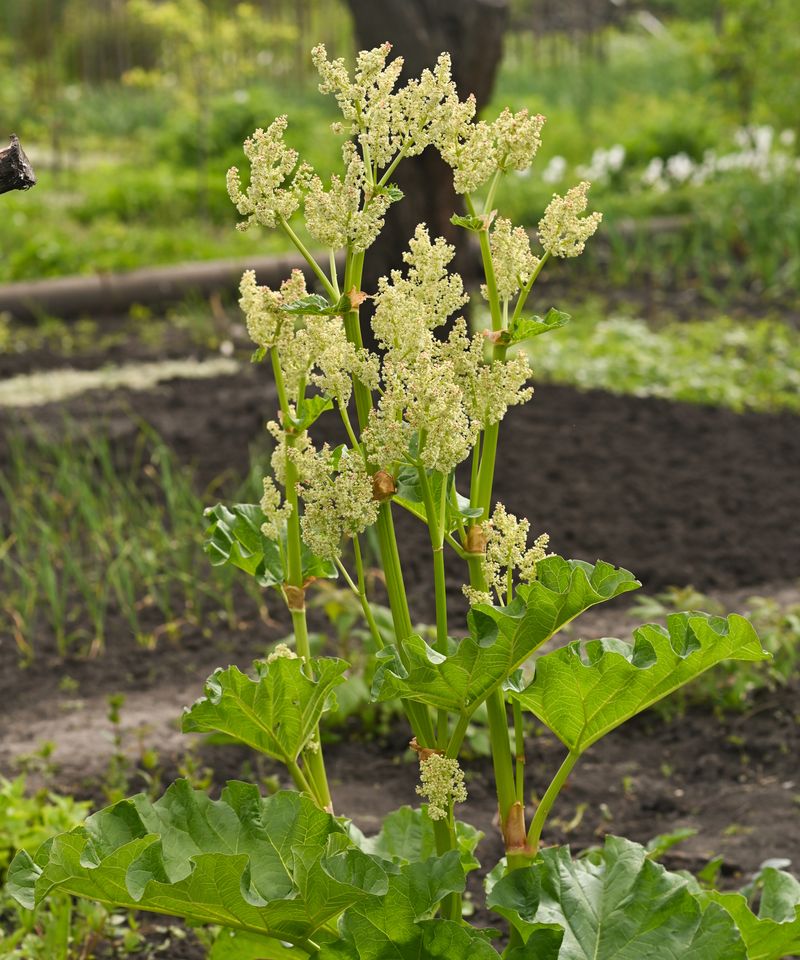
That tall, chunky stalk rising from the center of your rhubarb is its flower stalk, sometimes called a seed stalk. It tells you the plant has moved into its reproductive phase, the stage where it tries to make flowers and seed.

Nothing about that is unusual for a rhubarb plant.

Many gardeners assume a stalk like this means the plant is sick or about to die. Iowa State Extension describes blooming as something rhubarb plants do, and it does not treat a flower stalk alone as proof of disease.

A single stalk is not a death sentence for the plant.

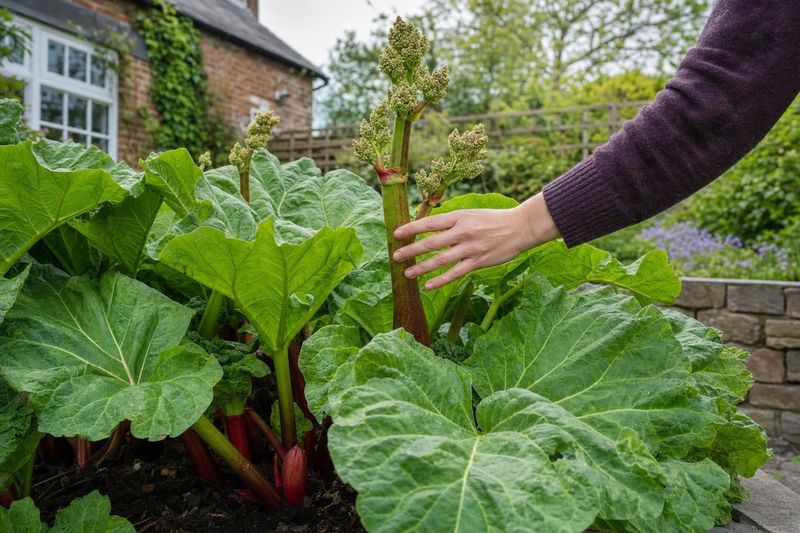
It helps to know which part is which. The flower stalk is thick, round, and grows up from the middle of the crown, ending in a bulky bud cluster that opens into small blooms.

The stalks you harvest for pies and sauce are the leaf stalks, which are flatter, often reddish or green, and each one holds up a big leaf.

Because these parts have different jobs, advice about one does not apply to the other. Purdue’s guidance on rhubarb flowers makes the same split, treating the bloom as its own thing and the harvest stalks as another.

Once you can tell them apart, the next steps get much easier.

Several conditions can prompt flowering
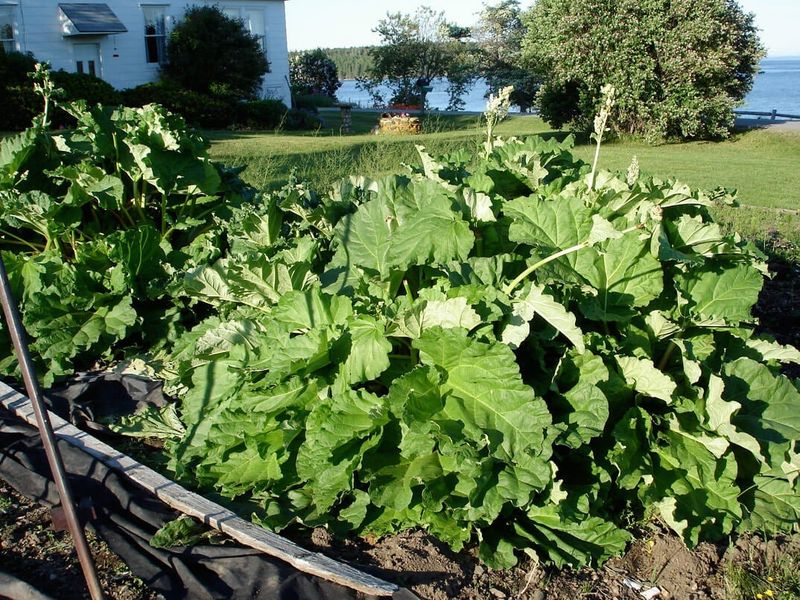
Several conditions can prompt flowering
© Bonnie Plants

Gardeners often want to know why their plant flowered this year. Extension sources point to a handful of possible reasons, and a flower stalk alone cannot tell you which one applies to your plant.

Think of the list as clues to consider, not a diagnosis.

Iowa State lists infertile soil, heat or cold, drought, and older plants as possible factors. Plant age matters because a patch that has been in the ground for many years is more likely to send up blooms than a young one.

A rhubarb plant can send up another flower stalk after the first is gone, as Purdue notes.

Stress from weather swings or a dry spell can also nudge a plant toward flowering.

Purdue adds variety, maturity, heat, drought, and poor nutrition to the mix. Some varieties simply flower more readily than others.

That means two plants side by side can behave differently even in the same bed.

Looking at your own garden may give you ideas. Did a hot, dry stretch come before the stalk showed up?

Has the patch gone years without compost or fertilizer? Is it an old clump that has never been divided?

For general care, Iowa State’s rhubarb growing guide covers soil, feeding, and watering practices that support a healthy plant. Good care will not guarantee that a plant never flowers, but it keeps the patch in better shape overall.

For a harvest-focused plant, remove the stalk promptly
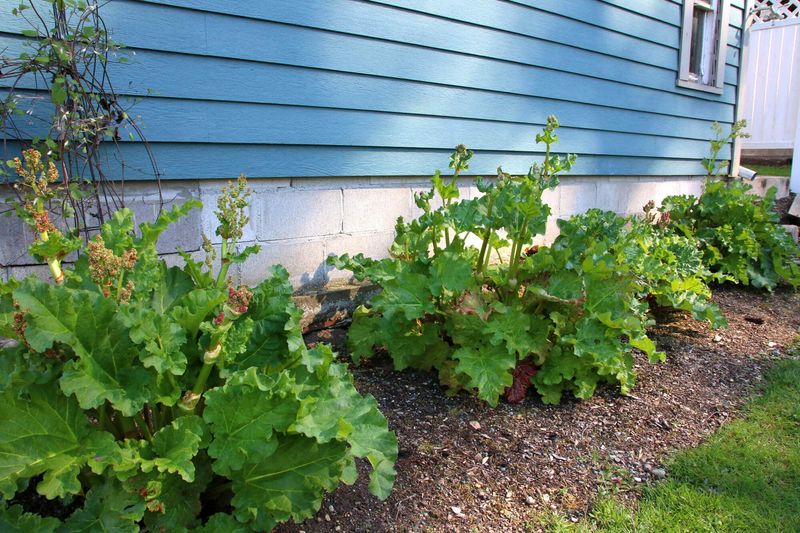
For a harvest-focused plant, remove the stalk promptly
© The Daring Gourmet

If you grow rhubarb mainly for the kitchen, take the flower stalk off as soon as you spot it. Cut or pull it close to the base, and discard it rather than leaving it in the bed.

Go slowly so you do not nick or tear the crown, which is where all your future growth comes from.

Iowa State advises pulling the stalk and throwing it away. Flowering and seed formation take energy that could otherwise go into leaves and leaf stalks, and they can reduce the plant’s vigor and cut into edible stalk production.

Utah State Extension also recommends removing flower stalks at the base. Taking them off early means the plant does not spend extra effort on blooms and seed.

Be realistic about what to expect. Removing the stalk supports the plant, but it does not promise bigger stalks or a larger harvest right away.

Think of it as removing a drain on the plant, not flipping a switch.

A clean cut or a firm, steady pull near the base works well. Keep tools clean and sharp if you use them, and keep your hands low and careful around the crown.

The same Iowa State growing guide stresses protecting the crown during this job.

Check for another stalk—and decide whether you want the bloom
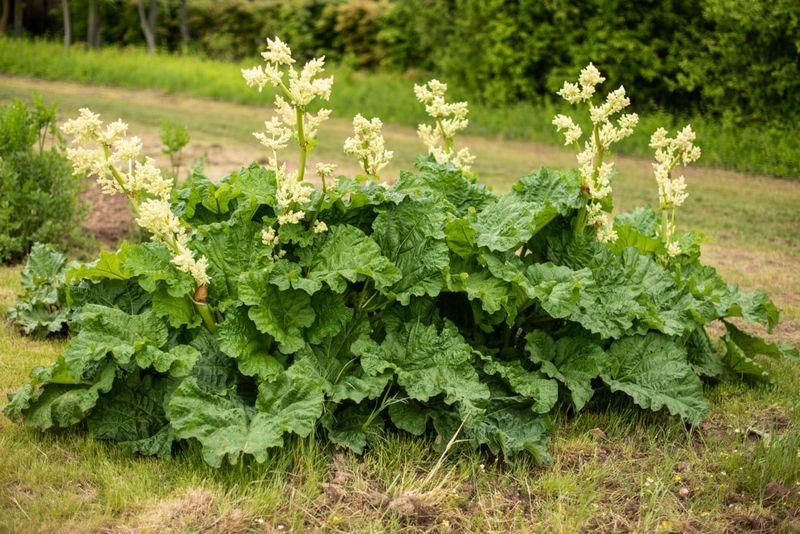
Check for another stalk—and decide whether you want the bloom
© Rural Sprout

Taking one stalk off does not always end the story. A rhubarb plant can send up another flower stalk after the first is gone, as Purdue notes.

Peek into the center of the plant every few days, and remove any new stalk the same way you took off the first.

A quick walk through the garden while you check on your other crops makes this easy to remember. Early catches are simple, because young stalks are small and cut or pull away with little effort.

Not everyone wants to cut the flowers, and that is a fair choice. Purdue says gardeners who enjoy the bloom can let the plant flower, then cut the stalk after the flowers fade so seed does not mature.

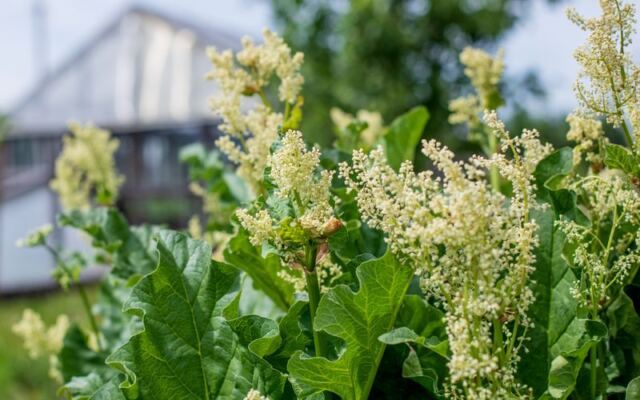
The big airy flower heads can be an eye-catching feature in the back of a border.

Keep in mind that this is a tradeoff. A plant that is blooming is putting less focus on making edible stalks.

If harvest matters most to you, early removal is still the better path, and letting the plant flower is the option for those who value looks over a bigger pick.

Flowering does not make the edible stalks poisonous
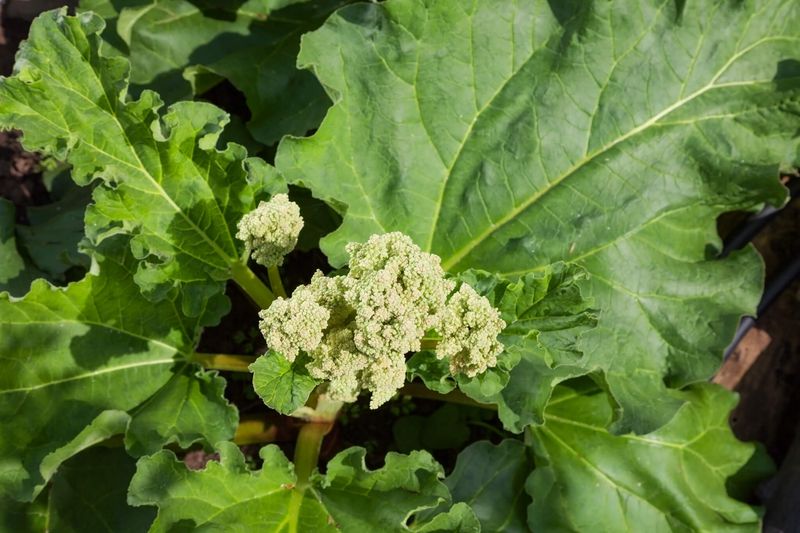
Flowering does not make the edible stalks poisonous
© Purdue University

A common worry is that a flowering plant turns all of its rhubarb bad. That is not the case.

Purdue says the ordinary leaf stalks remain edible when a flower stalk is present, so you can keep picking them as usual.

Three plant parts are worth keeping straight. The flower stalk is the thick central shoot that you remove for the plant’s sake.

The leaf stalks are the ones you eat. The leaf blades are the broad green tops, and they are a different matter entirely.

Rhubarb leaves contain more oxalic acid than the edible leaf stalks, and they should never go into food. Illinois Extension gives the same caution about the leaves.

Trim them off right after harvest and toss them in the compost or trash.

A simple kitchen habit helps. Cut the leaf off at the top of each stalk before you carry the stalks inside, so no blades end up near the cutting board.

That way, flowering or not, only the right part ever reaches your recipe.

Remove it and keep watch
Remove it and keep watch
© Netmums

If you grow rhubarb to eat, take off the flower stalk near the base and keep your cuts clear of the crown, as Iowa State recommends. Look again in the days ahead for any new stalk and remove it too.

A flower stalk is just rhubarb being a plant, and a quick snip keeps it focused on the stalks you came for.

Share this story
LP

Written by

Lyle Petersen

More from Lyle Petersen →

About Gardening Latest

Gardening Latest provides in-depth guides to maintaining and enhancing your garden and backyard. Learn how to make the most of the space you have and create a beautiful garden.

More about us →

Latest stories

  • Wisconsin GardeningWisconsin Bars All Fertilizer on Frozen Turf, While Phosphorus Lawn Fertilizer Faces a Separate Restriction

    Wisconsin Bars All Fertilizer on Frozen Turf, While Phosphorus Lawn Fertilizer Faces a Separate Restriction

    30 min ago
  • Massachusetts GardeningWhat Winter Owl Hoots in Massachusetts Can and Cannot Tell You

    What Winter Owl Hoots in Massachusetts Can and Cannot Tell You

    1 hr ago
  • Delaware GardeningHow Delaware Gardeners Can Winterize a Rain Barrel Before Freezing Weather

    How Delaware Gardeners Can Winterize a Rain Barrel Before Freezing Weather

    1 hr ago
  • Kentucky GardeningDo This To Your Outdoor Faucets Before A Hard Kentucky Freeze Splits The Pipe Inside Your Wall

    Do This To Your Outdoor Faucets Before A Hard Kentucky Freeze Splits The Pipe Inside Your Wall

    1 hr ago
  • South Carolina GardeningSouth Carolina Yards Hide These Venomous Creatures, And Here’s How To Tell Each One Apart

    South Carolina Yards Hide These Venomous Creatures, And Here’s How To Tell Each One Apart

    1 hr ago

Gardening by state

Stories for your state, and the hardiness zone most of it gardens in.

Keep exploring

Read next

All Iowa Gardening →
Iowa GardeningEating Celery Every Day In Iowa? Here’s What It Does To Your Body
Iowa Gardening

Eating Celery Every Day In Iowa? Here’s What It Does To Your Body

5 hr ago
Iowa GardeningWhat Those Coyote Howls Near Your Iowa Home at Night Really Tell You, and What They Don’t
Iowa Gardening

What Those Coyote Howls Near Your Iowa Home at Night Really Tell You, and What They Don’t

19 hr ago
Iowa GardeningVenomous Critters Live Closer Than You Think In Iowa Yards, And Fall Is When They Show Up
Iowa Gardening

Venomous Critters Live Closer Than You Think In Iowa Yards, And Fall Is When They Show Up

Yesterday

More from Iowa Gardening

  • There’s a Venomous Mammal in Iowa That Weighs Up to 1 Ounce, and It Lives in Lawns and Underground

    Nov 17
  • Tiny Flies in an Iowa Bedroom: Finding Where They Actually Started

    Nov 15
Back to top

Leave a response Cancel

Your email address stays private. Required fields are marked with an asterisk.

Gardening Latest

In-depth guides to maintaining and enhancing your garden and backyard: how to make the most of the space you have, and how to make it beautiful.

  • Facebook
  • X
  • Pinterest
  • YouTube

We may earn a portion of sales from products or services that are purchased through our site as part of our affiliate partnerships with retailers.

Explore

  • About GardeningLatest.com
  • Contact Us
  • Terms and Conditions
  • Privacy
  • Editorial Note:
  • FTC Disclosure

Newsletter

New garden guides and seasonal tips, straight to your inbox.

We’ll email you a link to confirm. Unsubscribe any time.

Almost there! Check your inbox and tap the link to confirm.

© 2026 Gardening Latest. All rights reserved.

Back to top