A tall flower stalk on your rhubarb is a normal part of the plant’s life, and it does not mean the plant is sick. If you grow rhubarb to eat, you should remove the stalk near its base, though the plant may send up another one.
The edible leaf stalks are still fine to eat, and the big leaf blades still go in the trash. Here is what that tall shoot is, why it shows up, and what to do next.
A flower stalk is part of rhubarb’s life cycle
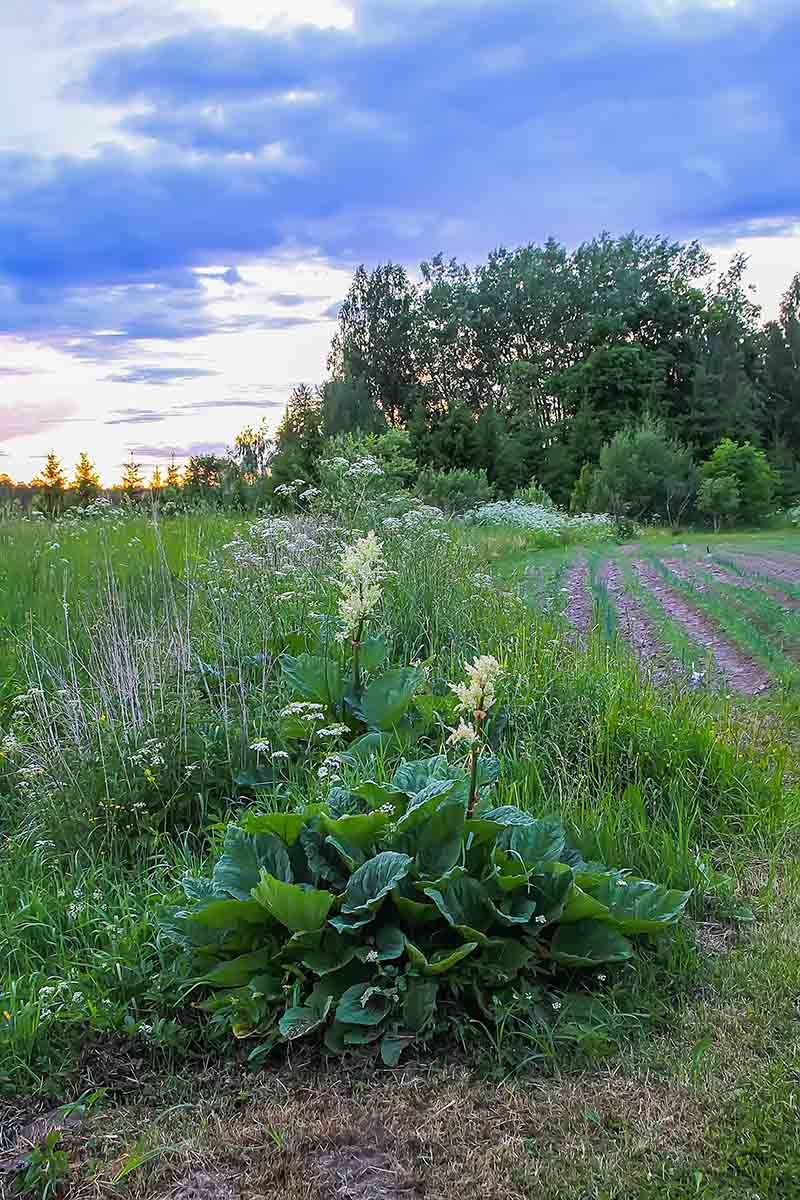
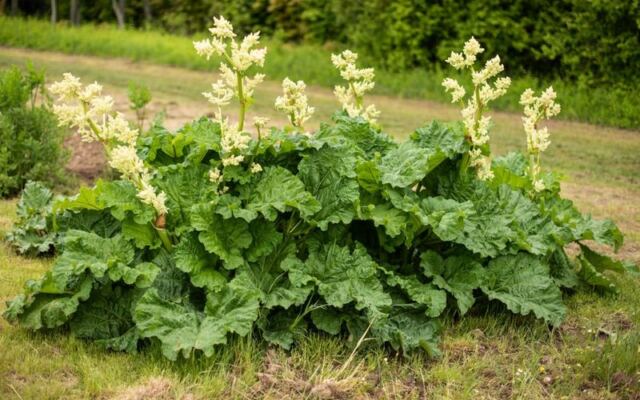
Walk out to the garden one morning and you might find a thick, knobby shoot rising well above the usual leaves. It can look a bit alien, with a swollen bud at the tip that opens into a feathery plume of tiny cream or pinkish flowers.
Many gardeners in Michigan and elsewhere notice these shoots and wonder if something has gone wrong.
Nothing has. That tall stalk is a reproductive shoot, and gardeners often call the habit bolting.
The plant is doing what rhubarb does naturally, which is to try to make flowers and seeds. Purdue’s rhubarb guidance treats flowering as part of the plant’s ordinary behavior rather than as a disease symptom.
It helps to know how to tell the flower stalk from a regular leaf stalk. The flower stalk is usually taller, rounder, and more rigid, and it grows from the center of the crown with a bulbous bud on top.
Regular leaf stalks, called petioles, are the flat-ish, celery-like stems that end in a big leaf blade.
Plenty of Michigan gardeners mention seeing these shoots in their own beds. Those personal observations are a useful reminder that the habit is common, but they do not add up to proof of a statewide surge.
Each plant makes its own choices, and your neighbor’s crown may behave differently from yours.
So there is no need to worry or to tear anything out. A flower stalk simply gives you a decision to make about what you want from the plant this season, and the next sections walk through those choices.
Several factors can lead rhubarb to flower
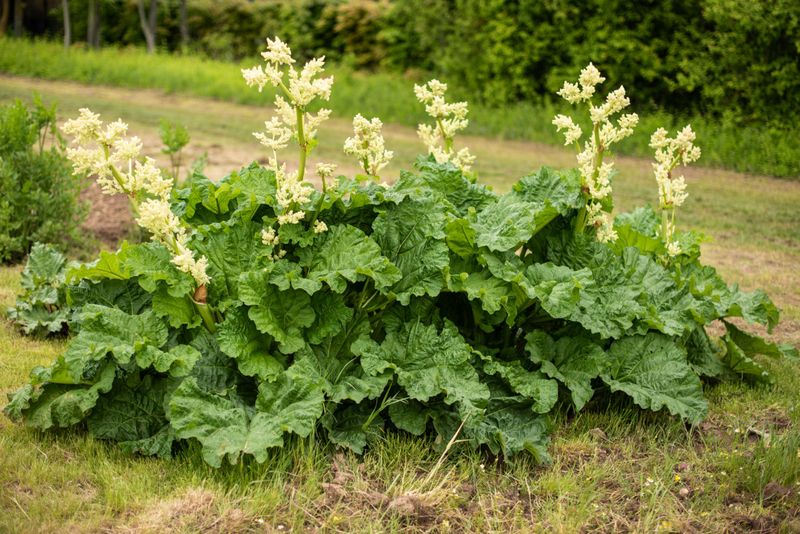
Ask five gardeners why their rhubarb flowered and you may get five different answers. Part of the reason is that there is no single trigger.
Mature plants tend to flower more often than young ones, so an old, well-established clump is a likely candidate.
Variety matters too. Some types are simply more inclined to send up flower stalks than others.
Heat, long dry stretches, and poor nutrition can also play a role, according to Purdue and Iowa State Extension. These factors can work alone or together.
Here is the catch: the flower stalk itself cannot tell you which one is at work. A tall shoot does not prove your soil is hungry, your summer was too dry, or your crown is overcrowded.
Guessing from the stalk alone can send you chasing the wrong fix.
A better approach is to look at the whole picture. Think about how old the plant is and whether you know its variety.
Consider whether it has had steady water during dry weeks, and when you last added compost or other organic matter to the bed.
If everything else looks healthy, with firm stalks and big green leaves, you can simply treat the flower stalk as normal behavior. If the plant also looks weak or the stalks are thin, that is a reason to review watering and feeding, not a diagnosis the flower stalk made for you.
Remove the flower stalk if you grow rhubarb to eat
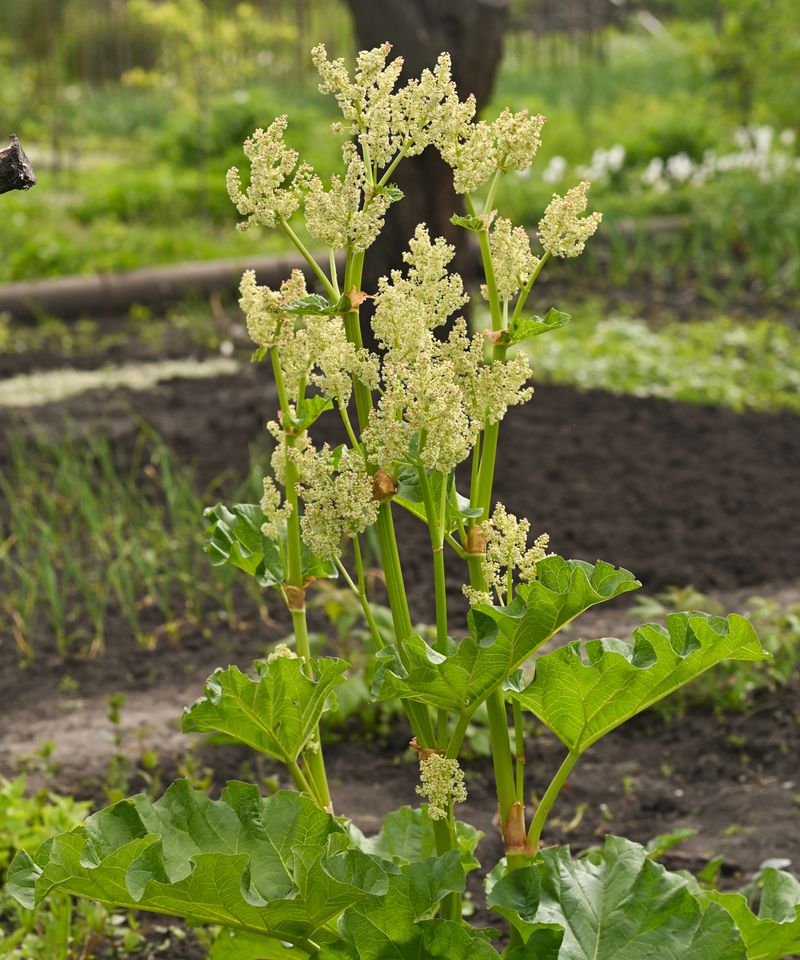
If your goal is a basket of tender stalks for pies and sauce, take the flower stalk off soon after you see it. Flowering can use resources that might otherwise support edible stalk production.
Michigan State University Extension recommends removing seed stalks because they inhibit petiole production.
Aim to take it off near the base, and be careful not to damage the crown. That is the part that matters most.
Extension advice differs on the exact method: Iowa State suggests pulling and discarding it, while Illinois Extension advises cutting it at the base.
Either approach can work. If you cut, use clean, sharp shears and keep the blade low without nicking neighboring stalks.
If you pull, grip the shoot near the bottom and work gently so you do not tug at the crown.
Do not be surprised if another stalk appears. Purdue notes that a plant may send up a new one, so a quick check every week or so during the growing season is a good habit.
Remove each new one the same way.
Removal is not a guarantee of bigger or more plentiful harvests. It simply keeps the plant from spending resources on a shoot you do not want, leaving it free to keep making the stalks you do.
Flowering does not make the edible stalks unsafe
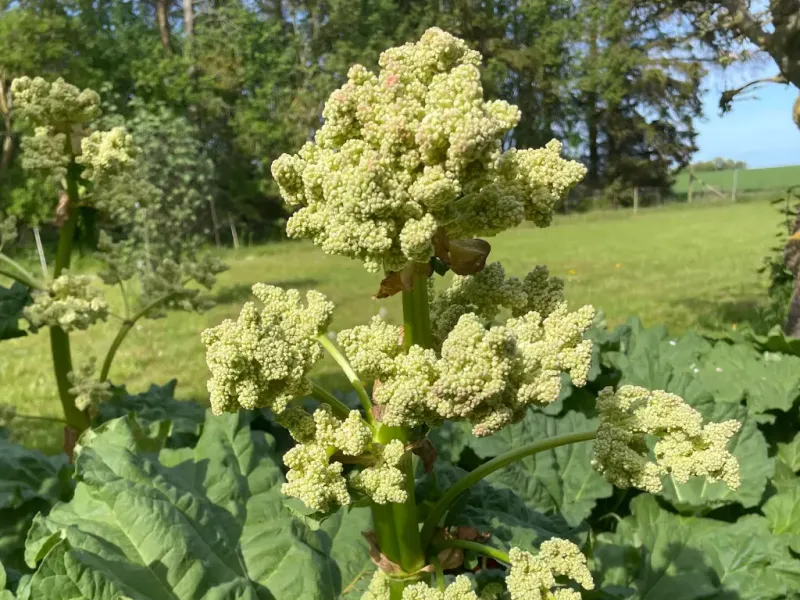
Rumors travel fast in garden circles, and one of them says that once rhubarb flowers, the stalks turn bad. That is not the case.
Purdue says the leaf stalks remain edible when the plant flowers, so you can keep harvesting as usual.
The leaf blades are a different story. They are not edible and should be discarded every time, whether the plant has flowered or not.
University of Minnesota Extension also advises against eating the leaves. Trim them off right in the garden and put them in the compost pile.
Now for a separate issue that has nothing to do with flowers. A hard late-spring freeze can affect rhubarb that has already started growing.
Wisconsin Extension advises against harvesting after such a freeze because the stalks may be poor quality and oxalic acid may have moved into them.
That caution matters in Michigan, where a cold snap can follow a warm early spring. If your plants were hit by a hard freeze, hold off on harvesting and let the foliage recover rather than picking stalks that may be limp or off.
Keep the two ideas apart in your mind. A flower stalk on a healthy plant is no reason to skip dessert, while a hard freeze is a reason to wait.
Keep the ordinary leaves growing
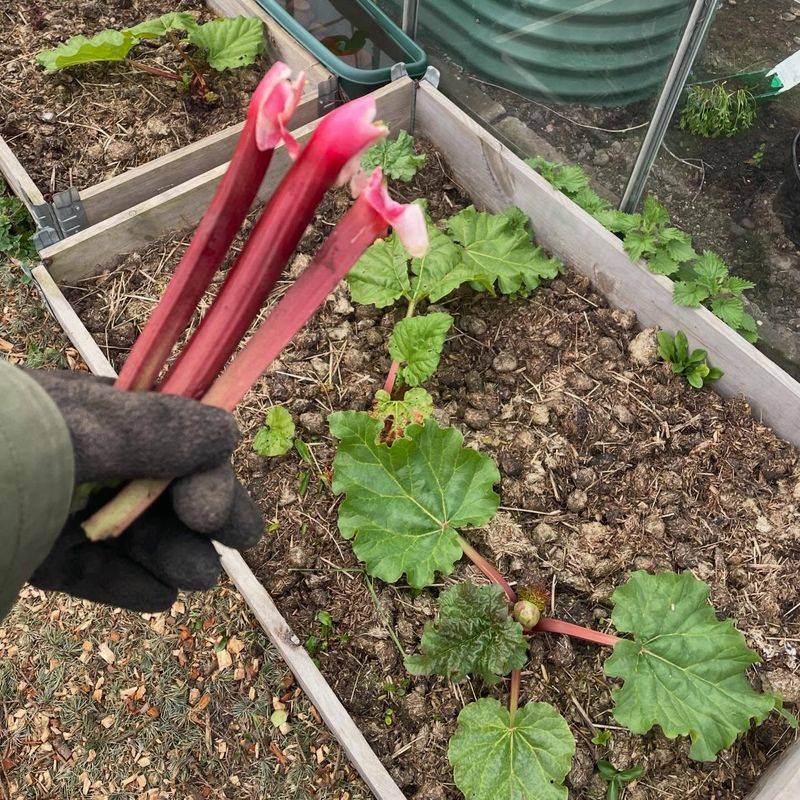
Taking off a flower stalk is a small job, and it is not a reason to strip the rest of the plant. The ordinary leaves are the plant’s solar panels.
They collect energy that supports the crown and feeds future growth, so most of them should stay put.
When you harvest, restraint helps. Michigan State University Extension says not to remove more than half the plant at one time.
After the harvest season ends, University of Minnesota Extension advises letting all the leaves remain.
Do not mix up the two tasks. Removing a flower stalk is one job, while picking leaf stalks for the kitchen is another.
Some guidance suggests pulling and twisting leaf stalks at harvest, which is a different motion from taking out a flower shoot near the base.
New plantings deserve extra patience. Illinois Extension recommends skipping harvest in the first year, taking only a limited amount in the second year, and waiting until the third year for a full season.
A young plant that flowers is a good example of when to be careful. Remove the flower stalk, leave the leaves, and resist the urge to pick.
Letting a new crown build strength now sets you up for years of steady harvests.
You can enjoy the flowers, too
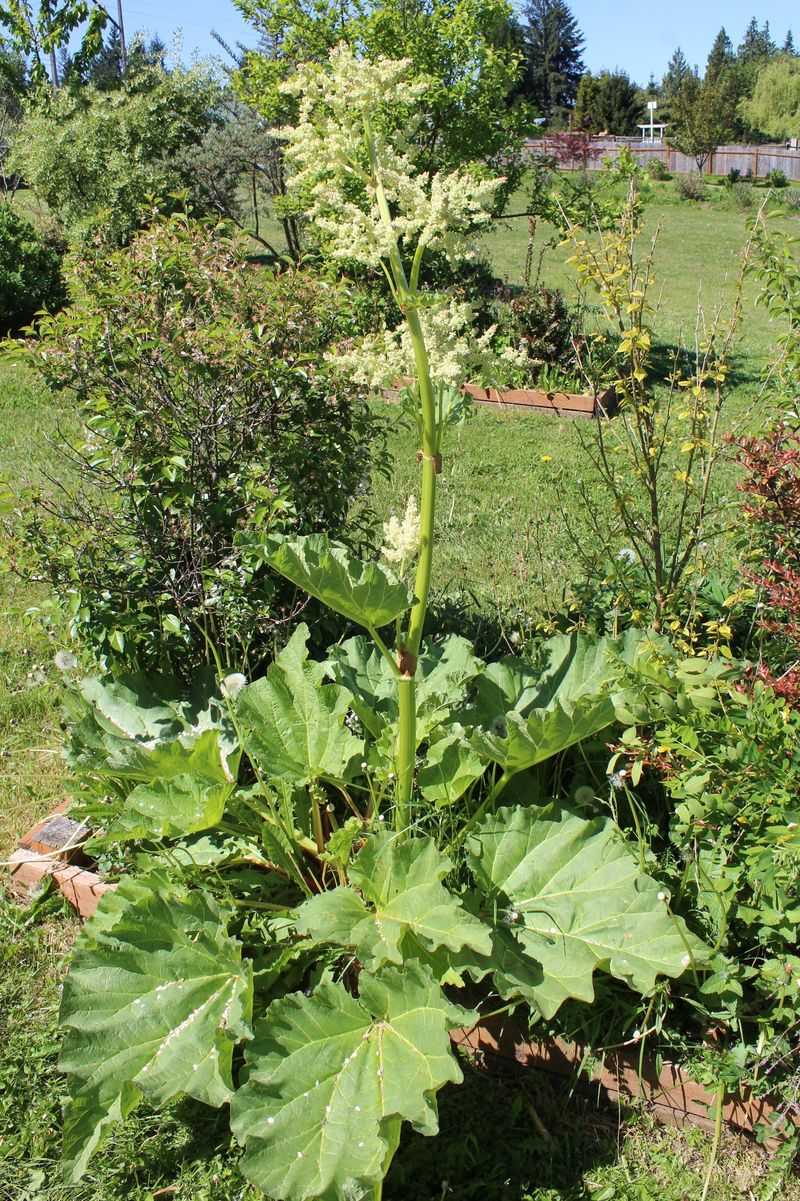
Not everyone grows rhubarb only for pie. Some gardeners like how the tall, frothy blooms look rising above the big leaves, and that is a perfectly reasonable reason to leave one in place.
It is a choice about what you value, not a mistake or an emergency.
The tradeoff is straightforward. A plant that is putting effort into a flower shoot may have less to give to leaf stalks, so if your priority is a big harvest, removing the stalk makes sense.
If you have plenty of rhubarb or simply enjoy the show, keeping one or two blooms does little harm.
A middle path works well for many people. Pick the stalks you want to eat, and leave a single flower stalk on the sturdiest plant while removing the rest.
You get a bit of ornamental interest without giving up the whole crop.
There is one follow-up step. Purdue recommends removing the stalks after flowering to prevent seed maturation.
Once the blooms fade, cut or pull the shoot so the plant does not spend more effort making seeds.
Whichever route you choose, rhubarb is forgiving. It is a tough perennial that has been coming back year after year in northern gardens for generations, and a flower stalk is one of its quirks rather than a flaw.
Share this story