Get the latest garden guides in your inbox →
Gardening Latest
  • General Gardening
  • Lawn Care
  • Plant Care
  • Composting
  • Soil Health
  • Backyard
  • Garden Muse Magazine
  • General Gardening
  • Lawn Care
  • Plant Care
  • Composting
  • Soil Health
  • Backyard
  • Garden Muse Magazine
  • News
  • Gardening Calendar
  • Garden Structures
  • Vegetable Garden
  • Vertical Garden
  • Raised Beds
  • Hydroponics
  • General Equipment
  • Community Gardens
Garden Themes
  • Spiritual Garden
  • Hydroseeding
  • Seeding and Laying Sod
  • Artificial Grass
  • Lawn Care Equipment
  • Plants
  • Trees
  • Planting Tools
  • Composting Basics
  • Fertilizer
  • Alternative Growing Mediums
  • Front Yard
  • Backyard Activities
  • Landscaping
Gardening Latest

Explore by state

Which state is your garden in?

Currently viewing Kentucky

All states

Northeast

  • Connecticut —
  • Delaware 40
  • Maine —
  • Maryland 26
  • Massachusetts 42
  • New Hampshire —
  • New Jersey 26
  • New York 35
  • Pennsylvania 35
  • Rhode Island —
  • Vermont —

Southeast

  • Alabama 26
  • Arkansas —
  • Florida 26
  • Georgia 26
  • Kentucky 40
  • Louisiana 25
  • Mississippi —
  • North Carolina 24
  • South Carolina 39
  • Tennessee 23
  • Virginia 25
  • West Virginia —

Midwest

  • Illinois 25
  • Indiana 27
  • Iowa 39
  • Kansas —
  • Michigan 26
  • Minnesota 25
  • Missouri 25
  • Nebraska —
  • North Dakota —
  • Ohio 26
  • South Dakota —
  • Wisconsin 41

Southwest

  • Arizona 25
  • Colorado —
  • Nevada —
  • New Mexico —
  • Oklahoma —
  • Texas 24
  • Utah —

West

  • Alaska —
  • California 25
  • Hawaii —
  • Idaho —
  • Montana —
  • Oregon —
  • Washington —
  • Wyoming —

No state matches that search.

Site menu

Gardening Latest
  • General Gardening
    • News
    • Gardening Calendar
    • Garden Structures
    • Vegetable Garden
    • Vertical Garden
    • Raised Beds
    • Hydroponics
    • General Equipment
    • Community Gardens
    Garden Themes
    • Spiritual Garden
  • Lawn Care
    • Hydroseeding
    • Seeding and Laying Sod
    • Artificial Grass
    • Lawn Care Equipment
  • Plant Care
    • Plants
    • Trees
    • Planting Tools
  • Composting
    • Composting Basics
  • Soil Health
    • Fertilizer
    • Alternative Growing Mediums
  • Backyard
    • Front Yard
    • Backyard Activities
    • Landscaping
  • Garden Muse Magazine

Explore

  • About GardeningLatest.com
  • Contact Us

Get the latest from the garden

New guides on lawn care, plants and backyard projects, sent when they go up.

Subscribe →

Follow

  • Facebook
  • X
  • Pinterest
  • YouTube
Kentucky Gardening

That Bright Green Snake Draped Over Your Kentucky Shrubs Is a Rough Green Snake, and It’s Eating Your Garden Pests

That slender green snake draped over your shrubs is most likely a rough greensnake, a quiet hedge dweller that eats…

HC

By Hattie Combs

November 27, 2026 · 6 min read

That Bright Green Snake Draped Over Your Kentucky Shrubs Is a Rough Green Snake, and It’s Eating Your Garden Pests
That Bright Green Snake Draped Over Your Kentucky Shrubs Is a Rough Green Snake, and It's Eating Your Garden Pests

That slender green snake draped over your shrubs is most likely a rough greensnake, a quiet hedge dweller that eats caterpillars and crickets. It looks startling, but a correctly identified rough greensnake is nonvenomous.

Many homeowners panic and reach for a shovel, which can cost them a natural insect hunter and put them at risk of a bite. Here is how to size up the snake, what it eats, and how to respond safely.

At a glance

Where
Kentucky Gardening
Hardiness zone
7 0 to 10°F
Read
6 minutes
Published
November 27, 2026

Could This Be a Rough Greensnake?

Could This Be a Rough Greensnake?
© Florida Museum of Natural History – University of Florida

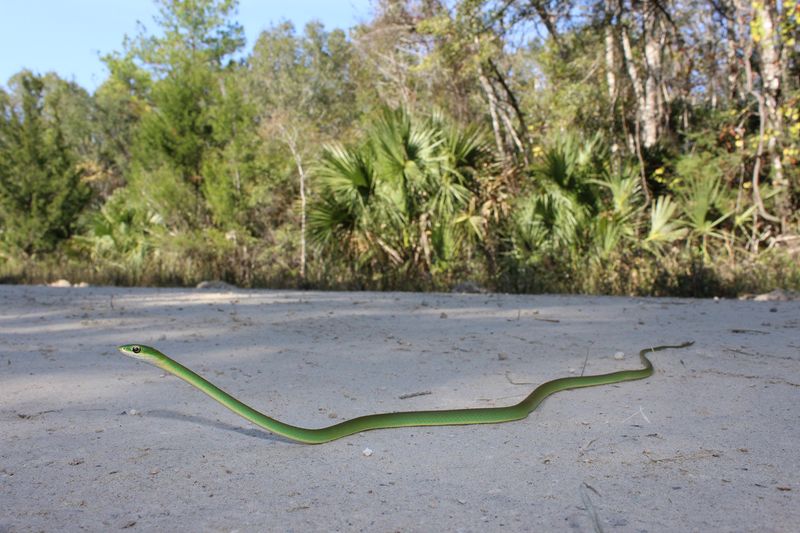
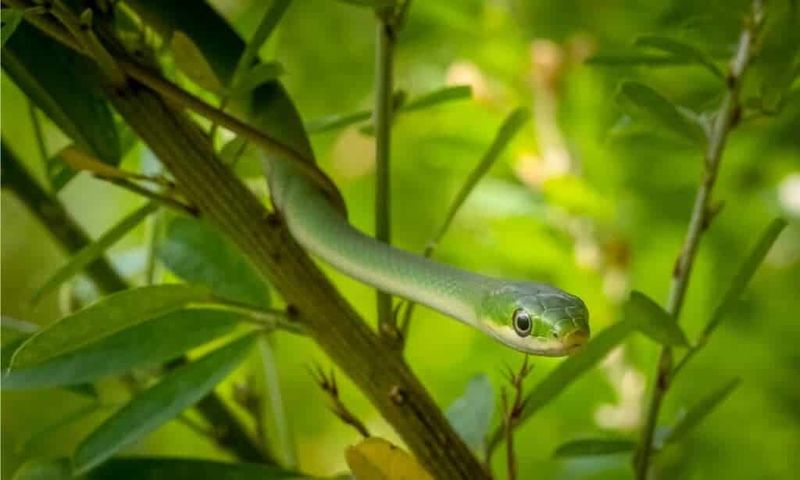
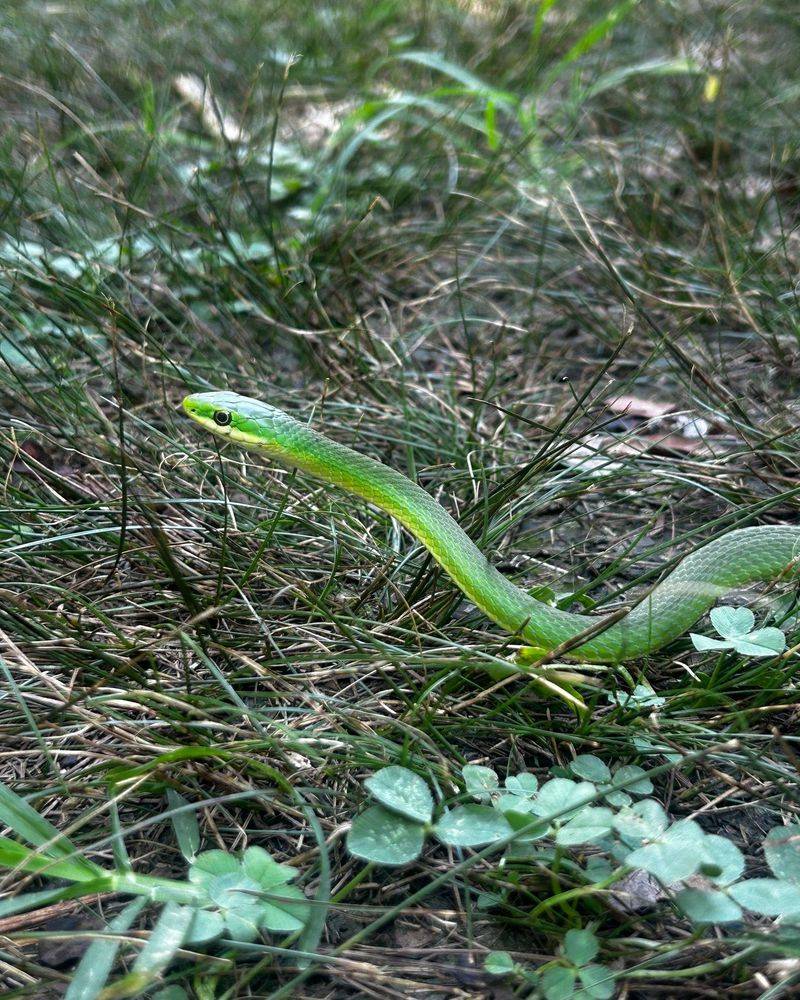
Picture a thin, solid green snake with no stripes, spots, or bands. A rough greensnake (Opheodrys aestivus) fits that look, with a whitish-to-yellow belly and keeled scales, which means each scale has a small ridge down the middle.

The University of Kentucky snake identification page describes the species this way and gives a typical length of about two feet.

The snake occurs throughout Kentucky, so seeing one in almost any county would not be a surprise. Its slim build is a big clue.

It looks more like a living vine than a thick-bodied snake.

Still, a snake with these field marks may be a rough greensnake, not a confirmed one. Bright green color and a shrubby location are not enough to settle the question by themselves.

Lighting, distance, and a quick glance can all fool the eye, and young snakes of other kinds can look different from adults.

The Kentucky Department of Fish and Wildlife Resources field guide is a good place to compare the full set of marks. Compare belly color, body shape, and scale texture to what the guide shows, but only from photos you take at a safe distance.

If you are still unsure, send a clear photo to a qualified local snake-identification resource and let an expert make the call.

Why It May Be in a Shrub or Hedge
Why It May Be in a Shrub or Hedge
© A-Z Animals

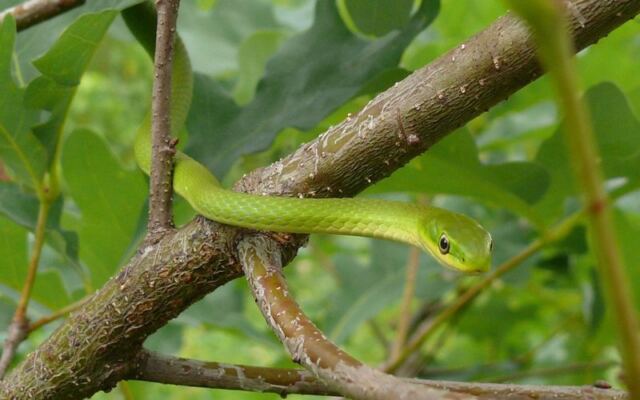
Hedges make sense for this kind of snake. The Kentucky field guide says the rough greensnake is usually found in trees or bushes, and it also uses vines and other shrubby vegetation.

Its slim green body blends into leaves, which is probably why so many people spot one only when it moves.

According to the University of Kentucky species page, that menu includes crickets, grasshoppers, spiders, and caterpillars.

That makes a garden shrub, a tangle of honeysuckle, or a foundation planting a plausible place to meet one. A yard with plenty of woody cover gives a climbing snake room to rest and hide.

Habitat is a hint, though, not proof. Plenty of snakes pass through shrubs, so a sighting in a hedge does not prove the species.

Think of location as one small piece of the puzzle, to be weighed along with body shape, belly color, and scale texture.

It also does not show that the snake came to hunt a particular pest. A snake resting on a branch may be warming up, hiding, or simply traveling.

Without seeing it catch something, you cannot say what it was doing there. A calm, distant look and a photo are the most useful things a homeowner can do.

Nonvenomous Does Not Mean Safe to Handle
Nonvenomous Does Not Mean Safe to Handle
© friendsofshelby

Species traits are one thing and personal safety is another. University of Kentucky information lists the rough greensnake as nonvenomous, and that holds only when the snake has been correctly identified.

It does not mean every green snake is harmless, and it is not an invitation to pick one up.

If you are not sure what you are looking at, leave the snake alone. Kentucky Fish and Wildlife warns that many bites happen when people try to handle or kill snakes.

Backing away removes the main reason a bite would happen.

Skip catching it, poking it, or leaning in for a close look. A photo from a comfortable distance works much better and keeps your hands out of reach.

If you truly need an identification, or the snake is in an unsafe spot such as a doorway or play area, reach out to a qualified local wildlife or snake-identification resource. Share the photo and describe where you saw it.

Let a trained person decide what, if anything, needs to happen next.

What Rough Greensnakes Eat
What Rough Greensnakes Eat
© A-Z Animals

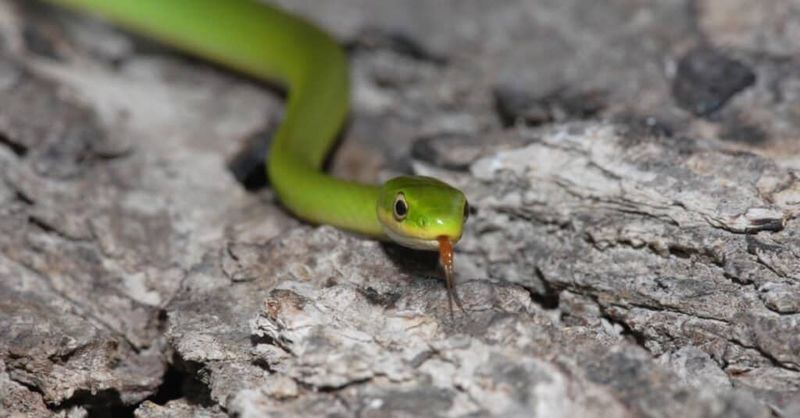
Rough greensnakes eat invertebrates, which means animals without backbones. According to the University of Kentucky species page, that menu includes crickets, grasshoppers, spiders, and caterpillars.

These are all things that live on leaves and stems, right where the snake does its hunting.

Researchers have looked at this closely in one place. In Michael Plummer’s research, more than 85 percent of the recorded diet in one study population was made up of caterpillars, spiders, grasshoppers, crickets, and dragonflies.

That number describes the snakes in that study. It is not a promise about what every rough greensnake eats, and it is not a measurement of what a snake in a Kentucky yard eats.

Food choices can shift with what is available nearby.

What you can say is that these snakes are insect and spider eaters rather than hunters of mice or birds. A snake in your shrubs may or may not be catching any given insect on a given day, and you would rarely see it happen, since the snake is so well hidden.

What Its Diet Can—and Cannot—Tell You About Garden Pests
What Its Diet Can—and Cannot—Tell You About Garden Pests
© Cottage Life

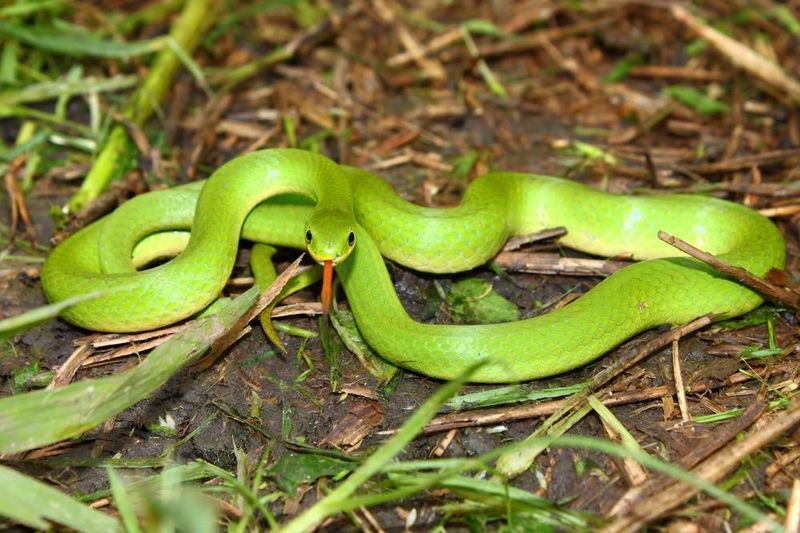
Gardeners often count caterpillars, crickets, and grasshoppers as pests when they chew leaves and stems. Since those animals show up in the snake’s documented diet, a rough greensnake can fairly be called a potential predator of some of them.

That is an ecological role, and it is where the claim should stop.

Nobody has shown how much damage one snake prevents in a home garden. The sources cited here do not measure leaves saved, plants protected, or outbreaks stopped.

The Plummer diet work described what snakes ate, not how gardens fared.

Kentucky Fish and Wildlife describes snakes broadly as animals that eat insects and other creatures people consider pests. That fits the general picture, but it is not a guarantee for your yard.

So a practical example: if caterpillars are shredding your tomato plants, keep up your usual garden care and treat any snake as a bonus. A snake might take a few insects, but you should not count on it to clear an infestation.

Give a Snake in the Garden Space
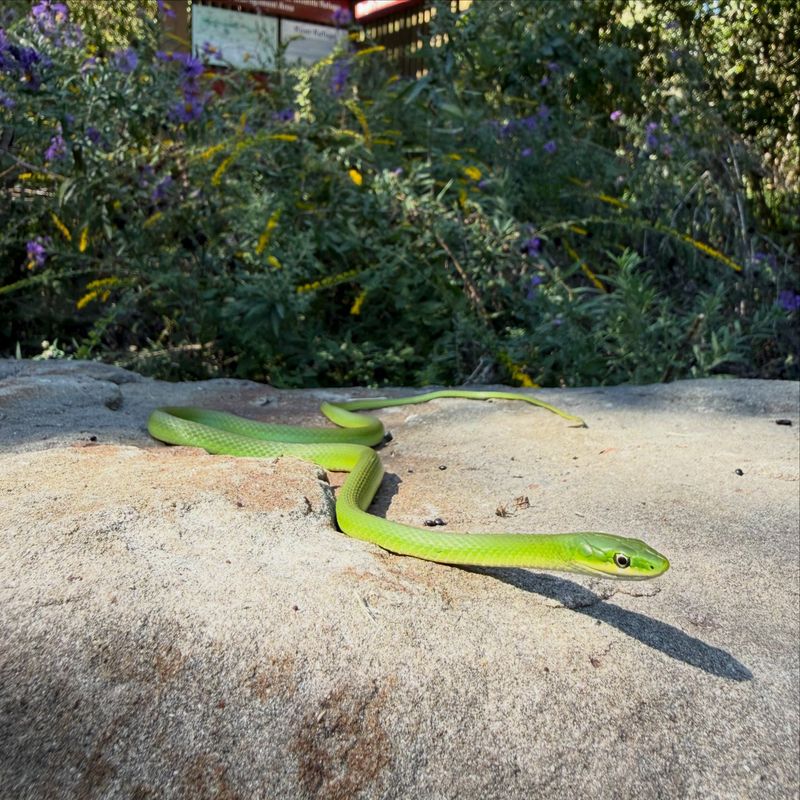
Give a Snake in the Garden Space
© adventure_gavon

The simplest plan is the best one: let the snake be. Do not try to catch it, kill it, or move it to another spot.

Kentucky Fish and Wildlife encourages people to appreciate snakes and leave them alone, and it is also the way to avoid a bite.

Keep kids and pets back while you trim or water nearby. If you cannot tell what kind of snake it is, or it has settled somewhere unsafe, contact a qualified local wildlife or identification resource and send a photo taken from afar.

Most green snakes in shrubs are simply passing the day, and a little space is usually all they ask.

Share this story
HC

Written by

Hattie Combs

More from Hattie Combs →

About Gardening Latest

Gardening Latest provides in-depth guides to maintaining and enhancing your garden and backyard. Learn how to make the most of the space you have and create a beautiful garden.

More about us →

Latest stories

  • Wisconsin GardeningWisconsin Winters Don’t Kill Your Brown Recluse Worries, Because Hobo and Yellow Sac Spiders Move Indoors Now

    Wisconsin Winters Don’t Kill Your Brown Recluse Worries, Because Hobo and Yellow Sac Spiders Move Indoors Now

    5 min ago
  • Missouri GardeningYour Frozen Missouri Lawn Isn’t Empty: A Tiny Mammal With a Venomous Bite Hunts Below All Winter

    Your Frozen Missouri Lawn Isn’t Empty: A Tiny Mammal With a Venomous Bite Hunts Below All Winter

    11 min ago
  • Tennessee GardeningThose Big Brown Spiders Showing Up Inside Tennessee Homes After the First Cold Snap Are Wolf Spiders, and Here’s Why They Came In

    Those Big Brown Spiders Showing Up Inside Tennessee Homes After the First Cold Snap Are Wolf Spiders, and Here’s Why They Came In

    17 min ago
  • Alabama GardeningHearing Great Horned Owls Hoot Outside Your Alabama Home at Night? Here’s What It Means

    Hearing Great Horned Owls Hoot Outside Your Alabama Home at Night? Here’s What It Means

    23 min ago
  • Minnesota GardeningMinnesota Homeowners Keep Yanking This Invasive Tree, and It Keeps Taking Over Their Yards

    Minnesota Homeowners Keep Yanking This Invasive Tree, and It Keeps Taking Over Their Yards

    29 min ago

Gardening by state

Stories for your state, and the hardiness zone most of it gardens in.

Keep exploring

Read next

All Kentucky Gardening →
Kentucky GardeningKentucky Winters Bring Big Brown Bats Into Your Walls, and Here’s How to Tell They’ve Moved In
Kentucky Gardening

Kentucky Winters Bring Big Brown Bats Into Your Walls, and Here’s How to Tell They’ve Moved In

4 hr ago
Kentucky GardeningKentucky’s Short-Tailed Shrews: Tiny Mammals With Toxic Saliva
Kentucky Gardening

Kentucky’s Short-Tailed Shrews: Tiny Mammals With Toxic Saliva

7 hr ago
Kentucky GardeningKentucky Law Says Who Pays When Your Neighbor’s Dead Tree Falls on Your House This Winter
Kentucky Gardening

Kentucky Law Says Who Pays When Your Neighbor’s Dead Tree Falls on Your House This Winter

22 hr ago

More from Kentucky Gardening

  • That Giant Black-and-White Bird Hammering Your Kentucky Tree Is a Pileated Woodpecker, and It’s Hunting Carpenter Ants

    Nov 25
  • That Black-and-Yellow Millipede Crawling Across Your Kentucky Patio Smells Like Almonds for a Dangerous Reason

    Nov 25
Back to top

Leave a response Cancel

Your email address stays private. Required fields are marked with an asterisk.

Gardening Latest

In-depth guides to maintaining and enhancing your garden and backyard: how to make the most of the space you have, and how to make it beautiful.

  • Facebook
  • X
  • Pinterest
  • YouTube

We may earn a portion of sales from products or services that are purchased through our site as part of our affiliate partnerships with retailers.

Explore

  • About GardeningLatest.com
  • Contact Us
  • Terms and Conditions
  • Privacy
  • Editorial Note:
  • FTC Disclosure

Newsletter

New garden guides and seasonal tips, straight to your inbox.

We’ll email you a link to confirm. Unsubscribe any time.

Almost there! Check your inbox and tap the link to confirm.

© 2026 Gardening Latest. All rights reserved.

Back to top