Get the latest garden guides in your inbox →
Gardening Latest
  • General Gardening
  • Lawn Care
  • Plant Care
  • Composting
  • Soil Health
  • Backyard
  • Garden Muse Magazine
  • General Gardening
  • Lawn Care
  • Plant Care
  • Composting
  • Soil Health
  • Backyard
  • Garden Muse Magazine
  • News
  • Gardening Calendar
  • Garden Structures
  • Vegetable Garden
  • Vertical Garden
  • Raised Beds
  • Hydroponics
  • General Equipment
  • Community Gardens
Garden Themes
  • Spiritual Garden
  • Hydroseeding
  • Seeding and Laying Sod
  • Artificial Grass
  • Lawn Care Equipment
  • Plants
  • Trees
  • Planting Tools
  • Composting Basics
  • Fertilizer
  • Alternative Growing Mediums
  • Front Yard
  • Backyard Activities
  • Landscaping
Gardening Latest

Explore by state

Which state is your garden in?

Currently viewing Massachusetts

All states

Northeast

  • Connecticut —
  • Delaware 45
  • Maine —
  • Maryland 31
  • Massachusetts 47
  • New Hampshire —
  • New Jersey 31
  • New York 40
  • Pennsylvania 40
  • Rhode Island —
  • Vermont —

Southeast

  • Alabama 31
  • Arkansas —
  • Florida 31
  • Georgia 31
  • Kentucky 45
  • Louisiana 30
  • Mississippi —
  • North Carolina 29
  • South Carolina 44
  • Tennessee 28
  • Virginia 30
  • West Virginia —

Midwest

  • Illinois 30
  • Indiana 32
  • Iowa 44
  • Kansas —
  • Michigan 31
  • Minnesota 30
  • Missouri 30
  • Nebraska —
  • North Dakota —
  • Ohio 31
  • South Dakota —
  • Wisconsin 45

Southwest

  • Arizona 30
  • Colorado —
  • Nevada —
  • New Mexico —
  • Oklahoma —
  • Texas 29
  • Utah —

West

  • Alaska —
  • California 30
  • Hawaii —
  • Idaho —
  • Montana —
  • Oregon —
  • Washington —
  • Wyoming —

No state matches that search.

Site menu

Gardening Latest
  • General Gardening
    • News
    • Gardening Calendar
    • Garden Structures
    • Vegetable Garden
    • Vertical Garden
    • Raised Beds
    • Hydroponics
    • General Equipment
    • Community Gardens
    Garden Themes
    • Spiritual Garden
  • Lawn Care
    • Hydroseeding
    • Seeding and Laying Sod
    • Artificial Grass
    • Lawn Care Equipment
  • Plant Care
    • Plants
    • Trees
    • Planting Tools
  • Composting
    • Composting Basics
  • Soil Health
    • Fertilizer
    • Alternative Growing Mediums
  • Backyard
    • Front Yard
    • Backyard Activities
    • Landscaping
  • Garden Muse Magazine

Explore

  • About GardeningLatest.com
  • Contact Us

Get the latest from the garden

New guides on lawn care, plants and backyard projects, sent when they go up.

Subscribe →

Follow

  • Facebook
  • X
  • Pinterest
  • YouTube
Massachusetts Gardening

That Tiny Moth Fluttering at Your Massachusetts Porch Light in December Is Bad News for Your Maple Trees

That small moth circling your porch light in December may belong to a pest that chews on Massachusetts maples and oaks…

AT

By Abigail Thatcher

November 28, 2026 · 6 min read

That Tiny Moth Fluttering at Your Massachusetts Porch Light in December Is Bad News for Your Maple Trees

That small moth circling your porch light in December may belong to a pest that chews on Massachusetts maples and oaks in spring. Only the males fly to lights, while the nearly wingless females crawl up trunks to lay the eggs that become hungry caterpillars.

The story has some twists, though, and a single moth does not mean your trees are in trouble. Here is how to read the signs and what to do when the buds open.

At a glance

Where
Massachusetts Gardening
Hardiness zone
6 −10 to 0°F
Read
6 minutes
Published
November 28, 2026

A light-attracted moth may be a look-alike
A light-attracted moth may be a look-alike
© Coastal Rivers Conservation Trust

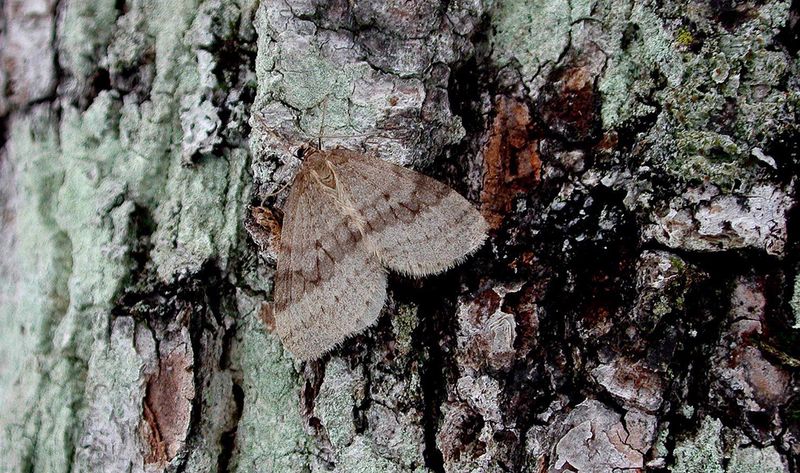
Picture a small, pale brown moth bumping against your porch light on a cold night in late November or December. In Massachusetts, that could be a male winter moth.

It could also be something else entirely.

A casual sighting cannot confirm winter moth. UMass Extension’s November scouting report notes that winter moth is hard to tell apart from native look-alikes.

Two of them, Bruce spanworm and fall cankerworm, have males that fly in roughly the same November to January window and are also drawn to lights.

Winter moth and Bruce spanworm are especially tough to separate. According to UMass Extension, reliable identification can require expert examination or even DNA analysis.

Your porch light and the calendar simply are not enough to name the species.

So treat that moth as a reason to keep your eyes open, not as a diagnosis. It does not tell you that your trees will be damaged, and it does not prove an infestation is underway.

It is a nudge to plan a spring check, which later sections explain.

The female climbs; the male flies
The female climbs; the male flies
© Bryan Pfeiffer

Adult winter moths split their jobs. According to the UMass Extension fact sheet, adults generally appear in mid- to late November.

In mild weather they can stay active into January.

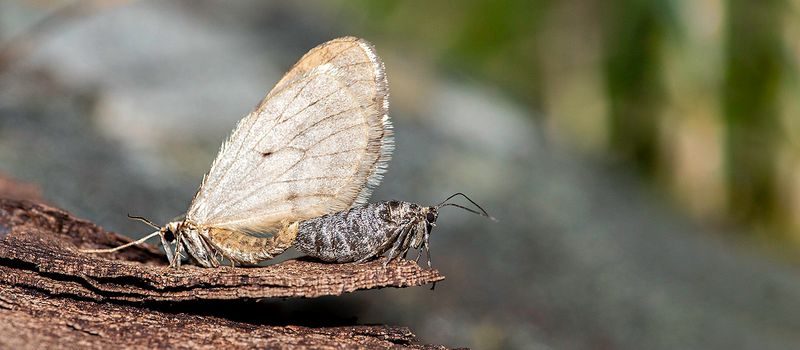
The males are the fliers. They have wings, they flutter around at night, and they are attracted to lights, which is why one may end up at your porch.

Seeing adults does not tell you how many moths live nearby, and it does not forecast what your trees will look like in May.

The females look very different. They are gray and virtually wingless, so they cannot fly at all.

Instead they crawl up tree trunks, mate, and lay eggs on bark and nearby surfaces.

That means the moth beating against your light is not the egg-laying female. The one doing the real work is the small, stubby-winged crawler on the trunk, and she is easy to miss in the dark.

One caution applies here. This description fits true winter moths, and you cannot assume an unidentified moth at your light follows the same pattern.

Look-alike species can behave differently, so a sighting stays a clue rather than an answer.

Eggs hatch as spring buds open
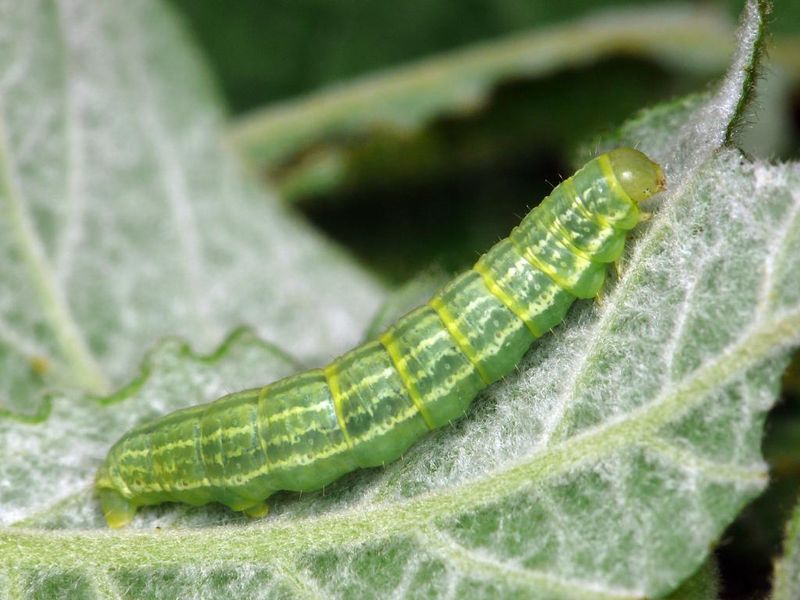
Eggs hatch as spring buds open
© Moth Identification

Winter moth eggs spend the cold months on bark and related surfaces. They sit quietly through snow and freezing nights, then wake up when spring warms the buds.

Hatching usually happens around bud break, from late March into early or mid-April in Massachusetts. Exact timing shifts with location and weather, so a coastal yard and a hilltop yard may not match.

The newly hatched caterpillars are tiny, green, and inchworm-like. UMass Extension explains that small larvae feed inside swelling buds, while older larvae move on to expanding leaves.

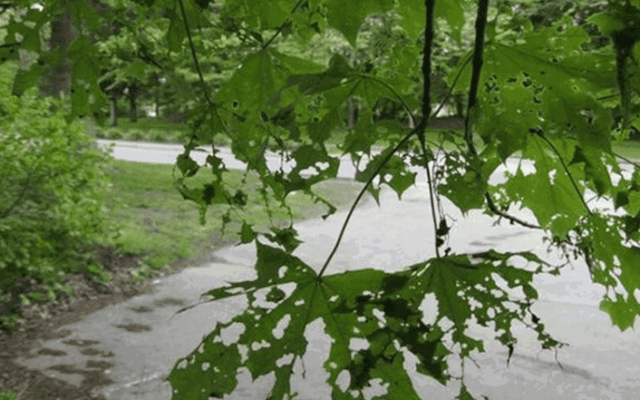
That feeding is what leaves ragged or chewed foliage.

Maple and oak are among the host trees. Apple, blueberry, and other plants can be fed on too, so a backyard garden may be involved as well as shade trees.

Notice how different this is from the winter scene. In December, adults are about flying, mating, and egg-laying, and they do not feed.

The leaf damage comes months later, from caterpillars, and only where enough of them survive.

A sighting cannot predict spring damage

A sighting cannot predict spring damage
© The Providence Journal

Seeing adults does not tell you how many moths live nearby, and it does not forecast what your trees will look like in May. Damage depends on the tree species, how abundant the insects are locally, the weather, and other things that kill eggs and caterpillars.

Population levels also change from place to place and year to year. UMass Extension’s January 2026 outlook said serious winter moth defoliation in Massachusetts was not expected to reach pre-2018 levels in spring 2026.

It also noted local variation. That is an outlook for that spring only, not a promise about any other year.

Part of the reason is a helper fly. The introduced parasitoid fly Cyzenis albicans became established at many release sites and has helped reduce winter moth populations.

It has not eradicated the moth, so some yards can still see problems.

The November scouting report confirms that adults may be seen in parts of the state. It does not say those sightings point to a damaging outbreak.

If your yard has a history of chewed leaves, take the winter moth more seriously. If it does not, a moth at the porch light is simply a moth.

Check trees as buds begin to open
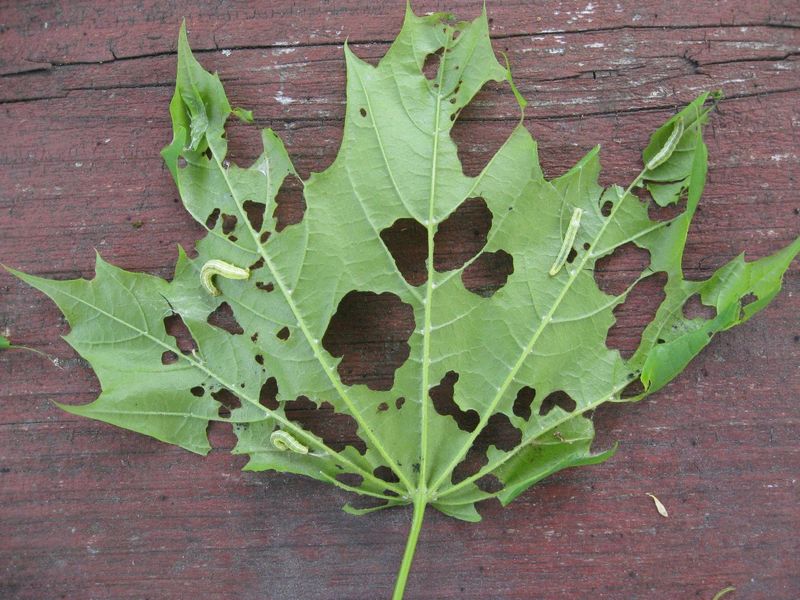
Check trees as buds begin to open
© RI Arborist | Tree Pro Inc.

Spring is when your attention pays off. As buds swell and begin to open, walk over to your maples, oaks, apples, and blueberries and look closely.

UMass guidance recommends monitoring expanding buds and leaves in early to mid-April. Allow for local and weather differences, since a cold spring can push things later and a mild one can move them earlier.

Look for small green caterpillars tucked in buds or on new leaves, along with tiny holes or ragged edges. Check a few times over a couple of weeks instead of once.

Resist guessing what you find. Other caterpillars can cause similar signs, so identification should come before any treatment.

If you suspect damage, UMass Extension points residents to its Plant Diagnostics Laboratory or to a trained arborist or landscape professional. A photo and a sample caterpillar in a small container can help them tell you what you have.

Compare this with winter. There is nothing useful to do about adult moths in December, but spring checks give you real information at the moment it matters.

Skip the sure-fix claims
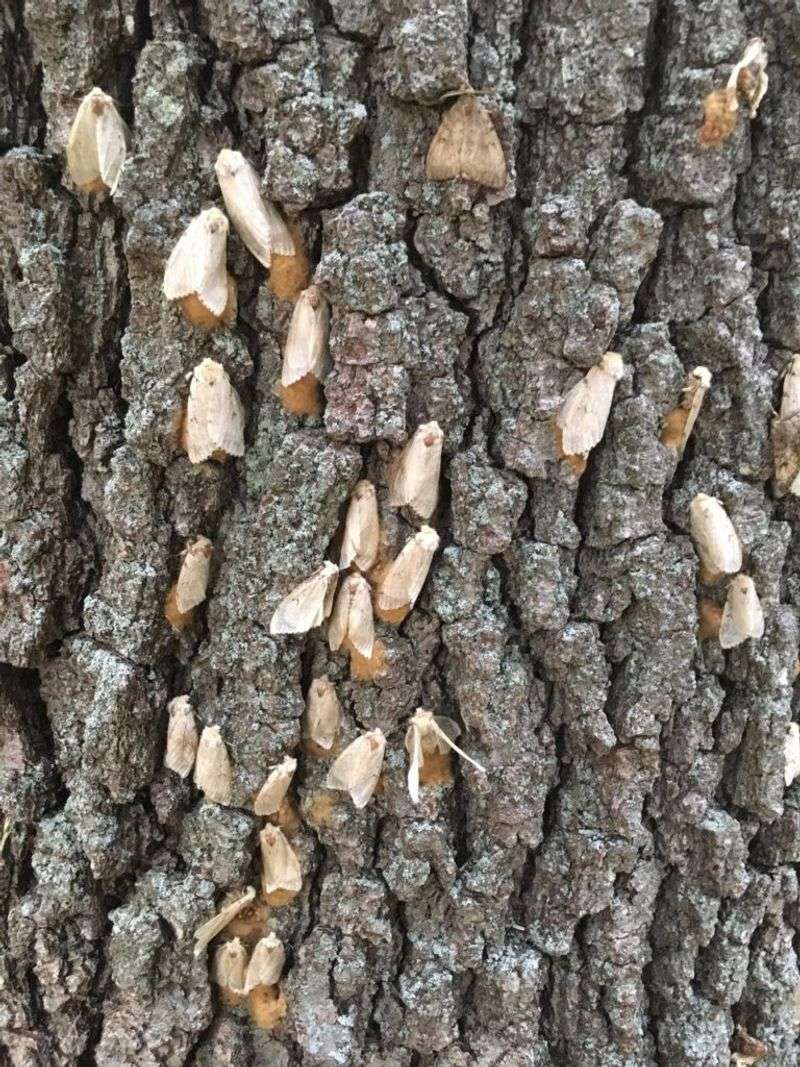
Skip the sure-fix claims
© www.wonderofeverydaynature.com

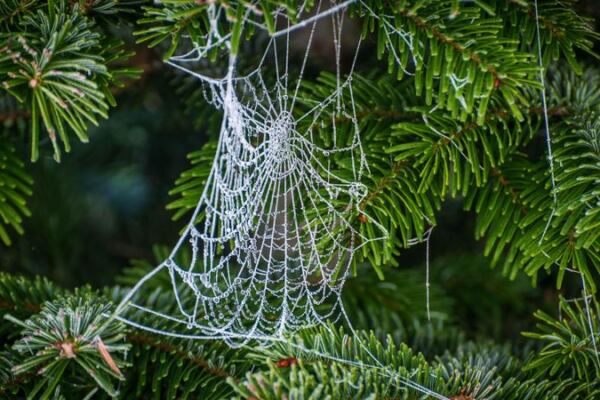
You may see ads or advice promising a quick winter fix. Be skeptical.

Sticky trunk bands are not a dependable way to prevent a major infestation, because they can fill up, be bypassed, or lead females to lay eggs below the band.

UMass Extension says bands may have a limited use for monitoring egg hatch on trees with a history of damage. Mass Audubon likewise points out their limits for controlling major infestations.

UMass also offers no control options for adult moths. Adults do not feed, so spraying them in winter is not a recommended path.

If you later think about pesticides, identify the pest first. Then read and follow the product label, and keep in mind that some products can harm pollinators and other helpful organisms.

Avoid spraying flowering plants when bees may visit, and do not assume one treatment suits every yard.

The simplest rule is to treat a winter sighting as something to watch, not something to attack.

Share this story

AT

Written by

Abigail Thatcher

More from Abigail Thatcher →

About Gardening Latest

Gardening Latest provides in-depth guides to maintaining and enhancing your garden and backyard. Learn how to make the most of the space you have and create a beautiful garden.

More about us →

Latest stories

  • Missouri GardeningIf Your Missouri Woodpile Sits Against the House, You’re Inviting Brown Recluses Indoors This Winter

    If Your Missouri Woodpile Sits Against the House, You’re Inviting Brown Recluses Indoors This Winter

    4 min ago
  • Tennessee GardeningBefore You Dig In, Here’s How To Recognize Every Venomous Creature Sharing Your Tennessee Yard

    Before You Dig In, Here’s How To Recognize Every Venomous Creature Sharing Your Tennessee Yard

    10 min ago
  • Alabama GardeningThat Burning Saddleback Caterpillar Sting in Your Alabama Garden Calls for These Steps Right Away

    That Burning Saddleback Caterpillar Sting in Your Alabama Garden Calls for These Steps Right Away

    16 min ago
  • Minnesota GardeningBefore You Pick Up That Big Black Caterpillar With White Spots In Minnesota, Read This

    Before You Pick Up That Big Black Caterpillar With White Spots In Minnesota, Read This

    22 min ago
  • Illinois GardeningDeer Are Rubbing Their Antlers on Your Illinois Saplings Right Now, and Here’s How to Save Them

    Deer Are Rubbing Their Antlers on Your Illinois Saplings Right Now, and Here’s How to Save Them

    28 min ago

Gardening by state

Stories for your state, and the hardiness zone most of it gardens in.

Keep exploring

Read next

All Massachusetts Gardening →
Massachusetts GardeningWhen Your Neighbor’s Tree Hangs Over Your Yard, This Is What Massachusetts Law Actually Says
Massachusetts Gardening

When Your Neighbor’s Tree Hangs Over Your Yard, This Is What Massachusetts Law Actually Says

1 hr ago
Massachusetts GardeningA Fisher Prowling Your Massachusetts Yard After Dark Is Hunting, So Keep Your Cat Inside Tonight
Massachusetts Gardening

A Fisher Prowling Your Massachusetts Yard After Dark Is Hunting, So Keep Your Cat Inside Tonight

7 hr ago
Massachusetts GardeningBefore You Bring a Fresh-Cut Christmas Tree Into Your Massachusetts Home, Check It for These Six Hitchhikers
Massachusetts Gardening

Before You Bring a Fresh-Cut Christmas Tree Into Your Massachusetts Home, Check It for These Six Hitchhikers

10 hr ago

More from Massachusetts Gardening

  • Raking Leaves in Massachusetts? Here’s What We Know About the Northern Short-Tailed Shrew’s Venom

    Nov 27
  • Spotted a Giant Flower Spike in Your Massachusetts Rhubarb Patch? Here’s What It Means and Whether to Cut It

    Nov 26
Back to top

Leave a response Cancel

Your email address stays private. Required fields are marked with an asterisk.

Gardening Latest

In-depth guides to maintaining and enhancing your garden and backyard: how to make the most of the space you have, and how to make it beautiful.

  • Facebook
  • X
  • Pinterest
  • YouTube

We may earn a portion of sales from products or services that are purchased through our site as part of our affiliate partnerships with retailers.

Explore

  • About GardeningLatest.com
  • Contact Us
  • Terms and Conditions
  • Privacy
  • Editorial Note:
  • FTC Disclosure

Newsletter

New garden guides and seasonal tips, straight to your inbox.

We’ll email you a link to confirm. Unsubscribe any time.

Almost there! Check your inbox and tap the link to confirm.

© 2026 Gardening Latest. All rights reserved.

Back to top