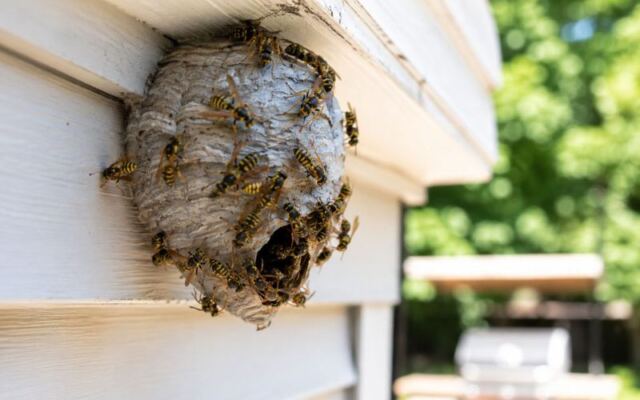
If you spot a yellow jacket nest near your Massachusetts home, the first move is simple: keep people and pets away from it and stay calm. After that, you can judge how risky it really is by how close it sits to your daily routine and whether anyone nearby has a sting allergy.
A nest in a spot you can easily avoid may be fine to leave alone, while one by a door or inside a wall needs help. Here is how to sort out which one you have.
A steady flight to one opening can point to a nest
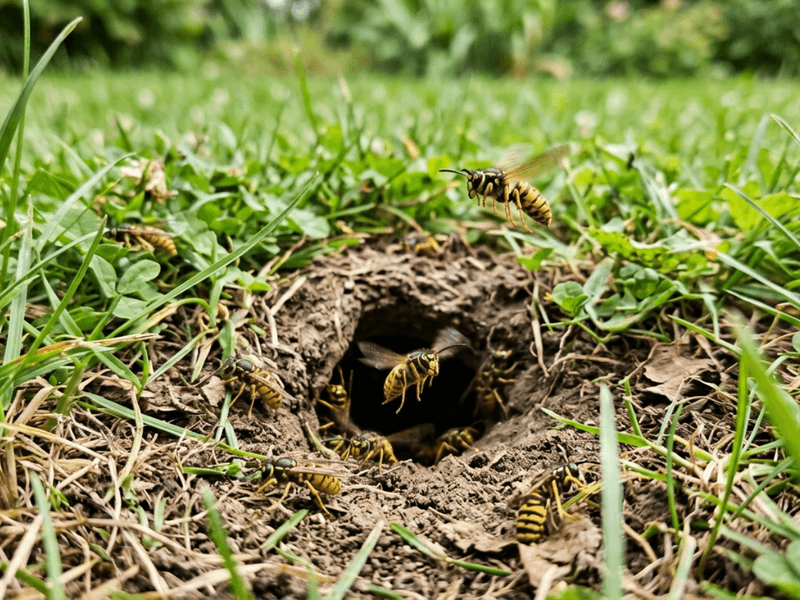
Many people picture a gray, papery ball hanging from a tree, but yellowjackets often hide their homes. According to UC Statewide IPM Program guidance, nests may be underground, inside wall voids, or in other cavities.
So you may never see a visible nest at all.
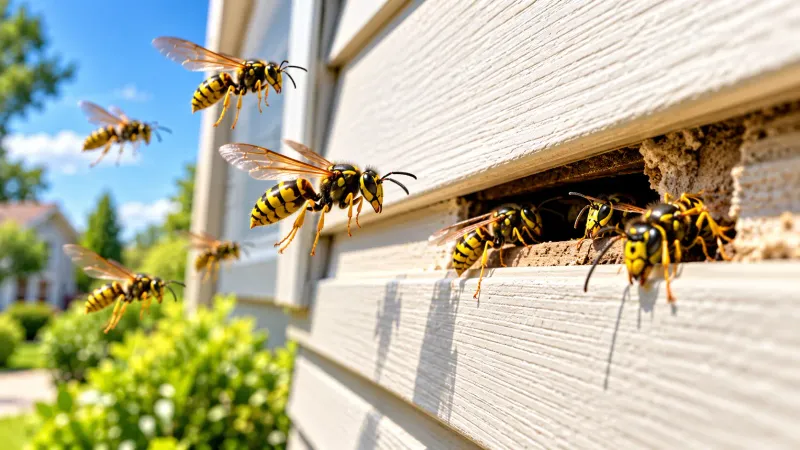
The best clue is traffic. When wasps keep flying to and from one small opening, such as a hole in the lawn, a gap in a foundation, or a crack in siding, that steady back-and-forth can point to a nest.
Watch for a few minutes and see whether the same spot keeps drawing them.
Wasps visiting a picnic table, a soda can, or a trash bin tell a different story. Yellowjackets forage for sugary and protein-rich food, and they may be coming from a nest that is not on your property.
Seeing them at the garbage alone does not prove a nest is nearby.
Any watching should happen from a safe distance. Do not walk up to a suspected entrance, poke at it, open a wall, or lean in for a closer look to confirm what you have.
Other black-and-yellow insects have different nests and behavior, so you can note what you see from afar and leave the close identification to a professional if it matters.
Keep people and pets away first
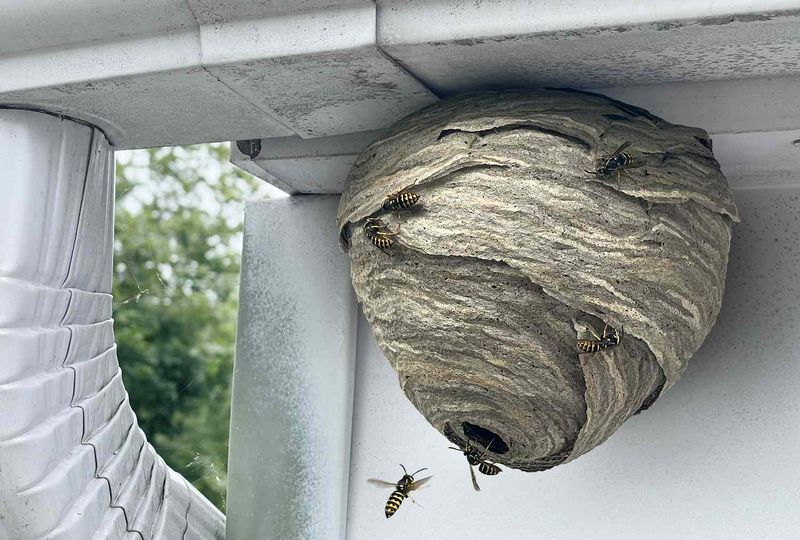
Your first moves cost nothing and carry little risk. Steer family members, visitors, and pets away from the suspected entrance, and tell children to stay clear of that part of the yard.
A leash or a closed gate can help keep a curious dog from wandering over.
Resist the urge to swat at wasps or to stomp, spray, or poke near the opening. UMass Extension notes that yellowjackets can sting repeatedly, and disturbing them can provoke defensive behavior.
Walking calmly away is a better answer than flailing.
Next, take away the snacks. Cover food and drinks when you eat outside, check cans before taking a sip, and keep garbage in containers with tight lids.
Rinsing recycling bins and cleaning up spilled juice or pet food also helps.
These steps lower the number of wasps hanging around your cookout and cut down on surprise encounters. They do not confirm that a nest is present, and they will not remove one.
Think of them as a safety buffer while you figure out the next step.
Decide whether people can safely avoid the nest
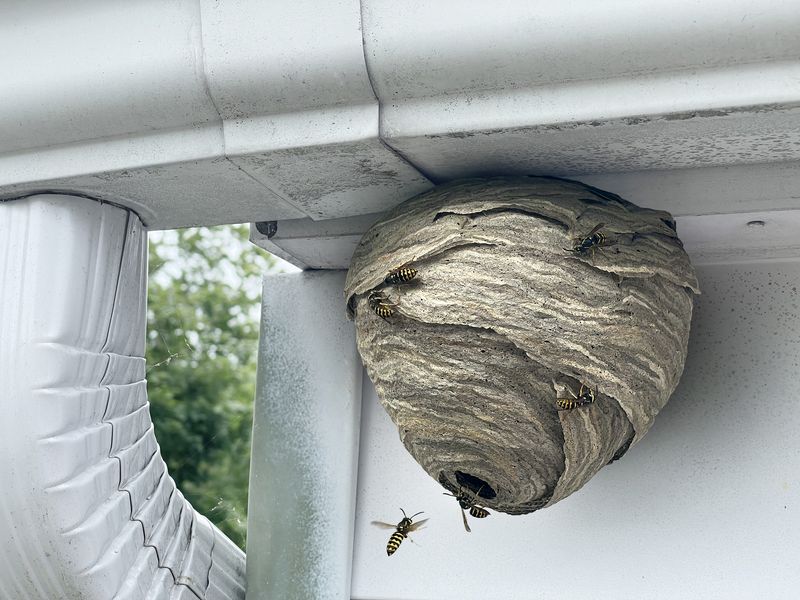
The question that matters most is not whether a nest exists, but whether you can live around it. Location and exposure drive the decision.
A nest tucked beside a rarely used corner of the yard, far from paths and play areas, may be left alone, and UMass Extension advises leaving colonies in areas people can avoid.
Picture a different setup. The opening sits beside the front door, along the walkway to the driveway, under a deck where kids play, or next to the spot where the mower must pass.
Here, avoidance is not realistic, because ordinary routines keep bringing people close.
Ask yourself a few plain questions. Does anyone need to walk, mow, garden, or play within a few steps of the entrance?
Can you keep a clear buffer for the rest of the season? If the answer is no, the nest is a problem even if it is small.
Size and placement also count. UMass recommends hiring a pest-management professional for large, unavoidable nests, especially when they are in walls or buildings.
A colony inside a wall can send wasps into living spaces, and it is not something to handle yourself.
If you land on the side of hard to avoid, call a professional for advice instead of trying to settle it on your own.
A known sting allergy calls for extra caution
If anyone in your household, or anyone who visits often, has a known sting allergy, the picture changes. The nest stops being an ordinary household nuisance and becomes a real safety question.
In that case, getting professional advice early makes sense, and so does talking with a physician.
UMass Extension recommends professional removal and consulting a physician about individual safety precautions. A doctor can tell you what is right for that person.
Close inspection and do-it-yourself treatment are poor ideas when a single sting could cause a serious reaction.
It also helps to know the warning signs. MedlinePlus describes serious allergic reactions to stings, and difficulty breathing or swelling of the mouth or throat needs urgent medical attention.
Do not wait to see whether those symptoms pass.
This article is not a medical guide, so it does not lay out a treatment plan. Your doctor and local emergency services are the right sources for that.
What you can do now is keep the allergic person well away from the suspected entrance and let a professional deal with the nest.
Waiting can work when the nest is safely out of the way
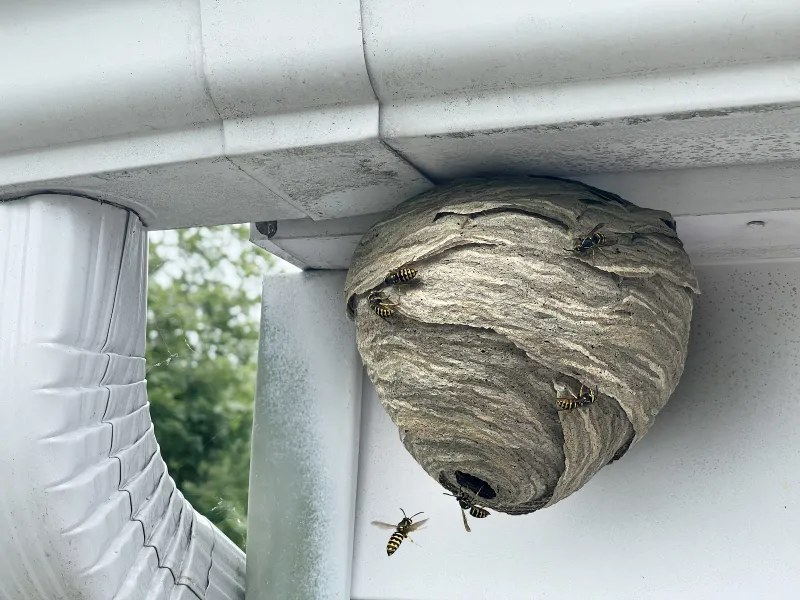
Yellowjacket colonies live on a yearly schedule. In Massachusetts, UMass Extension explains that colonies normally end at the first hard frost.
The workers die, while the new queens leave and overwinter separately, tucked away in sheltered spots.
That cycle is why late summer and fall feel so busy. Colonies are at their largest then, and workers hunt for sweet foods around people.
Once a hard frost arrives, the colony winds down on its own.
For a nest in a quiet corner you can easily stay away from, waiting may be a reasonable choice. You keep your distance, manage food and garbage, and let the season run its course.
That is a sensible plan only when the nest can be safely avoided.
Frost is no excuse to ignore a nest by the front steps or one that makes the yard hard to use. If it poses an immediate access or sting risk now, the calendar does not fix it.
Frost is weeks away, and stings can happen today.
Also, the old nest does not stay active or get reused the following year. The surviving queens start fresh colonies elsewhere, so you may still see new yellowjackets next summer.
Use a professional for nests that are hard to avoid
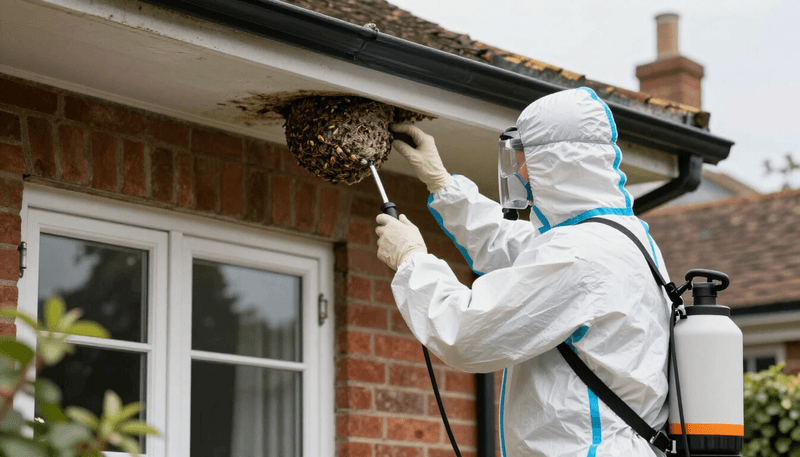
When a nest is large, sits near routine activity, or is inside a building, calling a pest-management professional is the safer path. UMass Extension specifically suggests this for large, unavoidable nests, especially those in walls or buildings.
Pros have protective gear, the right products, and experience with hidden entrances.
Your housing situation matters too. If you rent or live in a larger building, tell the owner or property manager about the nest instead of assuming you can treat it yourself.
The Massachusetts Department of Public Health has pest control guidance for renters that is worth a look.
State rules on pesticides also depend on the property and who is applying. Massachusetts General Laws, Chapter 132B, Section 10, generally calls for credentials to apply pesticides in places used for human habitation.
There is an exception for residential properties with three or fewer dwelling units.
That exception is narrow and does not apply the same way to every situation, so do not read it as permission for everyone. A larger building, a shared property, or a rental may fall under different expectations.
When in doubt, ask the owner, manager, or a licensed company before anyone sprays anything.
Avoid risky do-it-yourself nest treatments
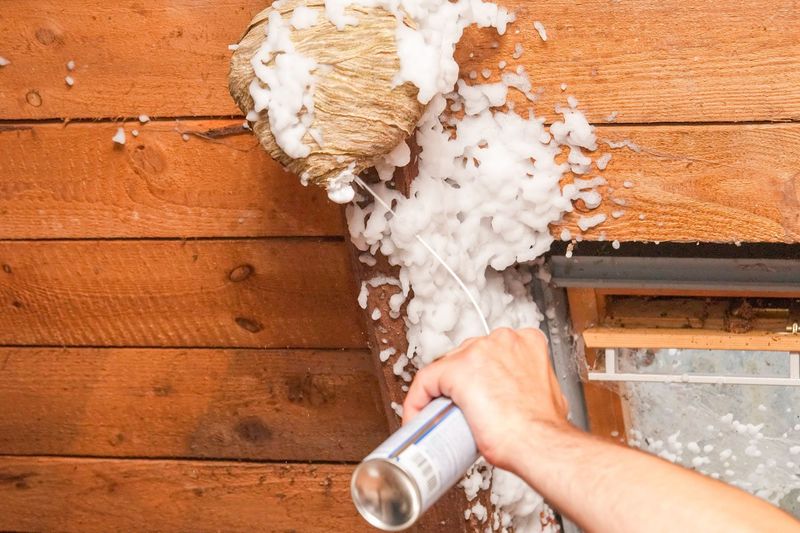
This article does not give step-by-step spray directions, and that is on purpose. Going near a nest can expose a person to many stings at once, as UMass Extension cautions.
Do-it-yourself treatment is not risk-free.
Pesticide directions also vary from one product to the next. The label governs how a product may be used.
For example, the EPA label for one wasp and yellowjacket product lists specific distance, clothing, timing, and environmental precautions, and those details should not be assumed to fit any other product.
Some home remedies are far worse. Gasoline, kerosene, and fire are not treatment options.
Penn State Extension calls fire a significantly more dangerous approach and warns that fuels can be more toxic than proper insecticides and can cause injury or property damage.
Traps are not a fix either. They may draw wasps away from a sensitive spot, but they will not wipe out a colony.
The calmest plan is often the most effective one: stay back, and let someone trained handle it. A nest is not worth a trip to the emergency room.
Share this story