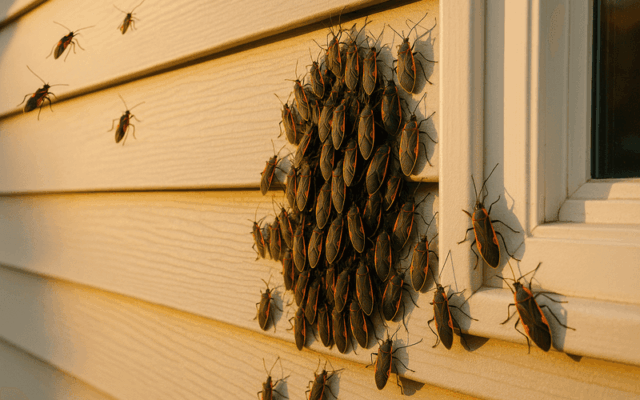
The black bugs with red markings crowding your sunny siding in fall are most likely boxelder bugs, and they are looking for a warm, sheltered place to spend the winter. Some will find a way into your house through small gaps.
A cluster on the wall does not mean every bug is coming inside, though, and a few simple repairs can cut down how many get in. Here is how to tell what you are seeing and what to do about it.
The stripes offer a clue, not a guarantee
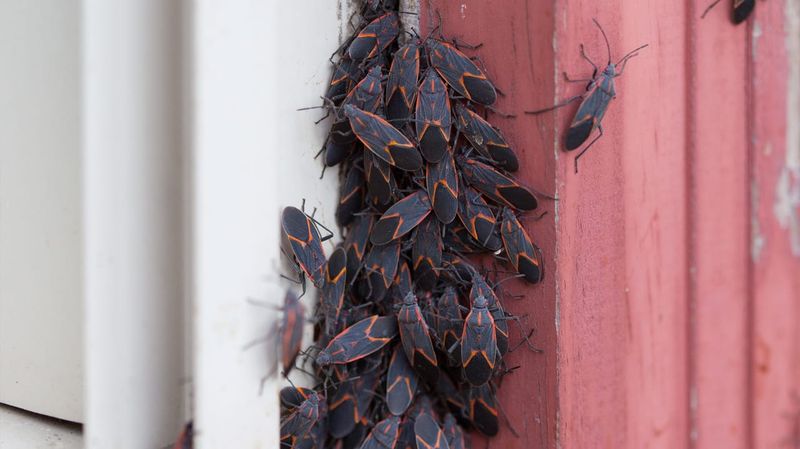
Black bugs with red or orange markings on your siding are plausibly boxelder bugs, a common insect in Iowa. Iowa State University Extension lists the boxelder bug as a familiar sight around the state, so the guess is a reasonable one.
Adults are dark, often blackish brown, with red or orange lines and edges on the back and along the wings. They are roughly half an inch long and have a flattened, slightly elongated shape.
When the wings fold over the back, the markings look like a set of narrow stripes or a V shape.
Young bugs, called nymphs, look different. They are smaller, often bright red, and can be mistaken for a different kind of insect.
You may see a mix of sizes in one cluster, with tiny red nymphs among the dark adults.
Color alone cannot confirm the identification. Several other insects share black and red patterns, so a quick look is worth the effort.
If you can, compare a close photo against images from University of Minnesota Extension, or take a sample to your county extension office.
Treat the name as a working label until you have checked. That caution matters because the right plan depends on knowing what is actually on the wall.
What a sunny-wall cluster means
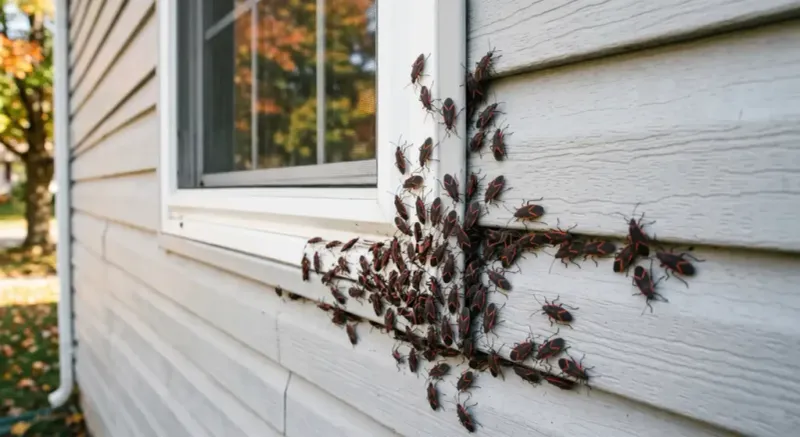
On a mild late-fall afternoon, a sun-warmed wall can look crawling with bugs. That fits what boxelder bugs do each autumn, which is to seek sheltered places to overwinter.
Buildings with sunny sides are a popular gathering spot, as the National Pesticide Information Center describes.
A gathering place is not the same as a nest. Boxelder bugs do not build nests in walls, so a crowd on the siding does not prove a colony lives behind it.
Nor does it prove that every bug will get inside. Some will slip through gaps and settle in walls, attics, or other protected spaces, while many will not.
Houses are only one option for them. Boxelder bugs can also overwinter in other sheltered spots, including leaf litter, so the bugs on your wall may have other places to go.
Warm spells can wake them up. On a sunny day in winter, bugs tucked into a wall may become active again and wander toward the light, sometimes into living areas.
If you find boxelder bugs indoors in winter or spring, they generally came in earlier. Iowa State notes that they do not reproduce indoors, so a few stragglers do not signal a growing population inside.
Minnesota Extension says the same.
Think of the cluster as a sign that the season has turned, and as a reminder to check your home’s weak points.
A nuisance, not a house-damaging pest
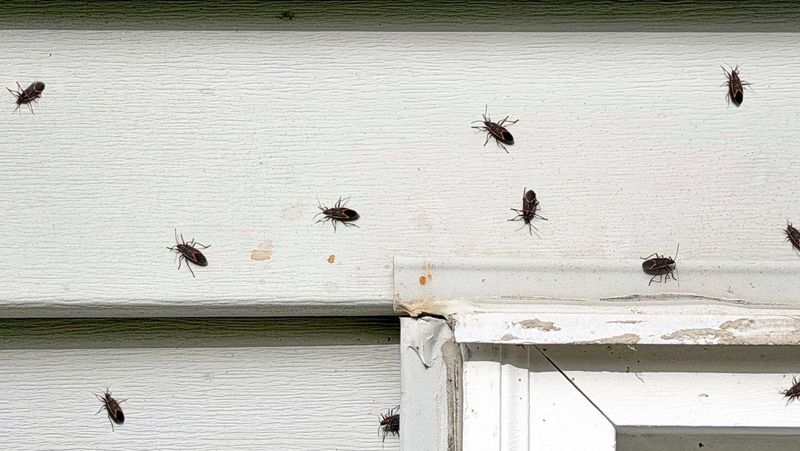
Boxelder bugs are annoying, but they are not dangerous in the way many people fear. They are considered nuisance pests, not a serious health threat, according to University of Connecticut Extension.
Biting is unlikely. Boxelder bugs are generally not known to bite people, though rare defensive bites have been reported.
The National Pesticide Information Center describes the same low risk.
The mess is the bigger complaint. Their droppings can stain light-colored surfaces such as curtains and walls.
Crushing a bug can also release an unpleasant odor, so scooping them up works better than squashing them.
They do not damage the house or its furnishings, and they do not reproduce indoors, as Iowa State explains. You also do not need to worry about them getting into your food.
That adds up to a realistic picture. Seeing dozens of bugs inside can be unpleasant, and the clean-up is a chore.
Still, the problem is about comfort and cleanliness rather than structural harm, which means you can respond calmly with simple steps.
Small openings can let bugs inside
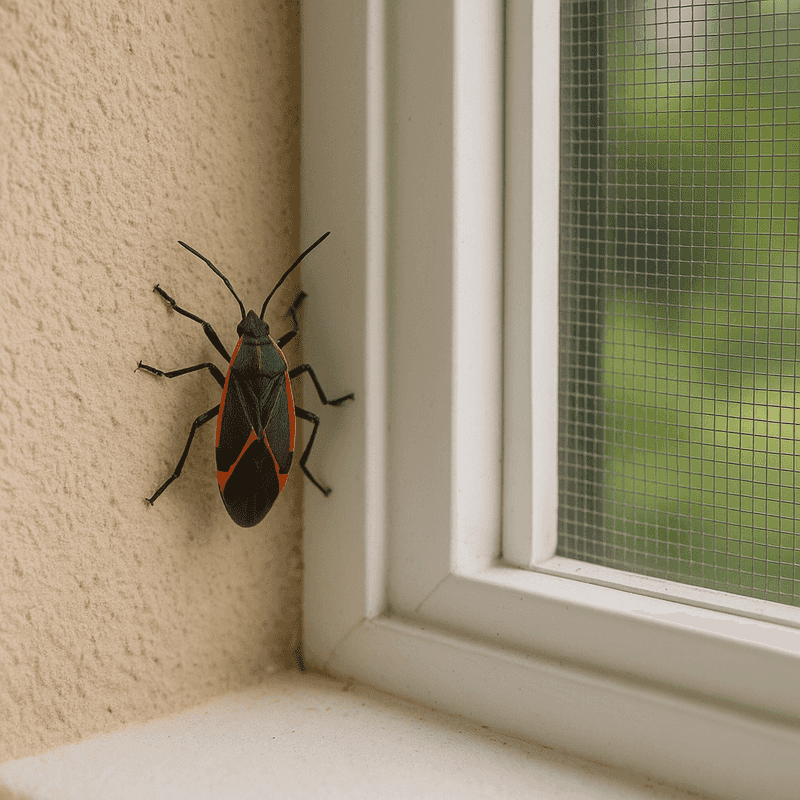
A boxelder bug needs very little room to get in. A walk around your house with a flashlight can show you where they are most likely to enter, so you can focus your repair work instead of guessing.
Check around windows and doors first, especially frames where caulk has cracked or shrunk. Then look at siding edges and trim, vents, and places where pipes, cables, or wires pass through the wall.
Finally, look along the foundation for cracks and gaps near the ground.
Sunny sides deserve extra attention, since that is where bugs gather. Notice where bugs crawl and linger, because they often crowd around likely openings.
One caution applies to brick or stone veneer. Do not seal weep holes, the small openings near the bottom that let moisture escape.
Minnesota Extension recommends appropriate ventilation plugs instead, which keep insects out while letting the wall breathe.
Jot down what you find as you go. A short list of gaps, torn screens, and weep holes gives you a clear plan for the next step.
Seal openings before fall—and repair them whenever you can
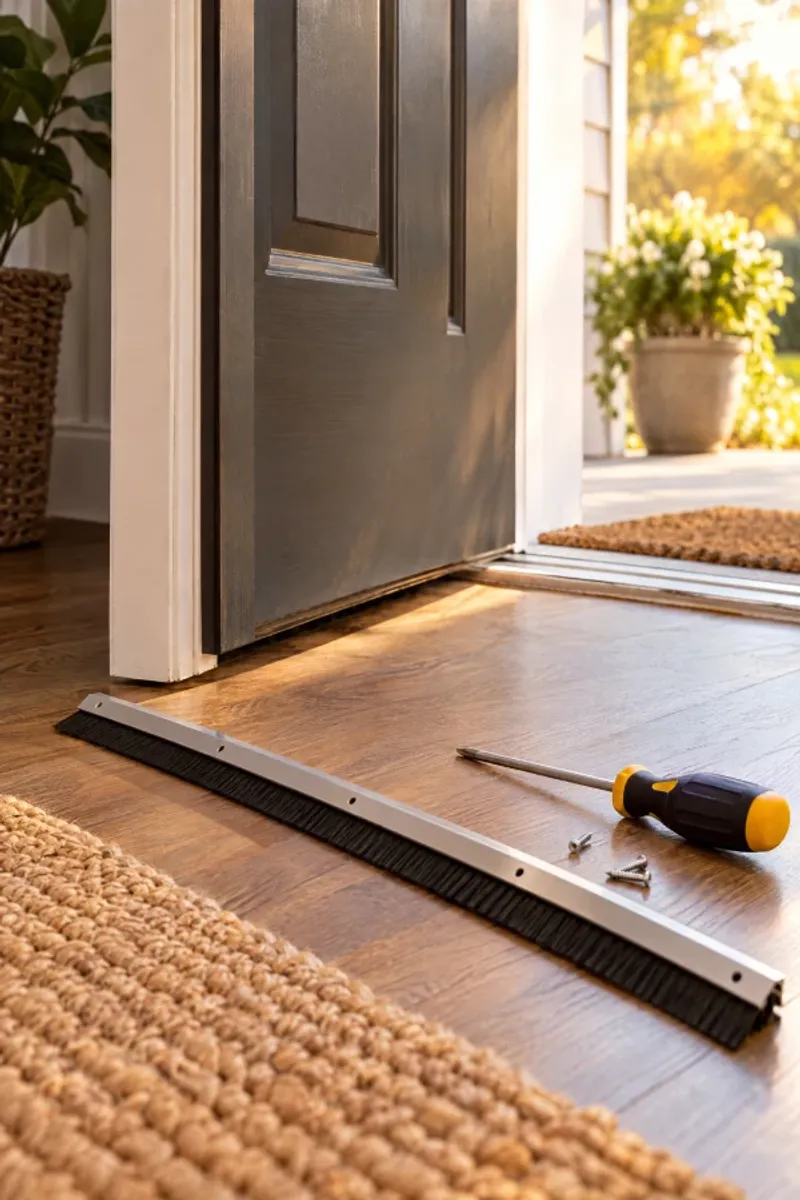
Once you know where the gaps are, the fix is straightforward. Repair or replace torn screens, seal cracks and gaps around windows, doors, siding, vents, and utility lines, and add door sweeps where daylight shows under a door.
Minnesota Extension suggests finishing repairs before the end of August. That is preventive timing, so bugs are kept out before they start looking for shelter.
It is not a deadline after which repairs stop helping, and sealing in October or even winter still closes doors on later strays.
Set your expectations honestly. Sealing reduces the number of bugs that get in, but it cannot promise a bug-free house.
Some older vinyl-sided homes have so many gaps behind the siding that complete exclusion may be difficult.
Trees are another part of the picture. Boxelder trees, especially seed-bearing female trees, are a preferred host.
Even so, bugs can travel from trees as far as two miles away, and Minnesota Extension advises against tree removal as a general strategy.
For many homeowners, cutting down a tree would cost a lot and might not change much. Patching gaps is cheaper and gives you more control.
Already indoors? Vacuum or sweep them up
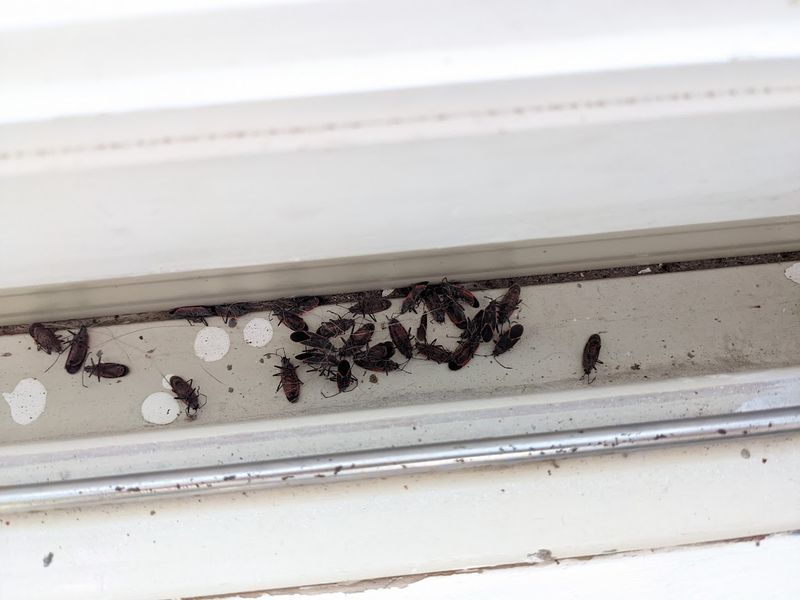
If bugs have already made it inside, the plain answer works best. Vacuum them up or sweep them into a dustpan and toss them outside or into the trash.
Empty the vacuum afterward so any survivors do not crawl back out.
Because boxelder bugs do not reproduce indoors, you are dealing with a fixed number of visitors rather than a growing colony. Iowa State and Minnesota Extension both recommend removing them physically.
Utah State University Extension points out that indoor insecticide treatment is generally not recommended.
Skip the crushing, since it can leave odor and stains on light surfaces. A vacuum with a hose attachment reaches window frames and curtains without making a mess.
Outdoor pesticides are not necessary for many homeowners. If you still consider one, use only a product whose label allows the specific site and use, and follow all directions and precautions.
The EPA is clear that outdoor chemicals should never be used indoors.
Use the cluster as a cue to inspect
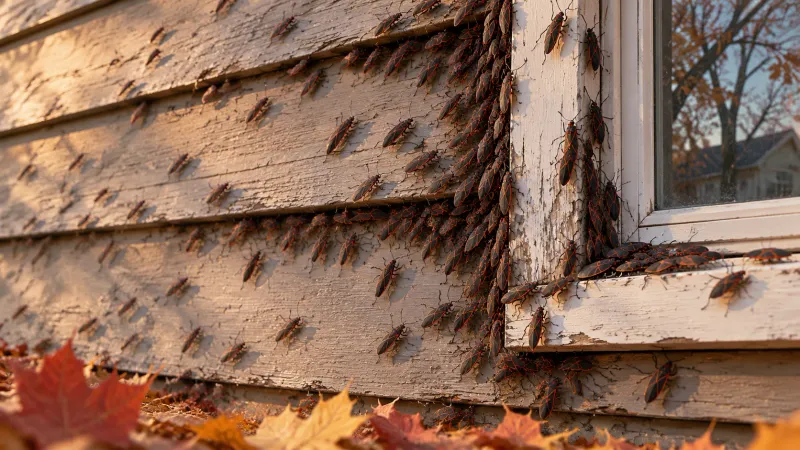
Treat a crowd on the wall as a friendly reminder rather than an emergency. Identify the bugs with care, check likely entry points, seal what you find, and sweep up any strays without making a fuss.
How many bugs you see depends on the year and your location. Iowa State notes large differences from place to place and season to season, so not every Iowa home will face an invasion.
No particular temperature or bug count tells you when to act.
A tight house keeps most of the winter guests where they belong, out in the leaf litter.
Share this story