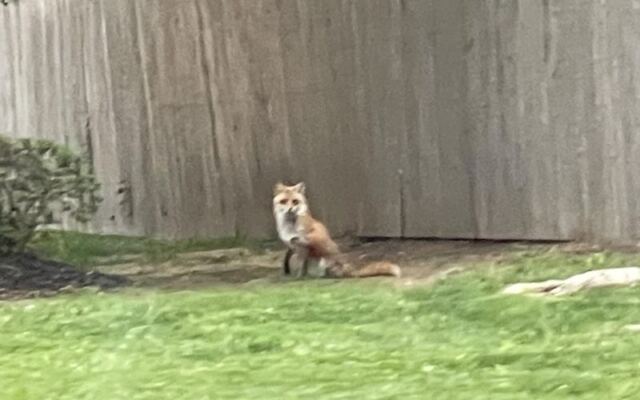
Those eerie screams in the night are foxes talking, and they are communicating with each other. Red foxes use different calls in different situations, so one sound can carry more than one possible meaning.
Delaware has two kinds of foxes, which makes it hard to know who is calling from sound alone. Here is what the sources say, what you cannot tell from your porch, and how to stay safe.
What a fox call can tell you

Foxes are talking to each other when they call at night. Red foxes make a range of sounds, and University of Maryland Extension describes calls used to signal danger and calls used when one fox meets another.
So the message depends on the situation, and red foxes have more than one reason to call.
That is the part we can say with some confidence. What we cannot do is turn a single scream into a precise message, like a sentence you could translate.
The same kind of sound may come up in different circumstances, and you are hearing it from a distance without seeing what the animal is reacting to.
It also helps to treat “fox scream” as an informal nickname, not a reliable identification. DNREC notes that Delaware has two fox species, the red fox and the gray fox.
A sound heard in the dark cannot tell you which one made it, and the call contexts described for red foxes should not be assumed for every fox-like noise.
So the useful way to think about it is simple. Documented red fox behavior tells us what calls can be used for.
An unseen, unidentified sound outside your window only tells you that some animal, possibly a fox, is out there making noise. Anything beyond that is a guess, and the guess is often wrong.
Foxes are active after dark

Evening is when the neighborhood quiets down and fox activity picks up. According to DNREC, both of Delaware’s fox species are mostly active at night and around dusk and dawn.
Hearing a call after dark fits that normal routine.
Red foxes are the more common of the two statewide, which might tempt you to assume the caller is a red fox. That is only a probability, though.
Gray foxes also live in Delaware, and a voice heard from inside your house gives you no way to separate them.
A practical clue is what you can actually observe. If you happen to see the animal in a porch light or a car’s headlights, its coloring and shape can tell you more than any sound can.
If you only hear it, simply note that a fox may be passing through and leave it at that.
Night activity also explains why many people hear these sounds without ever seeing the animal. The caller is doing ordinary fox things, such as moving through yards, fields, and wood edges, while most of us are indoors.
Red foxes call in different situations

Sources describe a handful of settings where red foxes use their voices. University of Maryland Extension says red foxes have calls to signal danger and calls they use upon encountering another fox.
Those are fox-to-fox forms of communication, not a message aimed at people.
The high-pitched wails many people call screams are a separate piece. The Natural History Museum associates those wails mainly with breeding-season communication.
Mainly is the key word, since it does not mean every scream is a mating call.
Nothing here says a call is a warning to homeowners or a sign that an attack is coming. It also does not say that a fox is in pain when it wails.
Those ideas show up in popular retellings, but the sources do not back them.
For a listener, the takeaway is modest. Red foxes can call in several contexts, and a single sound does not let you confidently assign one meaning to it.
The documented contexts also belong to red foxes, so they should not be stretched to gray foxes without supporting evidence.
Breeding season is only one piece of the picture
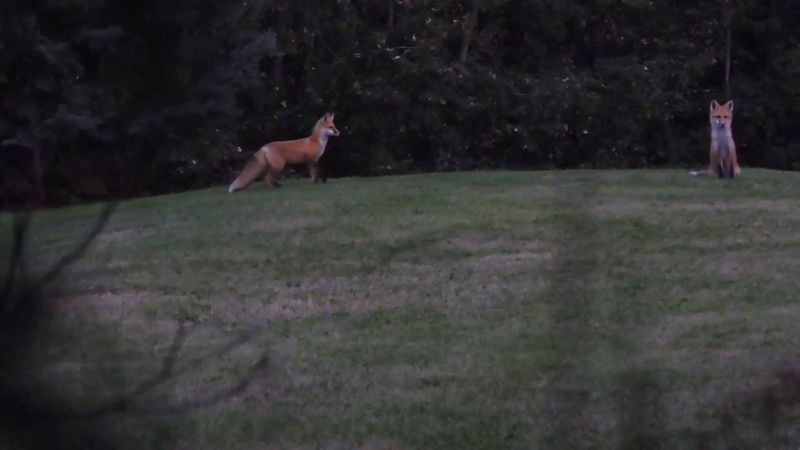
Late winter and early spring are when many people notice the loudest fox sounds. Breeding can help explain some red fox wails, but it is not a catch-all answer for every noise after dark.
A call in summer or fall, or one that sounds like a bark, may have nothing to do with it.
Even the dates vary by source. DNREC lists March and April as the red fox breeding season in Delaware.
Maryland Extension gives January through March for Maryland.
Treat both as regional guidance, not a precise calendar for each fox or each call. Individual animals and local conditions differ.
The Natural History Museum links high-pitched wails mainly to breeding-season communication, which fits as one piece of context and nothing more.
Secure food that can attract foxes
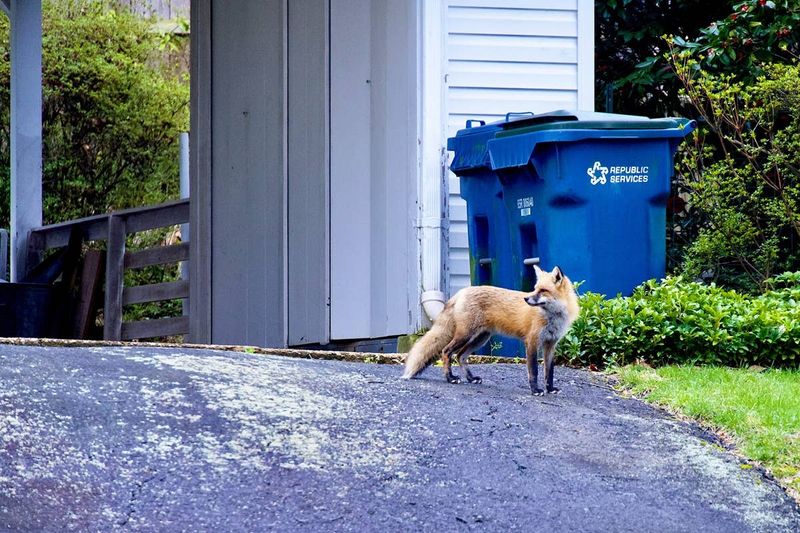
Food is the easiest thing around your home to change. DNREC advises removing or securing trash, outdoor cat food, and food scraps to discourage foxes from lingering.
Fewer easy meals means fewer reasons to hang around.
Start with the trash. Use cans with tight lids, and put bins out the morning of pickup instead of the night before.
Pick up fallen birdseed, fruit, and scraps from the yard, and keep compost covered.
Pets matter too. Delaware Public Health advises feeding pets indoors, keeping garbage secured, and not feeding or touching wildlife.
That includes leaving out food on purpose for a fox you enjoy watching.
These steps limit attractants. They do not guarantee that a fox will leave, since the animal may still pass through for other reasons.
Still, a yard with nothing to eat gives it little cause to settle in.
Keep your distance and know whom to call

Watch a fox from a distance and leave it alone. Do not approach, feed, touch, capture, or handle it, even to get a better look.
Delaware Public Health advises against touching wildlife and says to avoid an animal that appears unwell.
Seeing a fox in daylight can be alarming, but it is not proof of illness. Virginia’s wildlife agency says in its fox guidance that foxes can be active in the daytime and that a daytime sighting alone is not a sign of rabies.
That is Virginia’s advice, while Delaware’s focus is on staying away from any animal that looks sick.
If you are bitten or scratched, wash the wound and call the Division of Public Health at 888-295-5156 for guidance. Delaware’s Office of Animal Welfare also covers rabies exposure.
Do not try to catch the animal yourself.
For a sick or injured wild animal, contact the DNREC Wildlife Section at 302-739-9912. Describe where the animal is and what you see, then keep people and pets back until you get direction.
Listen without guessing at the message
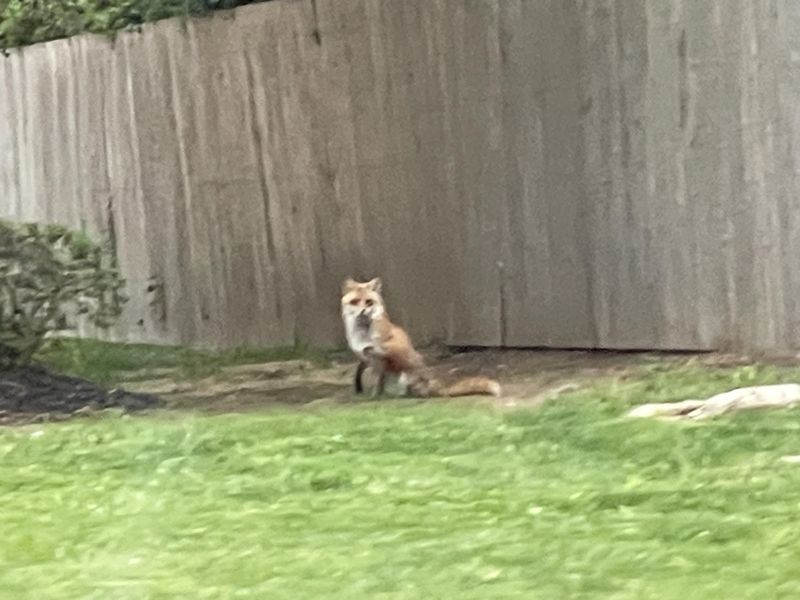
Red foxes call for different reasons, as Maryland Extension describes, but a scream heard in the dark cannot tell you the exact meaning or even the species, since Delaware has two. Keep your distance and keep food out of reach.
The night is simply fox business, and you are overhearing it.
Share this story