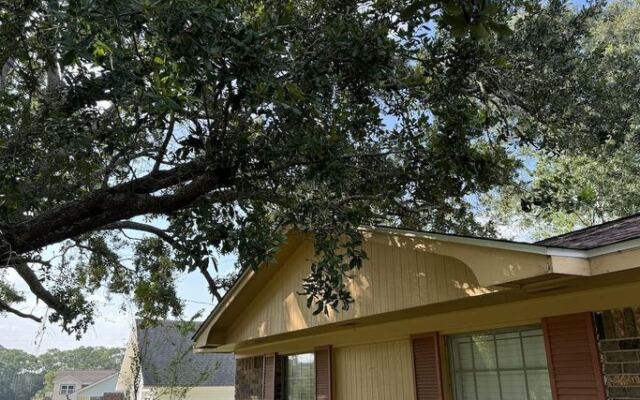
In California, you can cut the branches of a neighbor’s tree that hang over your yard, as long as you stop at the property line. That right comes from court decisions, and it has some practical limits.
Who owns the tree, how you cut, your city’s rules, and what is overhead can all change what you should do. A few quick checks before you pick up the saw can save you from a costly dispute or a dangerous mistake.
California case law limits how far you can trim
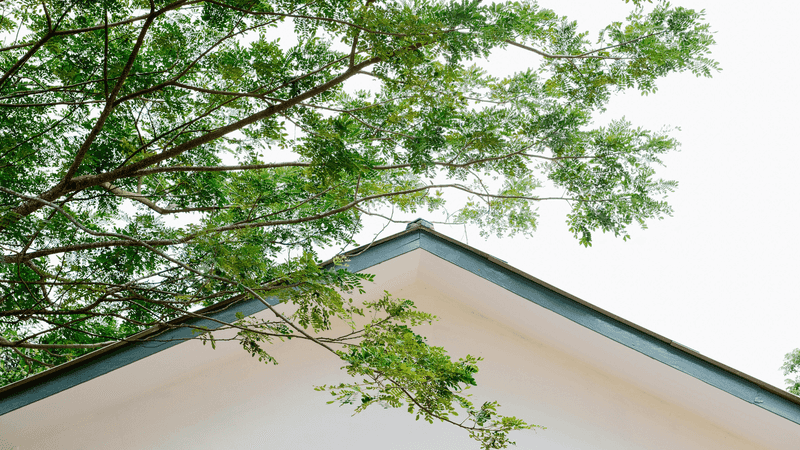
Branches from next door can block light, drop leaves, and scrape the roof. California courts have spoken to this problem.
In Crance v. Hems, a California appeals court said an adjoining owner may cut overhanging branches only as far as they extend over that owner’s land, and not beyond it.
You can read the reasoning in the Crance v. Hems decision.
Notice where this rule comes from. It is a case-law rule, built from court opinions, and not a statute that hands every homeowner an unlimited license to prune.
That difference matters because a rule made by judges has edges, and those edges are shaped by the facts of each dispute.
The boundary sets the reach of your right. Anything hanging over your side of the line is the part you may remove.
Anything past the line is off limits without the neighbor’s permission.
Yet the property line does not answer every question. It does not tell you who owns the tree, whether the way you cut might hurt it, or whether your city requires a permit.
The rest of this article walks through those questions in the order you will likely face them, starting with the tree itself and ending with the safety issues that call for professionals.
The trunk’s location helps determine who owns the tree
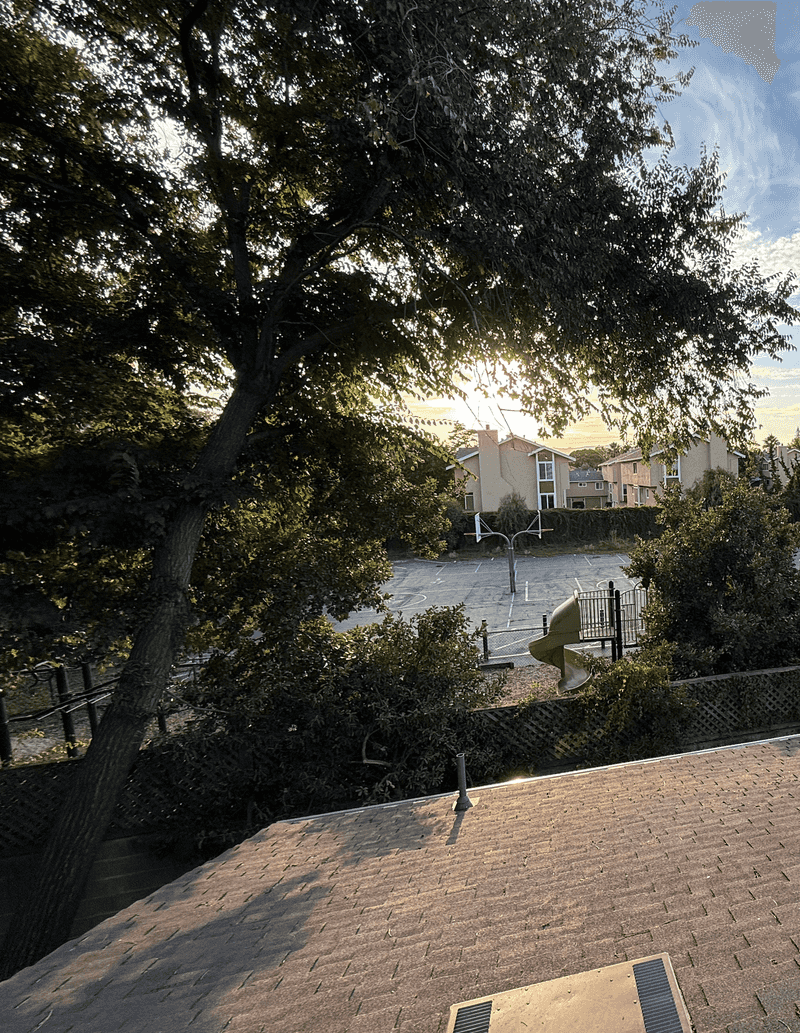
Before you trim, look at the trunk. Under Civil Code section 833, a tree whose trunk stands wholly on one owner’s land belongs to that owner, even if its roots or branches cross the boundary.
In that situation, the overhanging-branch rule is the one that applies to you.
A tree with its trunk partly on both properties is a different story. California courts treat a boundary-line tree as generally shared between the neighbors.
As an appellate decision in Russell v. Man shows, one co-owner may not cut that tree in a way that injures it.
The practical difference is large. With a tree that sits wholly next door, you trim only what hangs over your land.
With a shared tree, even a cut on your own side can cause trouble if it harms the tree as a whole.
A simple clue helps. Walk to the base and see where the trunk meets the soil in relation to the line.
If the trunk touches or crosses the boundary, treat the tree as shared and talk with your neighbor before any cutting. If you cannot tell, that is a good reason to get the line confirmed, which is the next step.
Confirm the boundary before pruning
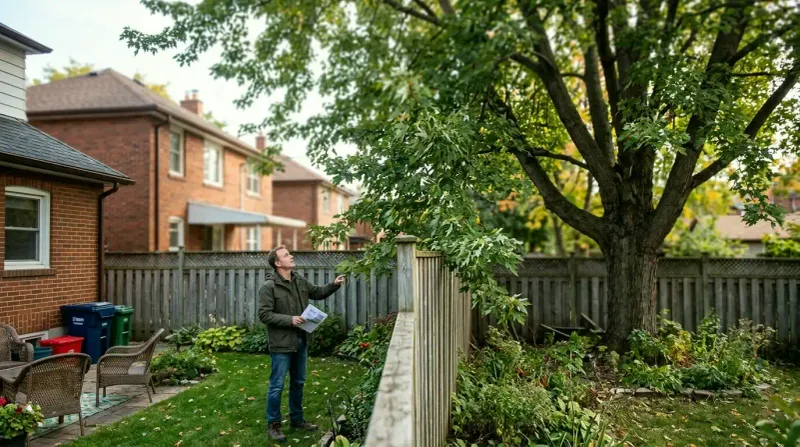
Everything about your right depends on where your land ends. Crance limits the right to the portion of the branches overhanging your own land, so a guess about the line can turn a lawful trim into a problem.
Establish the actual property boundary before you arrange or do any cutting.
Good places to start are your deed, your title records, and any survey done when the property was bought or built. If those documents are unclear or the tree sits close to the line, a licensed land surveyor can mark the boundary for you.
The cost is small compared with a dispute over a damaged tree.
Do not assume that a fence, hedge, or wall sits exactly on the line. Check the records instead of relying on what looks right from the yard.
Once you know where the line runs, keep your work on your side of it. Do not step onto the neighbor’s property or cut past the boundary without permission.
A friendly conversation first often settles the matter, and a neighbor may even agree to share the cost of a professional trim.
The boundary does not settle every question about harm
Stopping at the line limits where you cut. It does not settle how your cutting affects the tree.
A heavy cut that leaves the tree weak, lopsided, or unstable can raise questions even when every cut stayed on your side.
Booska v. Patel is a useful caution here, with a limit on how far to read it.
The court in Booska dealt with root cutting, not branch pruning. It stressed that a landowner’s use of their own land is bounded by reasonableness and a duty to avoid foreseeable harm.
It did not set a specific test or damage threshold for branches.
So no one can promise you immunity for stopping exactly at the line. At the same time, a tree owner does not automatically owe damages whenever a branch crosses the boundary.
The cases separate your ability to remove encroaching branches from claims for damages, and those claims depend on the circumstances. Crance itself, in its discussion of branches, treats the right to cut and a claim for damages as separate matters.
Money questions also depend on a legal basis. In Russell v.
Man, the court explained that the statutory multipliers for timber trespass require a qualifying trespass. It reduced the award there, while upholding liability for actual damages on a negligence theory.
Nobody should assume wrongful trimming means triple damages.
If the tree is valuable, shared, or likely to be hurt by the cut, talk with a California attorney before you start.
Check local rules before significant pruning
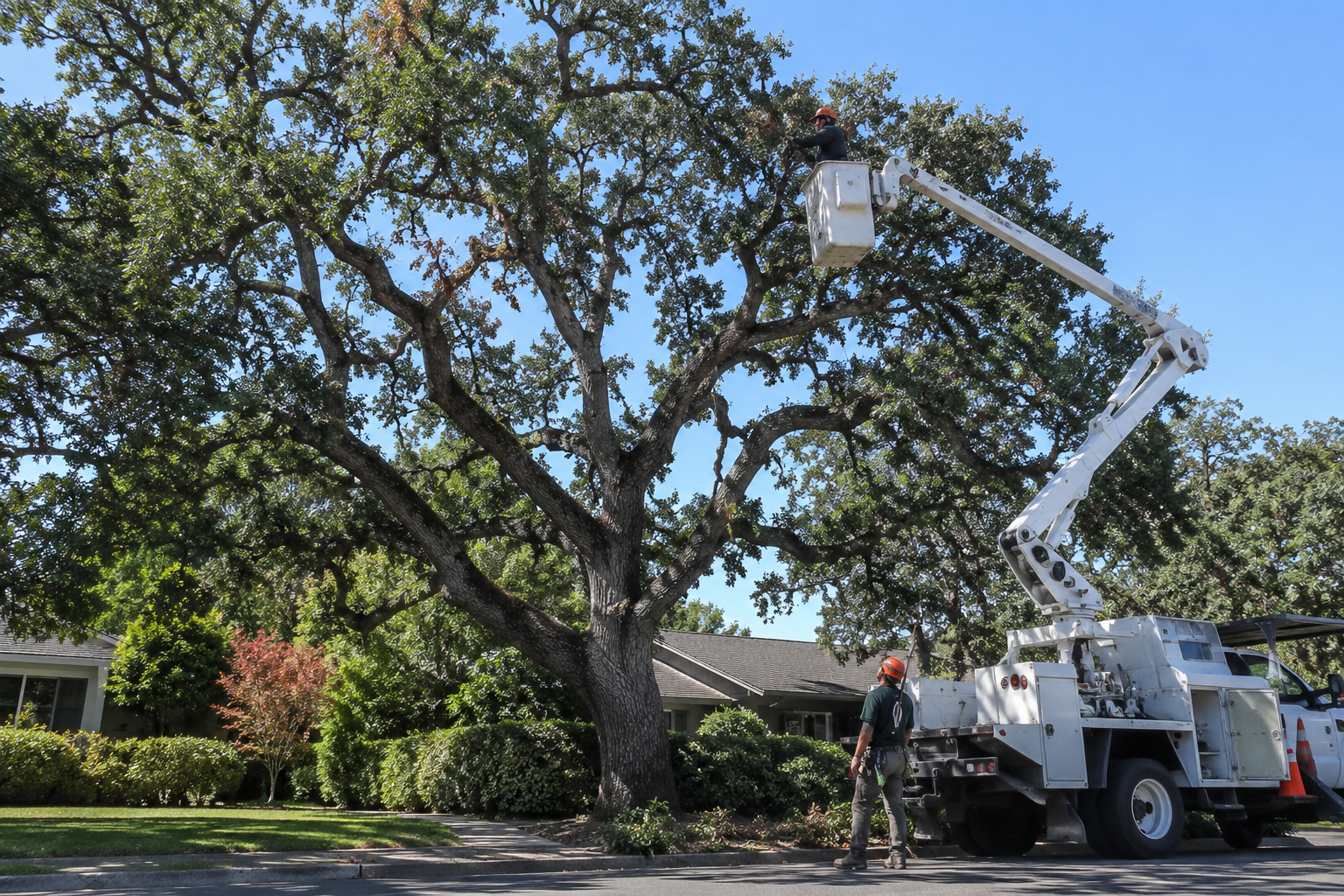
State case law is only one layer. Cities often add their own tree rules, and a claimed right under case law does not mean local permits stop applying.
Some cities protect certain trees by size, species, or location, even on private land.
San Mateo offers a clear local example. The city requires an approved permit for major pruning of a protected private tree, as described on its Protected Trees page.
That is one city’s rule, not a statewide requirement, and many places have different standards or none at all.
Your own city or county may use different size limits, protect different species, or define major pruning in its own way. Fines can apply when a protected tree is cut without approval, so a quick check is worth the time.
Search your city’s website for terms like tree ordinance, protected trees, or heritage trees. If the answer is unclear, call the planning or public works office and describe the tree and the work you have in mind.
Ask before you cut, since a permit question is much easier to fix beforehand than after.
Prune carefully to protect the tree
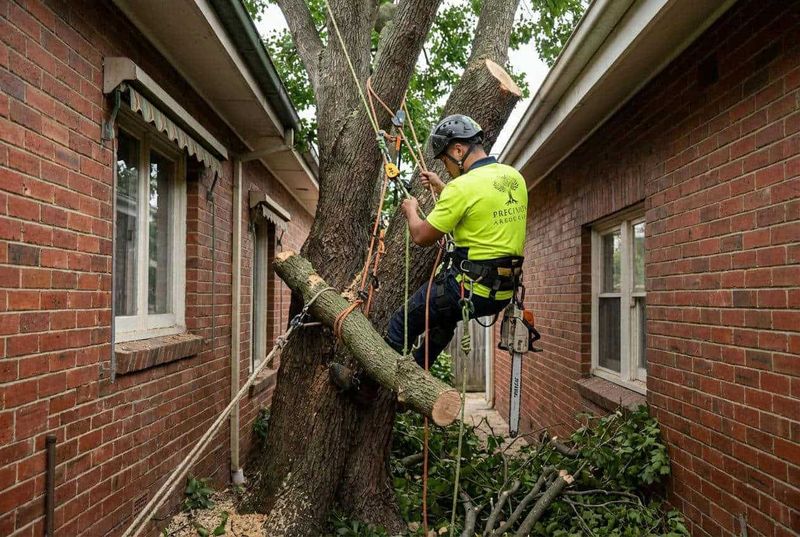
If the cut is lawful where you live, the way you cut still matters. For anything beyond light trimming, ask an ISA-certified arborist to assess the tree.
An arborist can tell you how much can come off without weakening it and which limbs are safe to reach.
University of California guidance gives a sense of scale. UC Agriculture and Natural Resources says about 25 percent of foliage is the upper limit for established trees, and about 10 percent is a better maximum for older, mature trees.
Those numbers are horticultural guidance, not legal limits, and they are not a prescription for every tree.
Technique counts too. UC’s pruning guidance says to make cuts outside the branch collar, the slightly swollen ring where a branch meets its parent limb, so the tree can grow over the wound.
Avoid flush cuts and stubs.
Large, high, or hazardous limbs are not weekend projects. A heavy branch can swing or drop unpredictably, and a ladder adds risk.
Hire a professional for any limb you cannot cut safely from the ground with hand tools.
Leave power-line work to the utility
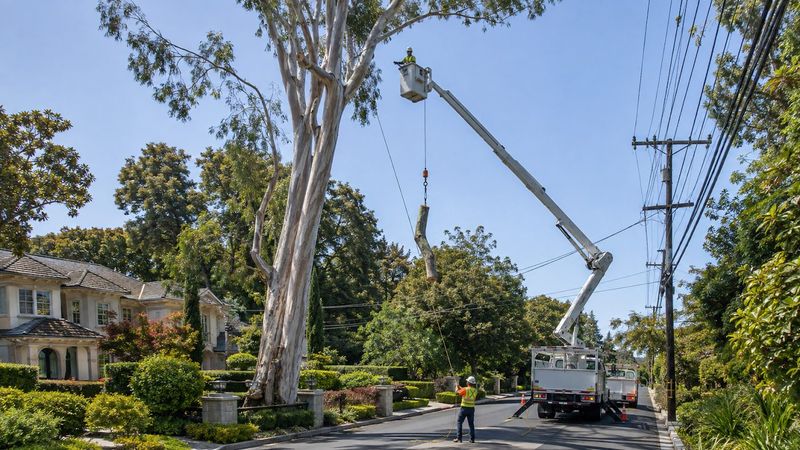
Branches near electric lines are a different category of problem. The California Public Utilities Commission says not to prune near electric lines and to contact the utility instead, in its tree trimming information.
A homeowner should not treat this as safe to do alone.
PG&E makes the same point. Its vegetation management page says only trained, line-clearance-qualified personnel should do tree work near powerlines.
Contact your utility, describe where the branches are, and let its crews or approved contractors handle it.
Wood and wet leaves can carry current, and a falling limb can pull down a line. That is why the line itself, and not only the property boundary, can decide who should do the job.
Before any other trimming, confirm the boundary and the tree’s ownership, check your city’s rules, and bring in an arborist when the limbs are large. Then, as UC guidance suggests, leave hazardous work to the pros.
A branch is easy to cut, but a mistake can be hard to take back.
Share this story