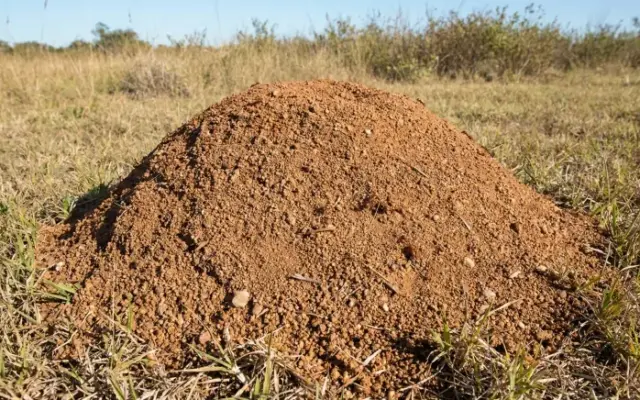
A fresh pile of soil in your yard after a winter rain is a clue that ants are active somewhere close by. It is a message worth reading, but it is not a reason to grab a spray bottle.
Ants build many kinds of nests, and one small mound can mean several different things. Here is how to read the clue, what it cannot tell you, and when action actually makes sense.
What does a fresh mound actually tell you?
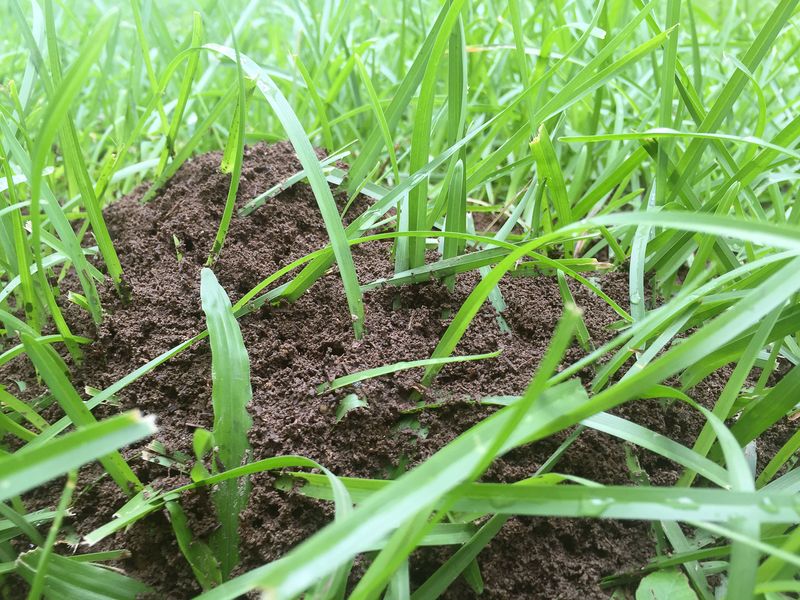
A fresh soil pile can mean that ants are active at a nest nearby. That is about as far as the clue goes.
It does not tell you that the colony was flooded, that ants just moved in, or that your yard has an infestation.
Researchers in northern California who studied Argentine ants noticed something useful. In a 2006 study of Argentine ant nest movement, they reported small piles of excavated soil at nest entrances, particularly after rain.
Workers dig out soil as they keep their tunnels open, and that soil ends up on the surface.
Notice the wording, though. This is a reported link between rain and visible soil piles in one set of nests.
It is not a rule that applies to every yard or every ant.
The same researchers also found that many nests showed no surface disturbance at all. So a yard with no mounds can still have ants nesting in it, and a yard with a mound may simply be showing you what was already there.
Think of the pile as a note that says ants live here. It does not say how many, which kind, or whether you need to do anything about it.
Those questions take a little more looking, and the next sections walk through them.
Rain can change ant activity in different ways
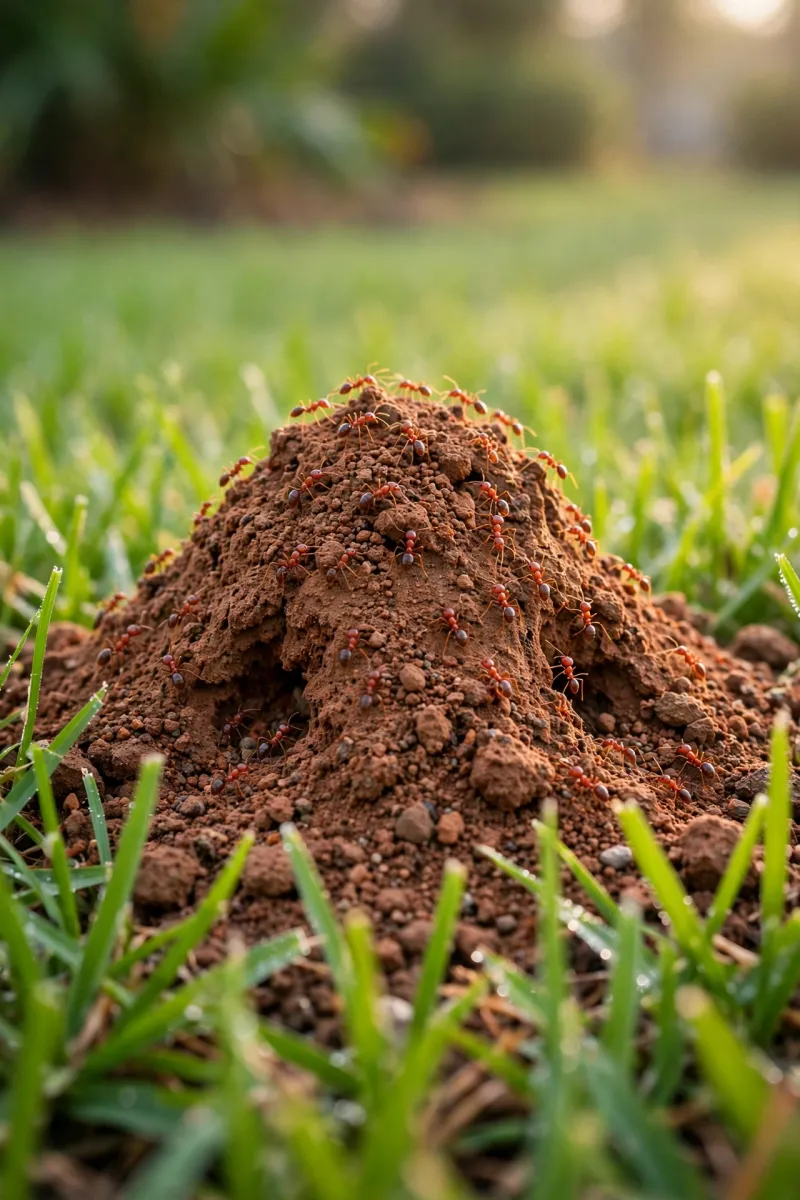
Rain and new mounds often show up together, but there is no single reason that explains every case. Different ants respond to wet weather in different ways, and each report applies to particular ants and conditions.
The northern California Argentine ant work, described in the Heller and Gordon paper, noted small soil piles at nest entrances particularly after rain. The paper describes what researchers saw.
It does not prove that flooding caused those piles.
UC IPM adds another piece. Its overview of ants says ants may seek shelter from flooded conditions.
That can bring them toward buildings, which is a different situation from a mound in the lawn.
Then there are fire ants. A UC Santa Barbara article reports that some fire ants increase mound-building after heavy rain.
That finding is about those ants, not about every mound-making species in California.
Put together, these reports show that rain can change what ants do and what we see. They do not show that rain flooded the colony under your hedge.
A fresh pile might come from cleanup digging, shelter-seeking, or ants that were there all along and are simply easier to spot on wet ground.
A mound does not show the size of a colony
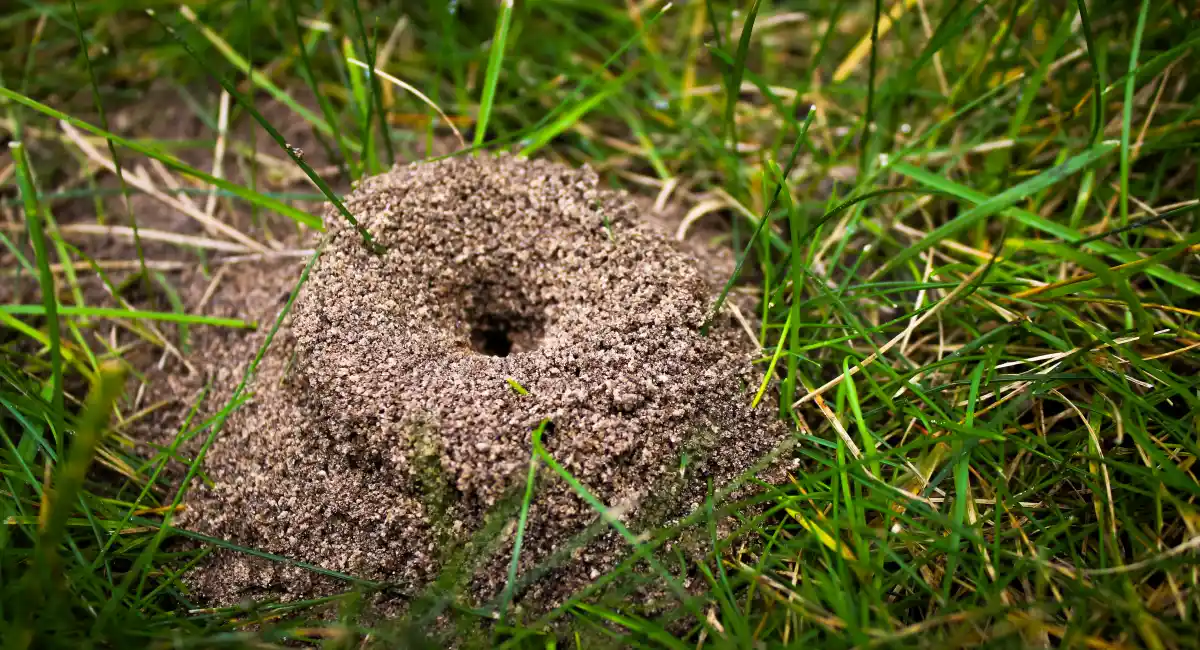
It is tempting to read a big pile as a big colony and a tiny pile as a tiny one. The surface simply does not work that way.
In the northern California Argentine ant research, the study’s nest observations showed that nests were shallow and sometimes had small soil mounds. Yet many left no obvious sign at the surface.
A pile is one possible clue, and its absence tells you very little.
That means a mound cannot tell you how large or old a colony is. It also cannot tell you where the colony’s edges lie, or whether the ants have relocated from somewhere else.
The pile is not even necessarily the main living space of the nest.
Here is a practical example. Two neighbors could have similar ant populations, and only one sees a mound after a storm.
The other has nests tucked under mulch or along a foundation with nothing visible at all.
So instead of measuring the pile, watch the ants. Where do they travel, and do they cross into places you care about?
Behavior you can observe over several days says far more than the shape of a heap of soil.
California ants build different-looking nests
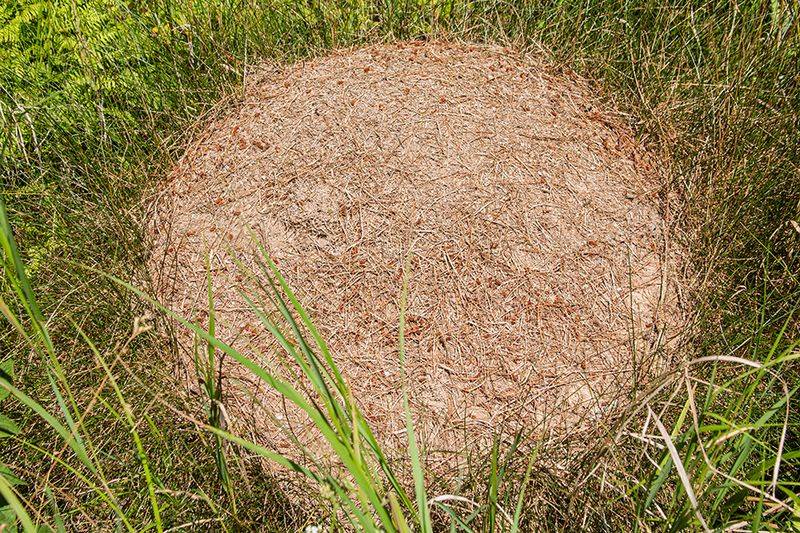
California is home to many ant species, and their nests do not look alike. That is exactly why a mound’s shape or freshness cannot name its builder.
UC IPM notes in its guide to identifying ants that California harvester ant mounds are often cleared of nearby vegetation and ringed with seed husks or plant debris. Pavement ants can leave conspicuous piles of excavated soil, often near pavement edges and cracks.
Imported fire ants add more variety. According to UC IPM’s page on fire ant mounds, their mounds can be domed, flattened by mowing, or even absent.
A missing dome does not clear a yard, and a dome does not convict it.
There is another catch. UC IPM’s fire ant information points out that California has native fire ants that can be confused with the imported kind.
Looking at a mound from a distance is not enough to confirm which one you have.
So appearance alone cannot identify a species, diagnose an infestation, or confirm imported fire ants. Most mounds also come from ants that are not stinging species.
If a firm identification matters, a local UC Cooperative Extension office or pest professional can help.
When should you leave the mound alone?
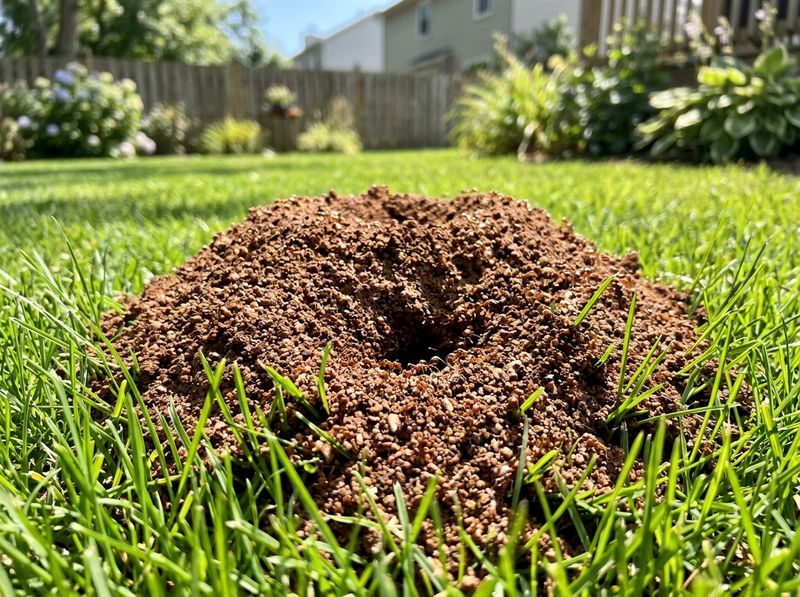
Most of the time, the best response to a mound is to let it be. UC IPM explains in its ant overview that outdoor ants can be beneficial and that trying to remove every one is unrealistic.
A mound by itself does not call for treatment.
Management starts to make sense when ants cause a specific problem. UC IPM’s guidance on gardens and landscapes points to three examples: ants entering a building, ants tending honeydew-producing pests on plants, and ants posing a sting concern.
If your mound is far from the house, away from plants with aphids or scale, and out of the way of kids and pets, you may have nothing to solve. Watching from a distance costs nothing.
Keep your hands and tools out of it, too. Do not poke, dig into, or otherwise disturb a mound you cannot identify.
Some ants can sting, and UC IPM warns that fire ants can attack when their mound is disturbed.
A garden hose, a shovel, and curiosity are a poor combination here. Curiosity is better satisfied with a photo and a quiet look from a few steps back.
Treat the ant problem, not just the soil pile
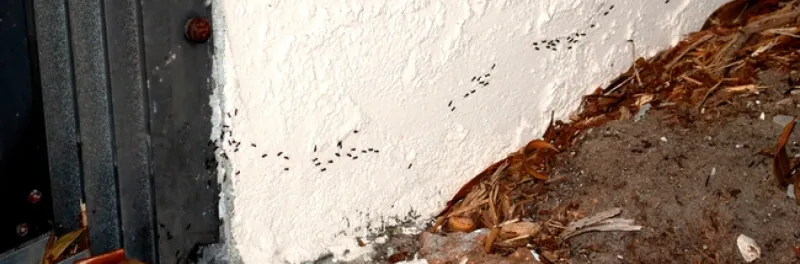
If ants really are causing trouble, the soil pile is not your target. The ants you see moving around are.
Start by watching for active ants and trails, and try to identify the problem. Where are they walking, what are they after, and which kind are they?
That homework pays off because the right tool depends on the ant. UC IPM’s management guidance favors ant baits over relying on sprays in most situations.
Sprays can kill the foragers you see without controlling the colony.
Be realistic about timing. Bait choice and effectiveness vary by ant species, and control may take more than a week.
Quick or universal results are not something any product can promise, so give a bait time to work before changing course.
Safety matters just as much as method. Follow the product label exactly, and keep products away from children and pets.
UC IPM’s pesticide basics are a good place to learn how to read labels and handle products carefully.
Finally, skip outdoor pesticide applications when rain is forecast. Water can wash products away from where you put them.
A dry stretch of weather is a better window for any outdoor step.
Let ant activity guide your next step

Look at the mound, but keep your distance. Then ask whether ants are doing something that bothers you, such as marching into the kitchen or farming pests on your plants.
If the answer is no, leaving things alone is a perfectly good plan, as UC IPM’s ant advice suggests. If the answer is yes, choose careful, targeted steps like those in its management guide.
The timing of the rain does not name the cause, the species, or the need for treatment. A wet-weather mound is a small bit of news from underground, and your job is just to read it.
Share this story