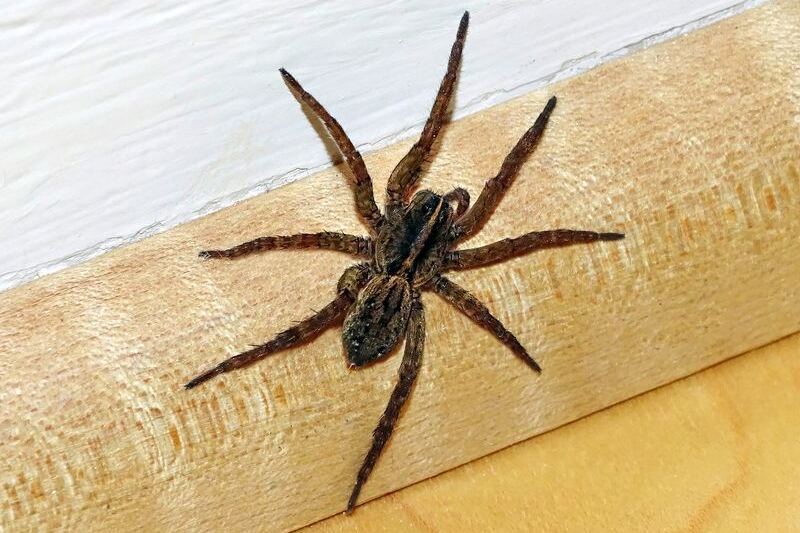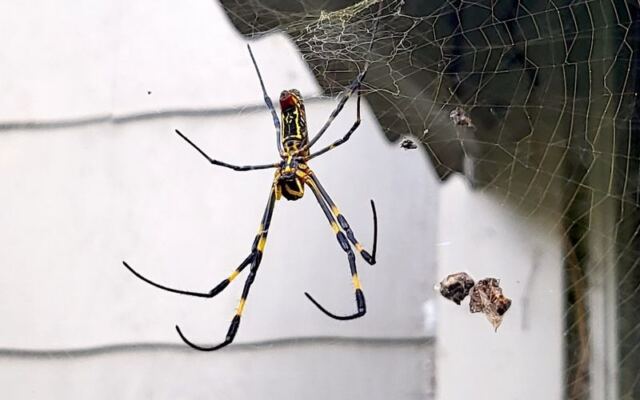
A big yellow-and-black spider hanging in a shimmering gold web can stop you in your tracks. In South Carolina, that sight might be a long-time native or a newer arrival from East Asia.
Knowing which one you have, and what each can do, turns a shiver into a good story. Here is how to tell them apart and what to do when one sets up shop in your yard.
A golden web can’t settle the ID
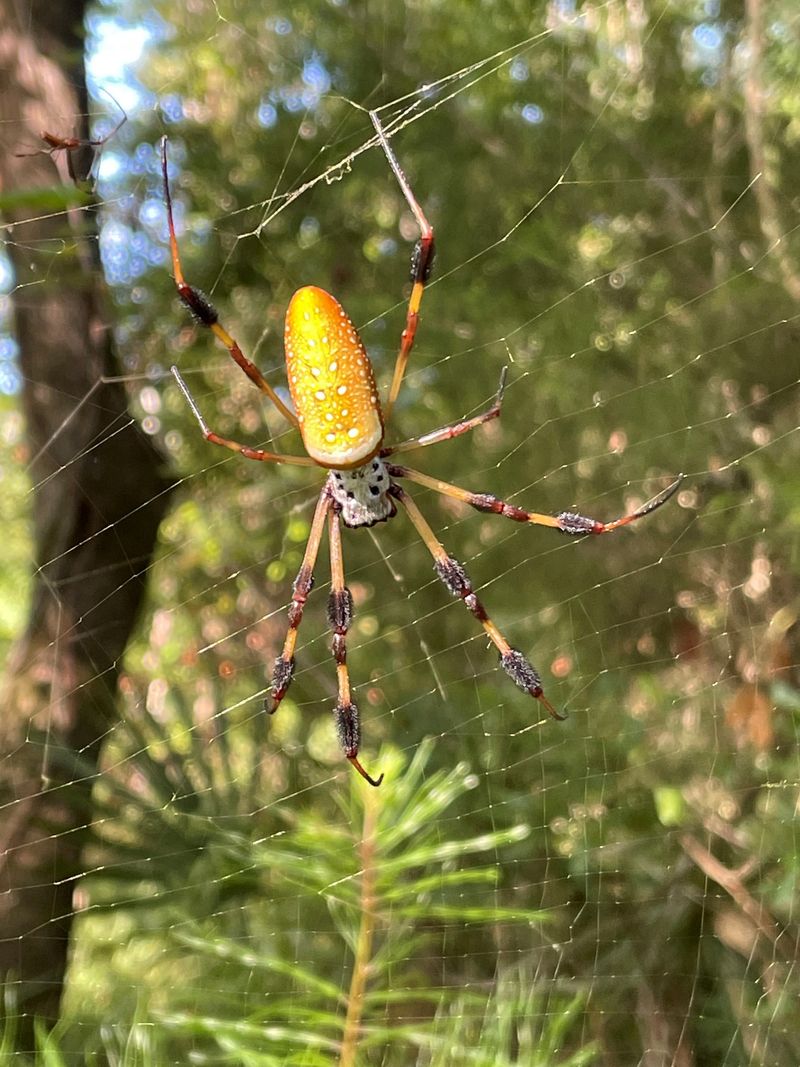
Here is the twist that surprises most people: gold silk does not tell you which spider made it. The native golden silk orb-weaver and the nonnative Jorō can both spin golden webs, according to Clemson Extension.
Mature female Jorō spiders make golden silk too, so web color alone cannot point to one species.
Size and color are shaky clues as well. Clemson lists four large yellow-and-black orb-weavers in the state, and several of them fit the rough picture of a big, bright spider.
A quick glance from across the yard may not be enough for a confident answer.
Yellow and banded garden spiders in the genus Argiope add another twist. Their webs often have a bold white zigzag running through the middle, which the large golden webs of Trichonephila spiders usually lack.
If you see that zigzag, you may be looking at a garden spider rather than either golden-web species.
A close look from a safe distance, or a clear photo you can zoom in on, helps a lot. Details on the legs, the stripes on the abdomen, and the underside are what separate these spiders, as described in UGA Extension’s Jorō profile.
The next sections walk through those clues one species at a time.
The native golden silk orb-weaver has its own telltale features
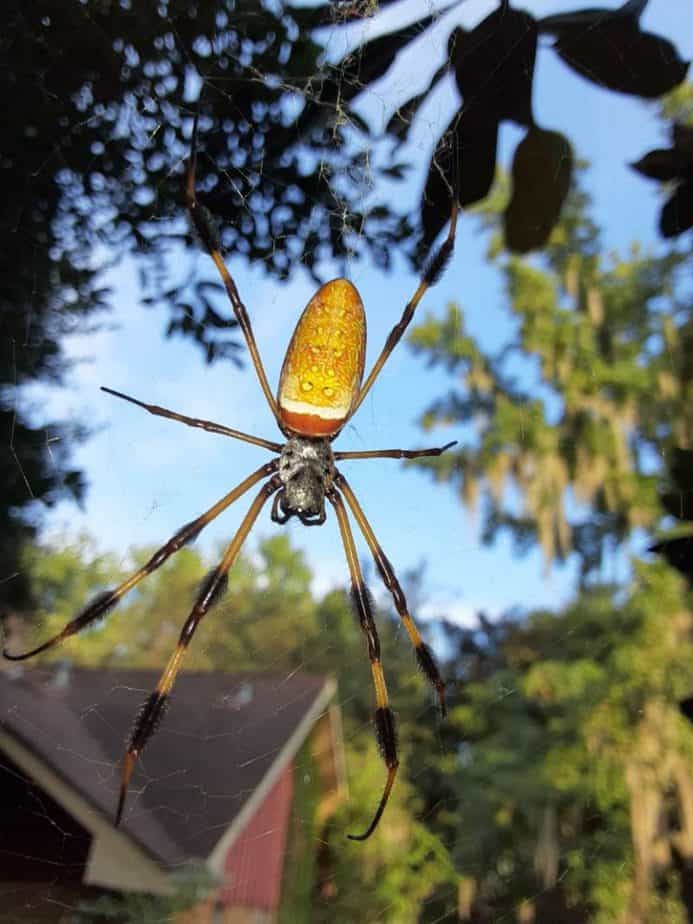
Old-timers in the Lowcountry may know this spider by sight. Trichonephila clavipes, the golden silk orb-weaver, is a common native in South Carolina, and Clemson reports it was documented in Charleston back in 1863.
That history is a good reminder that a dramatic-looking spider is not automatically a newcomer.
According to Clemson’s guide to big yellow spiders, adult females have a bright yellow abdomen. The feature to look for is on the legs, where some segments carry thick, hairy tufts that look a bit like tiny bottlebrushes.
Those tufts are the clue that helps most when you are trying to name the spider. They are easy to miss in a quick glance, but a photo taken from a few feet away often shows them well.
The long, slim body and long legs give the spider a stretched-out look in its web.
Imagine finding one strung between two porch posts in late summer. It looks like something from a movie, yet it belongs to the local landscape and has been part of it for well over a century.
Spotting those leg tufts can turn worry into a bit of pride in a native neighbor.
What makes a Jorō different?
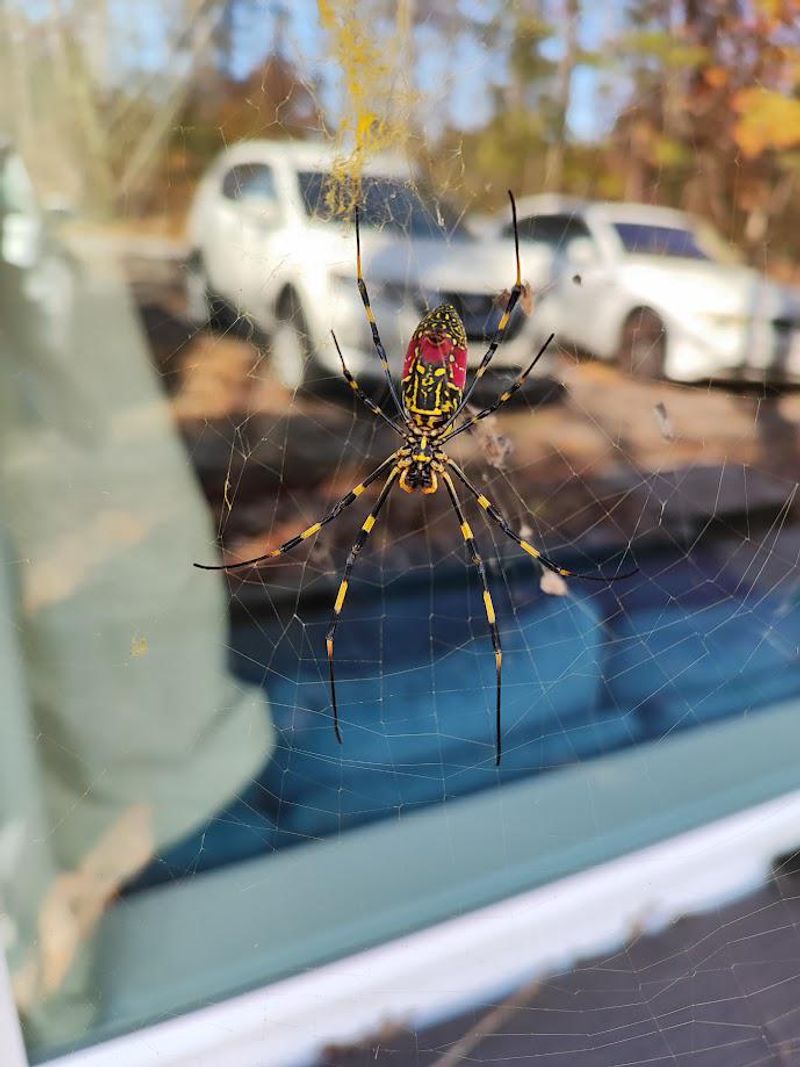
The Jorō spider comes from East Asia, and it was first detected in Georgia in 2014. Since then it has spread north and east.
Clemson’s Jorō page places it in the Upstate and parts of the Midlands, so it is not something found everywhere in the state.
Location matters when you are guessing at an ID. A big golden-web spider near the coast is not likely to be a Jorō just because it looks dramatic.
In the Upstate, the odds change, but you still need to check the spider itself.
Look at the adult female’s abdomen. As UGA Extension describes, a Jorō has horizontal stripes across it, and the underside shows reddish markings.
The native golden silk orb-weaver, by contrast, has a plain bright yellow abdomen and hairy leg tufts.
You may have heard that Jorōs fly. They do not.
Spiderlings can balloon, which means they release silk strands that catch the wind and carry them along. It is a ride on the breeze, not powered flight, and it helps explain how a young spider can end up far from where it hatched.
A frightening appearance does not mean a dangerous spider
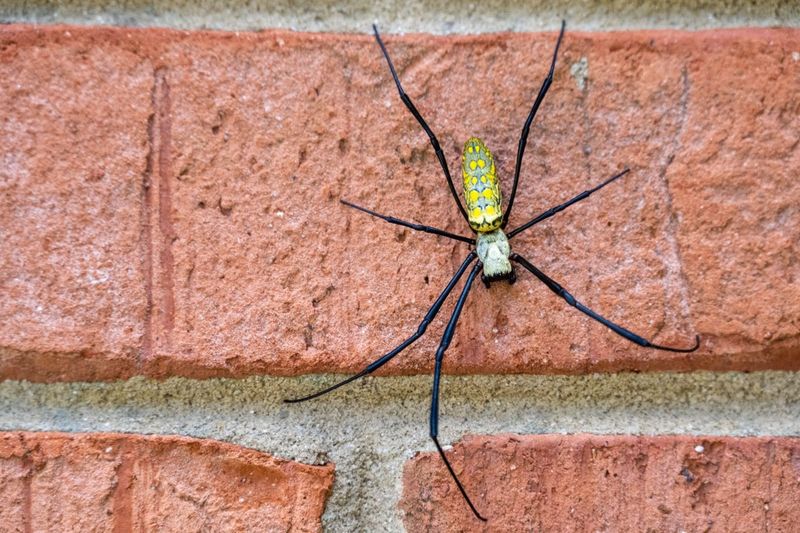
Big, bold, and colorful, these spiders look like they should be a threat. The facts are calmer.
Clemson describes both the golden silk orb-weaver and the Jorō as docile, and neither is considered dangerous to people, according to Clemson’s Jorō guidance and its big yellow spider factsheet.
That does not mean a bite is impossible. For the native species, UF/IFAS Extension says a bite is most likely when the spider is held or pinched.
The result may be localized pain and slight redness.
The takeaway is simple: low risk, not zero risk. Spiders defend themselves when they are squeezed, so the easy way to avoid trouble is to keep your hands off.
Kids and curious pets can admire the web from a few feet away.
This reassurance covers ordinary human safety only. Whether a nonnative spider affects other wildlife is a separate question, and scientists are still working on it.
Feeling safe in your garden and wondering about its ecology can both be true at once.
Leave the spider alone—or move an obstructing web safely
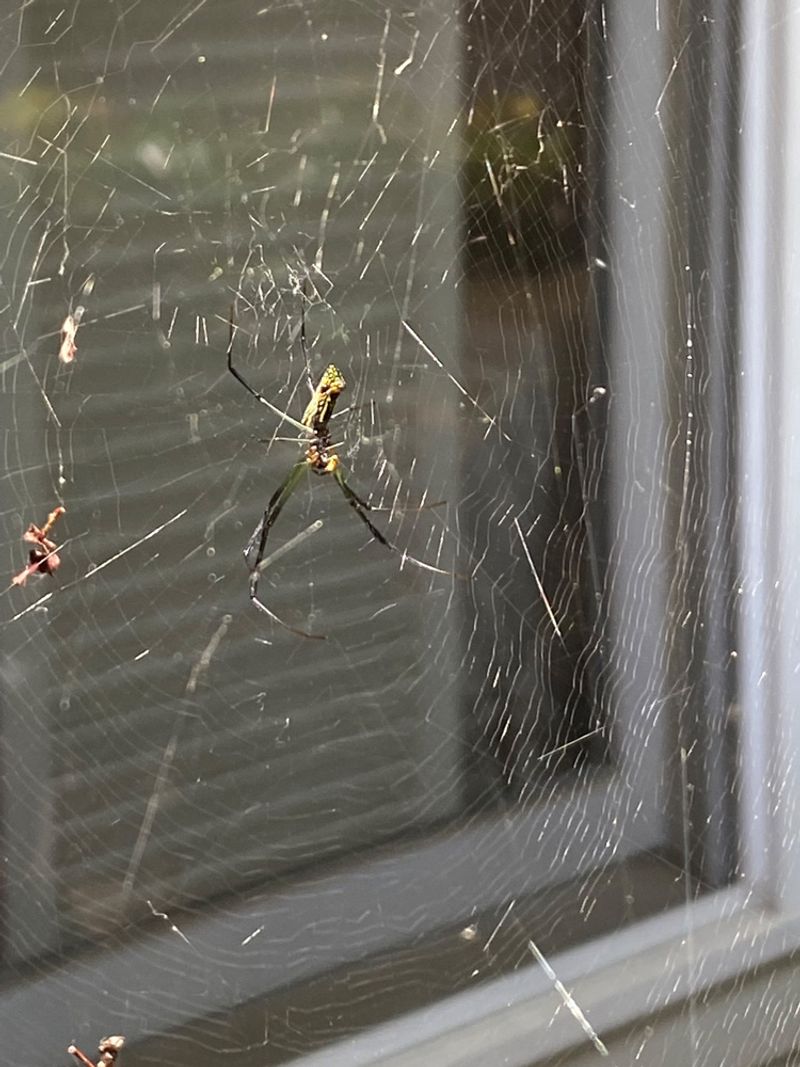
Sometimes a web lands exactly where you walk, like across a doorway or a mailbox path. The best default is to leave the spider alone and walk around it.
Orb-weavers are seasonal, and the web often becomes less of a problem on its own.
If the web has to move, Clemson recommends using a stick to shift the web and spider somewhere else. Stand where you can reach with the stick without leaning or stretching.
Move slowly and keep your face and hands back.
Do not grab the spider. Swatting at the web also may not fix things for long.
UGA Extension cautions that knocking down a Jorō’s web can be a short-term fix, because the spider can rebuild.
A few things are off the table. Clemson specifically advises against fire, which risks burning your home or yard.
Skip ladders and awkward reaches for webs high in trees or eaves too, since a fall is a bigger danger than any spider.
The Jorō’s ecological effects are still an open question
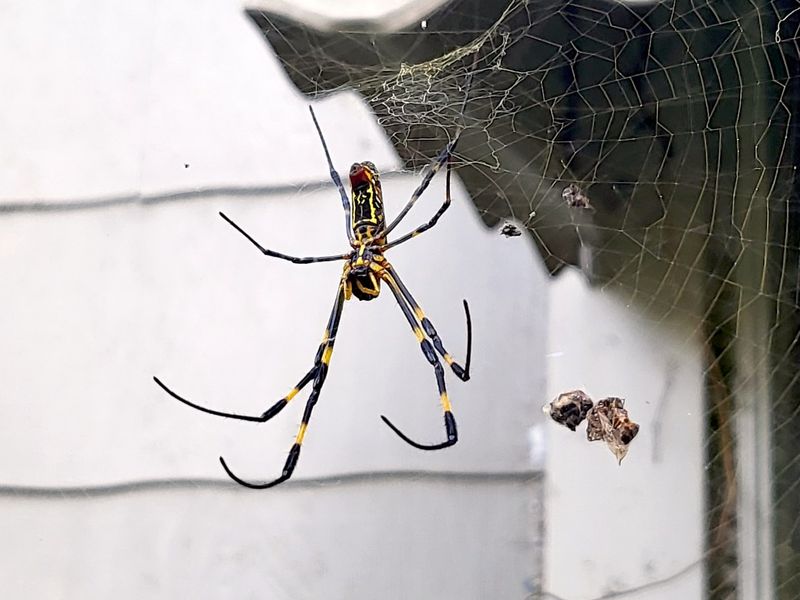
Being safe for people is not the same as having no effect on nature. The Jorō is a nonnative species, and scientists are still sorting out how it fits into Southeastern ecosystems.
Two recent studies give pieces of the picture, not the whole answer.
A 2026 PLOS ONE study sampled spiders at 52 sites in Georgia and South Carolina to compare what they eat. It found some diet overlap, but also distinct prey use.
The authors said the initial results did not suggest strong competition from diet alone.
A 2025 study in Insects counted spiders in an Atlanta forest and saw Jorō numbers rising while native orb-weavers declined. That sounds alarming, but the study itself says this link does not prove the Jorōs caused the decline.
It also had no count from before the Jorōs arrived to compare against.
So claims that Jorōs are wiping out native spiders go further than the evidence. Claims that they are totally harmless to the ecosystem go further too.
Both studies are partial evidence, and neither delivers a final verdict.
Use the details—not the drama—to decide what to do
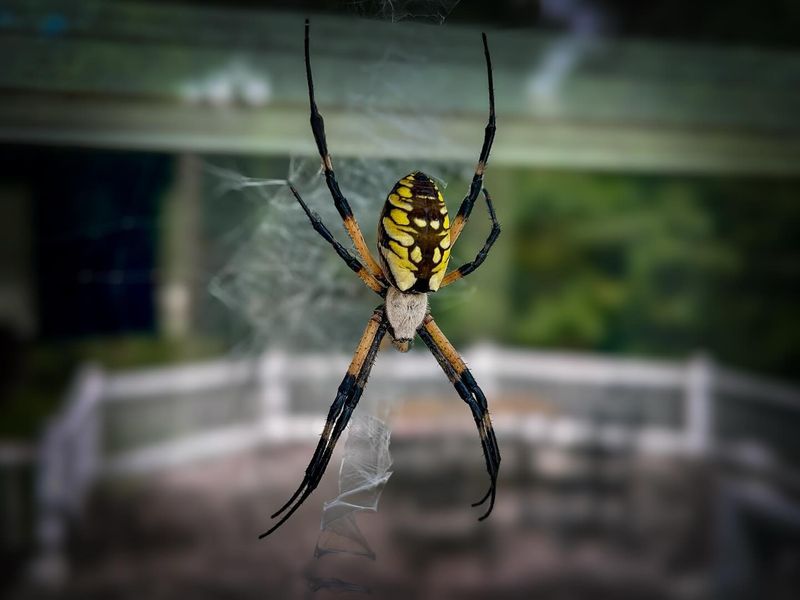
A golden web alone cannot name the spider, so look at the legs, the stripes, the underside, and where you live. Those clues point toward an answer, but a photo may still be needed.
Neither the native golden silk orb-weaver nor the Jorō is considered dangerous to people, per Clemson.
Keep your hands off the spider, and if a web blocks your path, nudge it aside with a long stick from a safe spot. The bigger ecological questions are still being studied, and they are separate from your safety.
Meanwhile, the web makes a fine free show.
Share this story