Get the latest garden guides in your inbox →
Gardening Latest
  • General Gardening
  • Lawn Care
  • Plant Care
  • Composting
  • Soil Health
  • Backyard
  • Garden Muse Magazine
  • General Gardening
  • Lawn Care
  • Plant Care
  • Composting
  • Soil Health
  • Backyard
  • Garden Muse Magazine
  • News
  • Gardening Calendar
  • Garden Structures
  • Vegetable Garden
  • Vertical Garden
  • Raised Beds
  • Hydroponics
  • General Equipment
  • Community Gardens
Garden Themes
  • Spiritual Garden
  • Hydroseeding
  • Seeding and Laying Sod
  • Artificial Grass
  • Lawn Care Equipment
  • Plants
  • Trees
  • Planting Tools
  • Composting Basics
  • Fertilizer
  • Alternative Growing Mediums
  • Front Yard
  • Backyard Activities
  • Landscaping
Gardening Latest

Explore by state

Which state is your garden in?

Currently viewing New York

All states

Northeast

  • Connecticut —
  • Delaware 6
  • Maine —
  • Maryland 3
  • Massachusetts 8
  • New Hampshire —
  • New Jersey 3
  • New York 3
  • Pennsylvania 3
  • Rhode Island —
  • Vermont —

Southeast

  • Alabama 3
  • Arkansas —
  • Florida 3
  • Georgia 3
  • Kentucky 7
  • Louisiana 2
  • Mississippi —
  • North Carolina 1
  • South Carolina 6
  • Tennessee —
  • Virginia 2
  • West Virginia —

Midwest

  • Illinois 2
  • Indiana 4
  • Iowa 6
  • Kansas —
  • Michigan 3
  • Minnesota 2
  • Missouri 2
  • Nebraska —
  • North Dakota —
  • Ohio 3
  • South Dakota —
  • Wisconsin 7

Southwest

  • Arizona 3
  • Colorado —
  • Nevada —
  • New Mexico —
  • Oklahoma —
  • Texas 2
  • Utah —

West

  • Alaska —
  • California 3
  • Hawaii —
  • Idaho —
  • Montana —
  • Oregon —
  • Washington —
  • Wyoming —

No state matches that search.

Site menu

Gardening Latest
  • General Gardening
    • News
    • Gardening Calendar
    • Garden Structures
    • Vegetable Garden
    • Vertical Garden
    • Raised Beds
    • Hydroponics
    • General Equipment
    • Community Gardens
    Garden Themes
    • Spiritual Garden
  • Lawn Care
    • Hydroseeding
    • Seeding and Laying Sod
    • Artificial Grass
    • Lawn Care Equipment
  • Plant Care
    • Plants
    • Trees
    • Planting Tools
  • Composting
    • Composting Basics
  • Soil Health
    • Fertilizer
    • Alternative Growing Mediums
  • Backyard
    • Front Yard
    • Backyard Activities
    • Landscaping
  • Garden Muse Magazine

Explore

  • About GardeningLatest.com
  • Contact Us

Get the latest from the garden

New guides on lawn care, plants and backyard projects, sent when they go up.

Subscribe →

Follow

  • Facebook
  • X
  • Pinterest
  • YouTube
New York Gardening

That Big Clump Of Leaves High In Your New York Tree Might Be A Squirrel Nest

Once the leaves drop, trees across New York reveal some surprises. That big, round clump of leaves way up in the branches…

E

By Elyanna

November 18, 2026 · 6 min read

That Big Clump Of Leaves High In Your New York Tree Might Be A Squirrel Nest

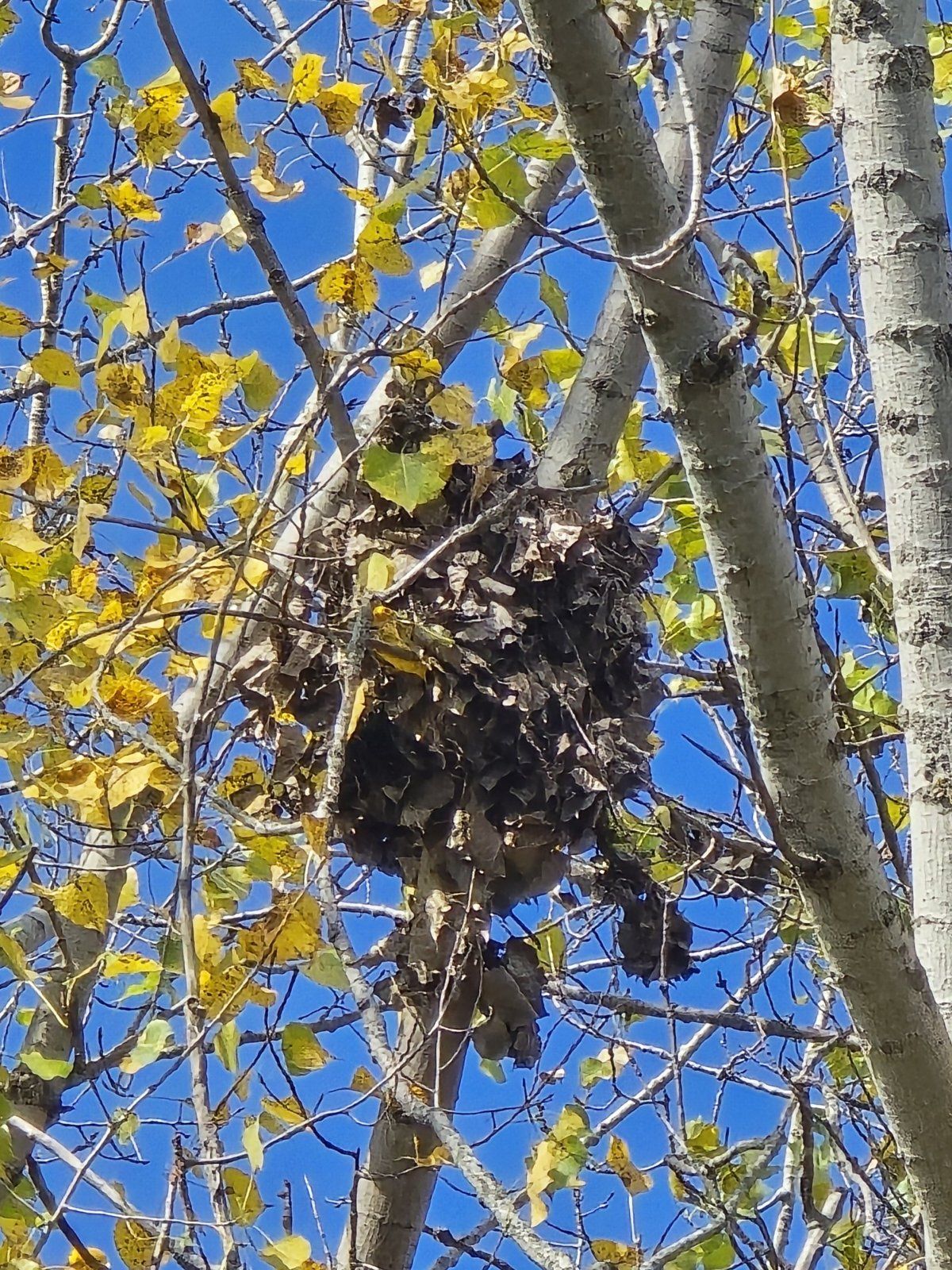
Once the leaves drop, trees across New York reveal some surprises. That big, round clump of leaves way up in the branches stands out like a shaggy basketball.

It may be a squirrel nest, but it could also be something else, and you cannot tell who made it just by looking. Here is how to read the clues without bothering anyone.

At a glance

Where
New York Gardening
Hardiness zone
7 0 to 10°F
Read
6 minutes
Published
November 18, 2026

The leaf ball may be a squirrel drey

The leaf ball may be a squirrel drey
© Private Lands Wildlife

Winter strips the cover from our trees, and suddenly a dark, rounded bundle of leaves appears in a high branch fork. Plenty of people assume it must be a bird’s nest.

Often, though, it is a squirrel nest, which has its own name: a drey.

Eastern gray squirrels are widespread across New York, so one is a plausible builder of a clump near you. New York’s Department of Environmental Conservation squirrel guide covers the species found in the state, and its Conservationist magazine feature describes how squirrels use nests and dens.

Those sources help explain why a leafy ball in your maple or oak is such a familiar sight.

Here is the catch. A round shape is a clue, not an answer.

According to Audubon’s guide to telling squirrel nests from bird nests, a nest’s look alone does not settle which animal built it. Some clumps are squirrel dreys, and some are bird nests.

The shape also says nothing about whether anyone is home. The clump could be old, abandoned, or in use right now.

So treat it as a good puzzle, and enjoy working through the clues in the sections ahead.

How a drey is built
How a drey is built

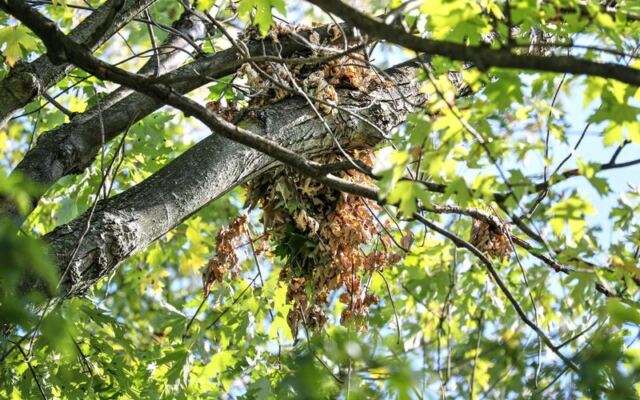
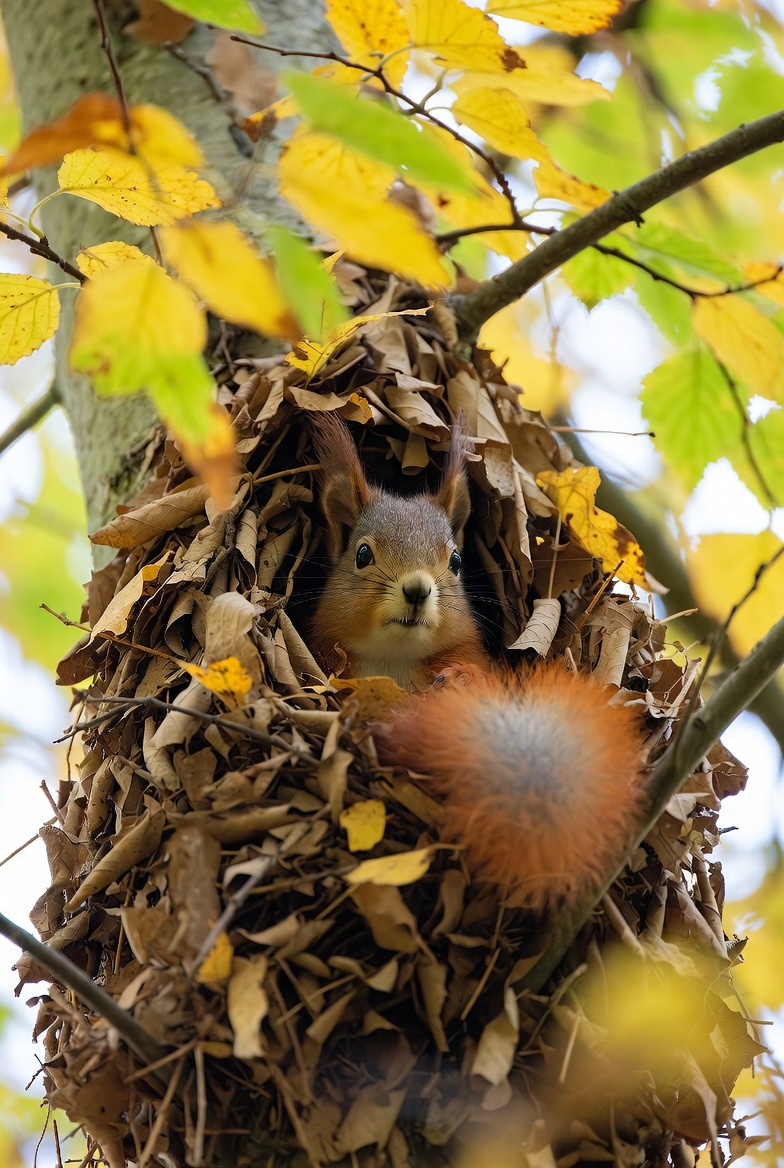
Building a drey is a bit like making a woven basket and then stuffing it with insulation. A squirrel usually starts with a frame of twigs set in a sturdy fork of branches.

Then it piles on leaves until the outside is thick and shaggy.

New York gray squirrels may spend several days in a nest or den during severe winter cold, as the state’s Conservationist magazine describes.

The leafy outer layers give a drey its rounded, ball-like look from the ground. Inside, the nest can have a small chamber lined with softer material such as shredded bark and more leaves.

The SUNY ESF Adirondack Ecological Center’s gray squirrel page describes this kind of nest use, and Audubon notes that dreys are mostly leaves over a twig base.

That construction explains why a drey looks the way it does. Leaves packed over a frame make a dense, lumpy sphere rather than an open cup.

From below, you may see mostly a dark mass with sticks poking out here and there.

Still, do not treat those features as a foolproof test. A nest can be hard to read from far below, especially against a gray sky.

Think of the leafy, rounded look as a strong hint that points toward a drey, not as proof.

Bird nests can look different—and still be possible
Bird nests can look different—and still be possible
© National Audubon Society

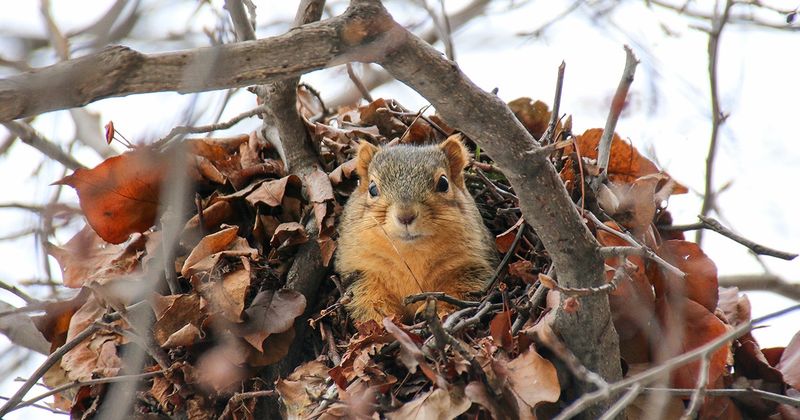
Picture a drey in one hand and a crow’s nest in the other. Audubon’s comparison guide points out that crows build mainly with twigs and thin branches, while a squirrel drey is typically leafy and roughly spherical.

Red-tailed hawk nests are also stick-based, though they may include some leaves.

So when you scan the tree from the sidewalk, ask a few questions. Does the clump look like a dense ball, or like a platform of sticks?

Is it mostly leaves, or mostly branches? A wide, open bundle of sticks leans toward a bird, while a thick leafy sphere leans toward a squirrel.

Those are visual clues, not a verdict. Leaves do not rule out a bird nest, since hawks can add them.

A messy nest in poor light can also fool even a careful observer.

Size and location can add context too. Large nests tucked high in the crown might belong to big birds, while a ball wedged into a branch fork often fits a drey.

Even so, keep your conclusion loose. Saying it looks like a drey is fair, and saying it definitely is one goes too far.

A visible nest does not prove it is occupied
A visible nest does not prove it is occupied
© NJ Pest Control

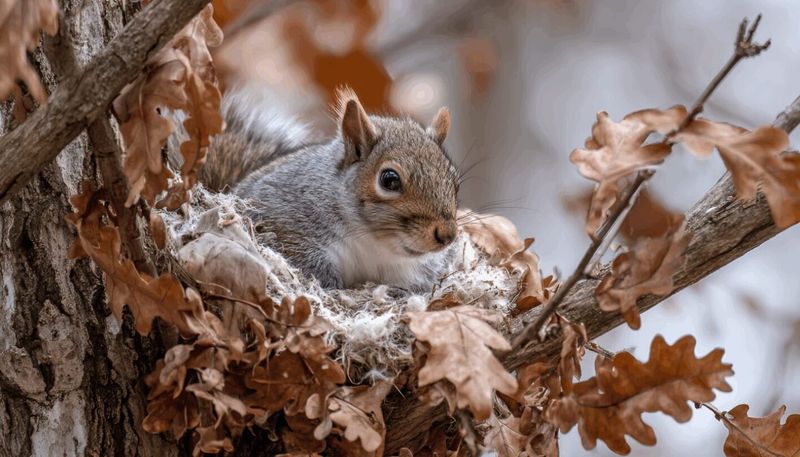
Spotting a drey and knowing someone lives in it are two very different things. A clump could be an old nest left over from a past season.

It could be an active drey, or an empty one, or even a bird nest.

New York gray squirrels may spend several days in a nest or den during severe winter cold, as the state’s Conservationist magazine describes. That fact can tempt people to picture a cozy squirrel curled up inside every leaf ball.

Real life is more varied.

Gray squirrels also use tree cavities, and SUNY ESF’s gray squirrel profile notes they may prefer them to leaf nests. So a squirrel on a freezing day might be in a hollow trunk, not the clump you can see.

Nest use varies from animal to animal and from week to week.

That is why appearance cannot settle occupancy. As Audubon’s guide suggests, you need more than a glance to say what made a nest.

A squirrel running up the trunk and vanishing into the leaves is a hint, but even that does not tell you the nest is its permanent home.

Observe from a distance
Observe from a distance
© Ark Wildlife

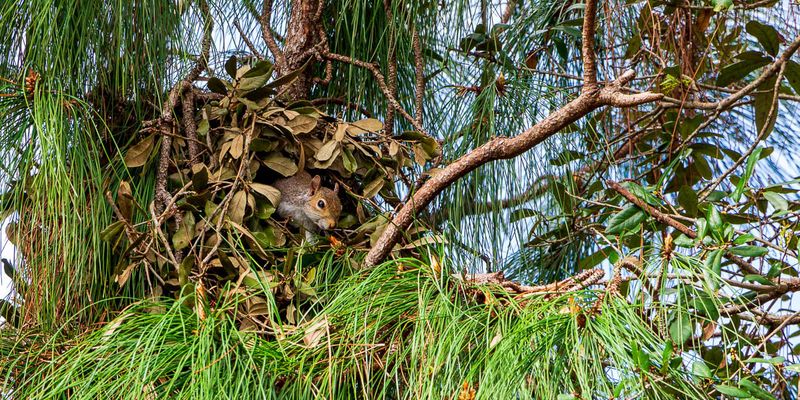
The best way to scratch the curiosity itch is simple: look, and keep your feet on the ground. A pair of binoculars works well, and so does a phone camera with zoom.

Watch for a few minutes at different times of day and see what comes and goes.

Please do not climb the tree, shake the branch, or poke the clump with a stick. Those moves can hurt you, and they can harm or stress an animal inside.

Disturbance is not a safe way to identify who lives there, and a nest does not need to be touched just because it is visible.

Distance matters with squirrels, too. New York City’s WildlifeNYC guidance on eastern gray squirrels advises keeping your distance from them.

Wild squirrels can bite or scratch if they feel cornered.

Try keeping a small notebook of what you see. Note the nest’s height, its shape, and any animals nearby.

Over a few weeks, you may gather real clues about activity.

Even then, remember that looking gives hints, not certainty. A squirrel that stops by may be passing through, and a quiet nest may still be in use.

Check before pruning or removing a tree
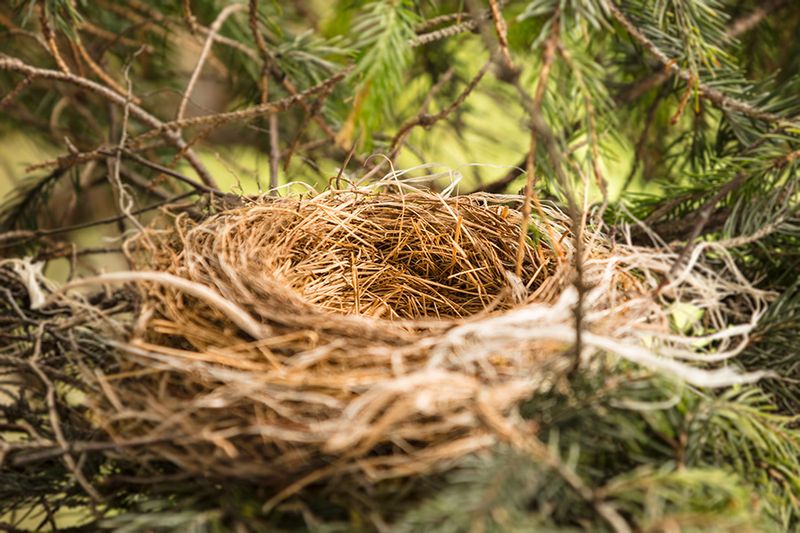
Check before pruning or removing a tree
© NY-NJ Wildlife Removal

Planning to prune or take down the tree? Pause before you assume the leaf ball is empty or that a squirrel built it.

Looks can mislead, and a stick-and-leaf nest could belong to a bird.

The U.S. Fish and Wildlife Service, in its bird nests guidance, recommends scheduling vegetation work outside bird nesting season when practicable.

That simple step avoids many problems before they start. If you hire a tree crew, ask them how they handle nests.

The rules also have details. Under the Service’s January 2025 nest memorandum, destroying an in-use migratory-bird nest requires authorization.

An inactive nest may generally be destroyed without federal authorization if it is not kept or relocated.

That does not make every nest fair game once leaves fall, and it does not mean every nest is off limits. Other federal, state, Tribal, or local protections may apply, and eagle nests have additional protections.

Check the guidance that applies where you live before work begins, rather than relying on a quick guess.

A leaf ball is a tiny mystery that rewards patience, and the wisest answer is often to wait and watch.

Share this story
E

Written by

Elyanna

More from Elyanna →

A passion for lavender! From a young age, Elyanna has had a passion for lavender. It began at the age of two when her mother walked her through fields of lavender in Norfolk England. This ignited her interest; she has grown harvested and learned about this beautiful herb.

About Gardening Latest

Gardening Latest provides in-depth guides to maintaining and enhancing your garden and backyard. Learn how to make the most of the space you have and create a beautiful garden.

More about us →

Latest stories

  • Pennsylvania GardeningStink Bugs in Your Pennsylvania Home: Remove Them Now, Seal Before Next Fall

    Stink Bugs in Your Pennsylvania Home: Remove Them Now, Seal Before Next Fall

    2 min ago
  • Wisconsin GardeningThese Venomous Critters Share Wisconsin Yards With You, And Fall Is When You’ll Spot Them

    These Venomous Critters Share Wisconsin Yards With You, And Fall Is When You’ll Spot Them

    3 hr ago
  • Iowa GardeningWhat Eating Celery Every Day Can and Can’t Do for You

    What Eating Celery Every Day Can and Can’t Do for You

    3 hr ago
  • Massachusetts GardeningMassachusetts Homeowners Keep Planting These Shrubs That Deer Strip Bare Every Winter

    Massachusetts Homeowners Keep Planting These Shrubs That Deer Strip Bare Every Winter

    4 hr ago
  • Delaware GardeningEating Raw Garlic Every Day in Delaware This Winter? Here’s What It Actually Does to Your Body

    Eating Raw Garlic Every Day in Delaware This Winter? Here’s What It Actually Does to Your Body

    4 hr ago

Gardening by state

Stories for your state, and the hardiness zone most of it gardens in.

Keep exploring

Read next

All New York Gardening →
New York GardeningEating Celery Every Day In New York? Here’s What It Does To Your Body
New York Gardening

Eating Celery Every Day In New York? Here’s What It Does To Your Body

Nov 11
New York GardeningThese Poisonous Mushrooms Are Showing Up In New York Yards, Here’s How To Tell Them Apart
New York Gardening

These Poisonous Mushrooms Are Showing Up In New York Yards, Here’s How To Tell Them Apart

Nov 11
Pennsylvania GardeningStink Bugs in Your Pennsylvania Home: Remove Them Now, Seal Before Next Fall
Pennsylvania Gardening

Stink Bugs in Your Pennsylvania Home: Remove Them Now, Seal Before Next Fall

2 min ago

More from New York Gardening

  • What Those Late-Night Coyote Howls Around Your Kentucky Home Really Mean

    4 hr ago
  • From Copperheads To Black Widows, Here’s How To Recognize Every Venomous Creature In Your South Carolina Yard

    4 hr ago
Back to top

Leave a response Cancel

Your email address stays private. Required fields are marked with an asterisk.

Gardening Latest

In-depth guides to maintaining and enhancing your garden and backyard: how to make the most of the space you have, and how to make it beautiful.

  • Facebook
  • X
  • Pinterest
  • YouTube

We may earn a portion of sales from products or services that are purchased through our site as part of our affiliate partnerships with retailers.

Explore

  • About GardeningLatest.com
  • Contact Us
  • Terms and Conditions
  • Privacy
  • Editorial Note:
  • FTC Disclosure

Newsletter

New garden guides and seasonal tips, straight to your inbox.

We’ll email you a link to confirm. Unsubscribe any time.

Almost there! Check your inbox and tap the link to confirm.

© 2026 Gardening Latest. All rights reserved.

Back to top