You are winding down for the night when a burst of high yips rises from the wash behind your house. Coyote calls do carry meaning, and they serve different purposes, from keeping in touch with group members to announcing territory.
Nobody can translate each yip or howl into one exact message, though, and knowing that makes the noise much less spooky. Here is what those sounds can tell you, and what you can do about them.
Coyotes call across Arizona’s urban and rural edges

Picture a quiet evening in a Tucson subdivision, a Phoenix cul-de-sac, or a rural lot with a view of the desert. Sooner or later, many Arizonans hear a wavering chorus of yips and howls drift in from somewhere nearby.
It can feel strange, but it is a very ordinary part of life here.
Coyotes are not limited to remote backcountry. Arizona Game & Fish describes coyotes as widespread across the state, living in cities and suburbs as well as in less-developed desert and rural habitats.
Their calls are commonly heard at night and in the early morning, which is when many people are home and listening.
Washes, golf course edges, vacant lots, and drainage channels often work like quiet highways for them. A coyote can call from a spot just beyond your block wall and still be a good distance from your door.
Sound carries far across open desert at night, so a call can seem closer than it is.
Here is the most useful starting point: hearing coyotes near a home does not, by itself, show that they are unusually aggressive or that you have an emergency. The state’s living-with-coyotes guidance still asks residents to keep children and pets away from coyotes and to take bold or aggressive behavior seriously.
Those are two separate things, a sound in the dark and an animal acting unafraid in front of you.
So what can you reasonably take from the noise? Mostly that coyotes are around and talking to each other.
The next sections explain what those calls generally do, and what they cannot tell you.
Calls help coyotes locate one another and mark territory
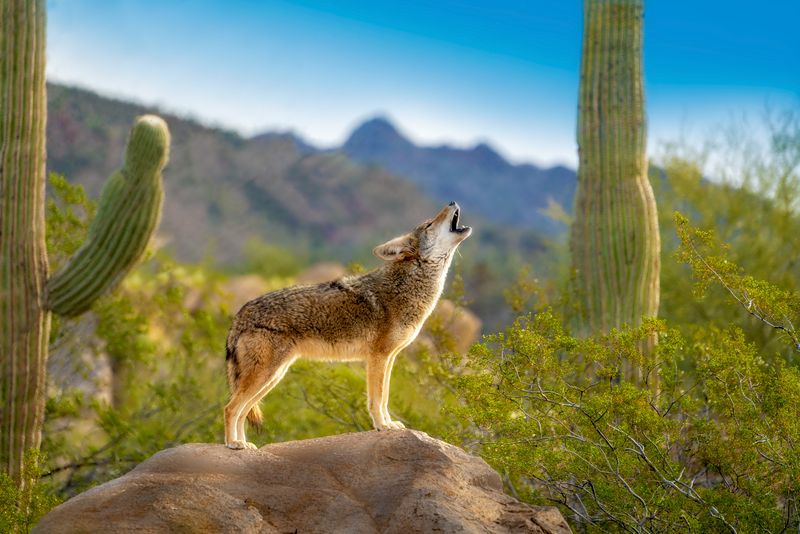
Coyotes live partly social lives, and they spend much of the night spread out across their range. Calling is one way to stay in touch across that distance.
Wildlife biologists describe coyote vocalizations as helping animals locate group members, and as a way to maintain or announce territory to neighbors, as laid out in a North Carolina wildlife biology review.
Think of it like a shout across a big field. It tells others in the area that someone is here, and roughly where.
For a neighboring coyote, it can also be a signal that this patch of desert is already occupied.
Sometimes a pair or family group that has been apart will meet up, and a burst of group calling can accompany that reunion. That is a possible setting for a chorus, not a confirmed explanation for the one you heard last night.
You cannot tell from your back patio whether the animals are reuniting, answering a rival, or doing something else.
Researchers studying how people hear these calls, including a Human-Wildlife Interactions paper on coyote group size, also point to territory signaling as a well-supported general purpose of howling.
Keep the focus on the big picture. Calls are tools for keeping track of one another and for sharing information about space.
They are not a coded message aimed at your household.
What one yip or howl can tell you
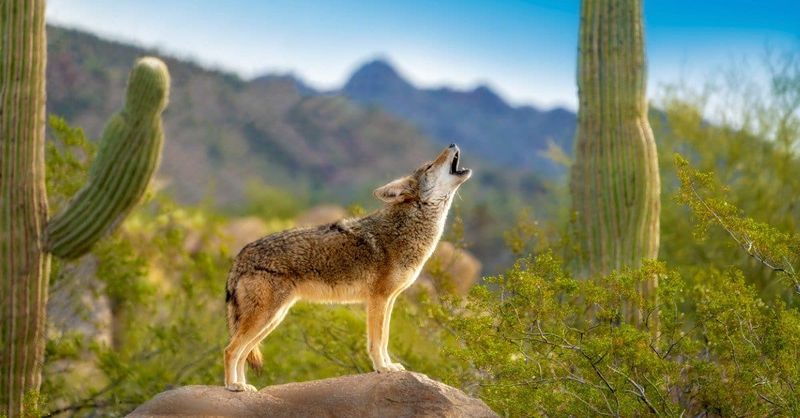
Here is where the headline needs a careful reading. Different coyote sounds do exist, including yips, howls, yelps, and barks, and they serve communication purposes.
But nobody has a dependable decoder that links each one to a single precise intention.
Wildlife agencies describe the coyote repertoire in broad terms. A review from the North Carolina Wildlife Resources Commission groups calls into general jobs, such as keeping group members in contact and signaling territory.
Some guidance also lists distracting intruders away from a den as one possible use of the wider repertoire. That is a background fact about the species, not something you can diagnose from a call in your neighborhood.
Early research on how coyotes use their voices over long distances, such as Lehner’s study of long-distance vocalizations, shows how complex these signals can be. Complexity is the point.
A single sound can fit several situations, and the same situation can produce several sounds.
You may see the phrase family check-in used for a group yip-howl. It is a handy shorthand, but it is not a literal translation.
Calls may help coyotes find each other or accompany a reunion, and that is as far as it is safe to go.
A practical way to listen: notice the time, the general direction, and whether the sound moves away. Then let it be.
The call tells you coyotes are active nearby, and little else.
Winter and spring add context, not a call-by-call calendar
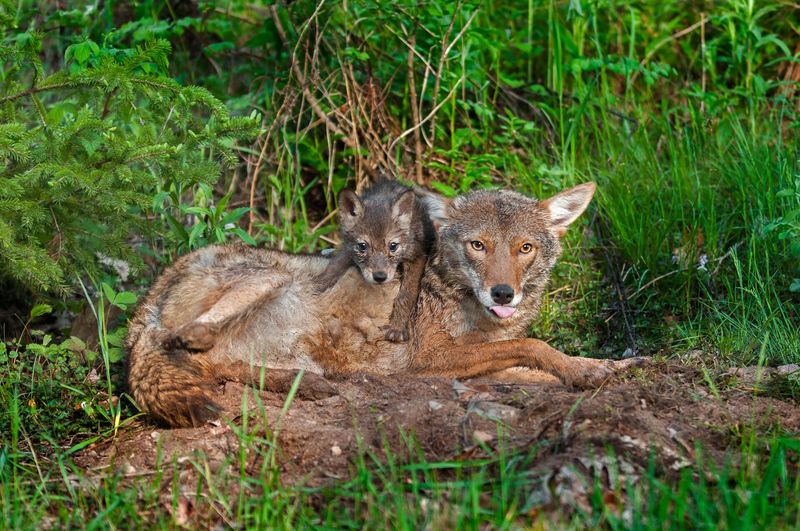
Arizona’s seasons do shape coyote life. Arizona Game & Fish says coyotes breed mainly from January through March, and females typically have four to seven pups in underground dens between March and May.
University of Arizona Extension gives a similar breeding window and says young are born March through May.
That timeline explains why winter and spring can be busy times for coyotes. Adults are pairing up, then raising young, and more coyote activity can mean more reasons to call.
But a calendar is a pattern, not a clock for any single night. A chorus in February is not proof of mating chatter.
A chorus in April does not prove a den is close by or that pups are calling.
Spring is also not the only season for pup-related sound. The North Carolina wildlife biology review notes that young coyotes may practice howling and become especially vocal in late summer.
So a squeaky, uneven chorus in August or September can come from youngsters trying out their voices.
If you want a simple rule, treat the seasons as background. They tell you when coyotes are generally more engaged with mates and young.
They do not tell you what a specific sound meant, and they are no reason to go looking for a den. Leave any suspected den alone and give it plenty of room.
A loud chorus can sound larger than it is
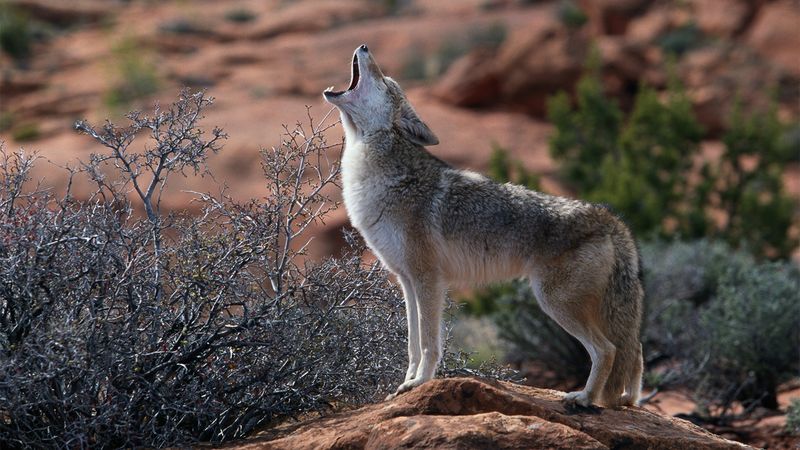
One surprising result comes from research on human hearing. In a study of coyote calls, 427 participants listened to recordings of one to four coyotes.
Listeners consistently overestimated group size by nearly twofold, according to the Human-Wildlife Interactions study record.
That finding is tied to those participants and those recordings, so it is not a rule about every night in every neighborhood. Still, it is a strong reason to be modest about counting animals by ear.
Coyote calls are high, quick, and overlapping. A few animals can produce a stream of yips and howls that blend together, and each voice seems to arrive from a different spot.
The effect is a sound that feels bigger than the group making it.
Desert surroundings add to the illusion. Block walls, rocky slopes, and open washes bounce sound around, so one coyote can seem to be answered from several directions.
Your ears may be picking up echoes as well as extra animals.
So when a chorus erupts near your home, resist the urge to decide how many coyotes there are. It could be a pair or a small family.
It could be more. The sound alone will not settle it, and a big-sounding chorus is not evidence of a large pack in your neighborhood.
Keep your distance and make the yard less inviting
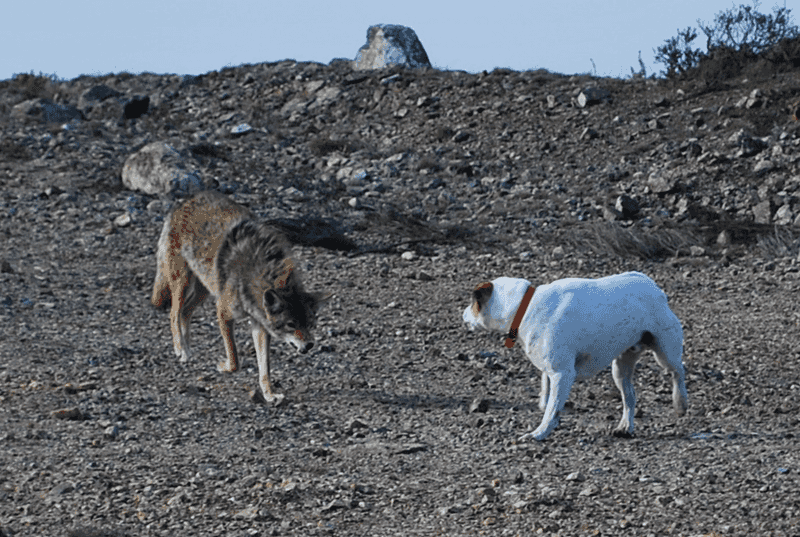
The best response to a nighttime chorus is a calm, practical one. Arizona Game & Fish guidance focuses on prevention: secure garbage, remove pet food and other attractants, and never feed wildlife.
Supervise small pets, especially around dusk and dawn, and keep children and pets away from coyotes.
Do not approach, chase, or investigate a coyote, and do not go searching for a possible den. Curiosity is natural, but distance is what keeps both you and the animal out of trouble.
If a coyote comes toward you, the department’s tips for avoiding conflicts say to keep eye contact, not run, make yourself look larger, and use loud noises to discourage it. Report aggressive behavior to Arizona Game & Fish.
Call 911 if a coyote approaches or bites a person, and seek medical care after a bite.
A walk around your yard in daylight can help. Look for fallen fruit, unsecured bins, bowls of pet food left outside, and gaps where small animals can slip in.
Each fix makes your property less interesting to wildlife.
The calls you hear are broad communication, not a personal warning or a message you can translate. Let the howls remind you to tidy up, then let the desert have its night.
Share this story