If you spot a yellowjacket nest near your Texas home, the best first move is to stay back and figure out how much risk it really poses. A nest far from where people walk, play, or work can often be left alone, while one close to daily activity may need a safer plan.
Yellowjackets defend their homes and can sting many times, so a calm decision beats a quick fix. Here is how to sort out your options without taking chances.
Judge the risk by how people use the area
Here is the simple rule: look at how people and pets use the space around the nest. If it is tucked away from places where anyone regularly walks, plays, works, or gathers, it can often stay undisturbed.
Texas A&M AgriLife guidance says to leave nests alone when they are not close to human activity and to mark the area so no one wanders into it.
A nest does not need to be removed just because it sits on your property. Yellowjackets can defend the colony and sting more than once, so poking at a harmless, out-of-the-way nest creates a problem that was not there before.
Closeness is not about a magic number of feet. A nest ten steps from a gate your kids use every day is a different situation from one at the far edge of a large lot that nobody visits.
Think about the paths you take, the spots where you mow, the play areas, the grill, and the doors you use most.
Household circumstances matter too. Oregon State University Extension points to nests near homes or recreation areas, and to known sting allergies, as reasons to consider taking action.
If someone in your home has a known allergy, even a nest at a modest distance deserves more careful thought.
Start by watching from afar and noting how often anyone passes near the spot. That answer will guide every other choice.
A yellowjacket nest may be out of sight
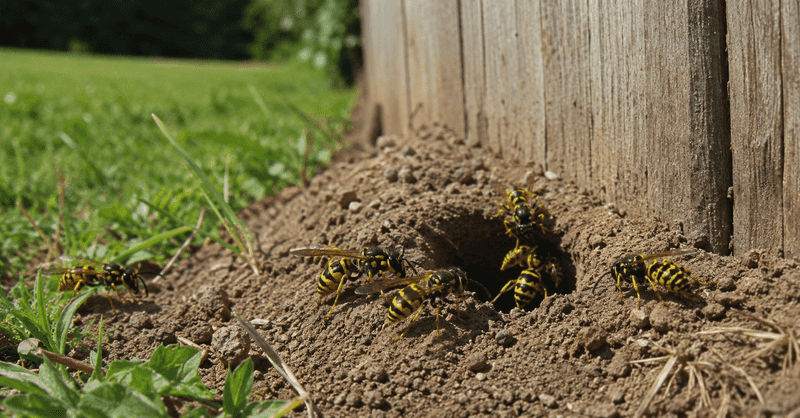
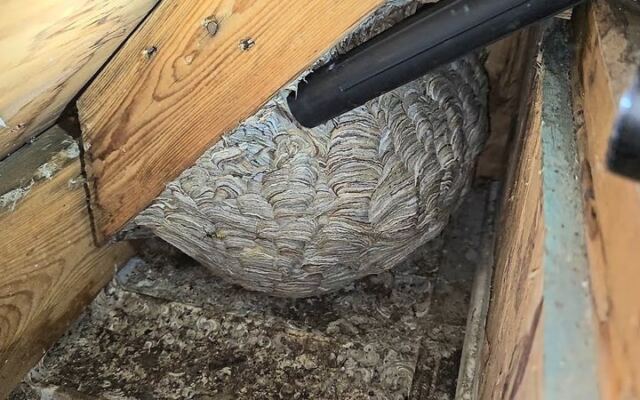
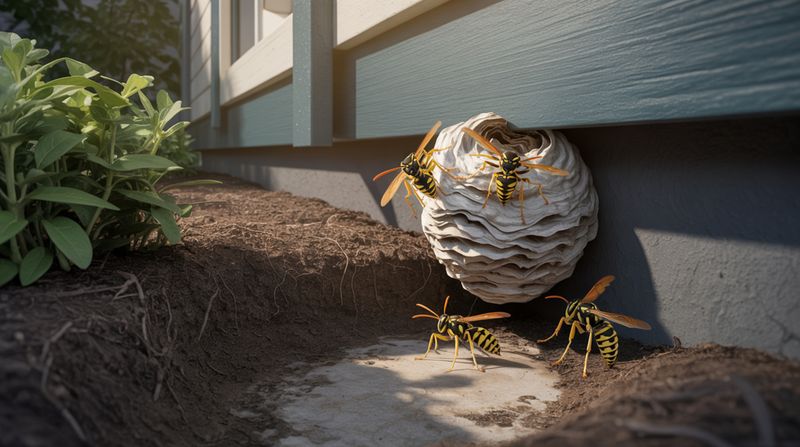
Many people picture a gray paper ball hanging from a branch, but yellowjacket nests often look nothing like that. According to Texas A&M AgriLife, Texas yellowjackets nest mostly underground, though they can also use walls, eaves, trees, sheds, and other sheltered places.
That means the nest itself may be completely hidden. What you notice might only be a small opening in the ground or a gap in a building, with wasps coming and going.
Repeated flight in and out of one spot can be a clue. It is only a clue, though.
Seeing it does not confirm which wasp you have or exactly where the nest sits, since species and nest location both affect identification, as the Texas Apiary Inspection Service notes.
If you see this kind of traffic, keep your distance and watch from across the yard. Do not walk up to it, probe it with a stick, cover it, or shine lights into it.
Disturbing an entrance is the quickest way to set off a defensive swarm.
Jot down where you saw the activity and what time of day. Those notes will help a professional if you decide to call one.
Keep people and pets away while you decide
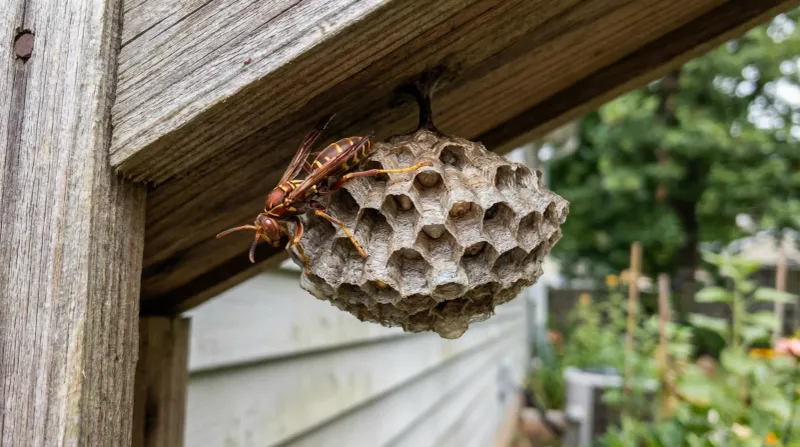
While you weigh your options, the goal is simple: nobody gets close. Tell everyone in the household where the activity is, and keep pets on a leash or in another part of the yard.
Kids especially need a clear rule to stay away.
If the nest is in an out-of-the-way spot, mark the area from a safe distance so mowers, visitors, and curious pets do not wander in. Avoid walking up to place a marker right at the entrance.
A flag or ribbon set well back works better than a close approach.
Next, take away reasons for yellowjackets to visit your outdoor spaces. Texas A&M AgriLife recommends covering food and sugary drinks, keeping garbage sealed, and removing food scraps.
Picnic tables, pet bowls, and open soda cans are common draws.
You may be tempted to hang a trap. Traps may reduce the number of wasps out foraging, but they do not control the colony.
The nest keeps producing workers, so a trap is not a stand-in for deciding what to do about a nest near people.
Think of these steps as a holding pattern. They lower your chances of getting stung today while you work out the safest long-term plan.
When should you call a professional?
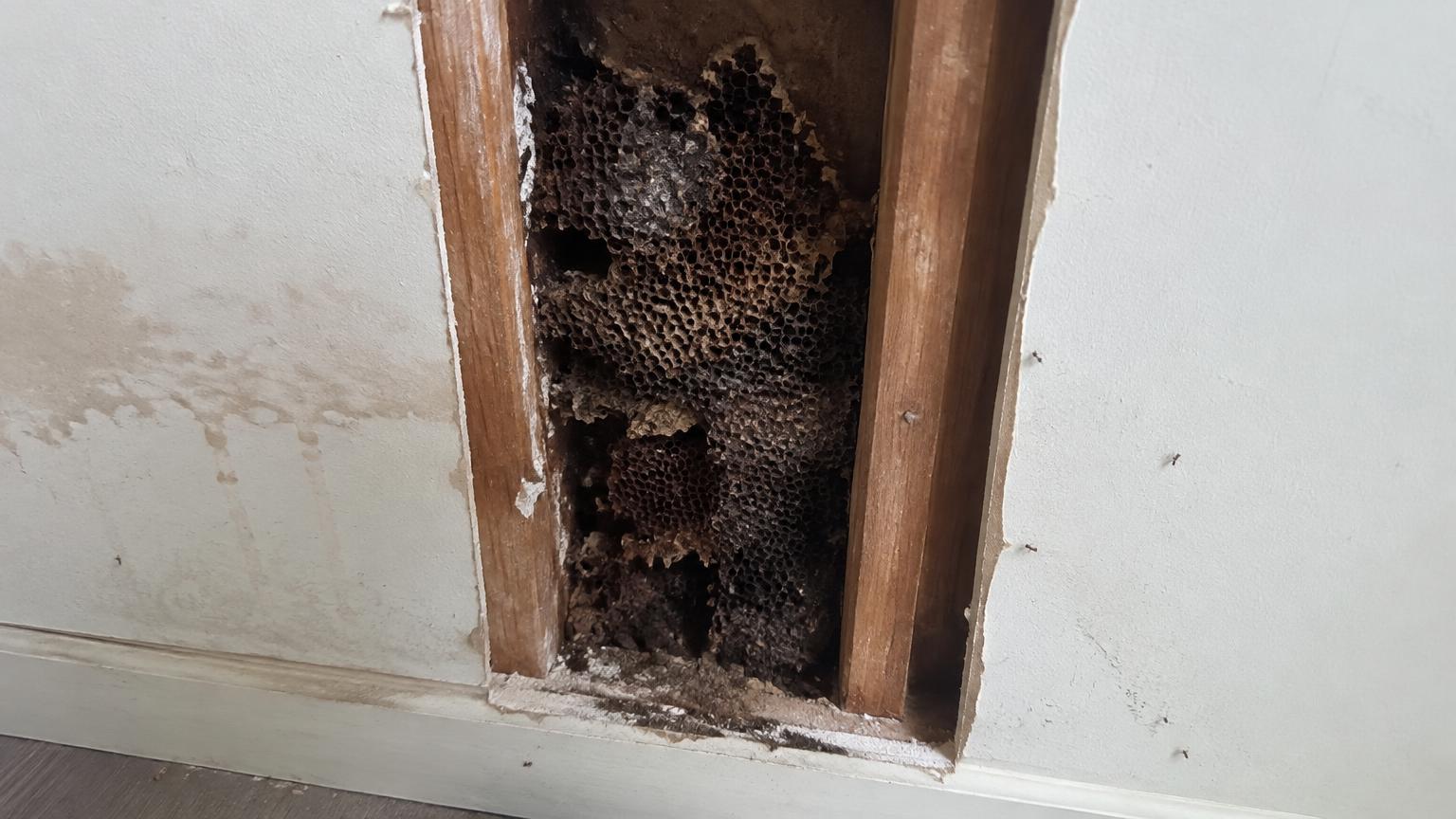
Some situations are better handled by someone with training and the right gear. A nest inside a wall or in another hard-to-reach spot is one.
A nest close to where people spend time is another. So is any case where you are unsure you can manage it safely.
Texas A&M specifically advises calling a professional when you doubt your ability to control a nest. It also says people with a heart condition or a known venom allergy should not undertake nest control themselves.
If that describes you or someone in your home, leave the work to others.
Hard-to-reach nests are tricky because you cannot see the full size or the exits. Wasps may come out in unexpected places, including indoors, when a wall nest is disturbed.
A trained technician can assess the situation without guesswork.
Oregon State University Extension also lists nests near homes and known allergies as reasons to consider control. The Texas A&M publication adds that large nests can occur in Texas, which can raise the stakes.
Calling a pro is a safety choice for certain circumstances. It does not mean every nest needs to be removed.
If a nest is far from activity and nobody is at risk, leaving it alone is still a sound option.
Any pesticide treatment must follow the label
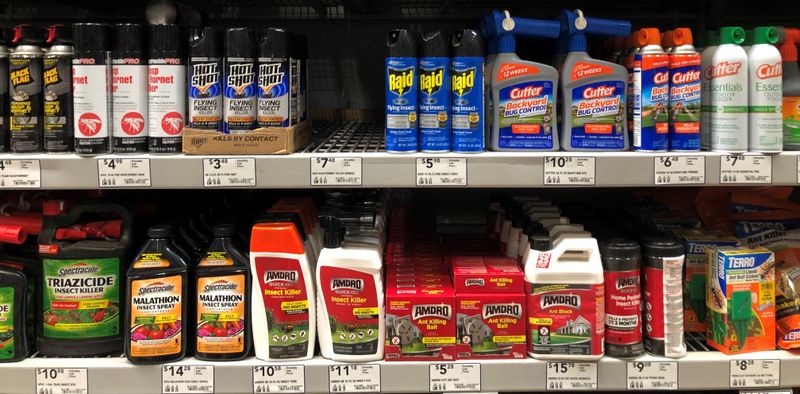
If you are thinking about a pesticide, the product label is your rulebook. Use only a product labeled for the kind of nest and the site where you plan to use it.
Labels differ, so the current directions and restrictions on the one you hold are what count. An EPA-registered product label shows the rules for that specific product.
Timing advice needs the same care. Evening or early morning is a common label direction, but it is not a guarantee of safety.
Oregon State University Extension notes that yellowjackets may defend the entrance when a nest is treated, so stings remain possible whatever the time of day.
This article does not offer a treatment recipe, because the right steps depend on the exact product. Read the label fully before you decide, and if anything on it is unclear or does not match your situation, that is a good sign to call a professional.
Some home remedies are unsafe and should never be used for nest control. Skip gasoline, lighter fluid, fire, smoke, bleach, and flooding.
Oregon State notes that gasoline and lighter fluid are not allowed as pesticides and that burning a nest is dangerous, and Virginia Cooperative Extension also cautions against such approaches.
Spraying individual flying yellowjackets does not solve a nest problem either. It will not reduce the colony, and it carries a real risk of being stung.
A severe allergic reaction is an emergency
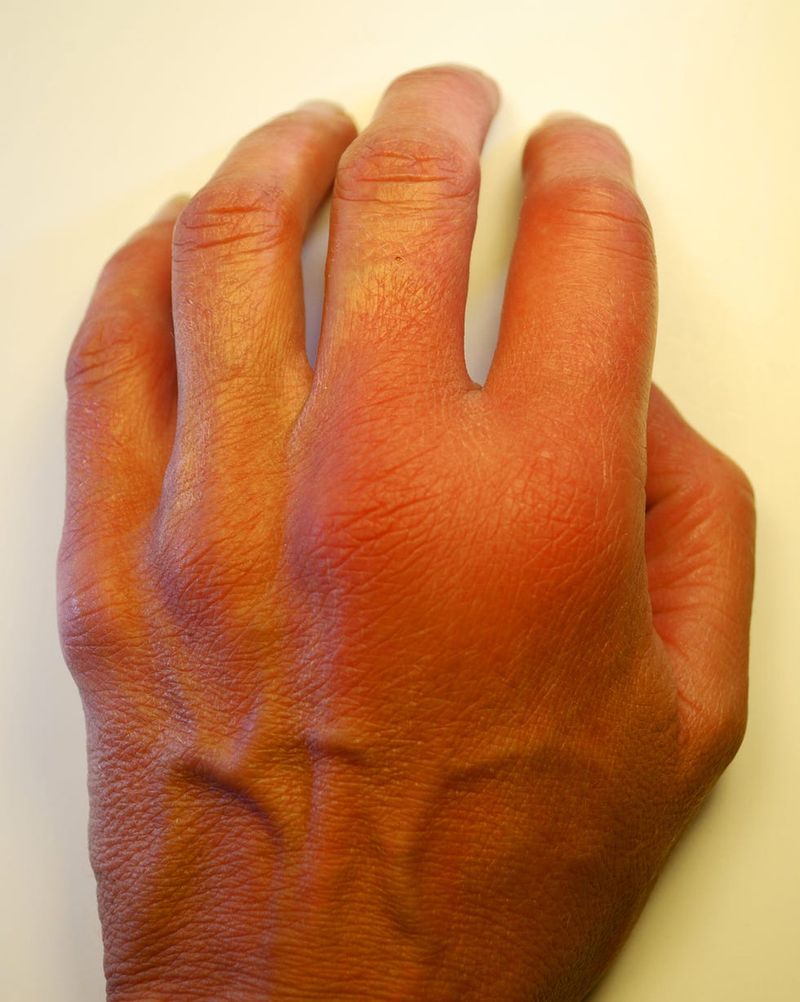
A sting is painful for anyone, but for some people it can trigger something far more serious. CDC/NIOSH guidance notes that a severe allergic reaction to a sting can be life-threatening and requires immediate emergency care.
If you think someone is having that kind of reaction, call 911 or get emergency help right away. Do not wait to see whether it passes, and do not rely on home treatment.
Wasps are manageable. Panic is what costs people time.
Share this story