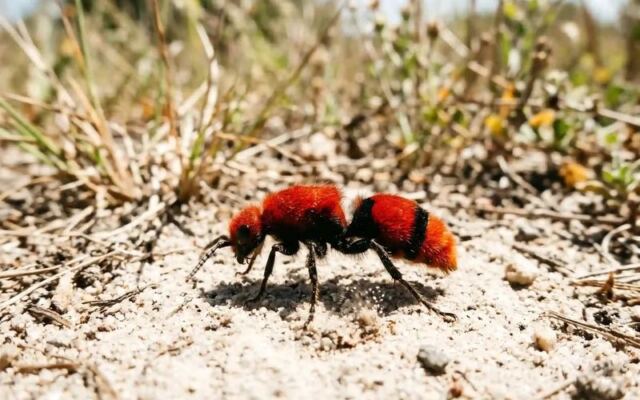
That fuzzy red insect crawling across your lawn looks like an oversized ant, but it is actually a wasp, and the female can deliver a very painful sting. People call it a cow killer, which sounds scary, though the name is more drama than fact.
Knowing what it looks like helps you keep your feet, hands, and pets out of trouble. Here is how to spot it, leave it alone, and handle a sting if one happens.
A fuzzy red insect may be a velvet ant
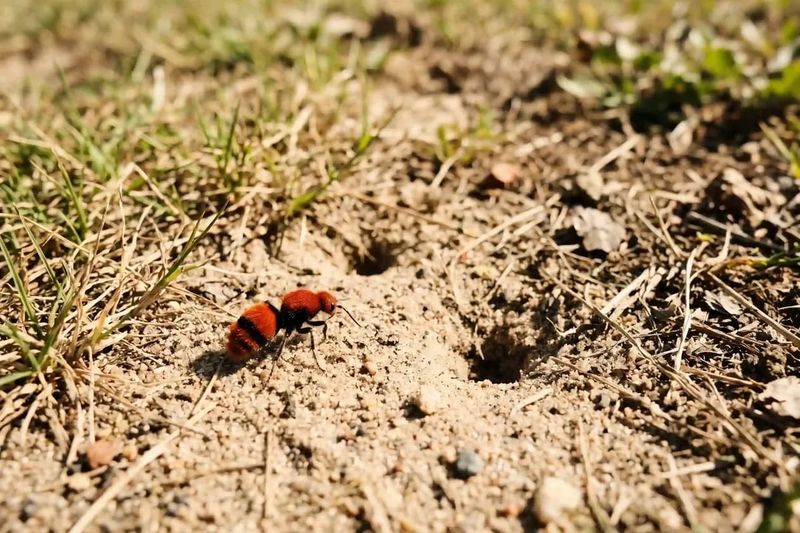
Picture a small, chunky, ant-shaped insect covered in velvety hair, scurrying over bare ground in the sun. That is the classic look of a velvet ant.
According to Clemson Cooperative Extension, velvet ants are black with velvety hair in red, yellow, or orange.
South Carolina is home to 41 velvet-ant species in six genera. The eastern velvet ant, Dasymutilla occidentalis, is the most common of them.
That means the bright red one in your yard could well be this species, but it might not be.
A photo or a quick description alone may not confirm the exact species. Some velvet ants are mostly orange or golden, and others have different patterns of black and red.
So avoid calling every fuzzy, red, ant-like insect a cow killer.
A few clues help you decide whether you are looking at a velvet ant. Look for a wingless, hairy body that runs quickly along the ground rather than flying or marching in a line like worker ants.
The bold color is a warning sign to predators, and it is a good cue for you to give the insect some room.
University of Florida researchers describe species in this group as quite variable, which is another reason to stay cautious about naming one by color alone. Think of the look as a strong hint rather than a final answer.
If you want a firm identification, a local Clemson Extension office is a good place to ask.
Velvet ants are wasps, not ants
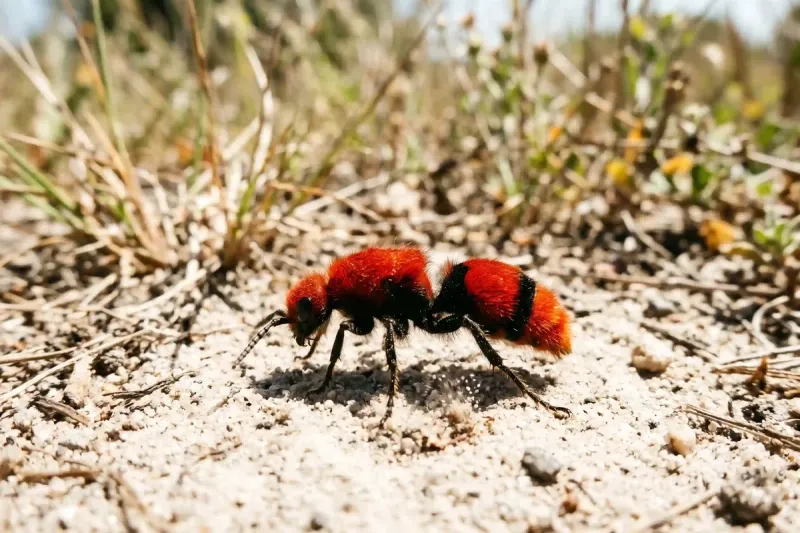
Despite the name, a velvet ant is a wasp. It belongs to the family Mutillidae, and Clemson is clear that it is not an ant at all.
The wingless, fuzzy female is the reason for the confusion, since she scurries along the ground just like one.
Males look quite different. They have wings, and they cannot sting.
Only the wingless female of the common eastern velvet ant, Dasymutilla occidentalis, carries the stinger that gets all the attention.
So when someone says the species is wingless, that is only half the story. A winged velvet ant buzzing near a porch light is a male and is not a stinging risk.
A wingless one trotting across the driveway is the one to respect.
It also helps to remember that velvet ant names a whole group of wasps, not a single kind. University of Florida IFAS Extension describes the group as variable, with many species that differ in color and size.
Claims about a painful sting fit best when tied to the species you have actually identified, such as the eastern velvet ant.
The “cow killer” name does not mean it kills cows
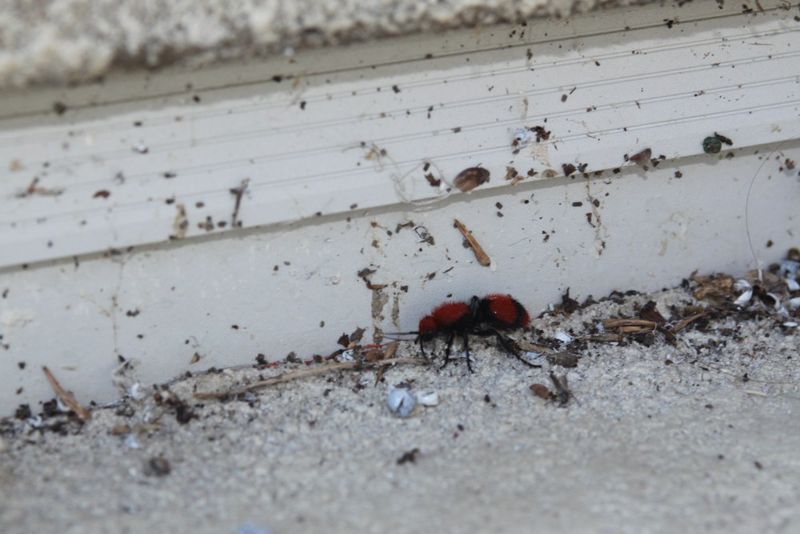
Cow killer is a nickname, and a bit of a tall tale. Clemson says there is no indication that one has ever killed a cow, and UF/IFAS treats the claim as an assertion rather than a documented effect.
Apart from an accidental sting, velvet ants pose no real threat to livestock.
The name was likely meant to say that the sting hurts enormously. The female eastern velvet ant can deliver a very painful sting, and Clemson calls it extremely painful but rarely dangerous.
Pain and danger are different things. A sting can hurt a great deal and still be medically minor for most people.
That does not rule out an allergic reaction in a particular person, which is covered later in this article.
Researchers have studied this wasp’s defenses. A 1977 study of Dasymutilla occidentalis documented features such as warning coloration and a powerful sting.
You may also see the Schmidt sting pain index mentioned online. Schmidt’s 2019 study is based on subjective pain ratings, not on how medically dangerous a sting is.
None of these sources compare every sting in South Carolina, so it is fairest to say the sting is very painful and leave the rankings out.
When and where you may see them
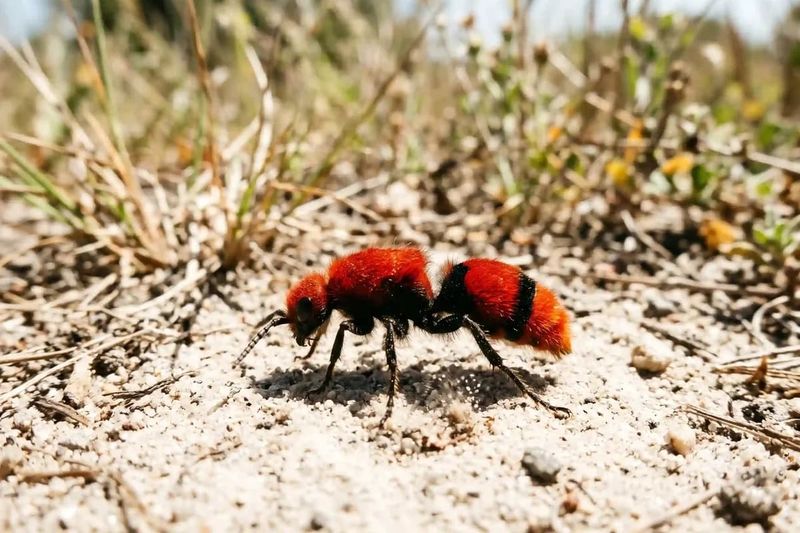
Summer is prime time. Clemson reports that velvet ants are commonly seen in South Carolina from about May through September.
If you spot one in January, it is worth a second look at what you actually saw.
Their lifestyle explains some of what you notice. Velvet ants are parasites of other insects, including ground-nesting bees and wasps.
Because they search for those hosts, you may see a female trotting along the ground rather than sitting still.
Adults, meanwhile, feed on nectar. That means a velvet ant near flowers may simply be having a meal.
None of this suggests that velvet ants hunt people or favor a particular corner of your yard. They are not looking for you.
Most encounters are a chance meeting on a walk across the lawn or a path.
Knowing the season helps you plan. In the warm months, think twice before heading outside barefoot, especially across open ground.
A quick look at where you step is usually all it takes.
Leave it alone instead of handling it
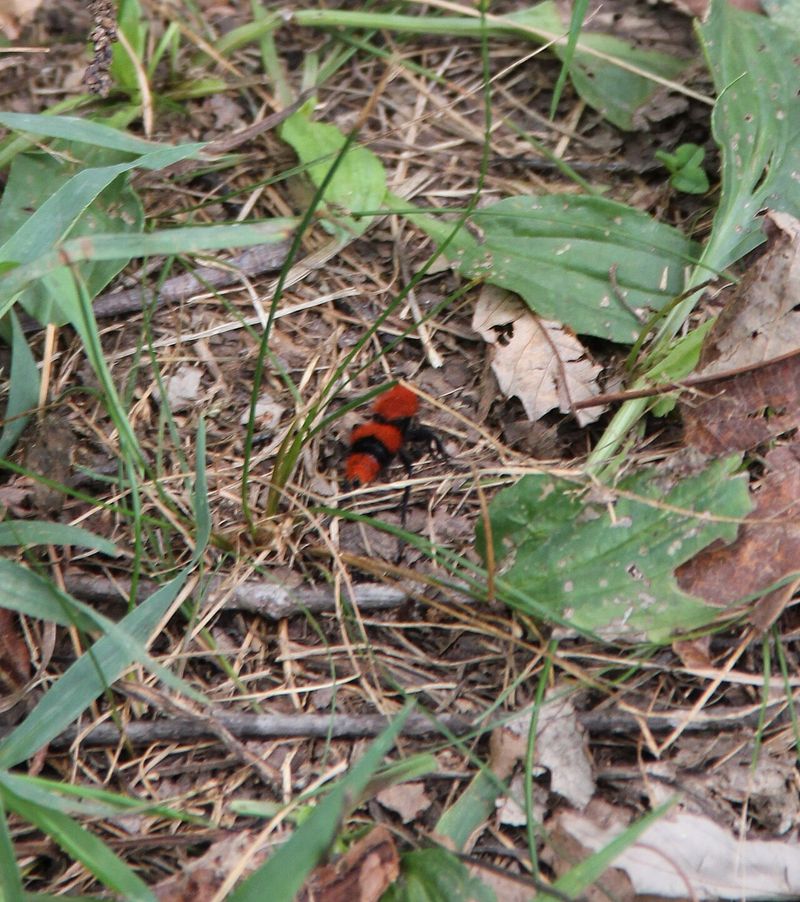
The best plan is simple: watch it, then let it go on its way. Clemson says velvet ants are generally not aggressive but advises against picking them up.
Do not crush one, and do not step on one barefoot.
Kids and pets are the most likely to get curious about a bright, fuzzy bug. Calling them back and pointing it out from a distance works well.
Shoes on in the yard are an easy habit in the warm months.
If one is in a spot where someone could step on it, move yourself or the people around it rather than moving the insect with bare hands. Clemson notes that a careful relocation is possible if truly needed.
Choosing to steer clear is usually easier and safer.
Spraying is not a good fix either. Clemson says control is usually unnecessary, and neither chemical nor mechanical control is very effective.
UF/IFAS likewise says no control measures are necessary.
In practice, a single velvet ant crossing your yard will move along on its own. Give it a few minutes and a little space.
How to care for a mild sting
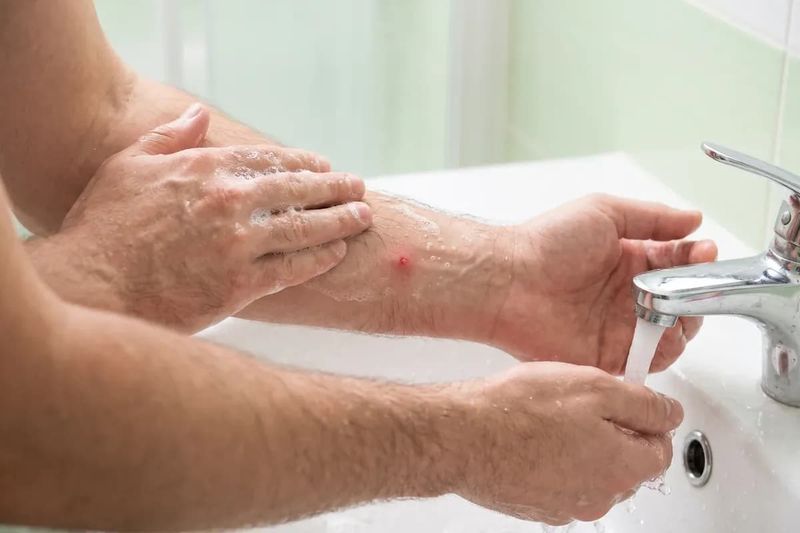
If someone is stung and has only local pain, start with the basics. Wash the area with soap and water.
This is the same first step MedlinePlus gives for insect stings in general.
Next, apply an ice pack wrapped in a cloth for short intervals. Wrapping it protects the skin from direct cold.
Taking breaks between rounds keeps the skin comfortable.
Check the spot for a stinger only to see whether one is visible. General sting advice says to remove a retained stinger, but that applies only if you can actually see one.
Do not assume a velvet-ant sting leaves one behind.
Then keep an eye on things over the next several days. MedlinePlus advises watching for increasing redness, swelling, or pain.
Those changes are worth reporting to a health care provider.
The sting can hurt a lot, so it is normal for the person to feel shaken up for a while. Let them rest and keep the area clean.
Pain by itself is not an emergency, but the signs in the next section are.
Call 911 for signs of a serious allergic reaction
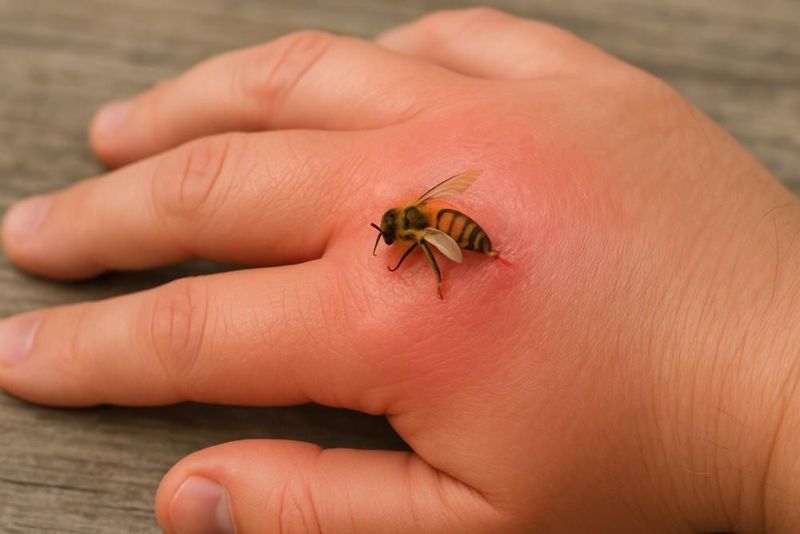
A very painful sting is not the same as a dangerous allergic reaction. Local pain, redness, and swelling right around the sting are the usual story.
Whole-body symptoms are different, and they need fast help.
Call 911 if the person has trouble breathing, swelling of the face or mouth, tightness in the throat, faintness, or weakness. MedlinePlus lists these as signs of a severe reaction to an insect sting.
Do not wait to see whether they pass.
If the person has prescribed emergency epinephrine, use it according to their instructions while help is on the way. Say clearly to the dispatcher that the person was stung and has symptoms.
Stay with them until responders arrive.
Insect stings can trigger anaphylaxis, which MedlinePlus describes as a serious allergic reaction. Clemson says the sting is rarely dangerous, but that does not rule out a reaction in any one person.
Keep the distinction in mind. Intense pain alone does not prove anaphylaxis, and it does not mean the person is safe if other symptoms appear.
Breathing, swelling, and faintness are the signals that change the plan.
Stay calm and give the insect space
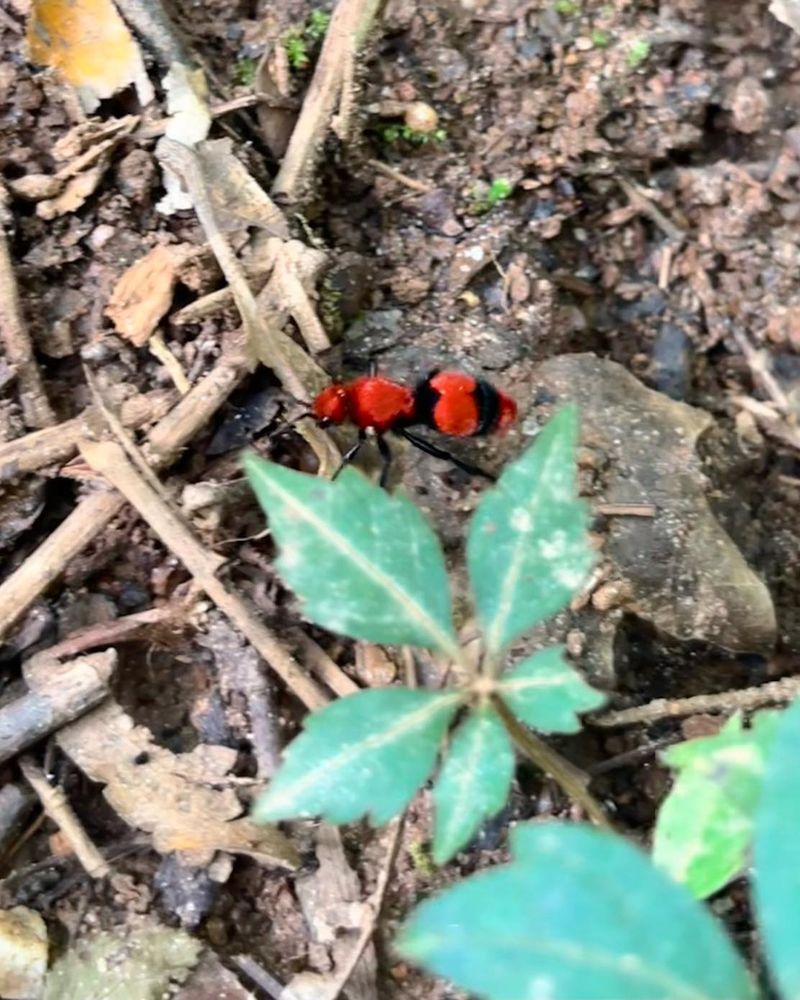
A bright red, fuzzy insect on the ground deserves a careful look, not a panic. Check the clues, keep your distance, and let it wander off.
Sting pain at the site is one thing, and trouble breathing or swelling of the face is another.
Most backyard meetings end with nothing more than a good story. The wasp wearing an ant costume is simply trying to get on with its day.
Share this story