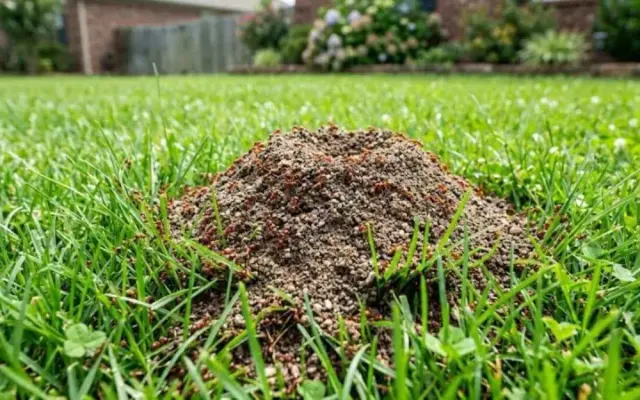
After a heavy rain, small piles of loose soil often pop up in Illinois lawns, and ants are frequently the builders. Those fresh mounds show that ants have been moving dirt, and some species can fix their nests fast.
Sparse grass can attract certain ants, but a mound by itself does not tell you how healthy your lawn is. Here is how to read the clues and decide whether you need to do anything at all.
What a fresh mound can tell you
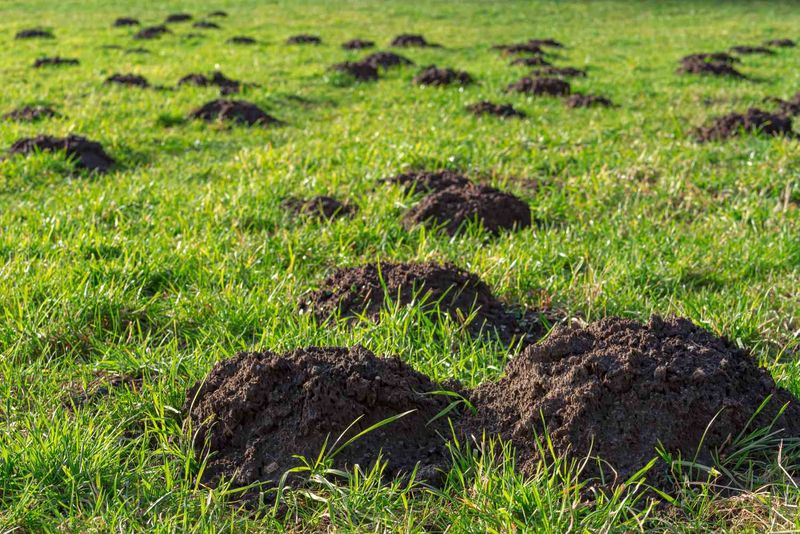
A fresh mound after rain tells you one solid thing: ants have been moving soil. They may have dug a new nest, or they may be keeping an old one in shape.
Either way, the pile is a sign of ant activity, and that is where its message ends.
Some ants can repair nests very quickly after wet weather. A field study of red imported fire ants in South China saw substantial mound repair within 12 hours after rain.
That is one species in one region, so it does not prove that the ants in your Illinois yard rebuild overnight. Some may, some may not, and you would need to know which ant you have to say.
Think of the mound as a footprint rather than a diagnosis. It shows who has been active, but it cannot tell you whether the grass underneath is strong or struggling.
Healthy turf and thin turf can both have ants living in them.
Ants also do some useful work. According to Illinois Extension, their tunnels loosen soil and let air and water move in.
A single mound is often just a small chapter in the life of your yard, not a warning bell.
The best first move after a storm is to look closely rather than reach for a spray bottle. Check whether ants are really present, how big the pile is, and what the grass around it looks like.
The next sections walk through each of those checks.
First, check whether the bump is an ant mound
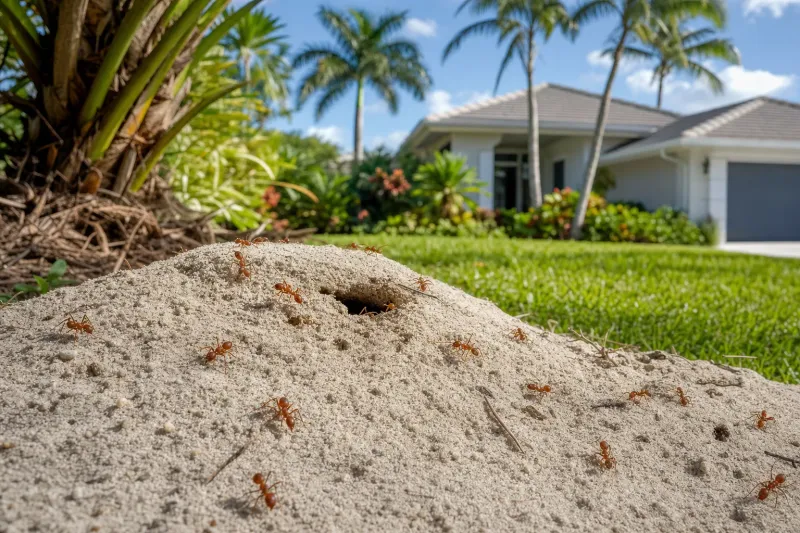
Not every bump in the grass comes from ants. Moles, voles, and even nightcrawlers can leave marks that look similar from across the yard.
A few minutes of close inspection can save you from treating the wrong problem.
The University of Minnesota Extension lawn guide separates ant mounds from mole ridges and mounds, vole trails, and nightcrawler castings. It points to hole patterns, mound size, and visible ants as clues.
No single clue settles it, so use them together.
Start with the pile itself. Ant mounds are usually small, loose soil with a tiny opening, and you may see ants moving in and out.
Mole mounds tend to be larger, and mole activity often shows up as raised ridges running across the lawn. Vole damage looks more like narrow trails in the grass.
Nightcrawler castings are small lumps of soil, often near a hole, and they show up most often after rain.
Location matters too. The Illinois Department of Public Health notes that pavement ants dig soil into small cone-shaped mounds, especially along hard surfaces.
So a tiny cone beside a sidewalk or driveway edge fits that pattern.
Try gently disturbing the top of the pile with a stick and watching for a few minutes. If ants pour out, you have a strong clue.
If nothing appears, consider the other suspects before deciding what you are looking at.
Ants and thin grass can be connected in different ways
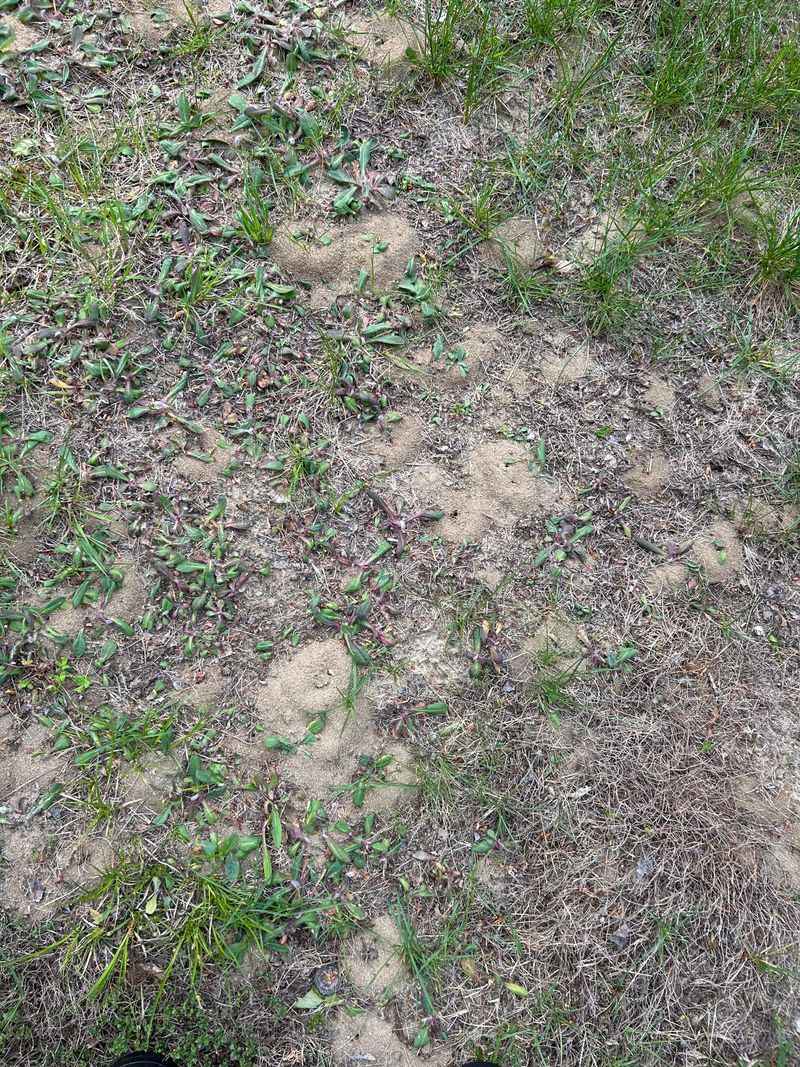
Ants and thin grass often turn up together, but the link can run in different directions. Some ants simply like open ground.
Others do not care how thick the grass is.
According to University of Minnesota Extension, cornfield ants are commonly found in thinning or bare turf. Field ants, on the other hand, also nest in healthy lawns.
So one species may move into a sparse spot because it is open and sunny, while another builds right in a thick stretch of grass.
That means a mound near thin grass could tell a few different stories. The turf may have already been weak, and ants moved in afterward.
The ants may be adding some stress to a patch that was struggling for other reasons. Or the two may just share the same spot by coincidence.
From the surface, you usually cannot tell which came first. The lawn diagnosis guide treats mounds as one clue to sort out, not as an answer.
If you want to know why a patch is thin, look at the usual suspects too. Shade, compacted soil, dry spells, and heavy foot traffic can all thin a lawn.
A mound can sit in the middle of any of those without being the reason for them.
Some mounds can damage grass nearby

Most small ant nests do little harm, but a few situations cause real trouble. The damage tends to be local, showing up right around the nest rather than across the whole yard.
Here is how it happens. Illinois Extension explains that tunnels loosen soil and let air and water enter, which can be a good thing.
But when ants carry soil up and out, the ground around roots can dry out, and that can kill some nearby turf.
Size is the other factor. Some species build mounds big enough to kill grass in an area of 1 to 2 feet.
Large piles can also get in the way of mowing, where a mower deck may scalp the top or fling loose soil.
Notice the conditions in that picture. A big, active mound in a dry stretch of lawn is more likely to cause a bare spot than a few tiny piles in well-watered turf.
Many ant nests never reach the point of hurting anything.
If you see browning right around a mound, check how big the pile is and how far the dead grass reaches. A patch that is about the size of the mound itself points to local effects.
Thinning that spreads well past it probably has another cause.
Decide whether the mound needs attention
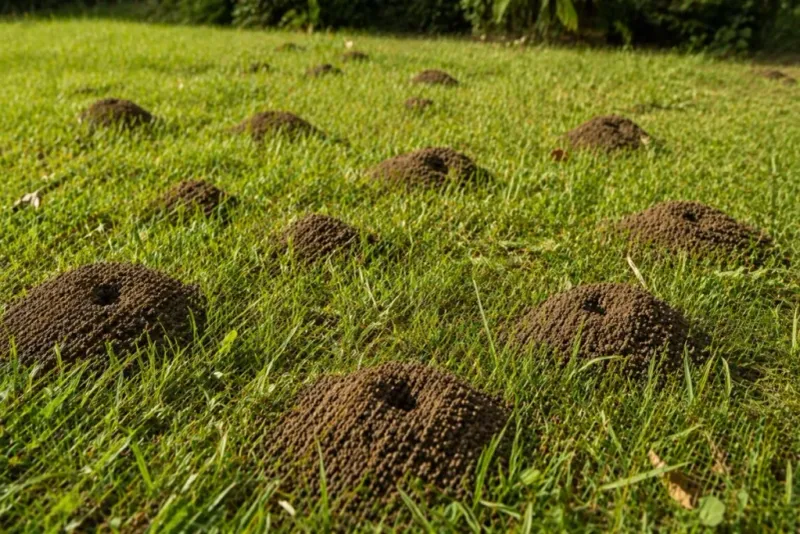
Whether to act comes down to practical impact. Ask yourself whether the mound is causing a problem you can point to.
If the answer is no, leaving it alone is a perfectly reasonable choice.
Consider stepping in when a large mound is damaging turf, getting in the way of mowing, or sitting near new sod you are trying to establish. Those are real, visible costs.
A few small piles scattered across the grass usually are not.
Treatment is not a permanent fix either. Illinois Extension cautions against repeated treatment of small mounds, because ants can move back into treated areas.
Chasing every pile can turn into a cycle of work with little payoff.
The Illinois turfgrass ant guidance supports the same practical view for lawns. Look at what the ants are doing to the grass rather than just counting mounds.
A simple routine can help. Flatten or rake a small pile and see whether it returns.
Mow around it for a week or two and note whether the grass nearby keeps declining. If a single large nest keeps getting bigger or the turf under it dies, you have a clearer reason to consider options.
If you use a pesticide, follow its label
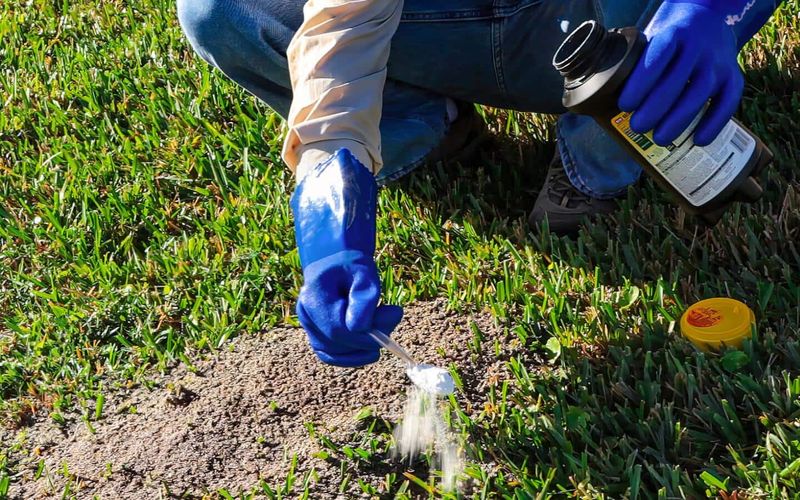
Pesticides are an option only if you have decided a mound really needs treatment. They are not a routine part of lawn care, and spraying the whole yard for a few small piles is not a good plan.
Begin by identifying the ant. University of Minnesota Extension stresses knowing which ant you have before choosing a product, and it notes that field ants can be confused with fire ants.
Fire ants do not occur in the upper Midwest, so avoid calling a mound by that name unless an expert has confirmed it.
Next, pick a product labeled for the intended lawn use. A product made for indoor ants or for another site may not be allowed on turf.
The label tells you where and how it can be used.
Then follow every direction on it. The EPA explains that pesticide labels are legally enforceable, so the instructions are requirements, not suggestions.
That includes precautions and re-entry directions, which say when people and pets can safely return to the treated area.
For more habits that lower risk, see EPA pesticide safety tips. Treat only the spot that needs it, and skip repeat applications on small mounds.
Use the mound as one clue among several
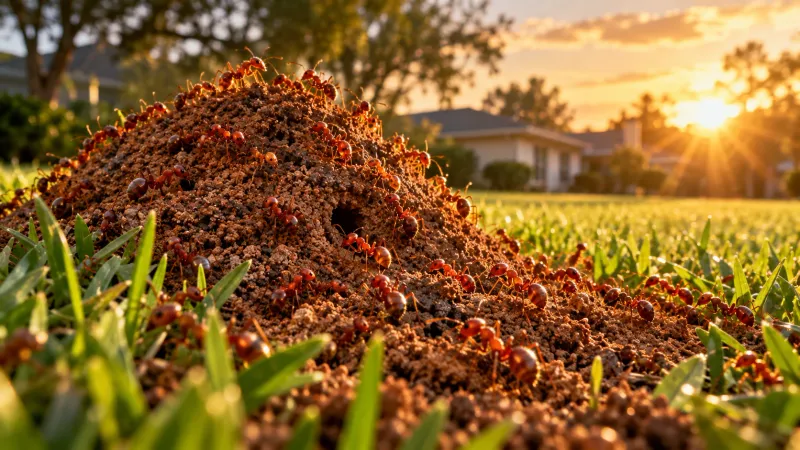
Next time a fresh pile shows up, slow down and gather clues. Look for ants, check the hole pattern, and compare the mound with the lawn bump guide to rule out moles, voles, and nightcrawlers.
Then look at the grass around it. A mound cannot explain thin turf or justify spraying on its own.
Ask whether it is large, killing grass, or blocking your mower, which are the kinds of problems Illinois Extension describes.
Most of the time, a small pile of dirt is just a neighbor going about its business.
Share this story